
I’ve been trying to post something every day to the blog for as long as I can, and it has been quite an exhilarating ride! I’m nearing the end of that run, and what better way to celebrate it, and the release of my book on invisibility, than to talk about another invisibility story that I just found!
In a random bit of inspiration, I realized today that I hadn’t looked at the classic magazine Planet Stories for invisibility fiction, and in looking I was instantly rewarded! “Phantom of the Seven Stars,” by Ray Cummings, appeared in the 1940 winter issue of the magazine.
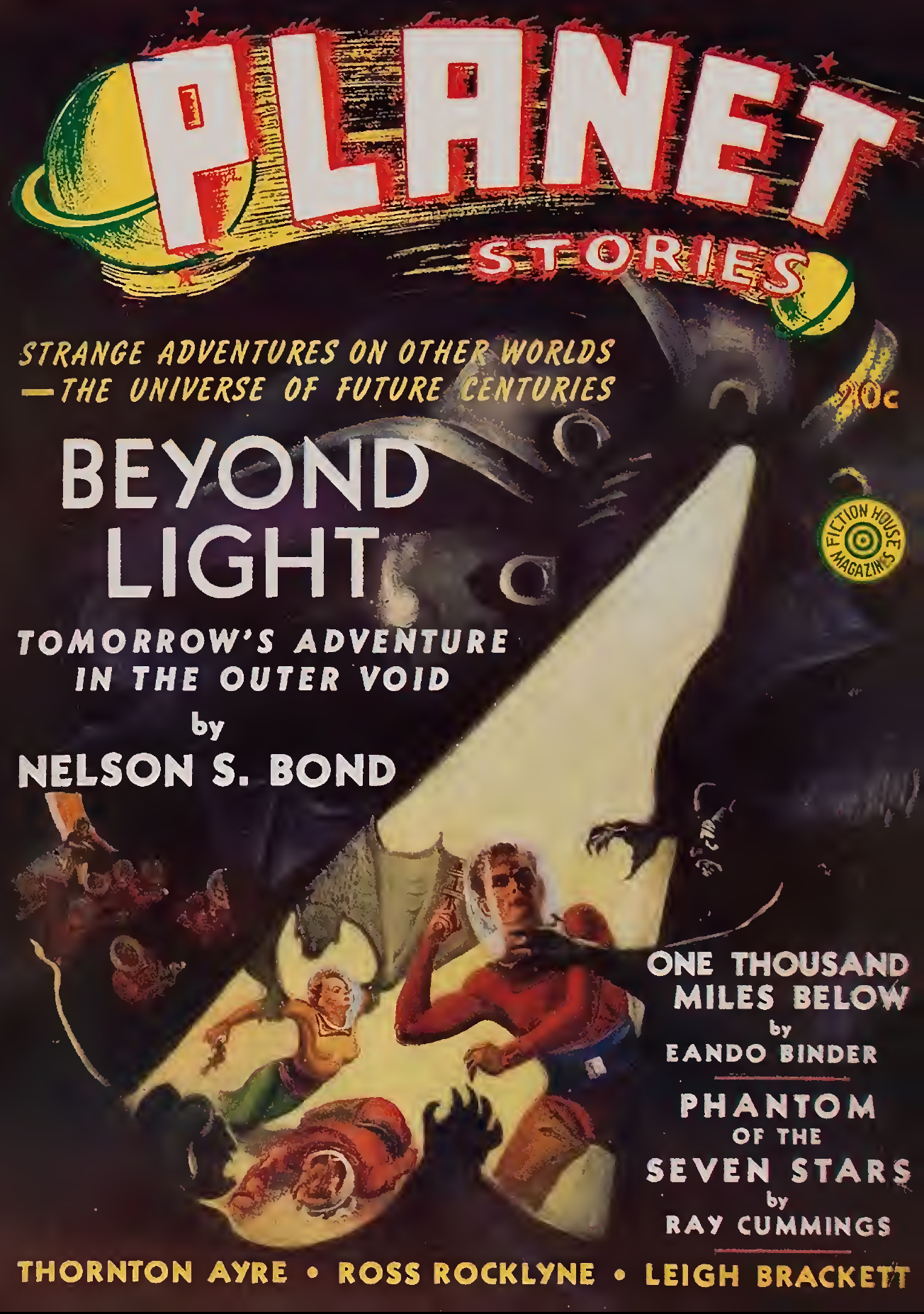
The story “Beyond Light” was what caught my eye as a possible invisibility story, but Cummings’ tale fits the bill perfectly!
This isn’t the first Cummings invisibility tale, by the way. We last saw him in action in the 1940 tale “Priestess of the Moon,” which appeared in Amazing Stories. Apparently 1940 was the year for Cummings to get invisibility out of his system!
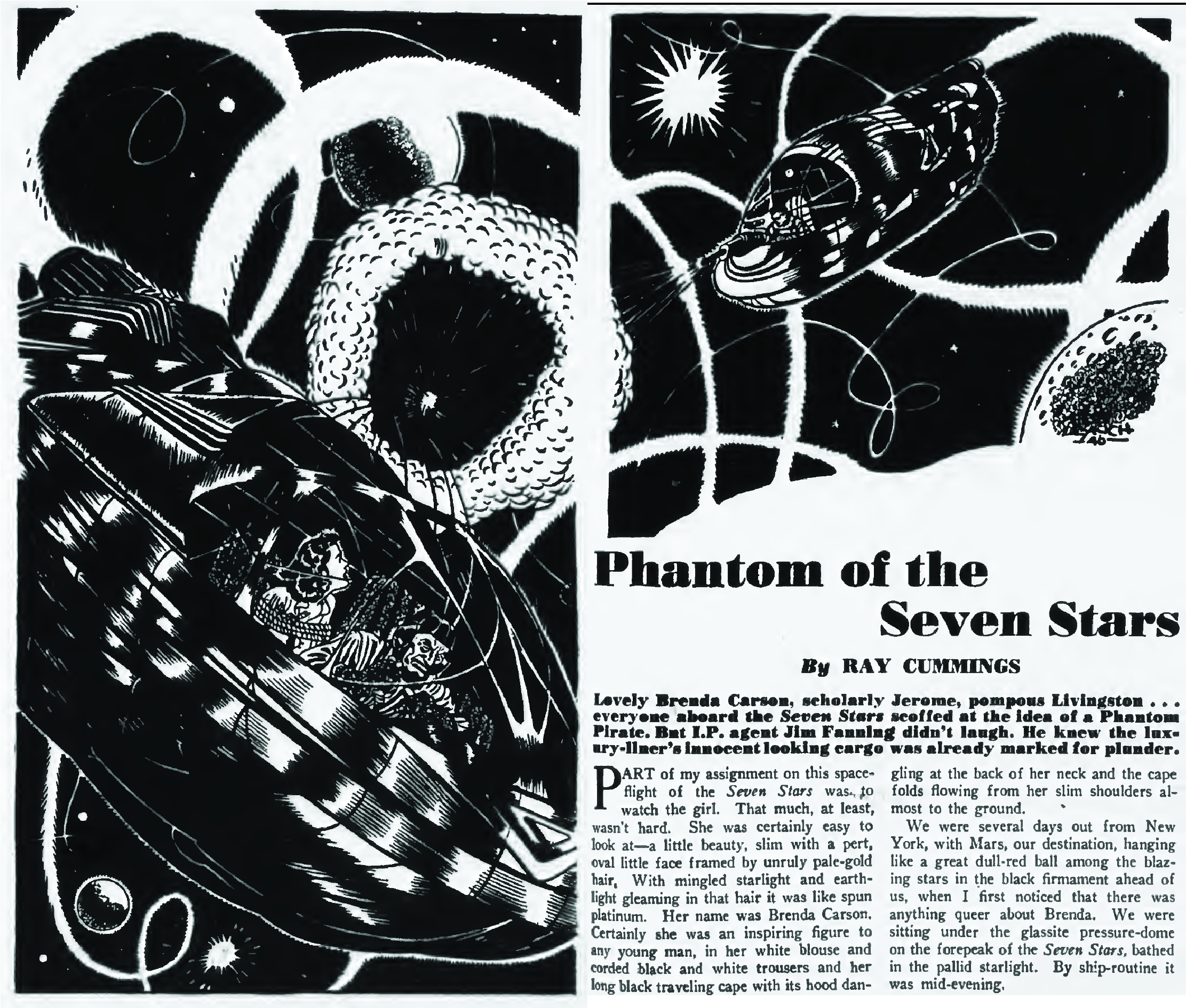
“Phantom of the Seven Stars” is another pulp science fiction action adventure. The hero of the story is Interplanetary Patrol Agent Jim Fanning, who is traveling on the spaceship the “Seven Stars” as it makes its way from Earth to Mars. Jim is on board because the ship is secretly transporting weapons and technology to the Martian government to aid them in putting down a rebellion on the moon Deimos (fortunately the weapons are non-lethal). There is more reason than normal to be concerned: a number of ships traveling the spaceways have been found adrift, all aboard dead, with the air within evacuated. Rumors have spread of a “Phantom Bandit” raiding the ships, all the more terrifying because nobody apparently ever sees him coming.
Yes, this is a story about an invisible space pirate!
Also on board is the lovely Brenda Carson and her brother Philip. We later learn that their father died in a mysterious accident while working on invisibility research — could he have faked his death and be the Phantom Bandit himself?
Suspicions grow that there may be a spy of the Phantom Bandit on board, and eventually Jim pursues a suspect to the surface of “Asteroid-9.” There, he will find the Phantom Bandit and eventually be drawn into a space combat between the Bandit’s invisible craft and a ship of the Patrol!
“Phantom of the Seven Stars” is a very conventional pulp sci-fi story, featuring a brave hero, a damsel in distress, and a cartoonish villain. As a story, it has relatively little to recommend it that readers haven’t seen many times before.
The main noteworthy wrinkle is the detail given to the invisibility device:
Briefly, its operation involved three scientific factors: De-electronization, thus to create around any metallic object a barrage of magnetic field of a new type to any previously developed; color-absorption, by which there can be no reflected light from the de-electronized object; and the Albert Einstein principle of the natural bending of light-rays when passing through a magnetic field. In effect then, the total color-absorption into the de-electronized object would make it, when viewed externally, a nothingness to see. A blankness, like an outlined dark hole. But that in itself is not invisibility — merely a silhouette. The background would be blotted out, so that the invisible object would be perceived by the background it obscured. The magnetic field, however, by natural law which Einstein discovered, bend the light-rays from the background, around the intervening object. The background thus seems complete. The intervening object has vanished!
Here, Cummings mixes together, reasonably well, several strategies for invisibility. First, he imagines a mechanism by which the spacecraft is made perfectly absorbing, preventing any reflection of light allowing it to be detected. But Cummings recognizes that this in itself would not be enough to be invisible: the craft would cast a shadow, or look in space like a dark hole, making it detectable! Such a possibility first appeared in Jack London’s 1903 story “The Shadow and the Flash,” in which two researchers come up with two very different types of invisibility: perfect transparency and perfect absorption, each of which has its limitations. The perfect absorber casts a shadow, making it detectable, like Cummings’ spacecraft.
Then Cummings draws upon Einstein’s general theory of relativity, imagining a system by which light rays are bent around a hidden object and sent on their way, just like gravity deflects light through a warping of space. Remarkably, Cummings’ description is very close to how the original 2006 invisibility cloaks were discussed in physics, using warpings of space analogous to general relativity to design structures that can bend light, as illustrated below.

Cummings, however, imagines that magnetic fields produce this bending of light, but there is no mechanism in vacuum for a magnetic field to manipulate light waves! In general relativity, gravity can alter the path of light, but not magnetism. I wonder if Cummings had Faraday rotation on his mind, the discovery in 1845 by Michael Faraday that light passing through matter can be affected by a magnetic field.
When I read Cummings’ description of magnetic invisibility, I got a sense of deja vu; with good reason, because it turns out he used the same explanation in “Priestess of the Moon!” I guess an invisibility explanation is too good to leave to just one story.
I would say that this is the last invisibility story that I’ll blog about, but I’ve said that before and still found more! I expect we’ll talk again about science fiction invisibility in the near future…


 Skulls in the Stars