
In addition to my long Twitter threads about Old School Dungeons & Dragons products, I’ve written a couple of “odes” to particularly good and influential products, namely Tomb of Horrors and Temple of Elemental Evil.
Now I want to do a shoutout to one of the oldest of RPG products, and one of the hardest to find in the wild! I am talking about the (almost) original edition of Empire of the Petal Throne, published by TSR in 1975. I have previously said, jokingly (I hope), that I would kill someone to get a vintage copy of this game; this summer, when I got a nice performance bonus, I decided to just go ahead and get one for myself, which was not cheap but not as expensive as you might think!
I’ve previously done an Old School thread on Petal Throne, but wanted to revisit it now that I have my own copy. This post will be a mix of my original thread plus photos of my acquisition. Let’s begin with the box:
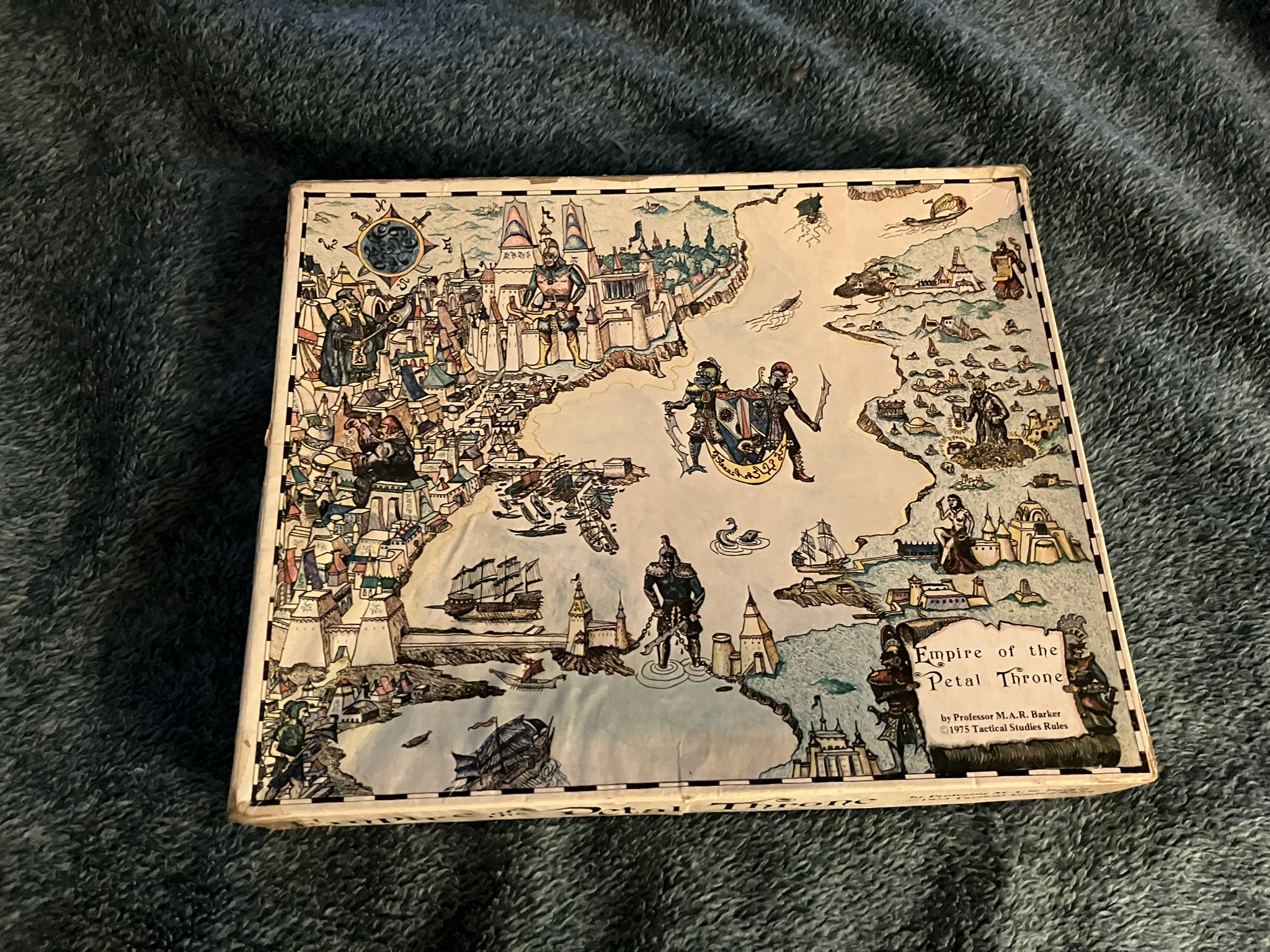
Just take this cover image in for a moment. This is one of the most gorgeous and creative covers I’ve ever seen for an RPG product — a stylized map of the lands of the Empire. This alone made me want to own a copy of this game, because this image isn’t included in any reprints of the game.
The Empire of the Petal Throne is a fascinating bit of gaming history: it starts with Professor M.A.R. Barker, an ancient languages scholar, who spent decades creating an utterly unique fantasy world called Tékumel, even crafting its own languages, much like Tolkien.
Tékumel, in a dramatic departure from most fantasy settings of that era, was not inspired by Western medieval history, but a unique mix of Indian, Egyptian, Middle Eastern, and Meso-American culture and history, and Barker used his own scholarly background for ideas.
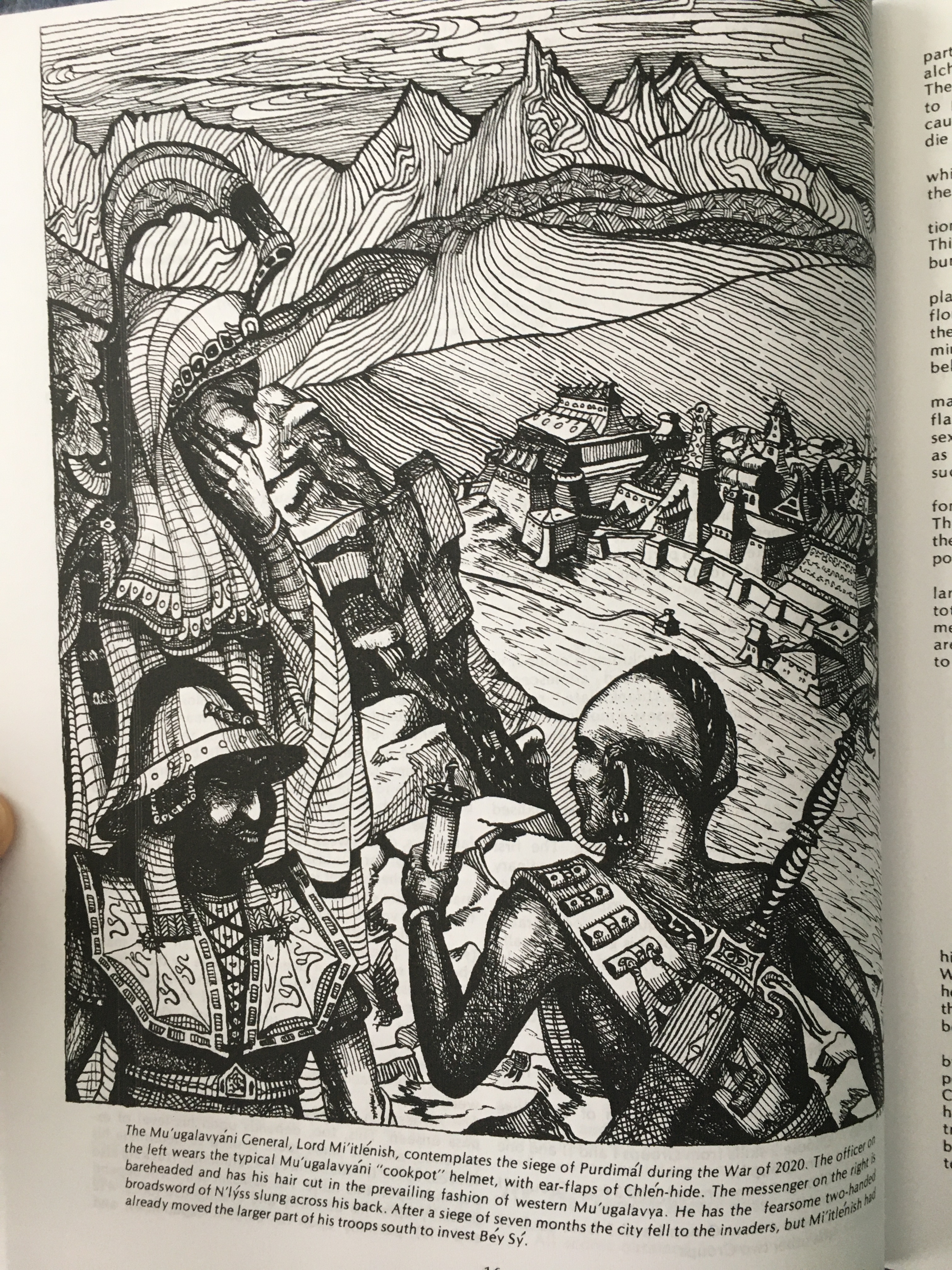
Barker’s setting was originally just a literary pursuit, but he also advised the University of Minnesota’s wargaming club, and in 1974 he was introduced to a new-fangled type of game, called “Dungeons & Dragons.” He quickly created his own game, Empire of the Petal Throne, set in his world of Tékumel, with rules strongly inspired by D&D. He self-published his new game in a 50 copy printing, but quickly drew the attention of Gygax and Arneson at TSR, who published a TSR edition of the game with a glowing introduction by Gygax himself.

So, the story of Tékumel is a mix of fantasy and science fiction: the world of Tékumel was settled by space-faring humans and alien allies some 60,000 years ahead of current times, and terraformed against the wishes of a number of intelligent native species.
Colonialism casts a fascinating long shadow over the world of Tékumel. The original sins of the colonists have led to a basically permanent hostility between them and the natives, even though much of the history of the conflict is forgotten.
But 50,000 years after Tékumel is converted into the jewel of the human empire, an inexplicable calamity causes massive planetary upheaval and in fact casts the entire solar system into another dimension, with no stars in the sky.
Over the next 1,000 years, Tékumel devolves into primitive tribes and empires, both human and nonhuman. Tékumel is iron-poor, and so instead of iron most weapons and armor are made out of the cured hide of a creature called a Chién. The lack of metals speeds the decline of tech.
But the passing of Tékumel into another dimension gives them access to new mysterious sources of energy, which they effectively view as magic, and contact with extra-planar beings with sinister intentions, viewed as demons.
So in additional to magical artifacts, characters can come across pieces of past tech that can be used as tools as well, such as the “eyes,” which are very powerful and highly treasured.
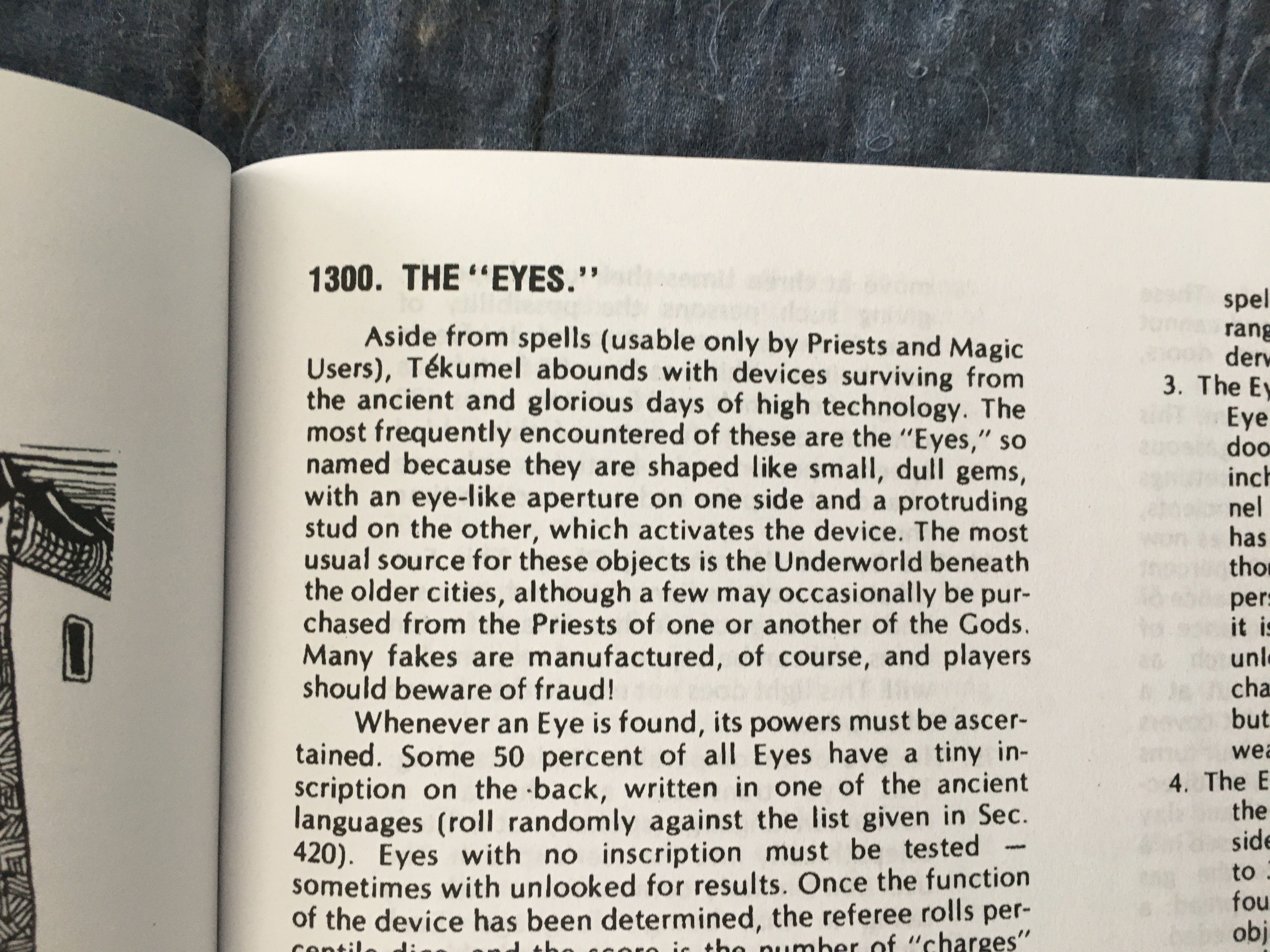
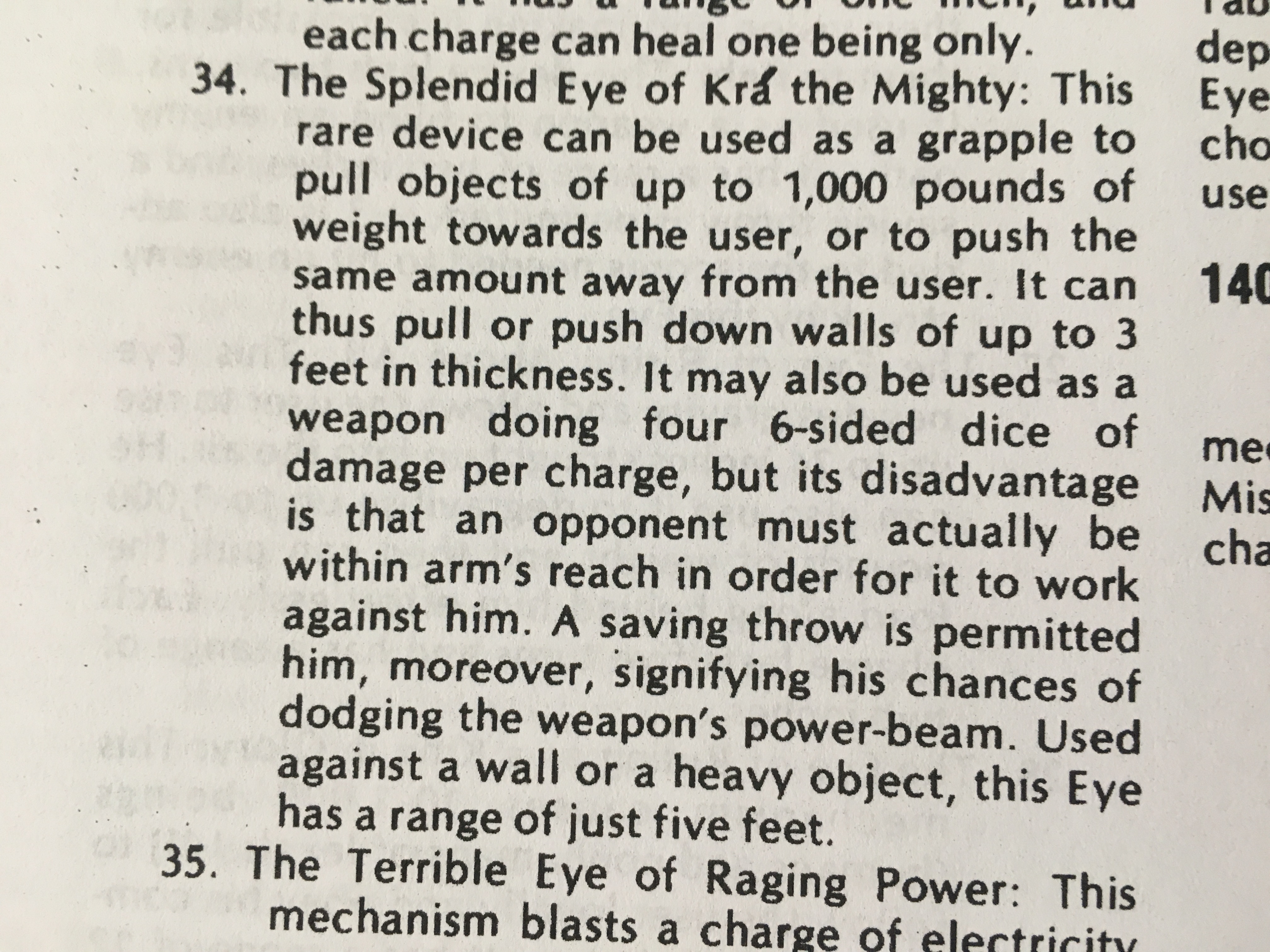
Most eyes produce effects comparable to magic spells, though not all are attacks. This eye, for example, can also be used to move heavy objects. Others can cause paralysis, instant death, or even raise someone from the dead.
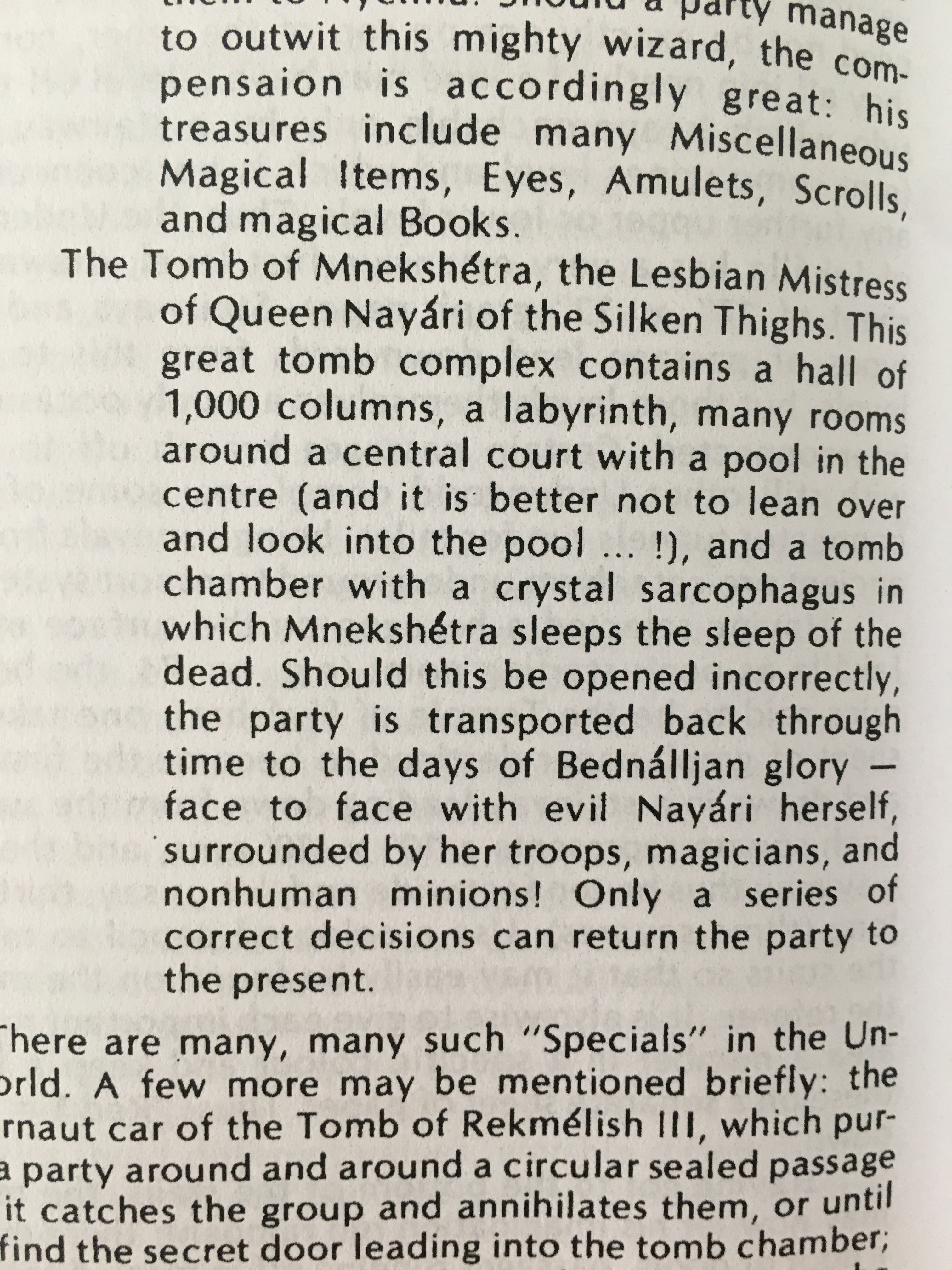
Dungeons include remnants of the lost technological civilization, as well as more recent (but still ancient) tombs and underground cities of Tékumel. This example from the book may be the first mention of homosexuality in a roleplaying game?
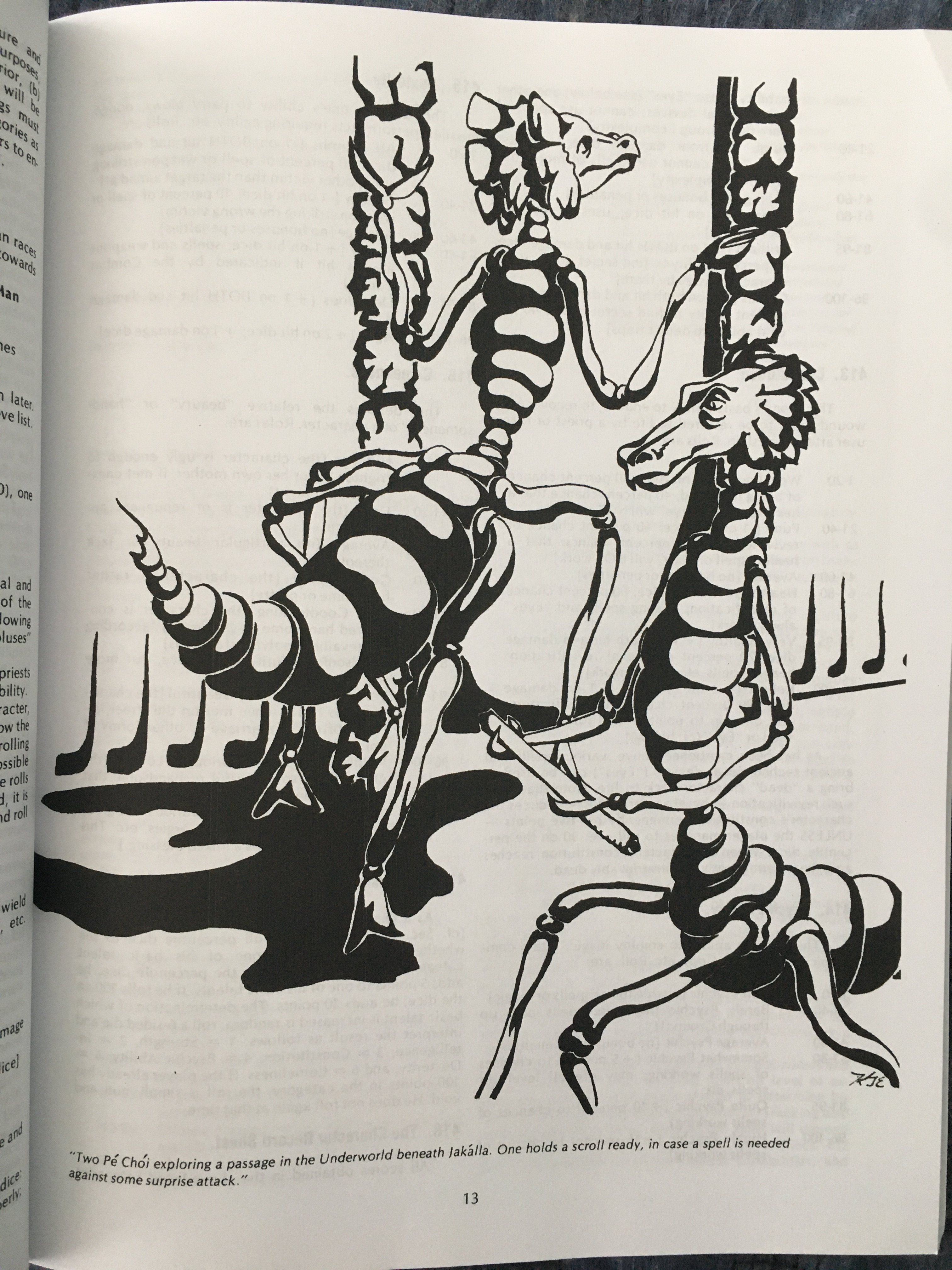
The monsters of Tékumel are also gloriously weird and unique. Here’s one example of an intelligent race on the planet.
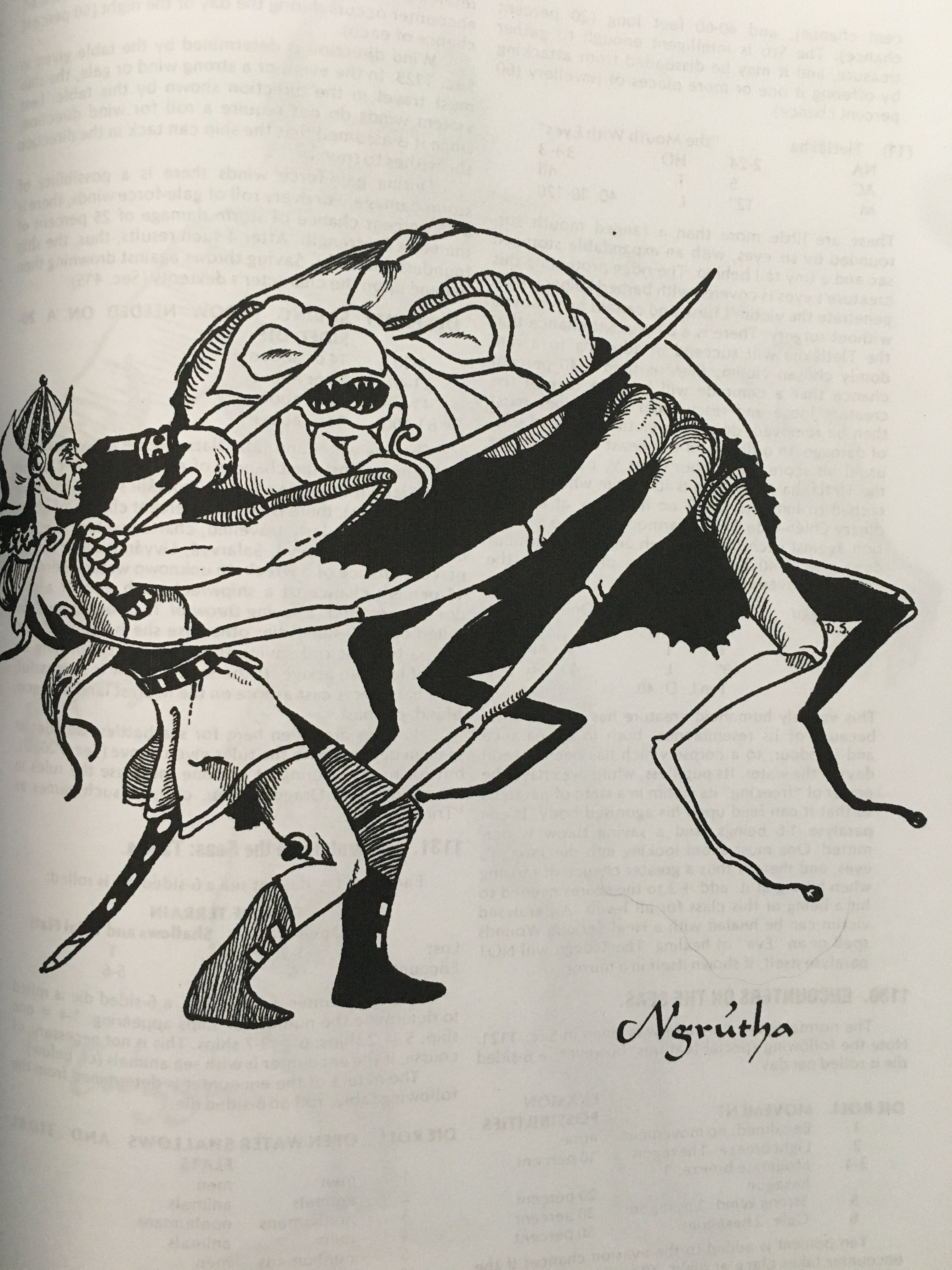
This one is a hideous giant insect which can suck out a character’s blood in moments with its mosquito-like proboscis.
One cannot mention Tékumel without pointing out the amazing work on language and writing that Barker did, some of which is included in the game book.


Empire of the Petal Throne lasted only a few years as a TSR edition, before Barker reclaimed the rights. It appears the original financial arrangement between TSR and Barker was unworkable for both parties, and Barker brought the game to different publishers, most notably Tékumel: Empire of the Petal Throne, published in 2005 by Guardians of Order!

And the world has lived on! There is a dedicated fanbase for M.A.R. Barker’s detailed work, and one can browse their website for lots of information.
And a reprint of the (almost) original version of this classic game can be ordered through DriveThruRPG, which is how I first read the rules!
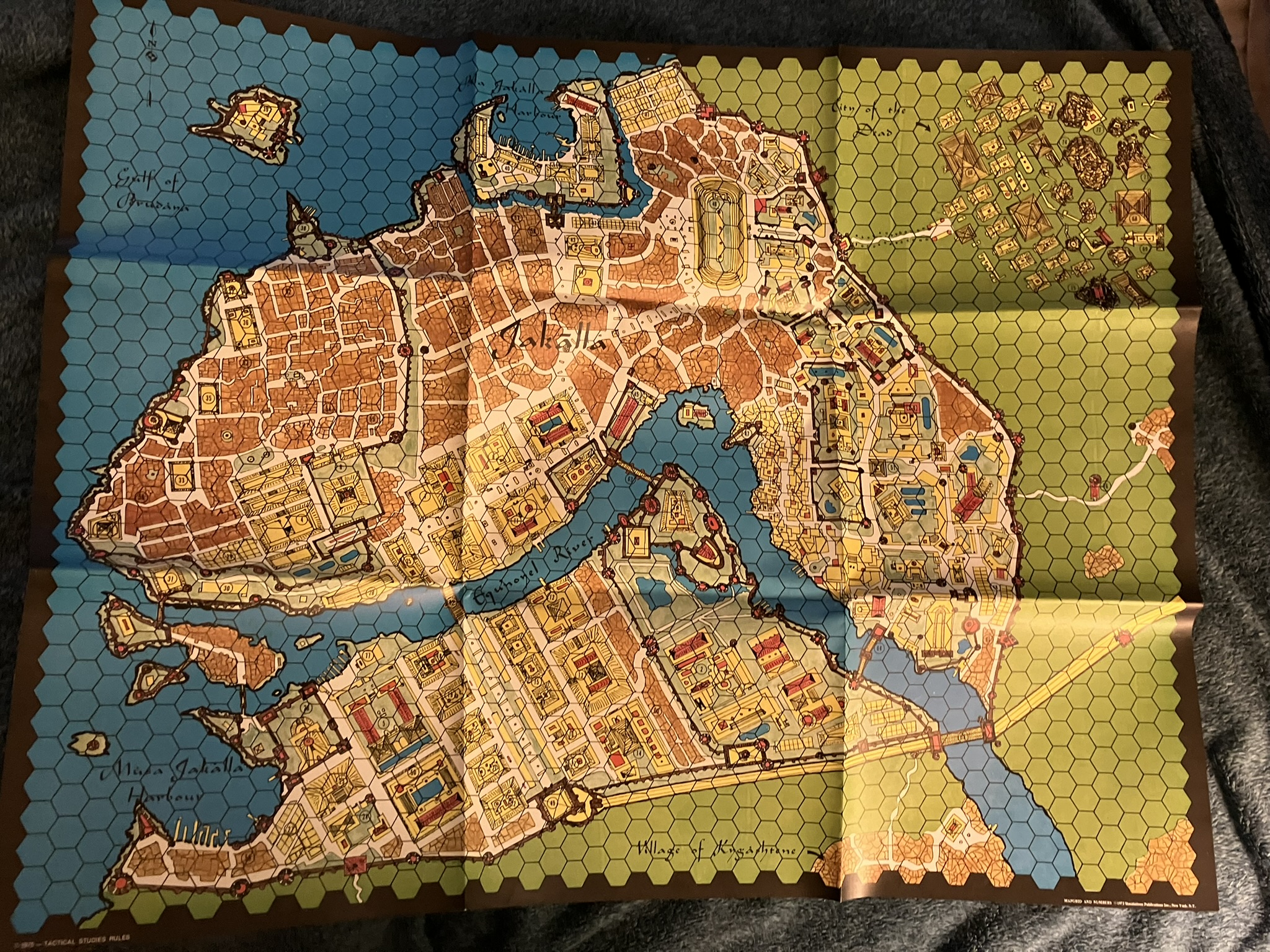
But having an original edition has its benefits. When I first shared on social media that I had secured a copy, several people immediately asked if the maps are present. They are, and I can see why they asked: the maps are gorgeous and of an exceptional quality. Printed on thick flexible cloth-like paper, they seem as good as new even though they are now almost fifty years old! Here is the map of Jakalla, the capital city of the Jakasha Province:
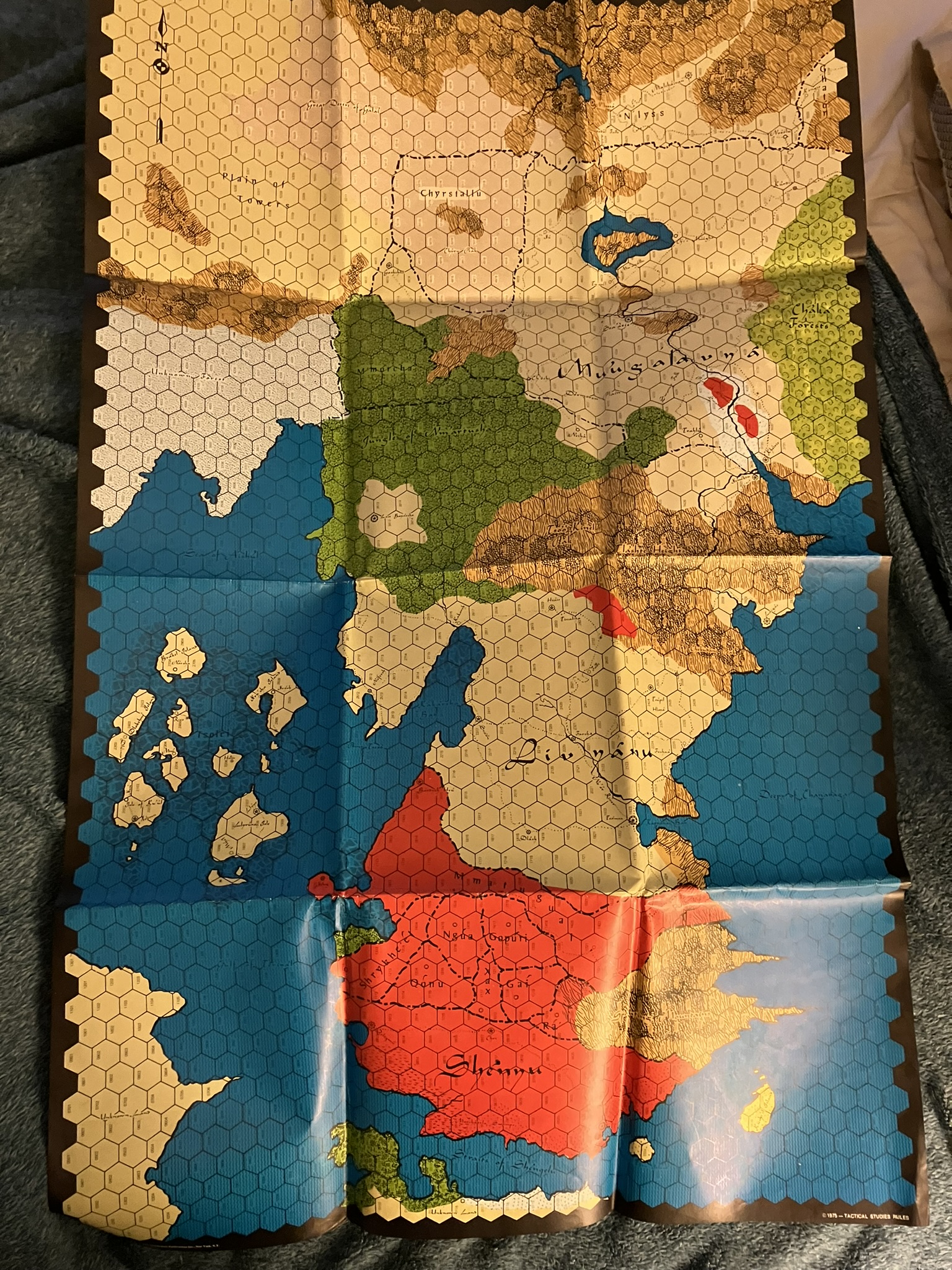
Then we have the two-part map of the continent, also excellent and gorgeous, especially considering the early era in which this game was published:

And here is the original printed rulebook, in all its spiral-bound glory:

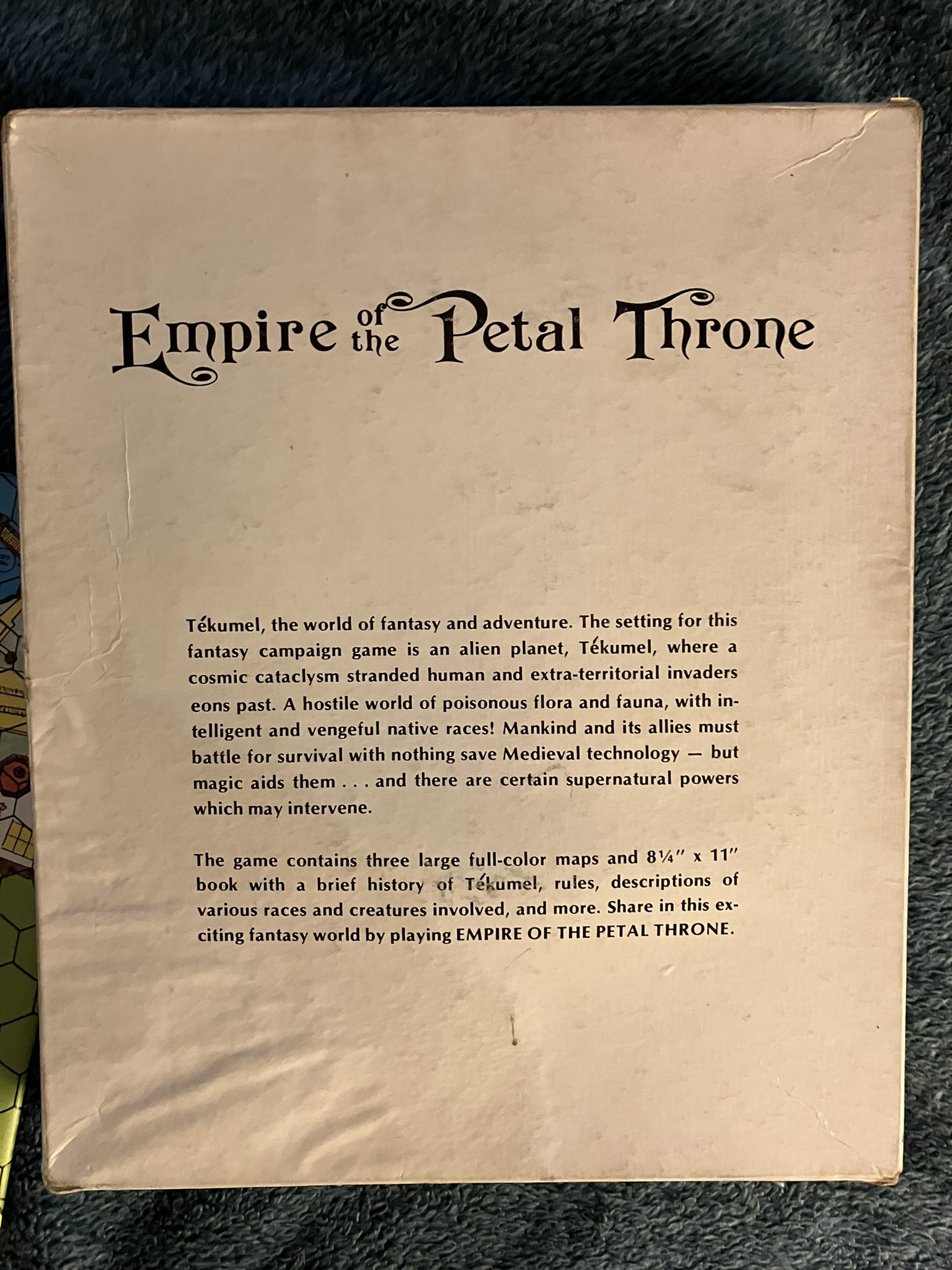
Finally, since I have made much ado about the box, here’s the text description of the game that appears on the back of the box:
Petal Throne, obviously, never quite reached the heights of popularity of Dungeons & Dragons. I feel like the game didn’t have strong support originally because the setting was TOO unique for gamers at the time, who had some inkling of medieval Europe but not much experience in envisioning entirely alien worlds! Dungeons & Dragons was inadvertently brilliant by being rather straightforward and easy to imagine. Hopefully, though, Barker’s vision will grow in influence, as it is quite remarkable.
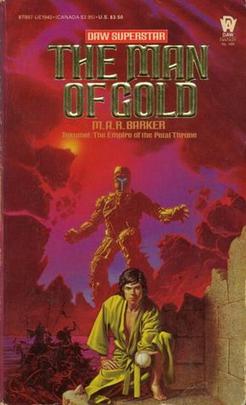
Barker also wrote *five* novels set in his fantasy world. Man of Gold was the first, which came out in 1984. I have a copy and have been meaning to read it. I understand that they’re not the strongest writing, but they have been reprinted multiple times.
I still find it fascinating that TSR went right ahead and published Petal Throne in the first place! It is perhaps a sign of how TSR was not yet a “corporate” entity in that Gary Gygax and colleagues could see a potentially competitor in Petal Throne but turn them into a colleague, with a printed edition that was absolutely magnificent for its time (and arguably much prettier than 0th edition Dungeons & Dragons)!
Disturbing postscript: I was only made aware after posting that Barker was revealed to be a HUGE neo-nazi later in life, publishing a pro-nazi novel and engaging in Holocaust denial. A depressing turn for a person who created such a groundbreaking fantasy world, and a depressing reminder to “never meet your heroes.”


 Skulls in the Stars
I like both of Barker’s original Tekumel books, but prefer the second, Flamesong. But both are solid reads, if not high literature.
I was so disappointed to hear about Barker’s fascination with the Nazis. I sold much of my personal Tekumel collection except the core box at the time.
I have since recovered, holding to my general philosophy of separating art from artist. So many musicians and actors whose work I love often range from ignorant to loathsome in their personal lives. Michael Jackson springs to mind. I can’t stop loving his music.
Agreed. And, though I could be wrong, it’s hard to reconcile his nazi views later in life with the multicultural setting of Tekumel that he created when he was younger. I like to imagine that he wasn’t always that awful and that he was radicalized as he got older. His published nazi work did appear in his 60s, after all.
(And I’m still processing all this because I literally learned about the nazi connection yesterday.)