
Book 3 for 2025! My goal is 30 this year.
Now that my rush to fulfill my arbitrary book-reading deadline for last year is done, I can relax and read books that are a bit longer. One I’ve had on my shelf for possibly years is Doomsday Book, by Connie Willis (1992). Once again I relied on a nice inexpensive “SF Masterworks” edition that weighed in at 587 pages.
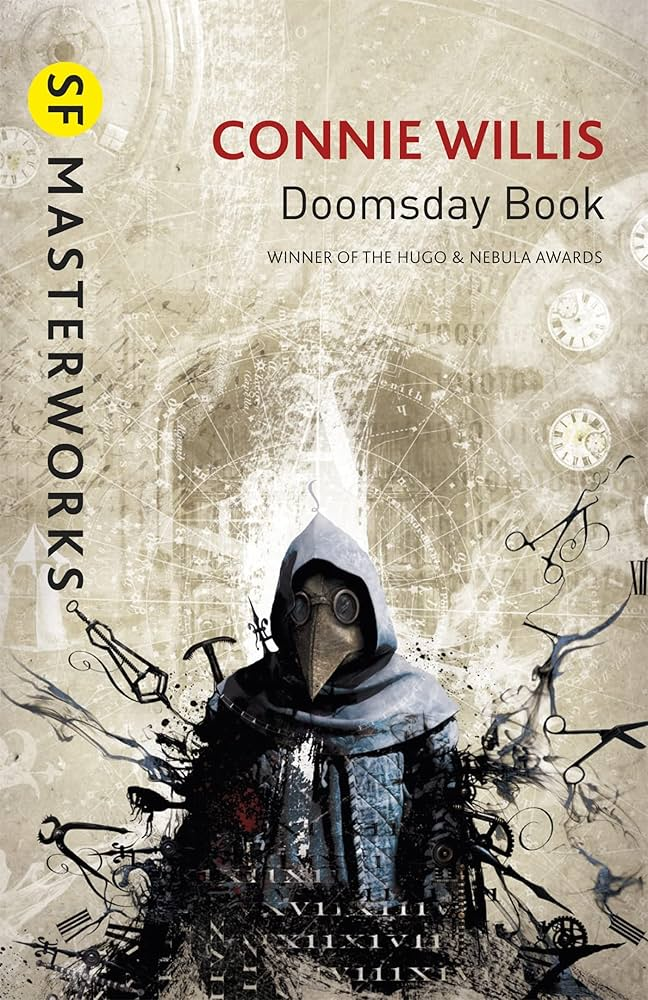
My review, in short: this book is amazing, and easily qualifies for the title of “masterwork.” It is a story of a time travel journey gone wrong, as the traveler in the past and her colleagues in the present struggle with their own unexpected crises.
Strangely, one can’t help but wonder if Connie Willis is a time traveler herself, because her novel remarkably anticipates many of the crises that have hit humanity in modern times!
The book opens as a young historian named Kivrin Engle prepares for her first time travel journey to research the past. In the 21st century, time travel technology has been discovered, and as it is found to be impossible to cause a temporal paradox by doing so, it creates an incredible opportunity for researchers to study firsthand various byegone eras. To this point, it had been decided that travel to the Middle Ages was far too dangerous an undertaking, but an ambitious Oxford administrator enlists the eager Kivrin, a student of that era, to make the journey. She is given inoculation against every possible disease she might encounter, is given a translator that will help her understand and speak the old English of the 14th century, and is given a cover story as a noblewoman waylaid by bandits near a remote village where she will do her fieldwork.
This trip is against the wishes of her instructor, Professor James Dunworthy, who worries that the trip has been hastily planned and without the usual unmanned trips and preparatory work. Still, the “drop” to a point near an isolated part of a road in the year 1320 seems to go as planned, and Dunworthy allows himself to be dragged away to a nearby tavern to await confirmation from a technician that Kivrin reached her target with minimal “slippage” in time.
But any attempt to relax is short-lived, as the technician arrives at the tavern in a panic, seriously ill, and can only convey to Dunworthy that “something’s wrong” before he collapses. The technician Badri has succumbed to an unknown illness that his countless vaccines and immune system treatments have failed to stop, and soon the entire area around Oxford is locked down in quarantine with fears of a possible new global pandemic. The time travel laboratory is shut down and Badri is unconscious, unable to explain what has gone wrong with the drop. Other technicians are unavailable, in part due to the quarantine and in part because it is the Christmas holiday and many people are away from the university area. Dunworthy and his friend Doctor Mary Ahrens rush to try to find the source of the new illness in order to contain it and get the lab reopened to rescue Kivrin by her scheduled pickup date, which is only two weeks away.
Meanwhile, in the past, Kivrin finds herself stricken down by the same illness, and ends up recovering in the home of local nobility. With her cover story unraveled in her delirium, she must keep her wits about her and fit in amongst the locals, while at the same time trying to discover the “drop point” where she arrived and could not keep track of due to her illness. And then, unexpectedly, she makes a horrifying discovery: she was not dropped into the year 1320 as planned, but instead arrived in the Oxford area in the year 1348 — the same year that the Black Death arrived in the area. She is in the center of a pandemic that is estimated to have eventually killed some 50% of the population…
Doomsday Book takes place in two different time periods — with Kivrin in 1348, struggling to survive and find a way back to her planned extraction, and with Dunworthy in 2054, trying to find the source of the modern epidemic and a way to bring Kivrin home. Both stories are incredibly and equally compelling, and they come together beautifully by the end of the book.
The “Doomsday Book” of the title is Kivrin’s name for her digital recordings of her observations, cleverly disguised subcutaneously as a bone spur in her arm. The chapters of her story often conclude with some excerpts of the Book.
What truly keeps the book constantly engaging is the incredible crafting of the characters, both in the past and the present. We meet characters in both time periods, all with their own hopes and dreams and motivations, and we come to be interested and involved in all their fates. Some of these characters are overall good and kind-hearted, and others are cruel and self-centered — in both eras.
On reflection, I suspect that the parallels between the characters in the past and the present is a large part of the point of the book. Before Kivrin heads to the Middle Ages, she is warned by every historian that it is a cruel place, full of robbers and murderers and rapists. When she arrives, however, she finds that people are… people, just like in 2054. In fact, one can draw close parallels between certain characters in the past and the present that emphasize that, regardless of the era, its technology, and its general enlightenment, people have remained human: largely trying to do good, but with their own failings.
The book is incredibly well researched, and the history comes alive in a way that I’ve never really encountered in a work of fiction before. And the details are fascinating — I would not have thought that reading pages and pages of the daily life of people in the Middle Ages would be so compelling, but it is. The incredible characters of the book indicate that Willis is not only an avid student of history, but of human nature.
That understanding of human nature is, what I suspect, makes Doomsday Book feel eerily like it was written by a time traveler warning us about the future. Her descriptions of the pandemic and the people’s reaction to it mirror in striking ways the response of the world to the COVID pandemic of 2020. For example, consider this passage, in which Dunworthy tries to explain to some visiting Americans why they can’t go about their planned activities in the middle of a quarantine:
“Explain! Perhaps you’d like to explain it to me, too. I’m not used to having my civil liberties taken away like this. In America, nobody would dream of telling you where you can or can’t go.”
And over thirty million Americans died during the pandemic as a result of that sort of thinking, he thought.
Then we see the role of anti-vaccination types in worsening epidemics and spreading disease:
“Do you think it’s a mutant strain?” Dunworthy asked.
She thought about it. “No. I think it’s much more likely that Badri caught it from someone at that dance in Headington. There may have been New Hindus there, or Earthers, or someone else who doesn’t believe in antivirals or modern medicine. The Canadian goose flu of 2010, if you’ll remember, was traced back to a Christian Science commune. There’s a source. We’ll find it.”
We also have the “lab leak” paranoia:
“They’re saying it’s some sort of biological weapon,” Colin said. “They’re saying it escaped from a laboratory.”
We also find people regularly refusing to wear masks, and claiming they don’t work. We even get people blaming the pandemic on immigrants, as an excuse for the United Kingdom to claim complete independence from Europe, ala Brexit!
Of course, I don’t think that Willis is actually a time traveler, and I’m sure that there are historical precedents for all the conspiracy theories that Willis imagines arise in response to the pandemic. But it is striking to see these things written about in 1992, long before most of us living were ever really thinking about what a pandemic would be like. As I said, Willis is an amazing student of history and human nature.
One other curious thing is worth mentioning that is a testament to Willis’ writing skill. The blurb for the book itself reveals that Kivrin gets transported accidentally to the birth of the Black Death in England, but the book itself only hints at it and doesn’t fully reveal this until its third and final part. One imagines it is intended as a bit of a shocking twist, but it can’t be when the book blurb tells us this explicitly! Nevertheless, the book remains utterly compelling and the twist remains devastating even though we know it is coming. Instead of it being a surprise for the reader, the reader feels a buildup of inevitable dread knowing what is coming.
Doomsday Book is a miraculous work of science fiction that manages to be moving, informative and entertaining constantly. I burned through the nearly 600 pages of it in only a few days, because I simply couldn’t stop reading until I knew the fate of Kivrin, Dunworthy, and all of their friends and colleagues. If you haven’t read it before, I highly recommend it.
Incidentally, this is not the only book that Willis wrote in the “Oxford Time Travel Series.” Doomsday Book was preceded by a novelette Fire Watch in 1982, and was followed by several other books. I will be checking them out in the future as well!


 Skulls in the Stars
This sounds like a must read, thanks!
Connie Willis is one of my must read authors & Doomsday Book is my favorite of hers.