
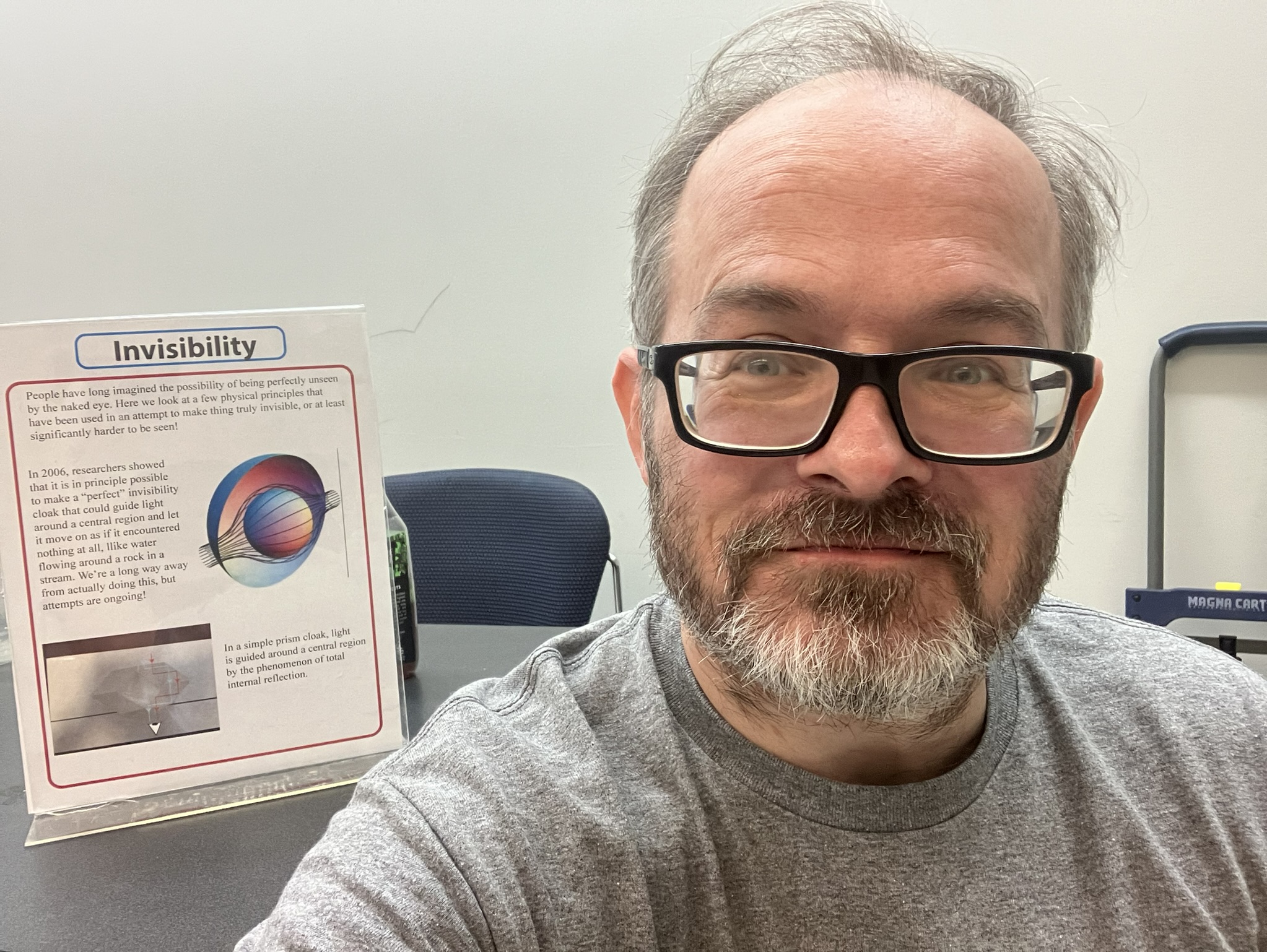
This past Sunday, I participated once again in the annual UNC Charlotte STEAM Innovation Expo, in which faculty, staff and partners present science, technology, engineering, arts and mathematics demonstrations and as well as demos highlighting the links between them. Last year, I planned a detailed table of interesting invisibility demonstrations, but I was unable to make it due to life stuff (which happens a LOT these days). However, this year I was able to get my demonstrations together and do the Expo and thought I would share the demos that I did, in the order I did them, with explanations!
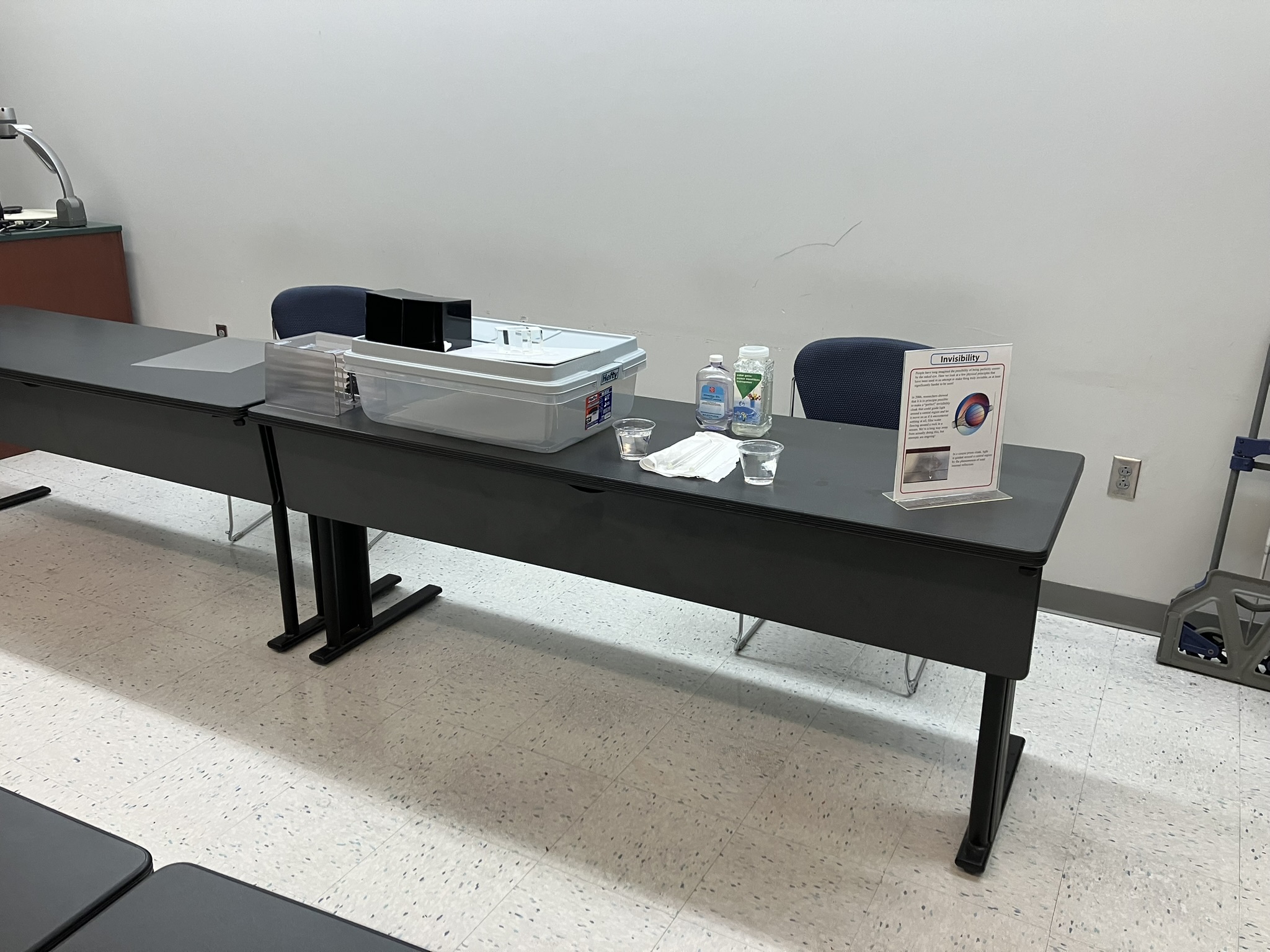
So my table consisted of five different small demos, which could’ve been six or seven (I’ll explain below). Many of these I’ve explained previous on this blog, so I’ll link back to those old posts for more information when I can.
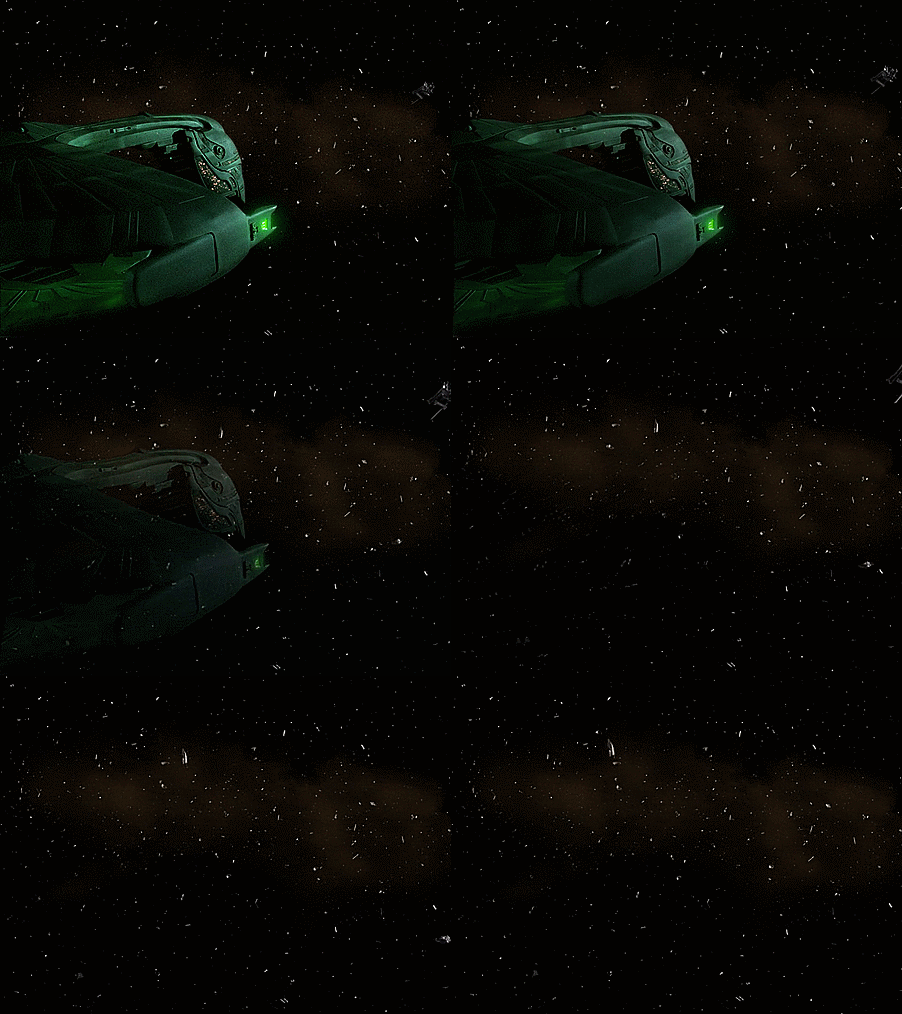
So what is invisibility? It is a term that is both highly suggestive and also extremely vague. When we use it, we tend to think of things like Romulan cloaking devices from Star Trek:
But “invisibility” in a literal sense just means “unable to be seen,” which includes hiding behind the sofa! So we must be a little more specific. I tend to refer to “invisibility” as any demonstration that uses optical effects to make something unseen.
The first demonstration is one of the simplest and most impressive, and one that I’ve blogged about before: index matching. When light enters a solid transparent material, it typically slows down; the factor by which is slows relative to the speed of light is called the refractive index. For example, the refractive index of water is about 1.33 for visible light, which means that the speed of light is slowed relative to the vacuum speed by a factor of 1.33.
At the boundary between materials of different refractive index, some light gets reflected and the light that gets transmitted changes direction, i.e. gets refracted. Reflection and refraction together are what make objects visible.
But what happens if you have two materials with the exact same refractive index? Then the reflection goes to zero and no refraction occurs: light passes through the object undistorted, and the object itself will not be visible.
The easiest way to perform this demonstration is with so-called “water gems” that can be bought at local craft stores. These are the ones I have:
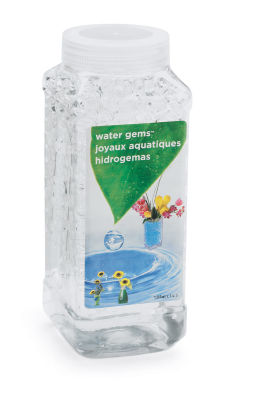
Put some of these in a transparent cup filled with water, and it appears that it’s just water in the cup. But use any sort of rod to disturb it, and you’ll see that the gems are hiding in plain sight!
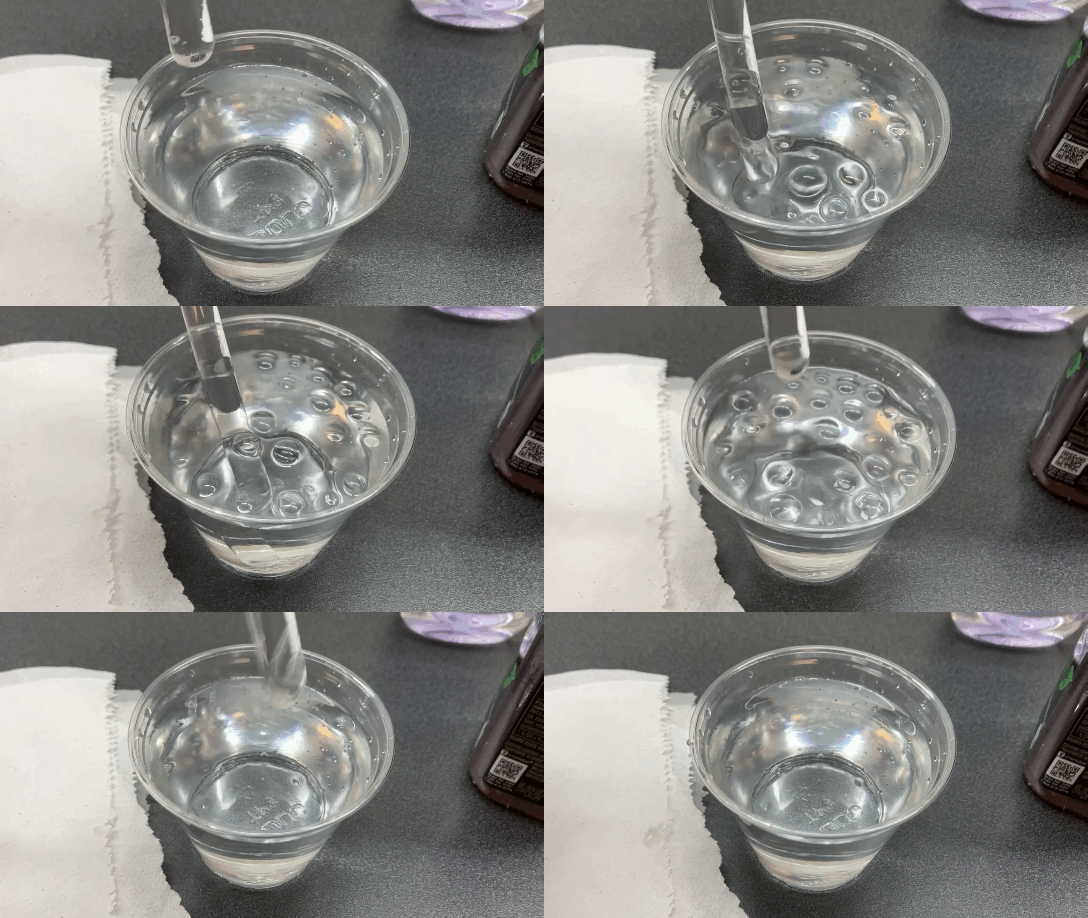
This example may be consider a little bit of a cheat, however, as water gems are something like 90% water themselves, which means that we’re hiding water in water, which makes it sound less impressive. A more compelling example can be done with a Pyrex glass rod and ordinary mineral oil that you can buy at a grocery store or pharmacy.
By pure physical coincidence, it turns out that mineral oil has nearly the same refractive index as Pyrex glass over the entire visible spectrum. When the rod is dipped into the mineral oil, it seems to (almost) completely disappear.
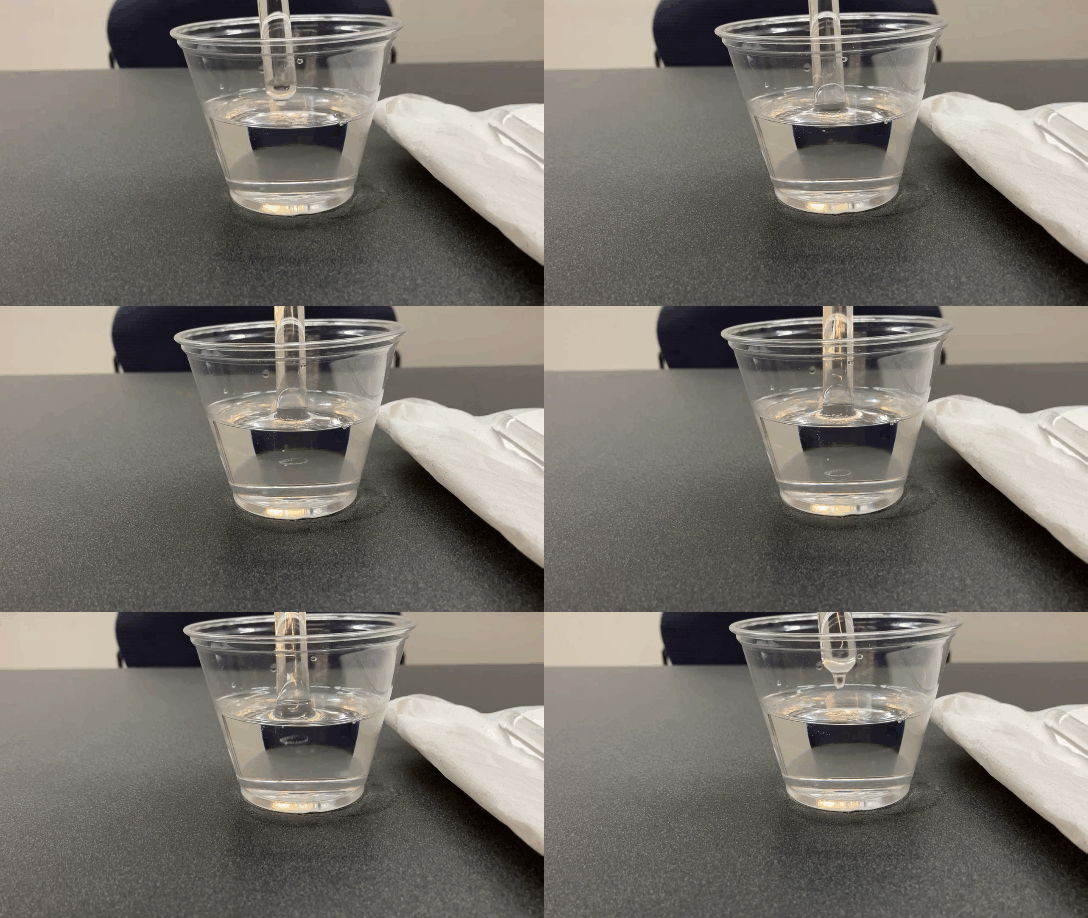
You can still see a hint of the bottom of the rod in the video above: this is partly due to air bubbles that get temporarily trapped at the surface, and I can’t rule out a slight index difference at the end of the rod.
Both the water gem and the mineral oil demonstrations are quite inexpensive to do at home. Pyrex glass rods are the hardest thing to find, but they can be purchased cheaply online.
Index matching is a very simple and effective demonstration, and it forms the basis of H.G. Wells’ classic novel The Invisible Man. It can only work in a liquid of reasonably high refractive index, however. The refractive index of air is basically the same as the refractive index of vacuum, and we don’t really know how to make a solid material with the same optical properties as “nothing.” We therefore need another strategy, a more complicated strategy, to make something invisible.
This is where the idea of an “invisibility cloak” comes into play! Back in 2006, two research groups simultaneously published papers suggesting that an invisibility cloak is theoretically possible. Such a cloak would guide light around a central hidden region and send it on its way as if it had never encountered anything at all. An illustration from one of the original papers is presented below, showing a simulation of light rays bending around the central region.
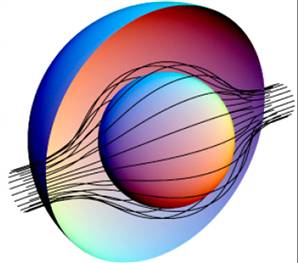
The challenge with this sort of cloak is it requires a very precisely defined optical structure — the spherical shell — that would have to be constructed with materials that don’t exist in nature and we don’t know how to manufacture at scale. (There are other problems, but I won’t go into them here.)
We can at the very least, however, illustrate the principle of light guiding with a clever “prism cloak,” another topic I’ve blogged about before. The idea of the prism cloak, from my earlier blog post, is shown below. When the cloak is looked at from head on along its side, one sees light that was guided from the back of the cloak around a central hidden region and then to your eyes.
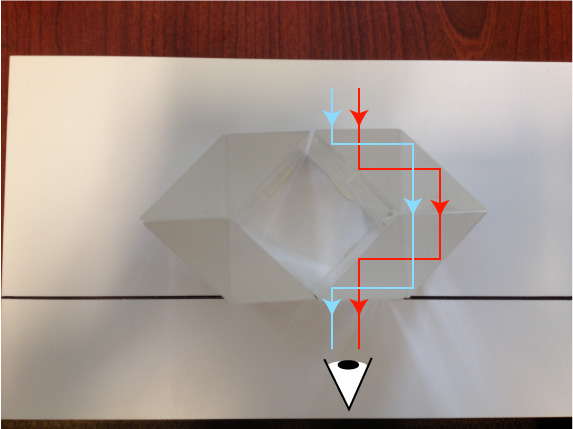
The light stays trapped within the prisms and doesn’t leak out of the sides thanks to the phenomenon of total internal reflection, where light reflecting from a dense (high index) to a rare (low index) medium at a grazing angle is perfectly reflected and not transmitted. This phenomenon forms the basis of fiber optics, and also one can guide a beam of light through a falling stream of water, which is a very old demonstration from the 1800s! In fact, this was one of the demos I had also planned for the Expo; because I didn’t want to refill a tank of falling water constantly for the four hour expo, I repurposed an old cat water dish pump to recirculate the water from a lower tank to a higher tank.
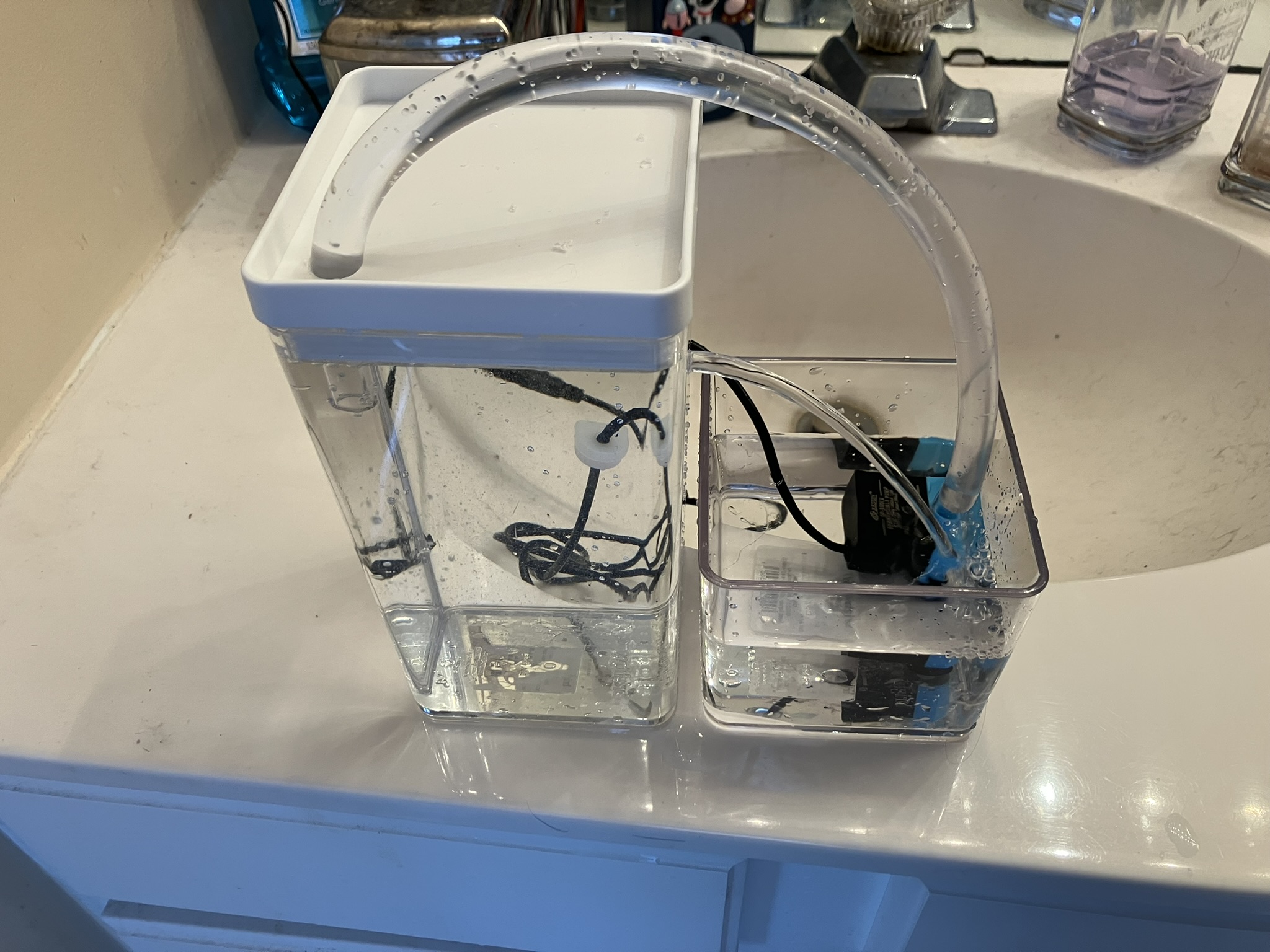
It actually worked perfectly when I tested it at home, and maintained a very steady level of water in both tanks. When I set it up at the Expo, however, the water stream ended up being too strong and it shot out past the lower tank, getting everything wet! (I likely had too much water in it.) I opted to not use it for the Expo largely because I didn’t want to spend all my time cleaning up water spills.
Back to the prism cloak: here is an image of my prism cloak in action, with one (invisible) finger inside and one (visible) finger behind it.
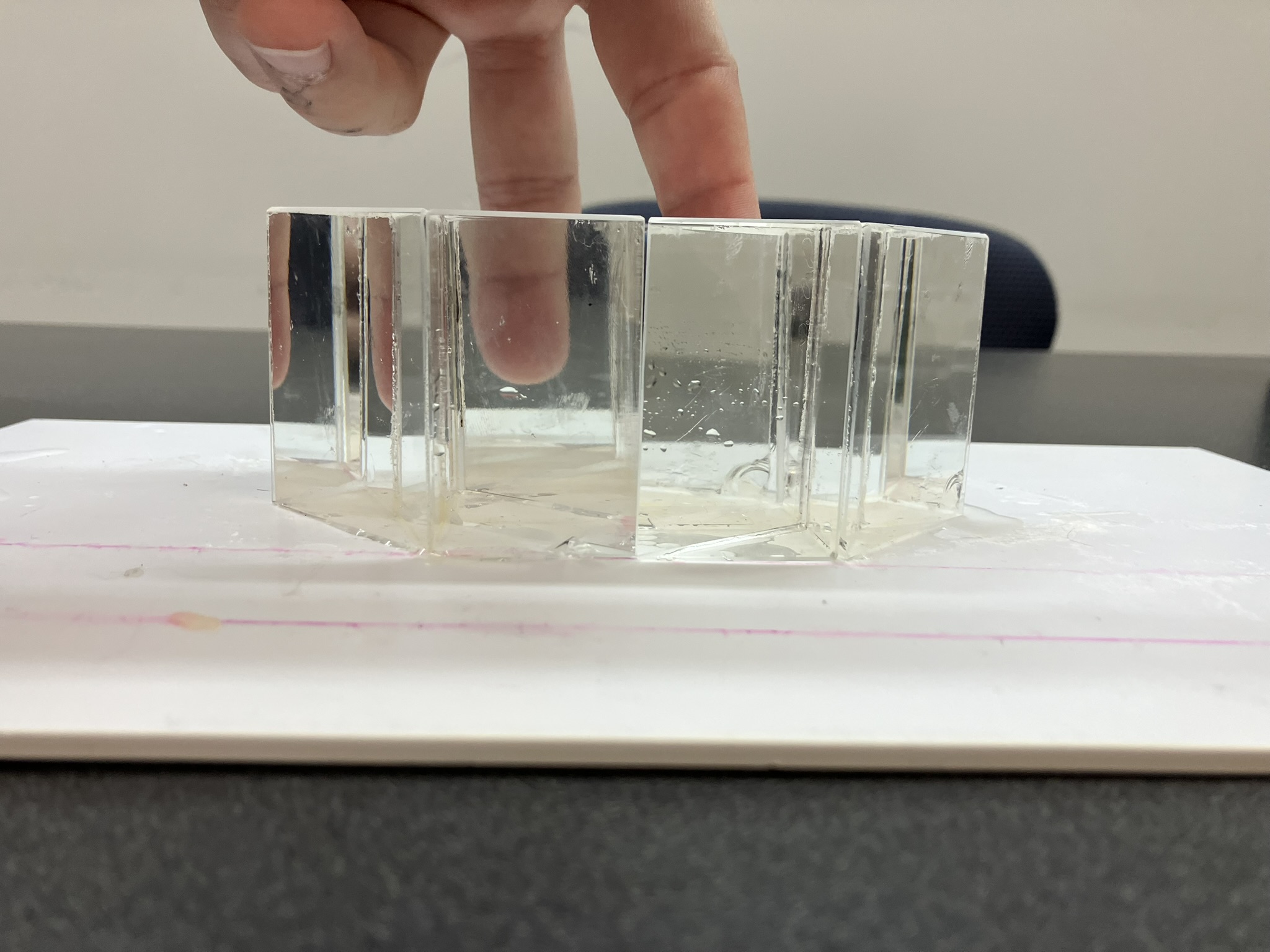
When I made my original prism cloak, I didn’t bother to provide any optical cement to couple the prisms together, which meant that there would be some light lost due to reflection where any two prisms meet. For the updated version, I purchased some Canada balsam, an optical cement that has very nearly the same refractive index as glass, to improve the optical contact.
What I didn’t reckon with is the messy stickiness of Canada balsam, and I ended up leaving sticky fingerprints on the outside of several prisms! These sticky spots break the total internal reflection at the surface, allowing light to leak out. This was another lesson learned in setting up such a demo, and when I try to make this device again, I will be a bit more careful.
I added two new demos to my setup that ended up being a big hit with the audience! The first of these is “invisibility” of the sort used by stealth aircraft. To reduce their radar cross-section, stealth aircraft are painted with some special paint that strongly absorbs radar waves. This means that very little of the radar signal gets scattered by the plane, and the radar station cannot detect the “echo” of their original signal.
We can do something similar with visible light. In recent years, there has been extensive research on “ultrablack” paints that absorb much more light shining upon them than ordinary black paints. The most famous of these is Vantablack, which absorbs some 99.965% of the light incident upon it. If one looks at an object painted with an ultrablack paint against an ultrablack background, it is effectively invisible.
Vantablack is not available for ordinary folks like me, and certainly not for a reasonable price, but fortunately there is an ultrablack paint known as Musou black that is available for about $22 for 100 mL, which is affordable for small projects.
In my case, I painted the interior of one small box with Musou black, and another with ordinary matte black spray paint. I also painted two dinosaur figures with the respective paints, and “hid” them inside the boxes. The result is shown below.
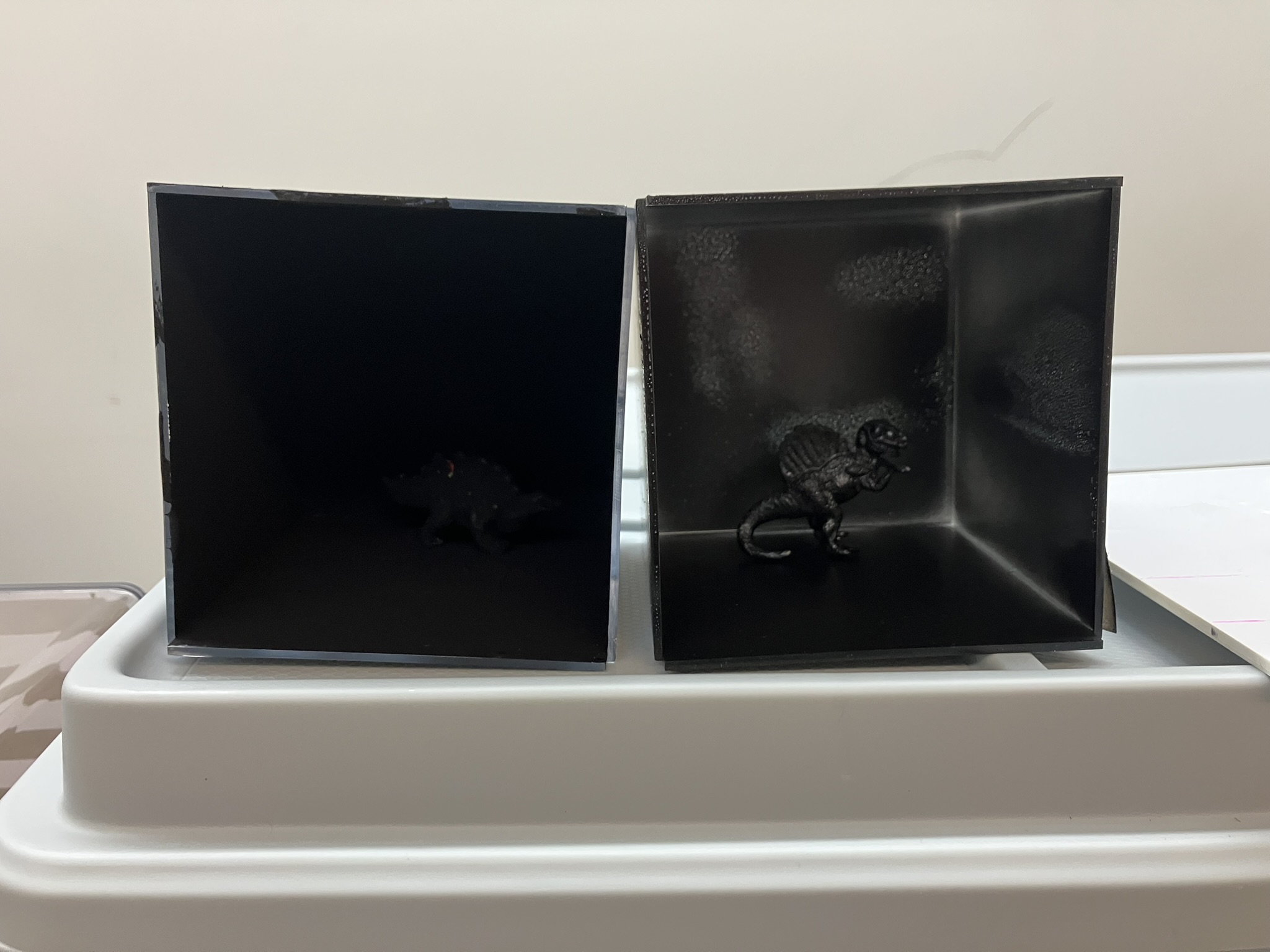
I did this somewhat at the last minute, and you can see that I didn’t do a great job with the ordinary matte black spray paint, but the figure is quite visible nevertheless. Ordinary matte black paint probably absorbs something like 95% of the light hitting it, but enough light is reflected back that you can distinguish features of objects if the light source is strong enough. The Musou black is touted as 99.4% absorbing, and one can really see the difference! This is another project that I intend to reproduce, taking more time to do the painting and giving it more time to dry. If you don’t believe me that there’s a dinosaur in the Mosou black box on the left, here is the same photo but with the contrast reduced.
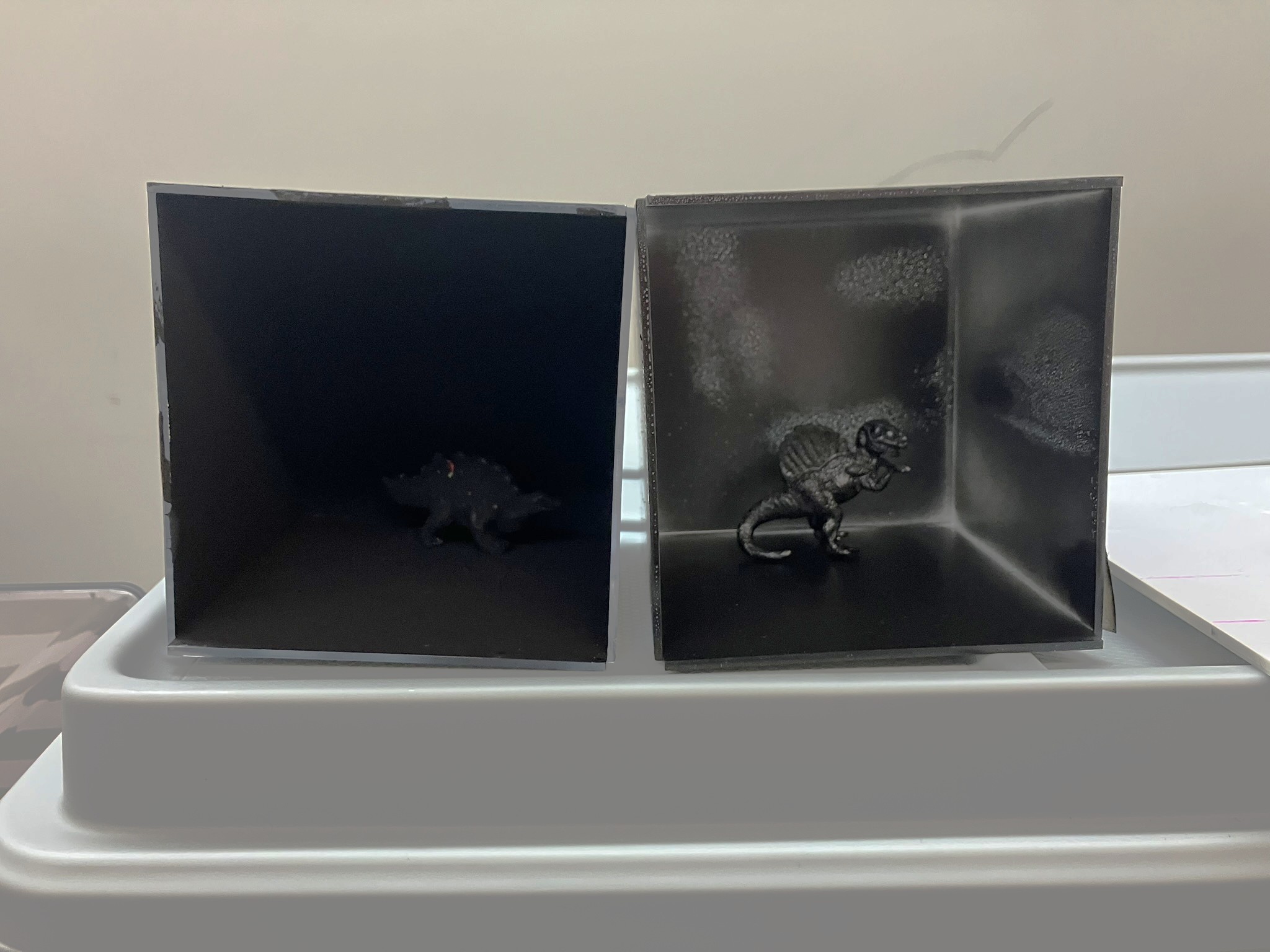
The figure is more visible, especially since you can see the spots where I accidentally rubbed off some of the not-quite-dry paint!
My final demo is again a bit of a cheat, because it really lies on the boundary of what one might arguably consider “invisible.” However, a company actually marketed this as “quantum stealth” and at first glance it seems like it is an almost supernatural form of invisibility.
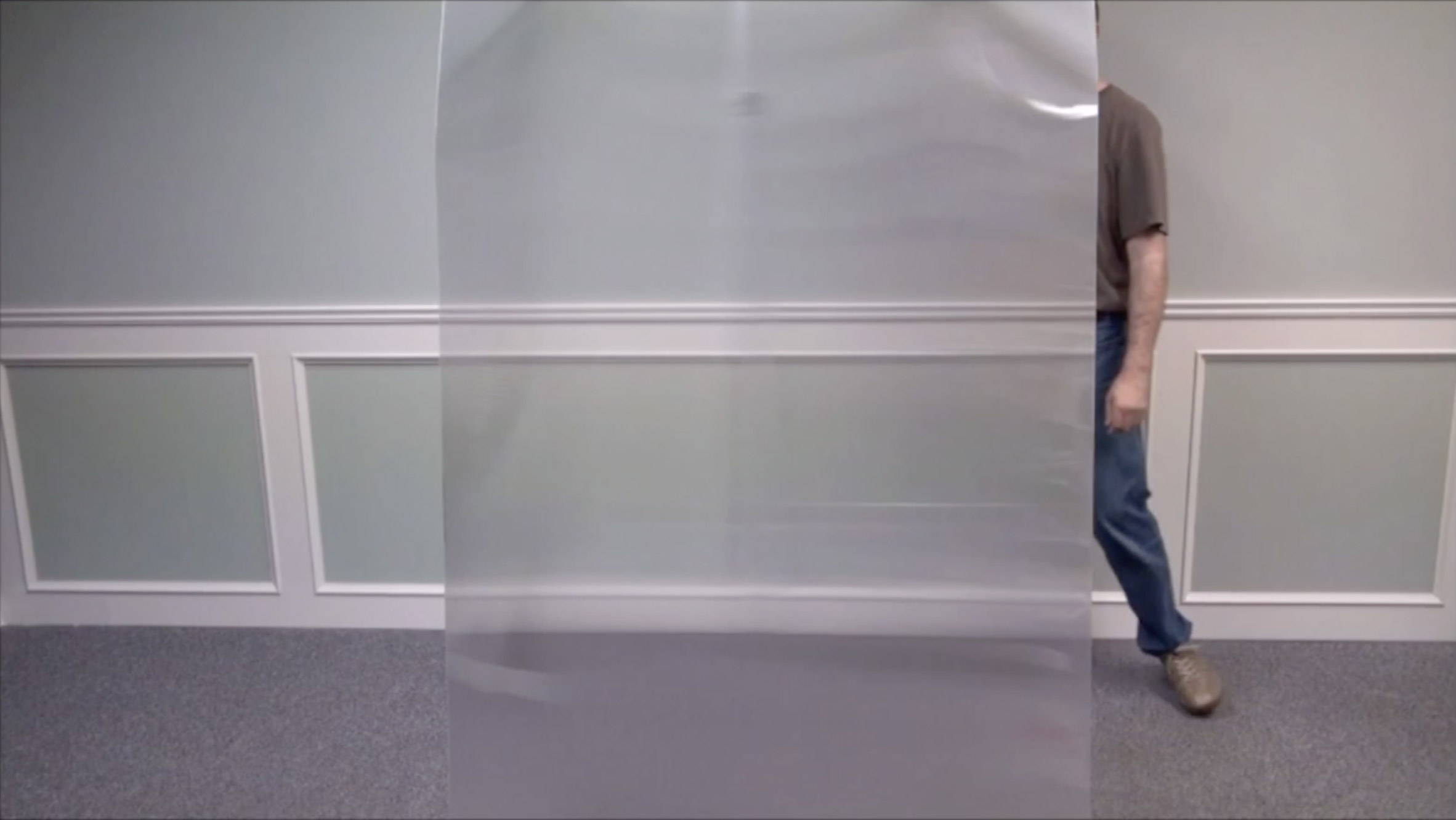
Note that the person seems to disappear and — this is the important point — the horizontal moulding is clearly visible.
Here is my demonstration of this effect. First, you look at a box with a plastic sheet in front of it, and it appears that there is nothing inside, because you can see the horizontal stripes at the rear of the box.
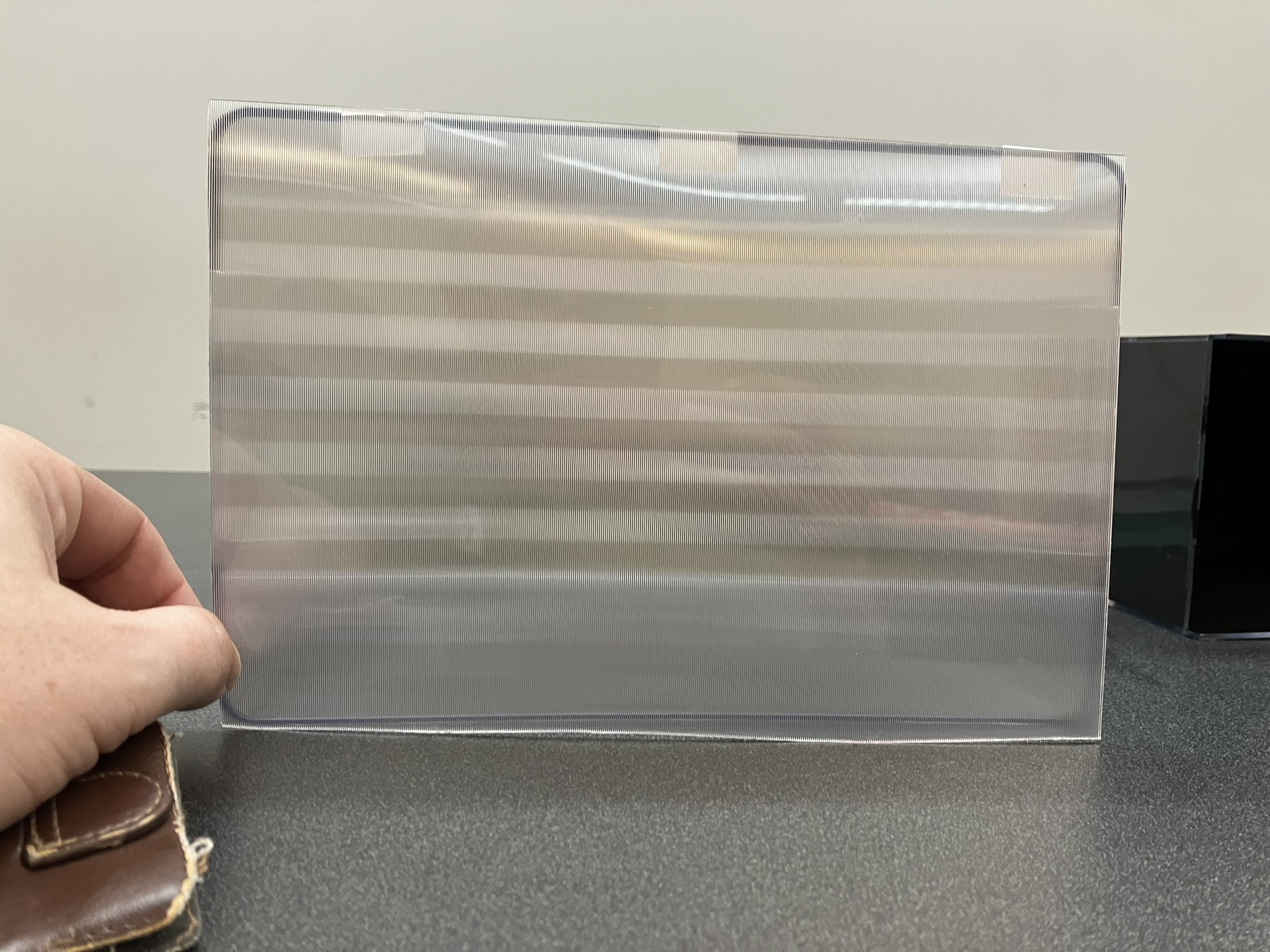
But if you lift up the sheet, you will see that there are in fact two model trees inside!
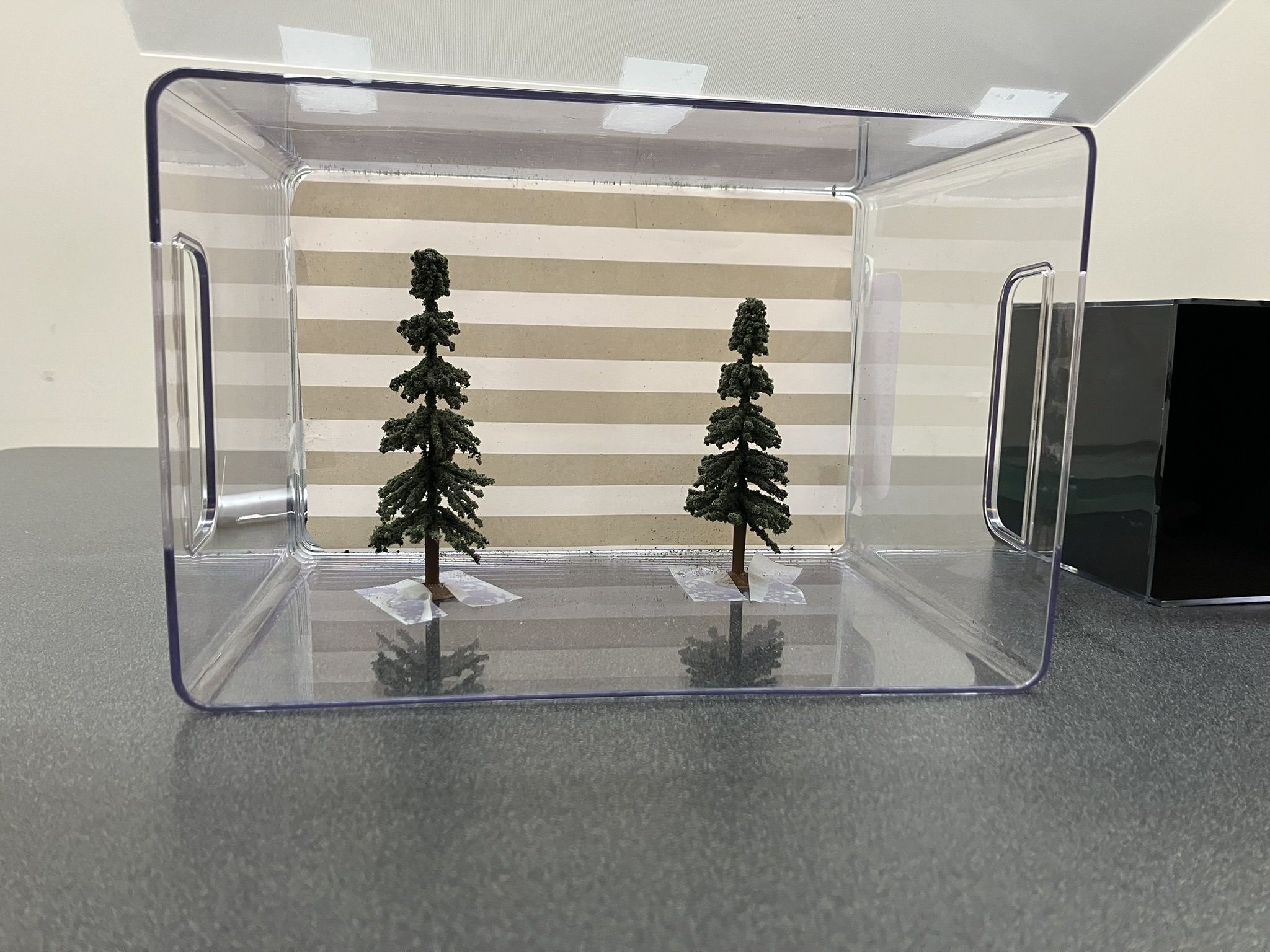
The trick here is that the sheet of plastic is a lenticular lens, which has small semi-cylindrical ridges along one direct of orientation. Here is a zoomed in image from Wikipedia:
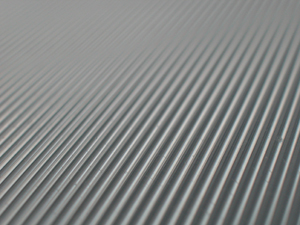
Those ridges act as a sequence of cylindrical lenses that smear out an image along a line perpendicular to the cylinders and essentially leave the image untouched along the line parallel to the cylinders. In the case of my box, the lenticular lens is oriented to smear the light passing through it along the horizontal direction. Because the lines on the back of the box are horizontal, the smearing does little to them; the vertical trees, however, have their image smeared out horizontally, effectively blurring them out of existence!
Hopefully you can see now why the “quantum stealth” sheet works so well in the configuration we showed above. Again, it is designed to smear horizontally, so the moulding looks effectively the same while the upright person gets blurred.
If one considers this invisibility, it is definitely a limited sort of invisibility, but it is really an eye-catching demonstration! People are stunned when they first see that there is in fact something in the box.
The only other demonstration I would’ve liked to include at the Expo was oculus mundi aka hydrophane opal. This material, though quite opaque under normal circumstances, becomes transparent when soaked in water. Hydrophane opal is very porous, and when water soaks into it, it fills in the pores of the material, effectively providing a limited degree of index matching between the water and the opal. This material led Isaac Newton to one of the first scientific hypotheses about the nature of light and their interaction with atoms. His hypothesis was mostly wrong, but it is a fascinating bit of history and it is in my blog post linked above.
Why didn’t I include oculus mundi in my science demos? Well… I couldn’t find where I put it. In effect, I made my oculus mundi invisible to me through my own poor organization skills.
It was just as well I couldn’t find it, though, because I had plenty of stuff to show people at the Expo! For next year, I’ll improve the presentation and stability of my existing demos and see if I can figure out some additional fun ones to show people.


 Skulls in the Stars