
There is a quite long history of novels published by TSR based on Dungeons & Dragons, and the quality is definitely a mixed bag! Some of the earliest were the classic Dragonlance novels by Weis and Hickman, the first of which came out in 1984. Those are quite highly regarded, but other early novels, such as the 1987 Darkwalker on Moonshae, have been remembered less fondly. The irregularity, especially for the early novels, likely stems from the fact that the books were written by the same people who wrote D&D adventures, who often had no prior experience writing novels.
With all this in mind, I was quite surprised a while back when I came across the TSR-published 1990 novel Dark Horse, by Mary H. Herbert!
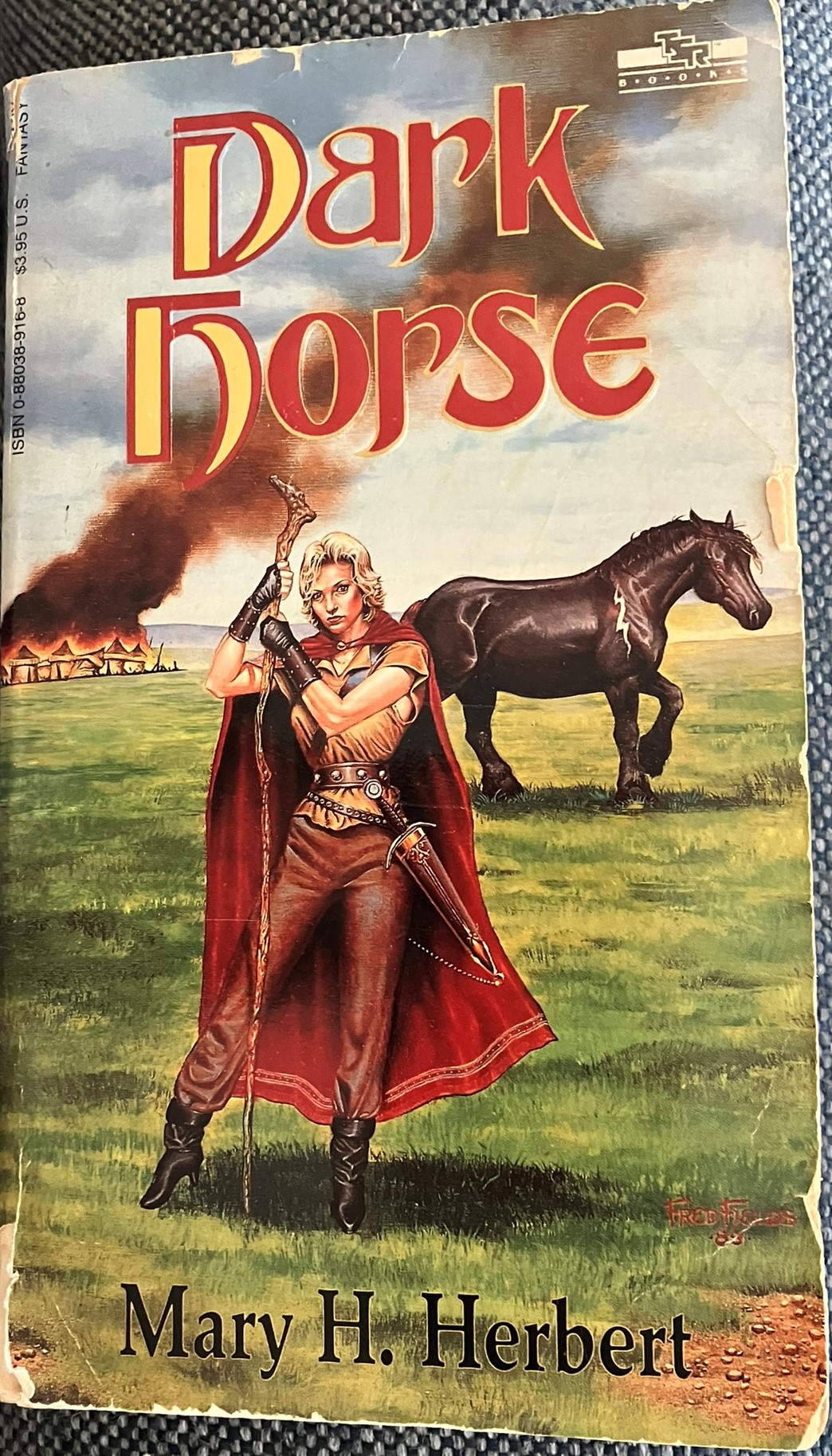
This novel is not, as far as I can tell, based on any existing Dungeons & Dragons setting, and is original to the author. Even though it is her first novel, it is also quite well-regarded, and has generally excellent reviews. So of course I had to take a look at it, and let’s see what it’s all about!
The novel begins as Gabria, sole survivor of clan Corin and daughter of the chieftain, wanders the wild plains by herself, on foot. She stormed off in a rage after an argument with her father about an arranged marriage, and when she returned, she found her family, her friends, everyone had been massacred. She immediately knew the culprit: Lord Medb, a chieftain of another clan, who had recently demanded that Corin submit to his rule and his plans to bring all the clans under his control. Gabria’s father refused, and though they feared retribution, they thought they could defend themselves. But Lord Medb had another tool at his disposal: he had learned the long-forbidden arts of sorcery, and used his powers to gain the upper hand against the unsuspecting Corin defenders.
Gabria vows revenge on Medb, and plans to travel the long distance to her mother’s former clan, the Khulinin clan. But along the way, she hears the sound of wolves — and a horse in distress. She find a horse mired in mud, harried by wolves, and almost without thinking leaps in to attack and drive them away, at great risk to herself. But the horse she has rescued is no ordinary horse, but one of the Hunnuli, magical intelligent horses that no person can tame; the Hunnuli choose their own rider. This Hunnuli, Nara, chooses Gabria as her rider — an unprecedented event, as it is said that the horses will only choose men to ride them.
With the intelligent Nara with her, Gabria makes an audacious plan. With her hair cut short, she can pass as a young man, and be accepted into the Khulinin clan as a new recruit. Once established, she can claim weir-geld, a combat challenge, on Medb, to get her revenge, as no woman is allowed to make such a challenge. But her plan is risky — if her true deception is uncovered, she will likely be put to death.
Complicating her plan further is that she soon learns that she possesses magical powers of her own, called the Trymian Force, and the use of such powers is also a crime punishable by death. Gabria must maneuver clan politics, learn to fight and use magic, all which disguising her true identity, for the chance to get revenge.
Dark Horse was Herbert’s first novel, and is quite enjoyable. It is very much a fantasy novel written by a woman, and I mean that in a very good way: Gabria is a strong and independent character, though often impulsive, and her focus throughout the novel is her quest for revenge. Though a potential romantic interest appears later in the novel, that complication never causes her to stray from her mission. The book avoids the tropes of fantasy women as written by men still in that era, and makes for a really unique and charming story.
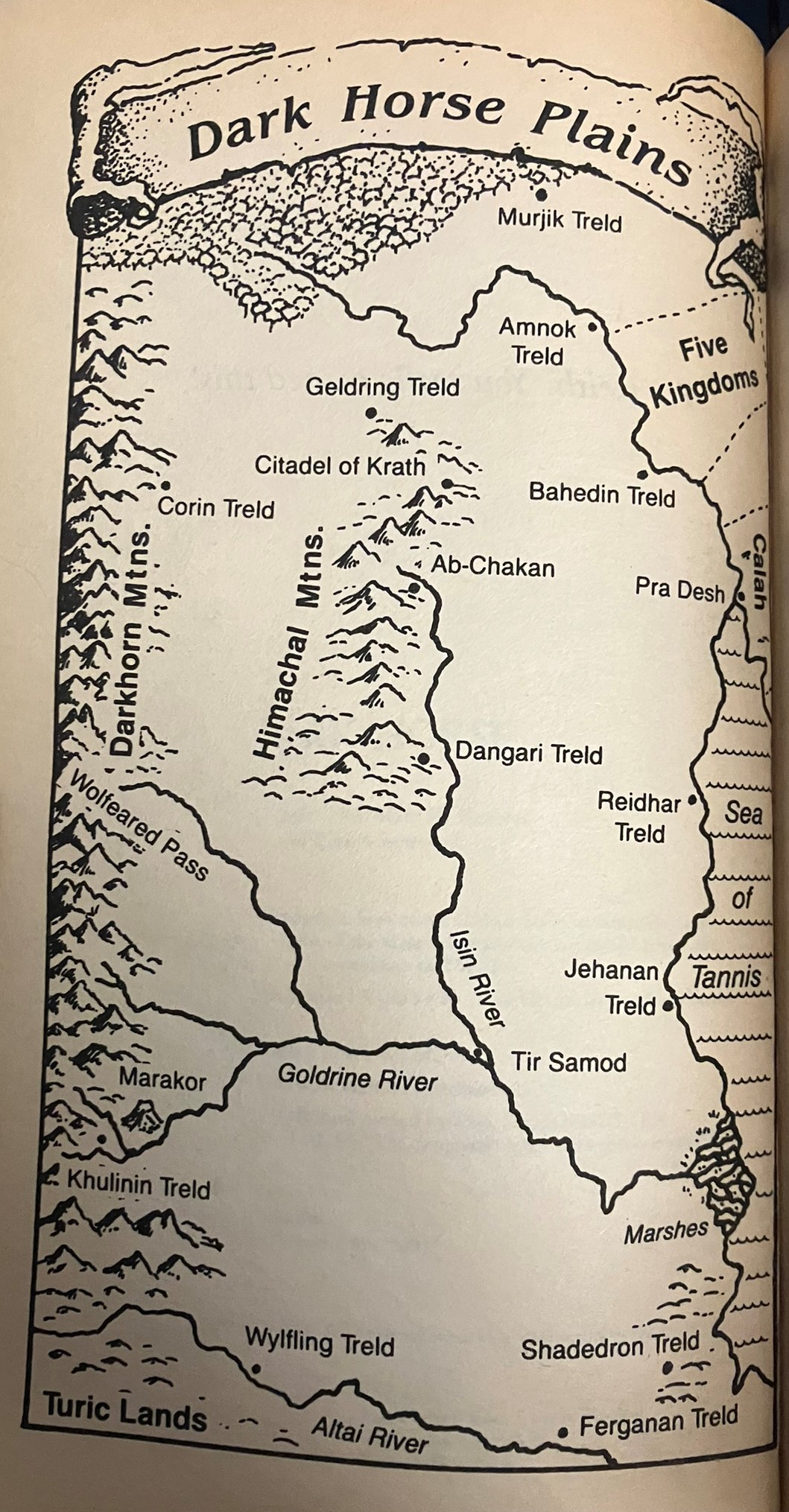
The world of Dark Horse has impressive detail and lore, and the book even includes a map of the region of interest in the story. It is clear that Herbert put a lot of thought into her tale of betrayal and battling clans. The Hunnuli, as magical intelligent horses that have their own independence and agenda, are used well to advance the story and have their own history revealed as the novel progresses. A supporting cast of humans with their own motivations and backstories fill out the world even further.
The book was apparently successful, because it became a series of five novels, with the second being Lightning’s Daughter in 1991. I think I may give it a read, as the first book was a pleasure to read. So expect more on this in the future!


 Skulls in the Stars
This is pretty neat. I don’t recall these at all.