
I have been criminally unaware of the works of Lillian Lieber until recently. Somehow, I got wind of one of her books, the extremely unconventional 1945 book The Einstein Theory of Relativity, and from the description I knew I had to read it!

The 1945 edition is in fact an expanded version of the 1936 edition, which only covered the special theory of relativity; the 1945 edition more than doubles the size of the book and includes a detailed discussion of the general theory of relativity.
There are many books on relativity, so why did I absolutely need to read this one? For two very big reasons: its style and its audience. Both of these reasons are evident in the preface to the book, which I include an image of below.

The first thing that grabs you is the style of writing, with individual words or phrases on separate lines. This looks a bit like poetry, though Lieber herself stresses that it is not free verse. In a note near the book’s beginning, she says, “Writing each phrase on a separate line — facilitates rapid reading — and everyone — is in a hurry — nowadays.”
The book also includes numerous whimsical illustrations, drawn by Lilian’s husband Hugh Gray Lieber. Some of them are very focused and get across a particular principle or idea, and others are very whimsical, like the illustration below.
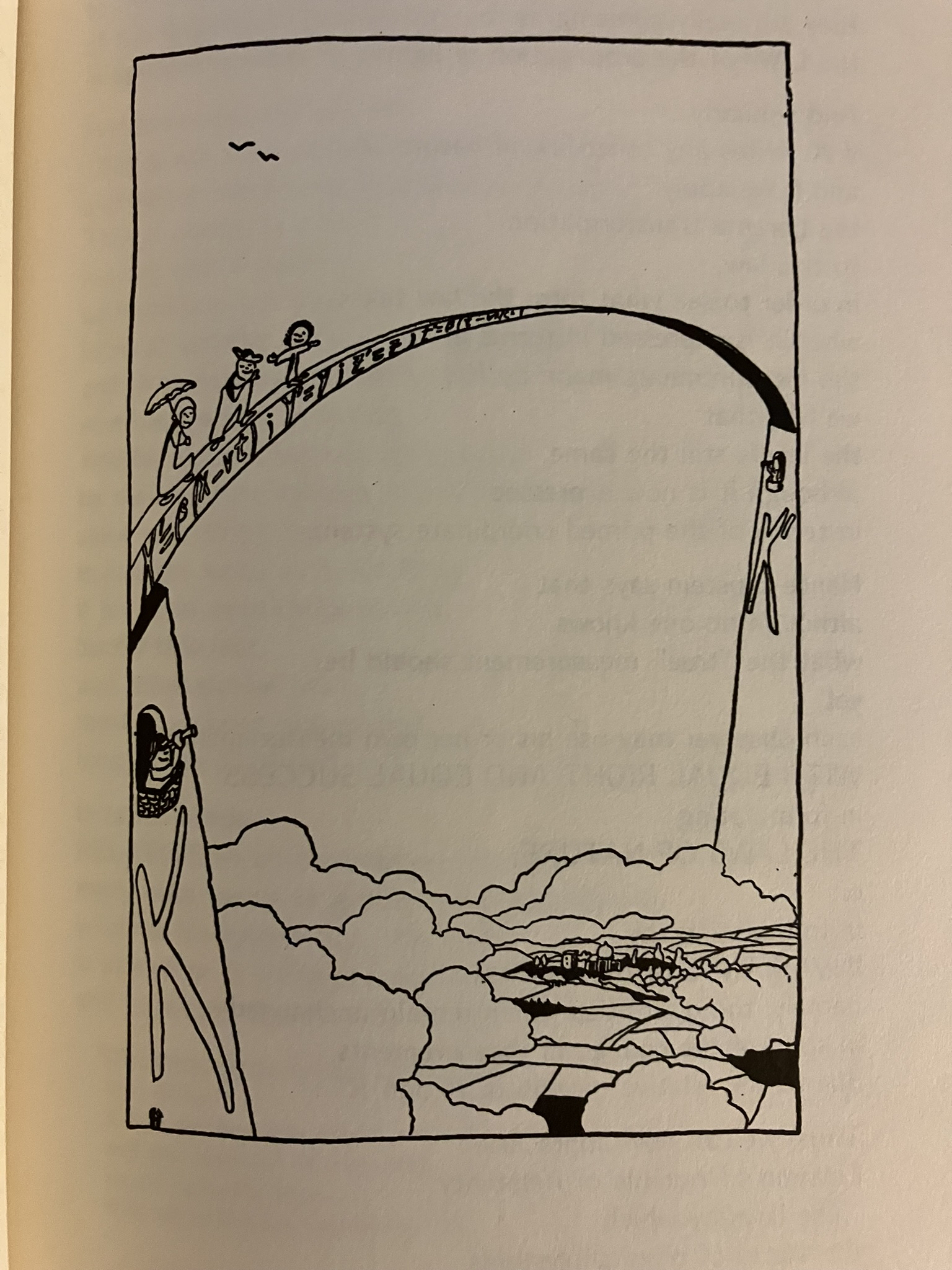
The audience of the book, as described in the preface, is also striking. Lieber notes that many discussions of relativity are done entirely without mathematics, and the only other alternative (at least at that time) were specialized text with all the mathematics. She aims for her book to fill a gap between these two extremes, and connect with an audience that wants to learn the subject a little deeper, and knows just enough mathematics to go that extra step.
This appeals to me because this has largely been my goal in my blog, as well! There are lot of very popularized discussions of physics out there, and I try to give just a little bit more detail and understanding in my posts.
There is a certain level of optimism in the book and its presentation, possibly in part due to the era it was written. The expanded edition includes a dedication “To Franklin Delano Roosevelt, who saved the world from those forces — of evil which sought to destroy — Art and Science and the very — Dignity of Man.” Coming off of victory in World War II, it must have seemed like anything could be possible, including teaching relativity theory to the masses!
Lillian Lieber (1886-1986) was a truly exceptional individual, so it makes sense that she would write an exceptional book. Born in Russia as Lillian Rosanoff, her family moved to the US in 1891. She received her A.B. from Barnard College in 1908, her M.A. from Columbia University in 1911, and a PhD in chemistry from Clark University in 1914, working under the supervision of her chemist brother Martin. She married Hugh Gray Lieber in 1926.

She worked a number of academic positions of increasing rank and significance, eventually joining the Department of Mathematics at Long Island University in 1934. She would become department chair in 1945, and a full professor in 1947. She published 17 books, a number of which were written with her unusual style. They were out of print for decades until Paul Dry Books started releasing new editions in 2007. Her books were widely praised, and her book on relativity was even praised by Albert Einstein himself!
So what did I think? I found ‘Relativity quite charming, and found a lot of her descriptions to be very enlightening. Lieber had a very good way with words and explanations, and the book is just fun! I’m not sure it is quite the next level book for people who want to learn a bit more relativity, as the math gets rather elaborate as the discussion moves into general relativity! In fact, Lieber even teaches some calculus and tensor mathematics, and the latter subject even gives physicists headaches at times!
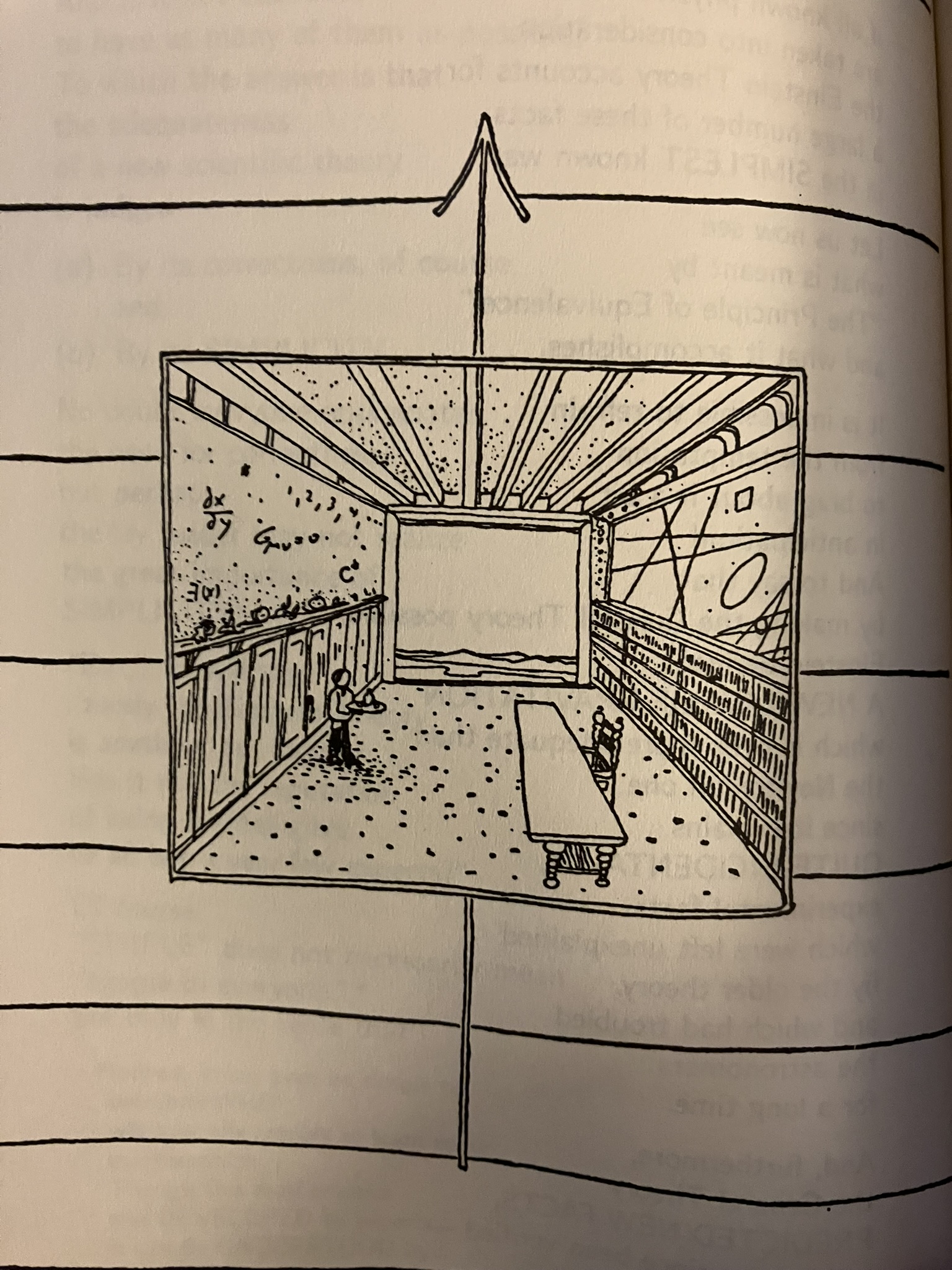
Nevertheless, if you’ve tried to read other more mathematical versions of relativity theory and found them boring or too complicated, you might want to give The Einstein Theory of Relativity a try! It is a delightful classic work of science communication and education.
Two other books of Lieber have been reprinted in recent years that I am now keen to read: The Education of T.C. MITS and Infinity: Beyond the Beyond the Beyond. The former is a book that introduces mathematical thinking into everyday life for “The Celebrated Man In The Street,” and the latter is obviously about one of my favorite subjects, the concept of infinity. I will probably be taking a look at both of these in the not-too-far future…


 Skulls in the Stars