
Day 19 of Blogtober, and I look at a favorite book that I’ve never written about before!
Folks who have read this blog for a while know that I’m a huge fan of Ramsey Campbell’s work, and have written about his latest releases as soon as I can after they come out. He is truly one of the great masters of horror fiction, and I am always a little in awe of how well he can write. I am currently finishing reading one of his more recent works, but it also occurred to me that I’ve never written about one of my favorite collections of his, Strange Things and Stranger Places (1993).
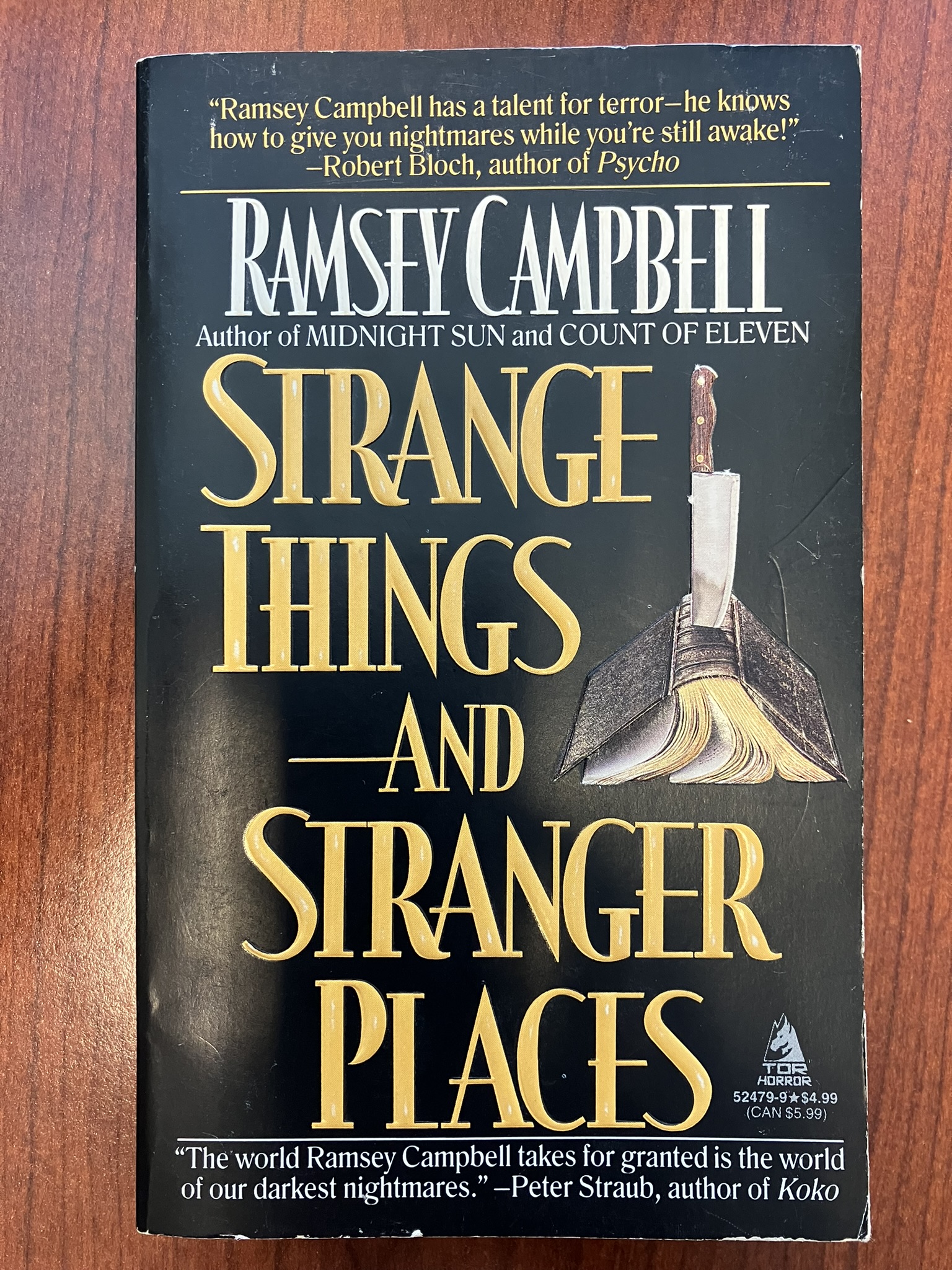
This book has a unique distinction in the list of things I’ve read: it is, to the best of my recollection, the only book that briefly made me doubt my own sanity after I finished it!
Let’s start with a few words about Campbell himself, for those not familiar. Born in Liverpool,England, in 1946, Campbell became one of many horror authors who was inspired early by the works of H.P. Lovecraft. His first published anthology, The Inhabitant of the Lake and Less Welcome Tenants, was published in 1964 by Arkham House and contained Campbell’s own spin and take on cosmic horror and the Cthulhu Mythos. (He would return to some Lovecraft style writing later, for example in The Last Revelation of Gla’aki.)
Not long after his Cthulhu compilation was published, Campbell started reading a variety of literary authors, determined to branch out and “be himself.” This culminated in the publishing of the collection Demons by Daylight in 1973, also released by Arkham House.
Demons by Daylight included one story that already highlighted a skill that Campbell would become a master at: harnessing the feeling of literal nightmares in his stories. In “The End of a Summer’s Day,” a woman goes on a cave tour with her fiancée and finds herself coming out with someone completely different. It is a story that has all the qualities of a dream and packs a huge emotional punch, and Campbell would only get better at that style of writing as his career progressed.
His first novel, The Doll Who Ate His Mother, was released in 1976, and it is a fascinating combination of supernatural and very real horrors. Since then, Campbell has been prolific, publishing horror in a variety of subgenres. He most regularly publishes supernatural horror and serial killer stories, but has also written a novel that is a curious haunted murder mystery, Ghosts Know, that I love.
Strange Things and Stranger Places came out in 1993, and it was the second collection of Campbell stories that I read, following his excellent 1991 collection Waking Nightmares. It contains eight short stories and two novellas, and includes a range of stories from Campbell’s career up to that date, including a number of obscure tales. Included is his very early 1972 story “Cat and Mouse,” featuring a very feline-haunted house, and his 1987 novella “Medusa.” That novella is one of the few forays into science fiction that Campbell has done, but is not one that stayed with me. He can definitely write really, really powerful sci-fi, however; his 1986 short story “Slow” is incredibly disturbing. It features an astronaut captured by aliens and placed into what amounts to an alien zoo; when the zoo is abandoned, however, the astronaut finds that something else, something deadly, has entered his enclosure to hunt him.
“Wrapped Up” is a story Campbell wrote inspired by the classic mummy movies and involves a collection of Egyptian tomb robbers who find that they didn’t really know what sort of tomb they were breaking into. “Rising Generation” is an unconventional zombie story about a school outing to a historic castle where their guide may not be quite alive anymore.
Three stories in this collection, however, are what really sells it for me. “Little Man” (1986) may be my favorite Campbell story of all time. The title seems to refer to the protagonist, a very short young man named Neal, who takes out his frustrations with life by going to the local arcade and plugging coins into the “murder machine,” a mechanical contraption that uses little dolls to simulate a Jack the Ripper style murderer grabbing a woman off a darkened street into a closed room. Neal finds himself increasingly obsessed with the murder machine, especially since no two runs of the machine seem to play out exactly the same. The whole idea of the murder machine is masterfully described and incredibly compelling; when reading the story, you can easily picture exactly what it must look like.
“Run Through” (1975) is a story that really highlights Campbell’s ability to harness the emotions and logic of a nightmare. Blair, frantically searching through his rural cottage for a key, finds his eyes continually drawn to the window, where he sees a figure rushing down the hill towards him. This hastens his search for the key, though he does not remember exactly why finding it is so important.
“Needing Ghosts” (1990) is the novella that practically made me go bonkers. We follow a nameless author as he awakens in his darkened house and groggily gets himself together to go into town. This may not seem like much, but this seemingly mundane day is overshadowed by increasing discomfort and dread, and it just keeps building and building as strange things of increasing frequency and intensity keep happening, building towards a horrific finale.
In this novella, Campbell’s ability to convey social discomfort and capture the essence of nightmares is on full display. Every conversation is standoffish to genuinely hostile, and exceedingly unpleasant. As far as nightmares go… have you ever had a dream where you were looking for something, think you’ve found it, but then realize the thing you are holding in your hand is something completely different? That is the sort of dream logic that punctuates the entire story.
The first time I read this, I was alone in my apartment in graduate school. I read the 90 page novella with increasing discomfort, powering through it, waiting for some release of the tension… and Campbell never gives it to you. He leaves the reader in a dark, horrible place in the end. When I finished reading this, my heart was racing and my head was spinning, and I immediately had to call a friend and talk to someone, just to calm myself down a bit. No other story has ever come close to throwing me off kilter as this one.
Strange Things and Stranger Places really cemented my love of Ramsey Campbell’s work. I’m not sure that it’s the first collection of his that I would recommend — I might suggest the 1993 compilation Alone with the Horrors as an introduction — but it is the one that really stands out to me.


 Skulls in the Stars