
Book 6 of my 26 books for 2024 goal! Way behind in reading now due to life, but working on it.
One of my big hangups in life is that I suffer from “already seen it” syndrome, as I just made up a name for it: if a story has permeated the public consciousness sufficiently and I am even familiar with a bastardized version of it, I am very unmotivated to visit the source material.
For this reason, in part, I had never gotten around to reading the novel that largely launched modern science fiction and horror, Mary Shelley’s Frankenstein. The other reason I had never gotten around to reading it is because the printed versions of it, being an old public domain novel, have largely been very cheap and disposable, and I like pretty books.
But check out this Union Square & Co. deluxe edition!
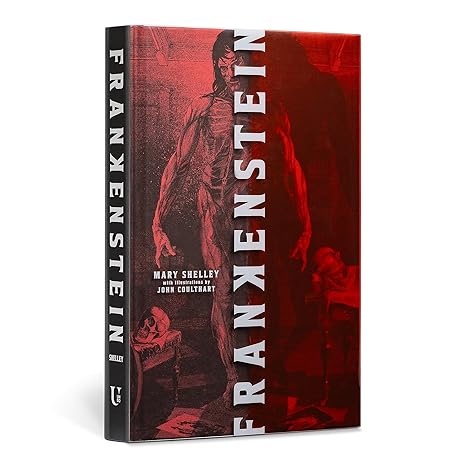
This gorgeous edition includes lovely illustrations by John Coulthart, and finally convinced me to read the book.
There probably isn’t that much I can say about such a famous, hyper-analyzed book that hasn’t been said before, so I’ll share a few of my random observations.
It’s worth noting the genesis of the story itself. Incredibly, we can credit the most powerful volcanic eruption in recorded history for Frankenstein even existing. When Mount Tambora erupted in 1815, it sent such a powerful cloud of ash into the air that it lowered global temperatures for a year, leading to 1816 being called “The Year Without a Summer.” In particular, this ruined a summer outing in Switzerland for Mary Shelley, Percy Shelley, Lord Byron and John Polidori, as stormy weather kept them indoors. The gloom caused Lord Byron to challenge his friends to write supernatural stories; Byron wrote a fragment of a story about a vampire, John Polidori finished a short story called The Vampyre, which would go on to inspire Bram Stoker’s famous novel. Mary Shelley, of course, wrote Frankenstein.
Shelley was inspired in large part by the phenomenon of galvanism, named after its Italian discoverer Luigi Galvani, who in 1791 first published work showing that muscles of dead creatures could be seemingly reanimated with electricity. This had led many to speculate on whether electricity could bring the dead to life, and this was a topic at the Switzerland summer outing. From this, a legend was born.
From the book itself, the most immediate thing that jumped out at me as a reader is how different the story is from the film versions I grew up with. I watched Sunday morning “Creature Features” on television, and the 1931 movie Frankenstein is one I saw many times. In the movie, “Henry” Frankenstein is a near-maniacal scientist living in a remote castle with his hunchback assistant, obsessed with creating life. The creature he does create is child-like and simple, and “Henry” works with it, until a series of cruel misunderstandings send it on a deadly rampage. By the end of the movie, the monster has been burned to death and Henry gets happily married.
In the novel, Victor Frankenstein works alone on his creature in a laboratory in the city, his obsession a distraction from the grief of losing his mother. When he finds his plan has succeeded, and his creation has come to life, he flees from it in terror. The Creature itself is quite intelligent, and has an immediate resentment of its creator for abandoning it, and after being shunned by society, it seeks revenge upon Frankenstein for imbuing it with life. It causes the death of many of the people closest to Victor, finally attempting to extort him into creating a mate for it so it does not have to live alone. Victor refuses, his bride is killed, and this leads to a vengeful pursuit to the very ends of the Earth.
It is interesting to see how many of the powerful ideas of the novel that were not implemented in the original movie were taken up in its sequel, Bride of Frankenstein. The very idea of the Creature demanding a mate to assuage its loneliness comes from the novel, as does the famous scene of the monster meeting and befriending a blind person, the only one who will not run from it in fear.
Small details of the novel have clearly inspired other remarkable stories. Victor Frankenstein’s fear that the Creature and a Bride could breed and take over the world with their monstrous brood seems to be part of the inspiration for Richard Sala’s The Hidden, that I reviewed ages ago on this blog.
The structure of the novel itself is quite fascinating and unconventional, and probably an indication of the author’s (at that time) novice writing skills. We begin with the account of a ship captain attempting to navigate the treacherous Northwest Passage when he views a monstrous creature in the distance and later rescues a man, Victor, in pursuit of it. From there, we get Victor’s account of his misery, up to the point where the Creature makes Victor its proposal, at which point we get the Creature’s narrative. We finally get the tragic end of the story from Victor again, which leads him to pursue the Creature even into the frozen north for revenge, and the book ends with the death of Victor and the Captain’s closing observations.
We often hear people mistakenly refer to the Monster as “Frankenstein,” which is usually followed by “no, Frankenstein is the name of the scientist,” followed smugly by “actually, Victor Frankenstein is the monster!” In the book, things are not so clear to me, though again that may be in part due to the inexperience of the author. Clearly, Victor’s original sin, so to speak, is the abandoning of his creation. However, the Creature becomes a malevolent force itself, murdering innocents in its quest for revenge. Overall, the novel feels like a story of loneliness and obsession to me, with perhaps some reflections on the conflicts in families between parents and children.
Overall, it was a fun and fascinating read! Now, maybe I should get around to reading Dracula…


 Skulls in the Stars