
Book 18 of 26 books for 2024! Maybe I’ll make at least 22…
Valancourt Books has been doing a great literary service by reprinting “Paperbacks from Hell” such as Carnosaur, and I’ve been reading as many of them as I can reasonable handle. One that I picked up some time ago and had not yet gotten around to is Gwen in Green, by Hugh Zachary, first published in 1974.
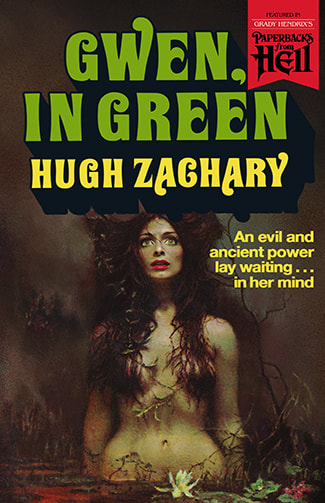
As they often do, Valancourt also used the original cover art for the book, which is actually pretty accurate and telling about the novel itself!
Gwen and George seem to have the perfect life. After receiving a large insurance settlement, they buy a wooded island off the coast of North Carolina where they can build their dream house and enjoy their time together. Gwen, who has struggled with intimacy since traumatic experiences in her childhood, even finds herself relaxing and becoming closer to her patient husband. The only downside — though it allowed them to buy the property for cheap in the first place — is the nuclear power plant being built across the water. All estimates indicate that it will pose no danger to their health and well-being.
But soon Gwen starts to change even further. She becomes even more passionate, even sexually insatiable, and develops an obsession with the local plant life. For the most part, this is actually a net positive for George, but then people start to go missing at the nuclear plant construction site. And Gwen herself spends more and more time in the clear pond outside their house, sinking her feet into the vegetation that covers its bottom (see the cover image). Are her changes natural, or has Gwen come under the influence of a sinister force?
Gwen in Green has been labeled an eco-horror novel, and for good reason. Gwen becomes a ruthless and violent advocate for the plant life of her area, willing to go to any lengths to protect it. This includes a significant amount of sex, though the novel for the most part does not dwell on or provide lurid details of sexual acts; those details provided are in service of the plot, making Gwen a femme fatale. This is not just a simple story of a women willing to commit violence: there is a sinister and strange power influencing Gwen throughout the book and all is revealed by the story’s end.
Those reading the book will probably be struck by the strong similarity between Gwen and DC’s famous villain Poison Ivy, who first appeared in comics in 1966. One might wonder if one character influenced another — if Ivy influenced the creation of Gwen, or Gwen further influenced the development of Ivy in later stories. It seems, however, that both characters arose independently from the zeitgeist of the era. As noted in the introduction by Will Errickson, Zachary was inspired by the joint and growing influences of feminism and environmentalism in the era he wrote the book, and it seems entirely reasonable that those same influences led to Poison Ivy. (Zachary was also motivated by the real-life construction of a nuclear plant in his vicinity, which gave him some negative feelings very much like Gwen.)
The book is a curiously slow burn. The first 50 pages almost entirely focus on setting up the backstories of Gwen and George and their growing happiness as they settle into a life on the island. When things start to change, it is an abrupt (and deliberate on the part of the author) shock to the reader. From that point on, the atrocities and horrors increase up to the final revelations of the novel, which I found weird and satisfying enough to justify the read. It is also a quite fast read — I finished the book within 24 hours, and it is less than 200 pages.
Overall, Gwen in Green is an intriguing novel that I had a good time reading, and it kept me guessing until the very end. It is well-written and I am happy that Valancourt took the time to reprint it.
PS one bit of trivia that I hadn’t known going into this book — did you know that Venus flytraps are only native to the wetlands of North and South Carolina?


 Skulls in the Stars