
Book 13 for my 2025 goal of 30 books for the year!
A few weeks ago I visited some friends in Rochester and, as always, that was a good opportunity to play some boardgames and snoop around on their bookshelves for reading inspiration. One that caught my attention is the classic novel Prince of Annwn (1974), by Evangeline Walton.
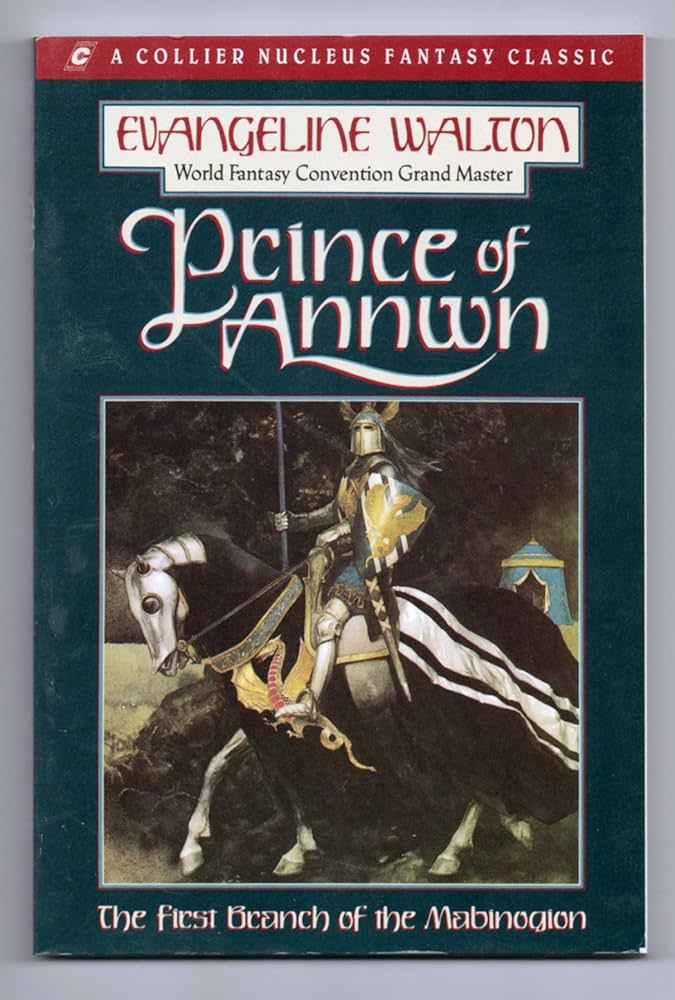
This fantasy novel is technically the first book in the “Mabinogion Tetralogy,” a series of four novels inspired by the ancient Welsh Mabinogion stories that were first compiled from oral traditions around the 12th century. I say “technically” because story-wise it is chronologically the earliest story in the series, though it is in fact the last novel that was published of the four. In what feels very George Lucas-y, he first published book in the series, The Island of the Mighty (1936), is the last story chronologically in the series. This original book did not sell well at the time, and so the others were not published until decades later.
The novel is centered around Prince Pwyll of Dyved and the challenges he encounters after he meets Arawn, Lord Death, the ruler of the underworld Annwn. Death has tricked Pwyll into an encounter in the forest and asks for his help: Arawn is soon to face off against another lord of death named Havgan, and because of a mistake that Arawn made when he was victorious in their first encounter, he is fated to lose the second. He asks for Pwyll to trade places with him for one year: Pwyll will become the Lord of Annwn, wearing Arawn’s face, and Arawn will wear Pwyll’s face and fill in his role as the Lord of Dyved. The lord of death Havgan is a cruel god of the Eastern religions, and if he wins the battle he will bring intense suffering and mass death to the land. In the face of this threat, Pwyll agrees to fight on Arawn’s behalf, but before he can make the battle he must first journey to Arawn’s palace, and there are many horrors waiting to claim him in the land of the dead…
The first half of the novel is called “Descent into the Abyss” and focuses on Pwyll’s journey into the underworld and his inevitable clash with Havgan. But his challenges are not only martial. In exchange for Pwyll’s aid, Arawn has offered up the temporary use of all that Arawn controls, which includes the offer to bed Arawn’s beautiful otherwordly wife.
The second half of the novel is “Rhiannon of the Birds,” and tells the story of how Pwyll journeys back into supernatural realms to find his beloved and make her his wife. Though his land prospers for years on his first return from the land of the dead, it eventually suffers from poor weather and a poor harvest, and the druids lay the blame at Pwyll’s feet and the fact that he has not yet taken a wife. In response, Pwyll goes off to a sacred place to be judged by supernatural forces, and there remembers that he had met a woman of unearthly beauty during his previous adventure who had promised to marry him. Following her instructions, he plans an expedition to find her. However, he is not only threatened by forces in the supernatural realm, but also by the scheming druids who advise him.
So… what can we say about this novel? First of all… it is incredibly randy. Presumably this is drawn from the original source material, but I was shocked at how much sex was involved in the story. This not only includes the custom of letting noble visitors sleep with your wife, but also the ruler’s prerogative to have sex with every woman before her husband on her wedding night. Also, and I shudder to mention it, the druid’s insistence that the ruler must have sex with a horse to ensure the stability of the kingdom. As I said, this is probably drawn from the source material, but it still made me go “whoa.”
Also likely due to the source material: the logic of the stories is strange and often seems contradictory and nonsensical. Characters losing their memory for no reason at all, other characters agreeing to fulfill a trick request after they themselves had fallen for a similar trick request, and just lots of odd notions that come out of nowhere and return to nowhere just as quickly. This did not really hinder my enjoyment of the book, but it is worth mentioning.
The strangeness of the story does work in its favor. The whole thing plays out like an extended dream, and in fact much of it takes place within a dream, so if the reader accepts the dream logic, it plays out like a very odd adventure story. There are a number of quite thrilling action sequences, most notably a nightmare chase through a forest in which Pwyll is pursued by a gigantic monster that he cannot hope to outrun forever.
One fascinating aspect of the novel that is not from the source material: allusions to the future, and to modern society. Though it is not said explicitly, it is quite clear that Pwyll’s fight against Havgan is a fight against the encroachment of Christianity into the Western world. This advance is seen as inevitable, but if Havgan wins in the short-term, the conquest will be much more bloody and cruel. The druids also talk later of visions of the inevitable modern world and its technology, which is part of their justification for betraying Pwyll. These aren’t really big moments in the book, but I found them an intriguing take on traditional tales of fate and prophecy.
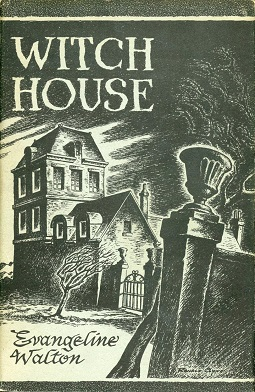
Overall, I found Prince of Annwn to be a fun, albeit somewhat baffling, read. I haven’t quite decided whether I want to read the other books in the series — the disjointed order of the books makes me a bit hesitant. There is one book, however, by Evangeline Walton that I have and I still want to read: the 1945 haunted house story Witch House!


 Skulls in the Stars