
Book 6 for my 2026 goal of 36 books for the year! Running a little behind but should be able to make it up pretty easily. As usual, my link to the book is through my bookshop.org affiliate account, which means I may earn a small commission if you buy from there.
Ramsey Campbell has long been acknowledged as one of the masters of horror fiction and is probably my favorite horror author of all time. Flame Tree Press has been publishing his new novels for a while now and have started reprinting some of his classic books, and they sent me a complimentary copy of the most recent reprint, Incarnate, which was first published in 1983.
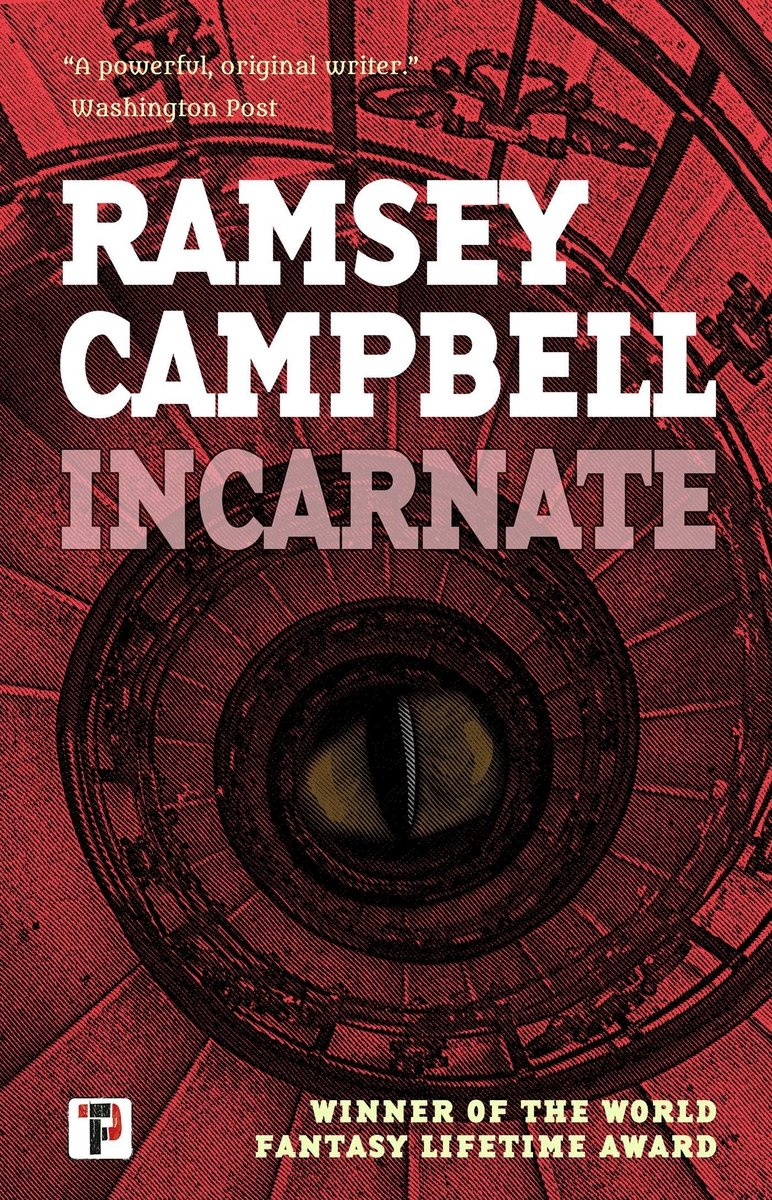
This was a double happy surprise for me — not only am I always happy to get a complimentary copy of a book by a favorite author, but once I started reading it I realized that I somehow had never read Incarnate before! (This in itself is not surprising, because Campbell has such an extensive bibliography it’s easy to miss a book if you haven’t been systematic about it.)
Incarnate is a fascinating, compelling, intricate book and one that stands out from a lot of Campbell’s other novels in ways that I will elaborate on below!
The story: when five people take part in a scientific study of precognitive dreaming, the experiment ends in terror and near insanity for the participants. Now, eleven years later, those test subjects have moved on with their lives and have largely forgotten what they saw in the nightmare they shared together and have consciously or unconsciously tried to avoid dreaming at all.
But then each of them receives a letter from one of the research assistants on the original project, asking if they have experienced any side effects since then. All of them try to ignore the letter, but nevertheless find their paths crossing far too often to be purely coincidental. Their collective dream all those years ago cracked the door open for something monstrous to slip through, and now that entity is working to assemble the group to throw the door open wide to rewrite reality itself. It falls largely on Molly Wolfe, one of the original participants, to try to stop this catastrophe before it happens. But considering their precognitive dreams always seem to come true, is it even possible to change their fate?
I found Incarnate to be a lot of fun and really intriguing! In my experience, most of Campbell’s novels focus on the viewpoint of one or two characters, but in Incarnate we get the perspectives of each of the original test subjects — and a few other involved figures — intertwined throughout the book as their paths are manipulated to bring them together. We get to experience the lives of each of them, and each has their own distinct story. The principal protagonist is Molly Wolfe, who works as a production assistant for television news, but we also get to see the very different lives of the others. We meet Danny Swain, who works as a projectionist at a declining theater and was driven to paranoid delusions by the original experiment. We meet Joyce Churchill, an older woman who runs a care home for seniors that is under threat of being shut down by developers. We meet Susan, the young daughter of one of the experiment participants, who gets drawn into the horrors as a tool of the entity trying to control them all. Each of the characters has a compelling subplot involving their own lives, and I found myself invested in their stories. Molly Wolfe gets involved in a news story about police brutality, a topic that is still very relevant and topical today.
Campbell does a remarkable job of tying all of these threads together. A lot of the fun for me was the slow recognition of how each character was being manipulated and how they were as a group being pulled together. It cannot be easy to manage all of these elements and make them into a coherent plot, but it worked very well for me.
Another way that Incarnate stood out to me was in its subject matter. Campbell got his start writing cosmic horror of the Lovecraft style and has written a lot of supernatural horror both in and out of that cosmic style. Incarnate, however, felt to me as something rather distinct. Campbell sets up a world where the boundary between dreams and reality is dangerously fluid, and the rough explanations of how it all works makes the story feel like it dances a little bit into the realm of science fiction. Nothing is ever fully explained — that would take away the horror — but it presents a lot of fun ideas to chew over. In a way, it reminds me of the much more recent Southern Reach Trilogy by Jeff VanderMeer, where characters are trying to comprehend just enough of the truly unfathomable in order to survive. The work is still partly inspired by Lovecraft’s Dreamlands, which are quoted in the book’s epigraph, but Campbell constructs his own intriguing universe of dreaming and reality.
I should note that Campbell has always been one of the few authors I’ve seen that can truly capture the spirit and illogical logic of a nightmare. Many of his short stories are completely unnerving because they set up situations that make no sense but will nevertheless feel familiar to anyone who has ever dreamed. (His short stories “Run Through” and “End of a Summer’s Day” and his novella “Needing Ghosts” are my favorite examples of this.) Incarnate is a full-length realization of that feeling of a bad dream set to a page.
I had a great time reading Incarnate and am happy to see Flame Tree Press releasing Campbell’s earlier work for a modern audience — I look forward to seeing what they unlock from the vault next!


 Skulls in the Stars