
So I’m now known as the falling cat physics guy, thanks to writing a popular science book on the history of scientists studying how cats land on their feet (“cat turning”) that you may or may not have heard of! Recently, Michael Marshall at New Scientist reached out to me to talk about a relatively new paper on the falling cat problem that looks at the falling cat problem from an interesting new perspective. Though it’s behind a subscription, here’s the link to the article that he wrote about the research.
The work, that was done by researchers at Yamaguchi University in Japan and published in February of 2026, looked at the flexibility of the spine of cats in order to assess the significance of different possible mechanisms for falling cat motion. Both the research approach and the conclusions were quite insightful to me, so I thought I would talk about it a bit here!
(Note: as far as I can tell, no animals were harmed to make this work happen, but the results are nevertheless kinda grisly, so fair warning.)
Before discussing the work, let’s briefly review some falling cat models. Research on falling cats really kicked off in 1894, when French physiologist Étienne-Jules Marey presented high-speed photographs of a falling cat landing on its feet, shocking the establishment at the time that assumed that it was simply not possible for a cat in freefall, with no net rotation, to turn over.

The crux of the misconception was the an oversimplified view of conservation of angular momentum, in which a twist in one direction must be balanced by a counter-twist in the opposite direction. In this thinking, a cat that falls without any starting rotation cannot turn over because any attempt to twist its body would be balanced by a counter-twist keeping it in place.
But cats are not rigid bodies, and they can bend and manipulate their limbs in clever ways to balance the twist and counter-twist in a way where they can turn over! (What follows are draft figures I made in preparation for my book; the book versions are much nicer.)
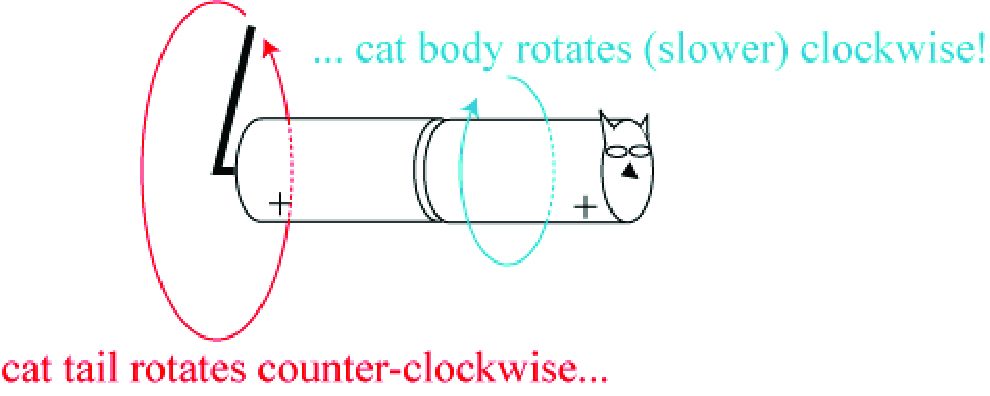
One method suggested is what I call “propeller tail”: a cat spins its tail in one direction, which will cause its body to counter-rotate. After enough propeller tail, the cat’s body will end up right-side up. A cat can use its tail to help rotation, but it has been shown that tailless cats flip over just fine, so this is not a main component of cat-turning.
The earliest suggestion, by Marey, is that a cat successively extends and retracts limbs, in what is called “tuck and turn.”
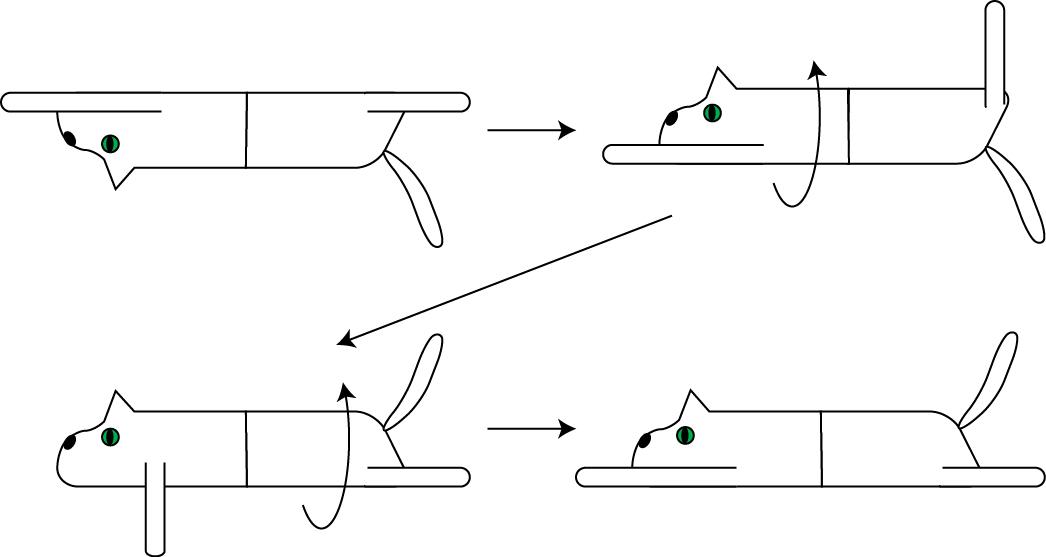
The idea: the cat tucks in its front paws, stretches out its back paws, and then rotates its upper body to the right position. The amount of rotation of an object is reduced the larger its moment of inertia; the moment of inertia is larger for objects with mass further away from the axis of rotation. So in the first position, the cat’s upper body will rotate much more than the lower body, or the cat as a whole, can counter-rotate. Then it reverses the process: it sticks out its front paws, tucks in its rear paws, and rotates the back part of its body. Because the front paws are out, the front part will again counter-rotate less. If this is done well, the cat ends up right-side up.
The third method, first introduced by Dutch physiologists Rademaker and ter Braak in the 1920s, is now known as “bend and twist.” The cat bends at the waist and twists the upper and lower halves of its body in opposite senses; in essence, the two halves are providing the counter-twist for each other. After twisting 180 degrees, the cat can unbend and it will be right-side up.
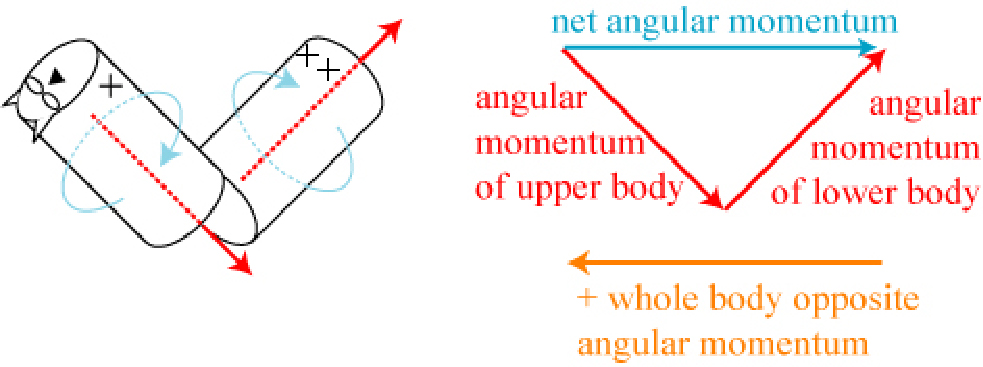
In Falling Felines and Fundamental Physics, I note that cats likely use all of these motions in combination, along with other subtler motions that we haven’t noticed, in order to turn over as quickly as possible. Nature is concerned with the most effective solution to the problem, which can throw off physicists who are often looking for the simplest solution. However, my impression has always been that “bend and twist” is more important than “tuck and turn.”
The new research has made me reevaluate the importance of “tuck and turn,” and consider it as a bigger deal than I thought!
Here’s where we get to the methodology of the recent paper. The researchers were given donations of five domestic cat cadavers and removed the spines of the cadavers with the ligaments and spinal discs still intact. The spine consists of three regions: the cervical (neck), the thoracic (upper), and lumbar (lower). They removed the cervical and separated the thoracic from the lumbar sections, and performed what amount to twisting stress tests on these sections. My crude illustration of their illustration is shown below.
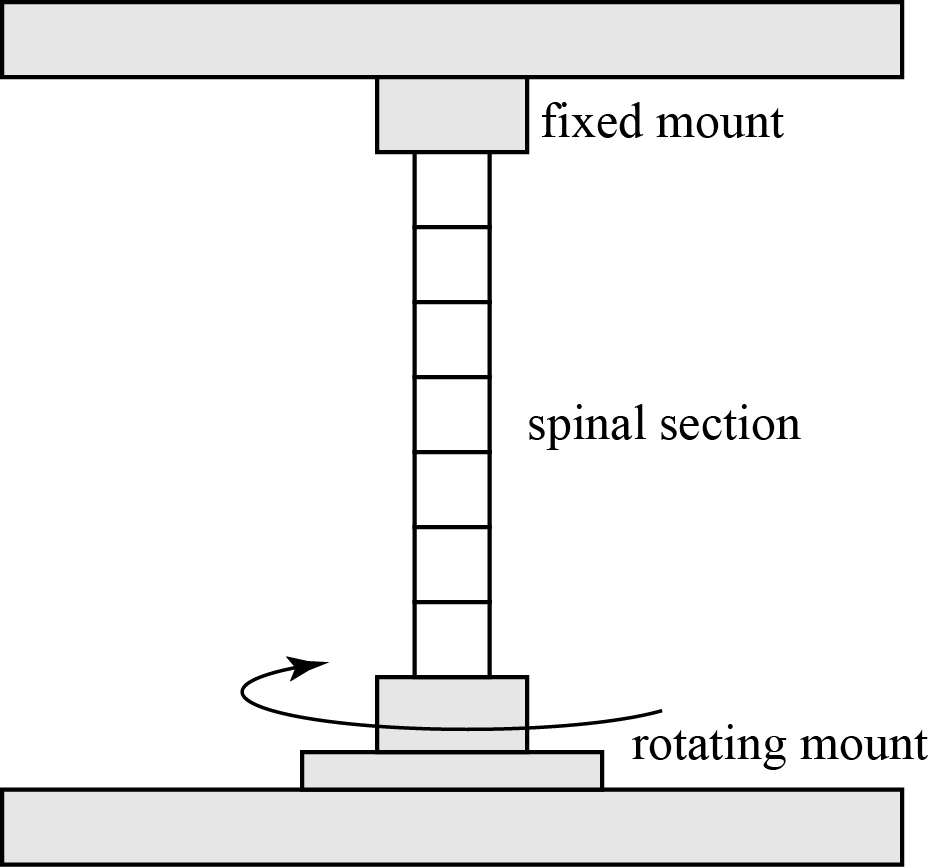
Basically, they fixed the spine sections in a device where they could twist them and see how far they twist and how much force it takes to twist them! They found that the upper (thoracic) section of the spine is not only much more twistable, but that it has a neutral zone of about 50 degrees of twisting, meaning that there is no resistance to the twist for a large range; the lumbar section of the spin was much less twistable and possesses no neutral zone at all.
Why is this significant? This is relevant to the importance of the “tuck and turn” model of cat turning, which suggests that a cat twists its upper body over first and then its lower body follows. The flexibility of the upper part of the spine strongly supports this perception that the cat turns to get its head right side up first and indicates that its biology is even tailored to make this as easy as possible!
The researchers also dropped a couple of cats and took high-speed photographs of them; let me share one particular image for its insightfulness and also just for amusement.
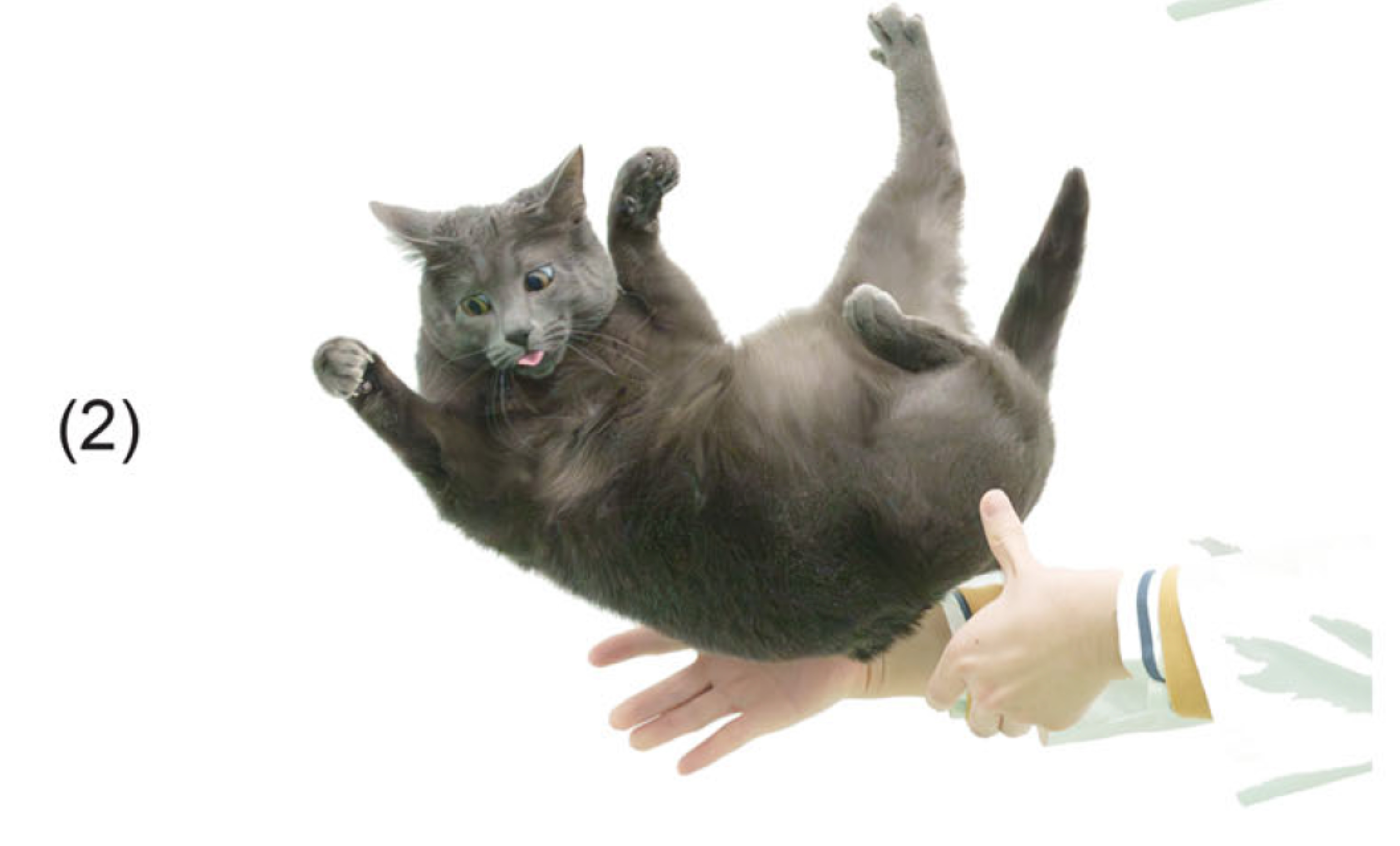
That tongue! Anyway, this image shows a couple of interesting things. First, you can see the sideways kink in the waist that is characteristic of a “bend and twist” approach, but you can also see that one of the cat’s rear legs is greatly extended, while its front paws are tucked in, which is characteristic of “tuck and turn.” Looking back at Marey’s original images, you can also see this single leg extension in his sequence of photos. Overall, one can really see both mechanisms playing a role here, and it gives me a greater appreciation for “tuck and turn.”
Thinking about that leg extension a little more, though, it occurs to me that this may be yet another small tool in the cat’s flipping arsenal! One rear leg is extended, while the other is tucked in. This motion, done suddenly, would also provide an initial rotation of the rear of the body in the direction the cat wants to turn. For me, this paper has revealed a little more of a cat’s rotational secrets.
Part of the reason the problem is so difficult to analyze is that almost all the photo sequences taken are from a single angle at a time. It would be really nice in the future to see someone take a multi-angle sequence that could be converted into a 3-D model; I suspect we might learn even more about how a cat performs its twist.
There is one other intriguing observation in the paper that, coincidentally, I was asked about by a cadet at The Citadel in Charleston a few weeks ago when I was giving a falling cat talk! That cadet noted that in all the photos of falling cats I had shared, the cats turned to the right, which is something I had never noticed before. The researchers at Yamaguchi noted that, of the two cats they dropped, one turned to the right eight out of eight times, while the other went right six out of eight times! Apparently there is some natural tendency for cats to twist right, even though they clearly can go both ways. My best guess at this point is that some asymmetric placement of internal organs may make it just a little easier to go one way than another.
So falling feline physics still continues to provide interesting insights! Considering that the first paper on the subject came out in the year 1700, when Isaac Newton was still alive, that means there is a 325 year history of scientists studying falling cats!
*****************************************************
Higurashi, Y., Kaino, Y., Habara, M., Okamoto, S., Yoshizaki, K., Sakurai, M., & Morimoto, M. (2026). Torsional flexibility of the thoracic spine is superior to that of the lumbar spine in cats: Implications for the falling cat problem. The Anatomical Record, 1–10.


 Skulls in the Stars