
The fiction that I read and discuss on this blog falls under the broad but relatively unknown category of “weird fiction”, which can include fantasy, sci-fi and horror as well as plenty of stories that are genuinely unclassifiable. Most of these tales involve some element of the fantastic — the supernatural, impossible technologies, and so forth — but it is certainly not a prerequisite, at least in my mind. Plenty of stories are stunningly “weird”, even “bizarre”, without having a single alien or sparkly vampire.
With this in mind, I recently acquired and read Thomas Berger’s 1980 novel, Neighbors:
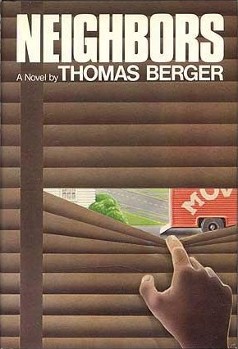
I have known about the book for a long time thanks to the movie version that came out in 1981 starring John Belushi and Dan Aykroyd; it was Belushi’s last film before his untimely death in 1982. Never heard of the film? It is still relatively obscure; it got mixed reviews on release, and seems to have faded quickly from the public’s conscience — there hasn’t even been a DVD release.
I’ll say some words about the movie version at the end of the post, but I wanted to share my thoughts on Berger’s book, which I can best describe as a genuinely unnerving story of suburban paranoia.
Middle-aged suburbanite Earl Keese lives in a nice suburban home on a lonely dead-end road with his wife Enid. He has a predictable routine: go to work in the city, come home to dinner with the wife, relax, repeat. Then one evening a couple moves into the house next door, the only other house on the road. The new neighbors, Harry and Ramona, are not your ordinary suburban residents. From the moment of introductions, their bizarre behavior catches Earl off-guard, and soon he finds himself in a war with them, even as he welcomes them to the neighborhood and attempts to be neighborly. Over the course of a single night, Harry and Ramona will challenge Earl’s carefully structured existence, and threaten to tear it down — would that be such a bad thing, though?
The novel is very dark comedy. Harry and Ramona are completely unpredictable, even bipolar — they have no sense of social conventions, and switch from friendly and flirtatious to threatening and condescending in an instant. Provoked by them, however, Earl finds himself matching them in madness, and many hijinx ensue. The novel contains fistfights, property damage, seduction, heart-to-heart conversations and even gunfire!
Paranoia resonates throughout the story. Earl finds in the course of the evening that his other friends, his daughter, and even his wife are not the steadfast allies he thought they were and are even as unpredictable as the new neighbors: supportive one moment, disparaging the next, even on the same topic! Earl’s story feels very much like a metaphorical train speeding along much too fast, threatening at every moment to come off the rails.
Oddly, though, I find the story a positive one, though to explain what I mean by that would give away too much. The novel is absolutely fascinating, though it can feel much of the time like hearing nails on a chalkboard!
As I said, the book was made into a 1981 movie starring John Belushi as Earl and Dan Aykroyd as Harry, renamed “Vic”.
The movie seems to be relatively unloved; it has a 5.2/10 rating on imdb.com as of this writing. Roger Ebert’s 1981 review of the film is much more forgiving — he referred to Neighbors as “a truly interesting comedy, an offbeat experiment in hallucinatory black humor. It grows on you.”
I wholeheartedly agree with Ebert. I find the movie to be bizarrely compelling, and have felt so since I first saw it probably over 20 years ago. The casting of Belushi and Aykroyd is very ingenious, especially since they more or less reversed the roles they were traditionally known for at the time. Belushi, the crazy guy, ends up playing the most straight-laced Earl Keese, while Aykroyd, the straight man, is the off-beat weirdo Harry/Vic.
I personally found the movie surprisingly faithful to the book, though many of the specific events are different. The movie has a deliberately goofy, sitcom-like soundtrack that I suspect irritates a lot of viewers but works just fine for me. The book is much darker overall, and “Harry” is much more menacing than the rather oafish “Vic”. The biggest departure, however, arises in what is essentially the last few pages of the book, and gives the movie a more positive tone than the book.
So would I recommend the book and/or the movie? Personally, I would give a qualified “yes” on both. They’re definitely not for everyone — lots of people don’t have the stomach for the sort of subtle insanity that is portrayed.


 Skulls in the Stars
Yes, there is a DVD release. I have a copy.
Are there any deleted scenes?
Neighbors is an entertaining movie, although Bill Murray might have been better as Vic because he would have been more threatening and challenged Belushi more.Aykroyd was funny and entertaining,but you knew he was never a real threat to Belushi because he was a lovable lug.Murray was the one guy on SNL who could challenge Belushi and keep him on his toes without getting him so pissed off he couldn’t see straight like the snobby,preppy Chevy Chase.Murray might have gotten Belushi so challenged he might have been better able to get past his awkwardness,which brings me to another major problem.Aykroyd is having a great time but Belushi clearly isn’t,because as much as he wanted to prove there was more to him than Bluto, he was so nervous and awkward whenever he was against type that it didn’t work.Continental Divide didn’t work ultimately because for one thing the writer couldn’t come up with an ending, and second,Belushi was insecure enough with women and in love scenes as it was but they paired him with a boring,intellectually superior,humorless woman with very little sex appeal who you never believe would ever be attracted to him anyway,when what he needed to bring out his interleading man was a gentler sweeter type of woman whom he could feel protective and strong around.
When Belushi played Bluto or a Bluto-type he was in control of the elements around them or he was disrupting them so much he controlled them because nobody else could, but when he played against type he was so insecure and uncertain that he was never quite able to pull it off and inevitably he would use cocaine as his crutch.
Another problem was Belushi’s dissatisfaction with the director and Larry Gilbert’s dissatisfaction with him which led inevitably to the crutch of cocaine.It also didn’t help that Belushi went behind the director’s back to try to get him replaced and that the filmmakers rejected Belushi’s idea of putting his punk group buddies Fear on the soundtrack,particularly after they sparked a riot when he got them a gig playing as a musical guest on Saturday Night Live.The conflicts led to Belushi’s unfortunate cocaine relapse and inevitable end. The movie is still fun to watch though.
I think John Candy might have been better as Vic though because he didn’t have John Belushi’s deep-seated insecurity and could better have let the character breath opposite either Aykroyd or Murray as Vic.
.