
Book 1 of my new modest goal of reading and blogging about 26 books this year! This one is a little bit of a cheat, as I read much of it near the end of last year, but I finished reading it for my book club this year, so I’m counting it!
A few months ago, I finally completed my long-delayed series of posts explaining quantum entanglement, and Part 7 was all about the question, “What does it all mean?” For the purpose of interpreting and predicting experimental results, quantum physics as it is currently interpreted (in what is known as the Copenhagen interpretation) works really, really well; however, from a logical and philosophical point of view, it seems filled with contradictions.
To get around these contradictions, numerous researchers have come up with different ways to interpret quantum physics, and one of those interpretations is known as relational quantum physics, as first introduced by the Italian theoretical physicist Carlo Rovelli in 1994 and published in a peer-reviewed journal in 1996 [1].
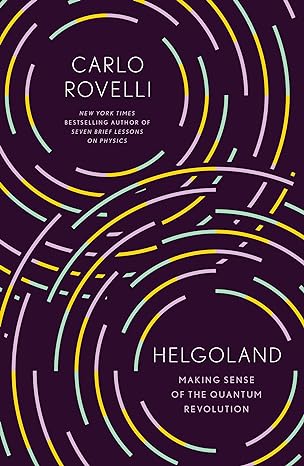
Several years ago, Rovelli wrote a popular account of the concepts of relational quantum physics, titled Helgoland (2020), and I was intrigued to learn more.
I must admit that I was deeply skeptical of relational quantum mechanics when I first heard of it, but a combination of reading Rovelli’s book and some of the research papers on the subject have made the ideas seem much more compelling, at least in a broad sense!
So “Helgoland” of the title refers to an archipelago in the North Sea that has a unique part in physics history: it is the location where Werner Heisenberg first formulated his view of quantum physics, a distinct view from Erwin Schrödinger’s approach that would be formulated soon after and would come to dominate the physics conversation. Heisenberg ended up on the island for the most mundane of reasons: pollen allergies. He took the retreat to the treeless Helgoland in the summer of 1925 to get a respite from his symptoms.
So to give some context for Rovelli’s book, let’s say a few words about the “Schrödinger picture” of quantum mechanics and the Copenhagen interpretation associated with it. In the Schrödinger picture, every particle has a wave associated with it, and this wave can interfere with itself and travels through space in accordance to Schrödinger’s wave equation.
But what is this wave, and why don’t we see it? According to the conventional Copenhagen interpretation, this wave characterizes the probability of finding the particle at any particular point in space (or the probability of finding some internal parameter of the wave, like spin, in a particular state). But when we actually measure the position of the particle, it “chooses” one of the possibilities allowed by the wave, and the wave “collapses” into a wave at the definite position at which it is measured. Then that collapsed wave can evolve again, until it is measured again, and on and on. An important aspect of this interpretation is that the particle is not in any definite state until it is measured — quantum physics in this view is inherently indeterministic.
This interpretation is known as the Copenhagen interpretation because Niels Bohr and Werner Heisenberg cobbled together this view of quantum physics, building on the work of others, while working together in Copenhagen in the 1920s. “Cobbled” is the right word here: physicists were faced with an extremely baffling set of experimental observations and Bohr and Heisenberg did the best they could with what was known at the time to create a physical model that agreed with the observations.
But the Copenhagen interpretation starts to give trouble as soon as one looks at it in detail. A particle is in an indeterminate state until an “observer” performs a “measurement” of it. But what constitutes an “observer,” and what “constitutes” a measurement? In the early days of quantum physics, it was good enough to say that an observer is the person doing experiments in the lab, and a measurement is anything measured using an experimental apparatus. But we are now quite confident that quantum physics applies to everything in nature, so there is no clear dividing line between the quantum world of particles and our everyday world of experimenters and equipment. This is not simply an academic question: because we say that the wavefunction “collapses” when an “observer” “measures” it, the definitions of all these things are crucial to understanding quantum physics.
The problem of the Copenhagen interpretation was vividly demonstrated by Schrödinger in his famous “Schrödinger’s cat” thought experiment. The experiment, in short: suppose we place a live cat in a box with a bottle of toxic gas, and this gas can be triggered to release by the radioactive decay of a single atom. Radioactive decay is a quantum process, so the system will be in an indeterminate state until it is measured. If we consider the cat in the box part of the system, then the cat’s wavefunction will be connected, or “entangled,” with the atom’s, and there will be a point in time when the cat is 50% likely to be alive and 50% likely to be dead! And because the Copenhagen interpretation says that the actual outcome of the experiment is undetermined until it is measured, the cat will be simultaneously alive and dead until the experimenter opens the box!

I have written a long series of posts on quantum entanglement that start here, for those who are interested. But the experiment highlights that quantum physics seemingly allows for contradictory ideas — cats alive and dead at the same time, for example. You might say that the problem is resolved if the cat, as a living creature, is the “observer,” but that goes back to the problem of defining an observer. If we replace the cat by a housefly, is a housefly still an observer? What if we replace the fly by a bacterium? Or a virus? Or a prion?
As I have said, the problem with quantum mechanics isn’t one where experiments disagree with theory. In fact, all experiments to date agree perfectly with the Copenhagen interpretation. But philosophically, it is quite the mess, and everyone agrees that Copenhagen cannot possibly be the correct answer. So other researchers have introduced alternative interpretations, such as the “many worlds” theory, which argues that the entire universe is one single wavefunction evolving, and that there is no collapse, just further branching and entanglement of the wavefunction. Everything is perfectly well-defined in one’s own branch of the wavefunction.
Rovelli takes a different approach, inspired more by Einstein’s special theory of relativity. Before Einstein, researchers were baffled by the fact that the speed of light was constant for every observer, regardless of relative motion of the source of light and the observer. Theorists ended up building up increasingly complicated and absurd rules to physics to account for this, like the idea that objects must physically shrink the faster they move, known as Fitzgerald contraction.
Einstein resolved all of these issues by introducing two relativistic postulates, from which it turns out that all the mathematics of special relativity can be derived. 1. The laws of physics are the same for any observer in relative constant motion. 2. The speed of light is the same for all observers, regardless of relative constant motion. Einstein allowed for a huge body of baffling theoretical and experimental observations to be condensed into two fundamental principles.
Einstein’s relativity also introduced another important concept: the relativity of simultaneity. Imagine that there is an observer standing by the side of railroad tracks, and he sees two lightning bolts hit at the same time at equal distances ahead of him and behind him on the track. Now imagine a moving train is passing that observer at exactly that instant. Einstein’s relativity indicates that the moving observer will argue that the lightning bolts did not hit simultaneously. From their perspectives, both observers are “correct,” in that there is nothing that violates the laws of physics for either of them. It just turns out that simultaneity is not a fundamental property of events in nature!
Rovelli is inspired by special relativity in two important ways. First, he wants to construct a new interpretation of quantum physics that allows all of known quantum physics to be derived from a small set of postulates. These are not discussed in the book in any detail, but my understanding is that postulates have been found that actually do the job. Second, and this is where the “relational” of “relational quantum mechanics” comes from, he argues that the wave properties are really a manifestation of the lack of knowledge that an observer has about a system. Just as simultaneity is not absolute in special relativity, the knowledge an observer has of a system is not absolute, and different observers can have different information and different interpretations of what is happening in a quantum system. However, if these observers compare notes, and basically make their information the same, they should agree.
Rovelli uses Schrödinger’s cat to illustrate how this would work, at least qualitatively. The cat in the box will always “know” if it is alive or dead, and will definitely be in one state or the other from its perspective. (I put “know” in quotes, because a dead cat presumably knows very little.) But the human researcher outside the box is ignorant of the current state of the cat, and this manifests in a wave interference pattern that could in principle be detected. When the box is opened, the experimenter will find the cat in the state that the cat always knew it was in, and they will be in agreement on the outcome.
Rovelli’s book is titled Helgoland because his relational approach is in line with Heisenberg’s original interpretation of quantum physics. Heisenberg formulated quantum physics as a series of relations between objects — it removed the idea that any object has an independent physical reality and reduced physics to a series of relationships between objects, like the relation of the cat to the radioactive atom and the cat to the experimenter.
Relational quantum physics solves the problem of observer, measurement, and wavefunction collapse by first saying that everything is an observer! Measurement ends up being any process that shares information between these observers. Wavefunction collapse disappears as a physical process — there is no physical wave that changes its behavior after measurement — and become a manifestation of this sharing of information between observers.
It is important to point out that relational quantum mechanics does not yet predict anything new that can be experimentally tested. Like all of the alternative quantum interpretations to date, it appears to do a good job of agreeing with what we already know. Until someone shows that this new approach produces some difference from the existing models that can be tested, it will remain an intriguing hypothesis.
I should note that all this is my preliminary understanding of relational quantum mechanics — I certainly don’t understand the concepts well enough to truly say I “understand” them! (Blog posts like this one are my way to take complicated ideas and try to understand them better by writing them down.)
And what of Rovelli’s book? It is a short and fun read. Because it is a popular science book, however, it cannot give a really full understanding of what relational quantum mechanics is and how plausible the hypothesis is. It is nevertheless fun! It begins with a historical view of quantum physics, and the Copenhagen interpretation and all the alternative interpretations that followed, before diving into an attempt to explain the relational model. The only thing I found a bit baffling is a late diversion into the writings of — I kid you not — Aleksandr Bogdanov and Vladimir Lenin, in an attempt to use their unique philosophical ideas to better explain relational quantum.
So, I enjoyed reading the book, and by the end I was much more intrigued by relational quantum mechanics than I was before I started! I am not sure how well the book conveys its ideas to a non-technical audience, however.
Personally, I am going to be reading more about the relational theory to better understand it!
*************************************
- Rovelli, C. (1996), “Relational quantum mechanics”, International Journal of Theoretical Physics, 35: 1637–1678.


 Skulls in the Stars
Thank you for the book review. I was hesitant whether to take a look at this book or not, but your explanations made me curious. Also, I understood now the origin of the title of the book, which was kind of mysterious (and not in a good way).
His newest book, White Holes, is intriguing, confounding, and beautifully written. Didn’t understand much of it at all, but I loved the read!