
Book 11 of my 26 books for 2024 goal! Still gonna try to make it to 26!
Sometimes I come across a book premise that is so intriguing that I snap up the book almost as a reflex action. Such is the case with Scott Sigler’s Aliens: Phalanx, that came out in 2020. I rarely pay much attention to genre novels, which is probably why I didn’t hear about this one when it first came out, but it was so, so worth the read.
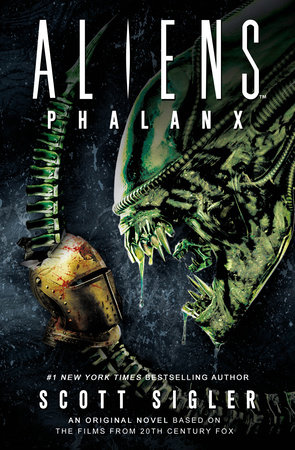
As the title indicates, it is a novel set in the Aliens extended universe of movies and book, which of course was sparked by the original 1979 movie Alien. In the 45 years since the original movie was released, there have been countless follow-ups, all of which attempt to do something interesting and new with the well-trodden source material. Most of them, from my experience, are variations on the same sci-fi story: a group of unwitting space travelers come across one or more xenomorphs and the bodies start piling up.
Aliens: Phalanx is so very different! The novel is set on an isolated world known as Ataegina, which is populated with humans with medieval culture and technology. It was not an idyllic society, but it worked well enough, until an event that happened decades ago known as the Rising. During the Rising, black husked “demons” with “tooth-tongues” appeared and swarmed the countryside without warning, dragging tens of thousands of people away to their deaths — and, it is rumored, to be turned into new demons.
Now, the last remnants of humanity live in isolated underground fortresses, communicating by optical signals from the tops of mountain peaks and engaging in precarious trading through the use of runners, young people who travel in teams of three to neighboring keeps to physically exchange needed supplies. The life of a runner is a dangerous one, and it is considered an exceptional achievement for a runner to survive even ten such runs.
The demons are far faster and more powerful than a single human, and it is a rare occasion for people to survive a direct confrontation with a demon, much less kill one. This is especially true because of the powerful acid blood of the demons, which can kill or permanently maim someone who manages to wound one of them. A direct fight against the demons seems hopeless, and the people of Ataegina have largely accepted their fate of hiding in the shadows.
Ahiliyah of Lemeth Hold is a particularly talented runner, and leads a team with the burly Brandun and the smart but caustic Creed. On their most recent run, they are nearly discovered by a demon that is traveling in the daylight, a rare occurrence, and Ahiliyah realizes that the tactics and strategies of the demons may be evolving, and they may be an even greater threat than ever before. Her warnings are ignored by the leaders of Lemeth Hold, however, and as more people are lost on runs the lack of response makes the situation even more dire.
But on their next run, the team stumbles across a new weapon that could potentially turn the tide against demons once and for all, if the authorities will listen to them. In the end, they must travel to the lair of the Demon Mother herself, within the depths of Black Smoke Mountain, and make one final attempt to save humanity.
Aliens: Phalanx is a fascinating and compelling mixture of science fiction and fantasy. My first impression, though a reductive one, is that it is a science fiction story told as a fantasy epic. The concept is delightful, and often feels like a Dungeons & Dragons campaign: a party of adventurers must travel to a dungeon to end the threat of the “demons” (xenomorphs). The world felt fully realized and alive to me, and the characters come across as sympathetic and understandable — we root for them throughout the book, through ups and downs and unexpected twists.
The premise is, of course, constrained by the source material and the need to check off certain “boxes” as every Alien story must. There will not only be the xenomorphs and the alien queen, but also a nasty encounter with facehuggers and at least one chest bursting (“Chekhov’s chestburster?”). However, this also is a large part of what makes Aliens: Phalanx work so well: as a reader, we know that certain things must be on the horizon, and it is fun to see how they inevitably make their appearance.
I should note that the story is anything but straightforward — I was surprised by developments multiple times through the narrative, and Sigler keeps you guessing to the very end.
As I’ve said, I’m not often one to read genre fiction, but Sigler’s Aliens: Phalanx is such a novel and compelling twist on the Aliens stories that I found it irresistible and impossible to put down. Now I’m going to have to track down more of Sigler’s work…


 Skulls in the Stars
Sounds interesting. I really liked the first half of Romulus, but then it tried to pull in “the black goo,” and it just unraveled.