
Book 7 for my 2025 goal of 30 books for the year!
I love a good science fiction story that really leans into one of the weird aspects of modern physics, and so as soon as I learned the premise of Poul Anderson’s Tau Zero (1970), I knew I had to snap it up and read it!
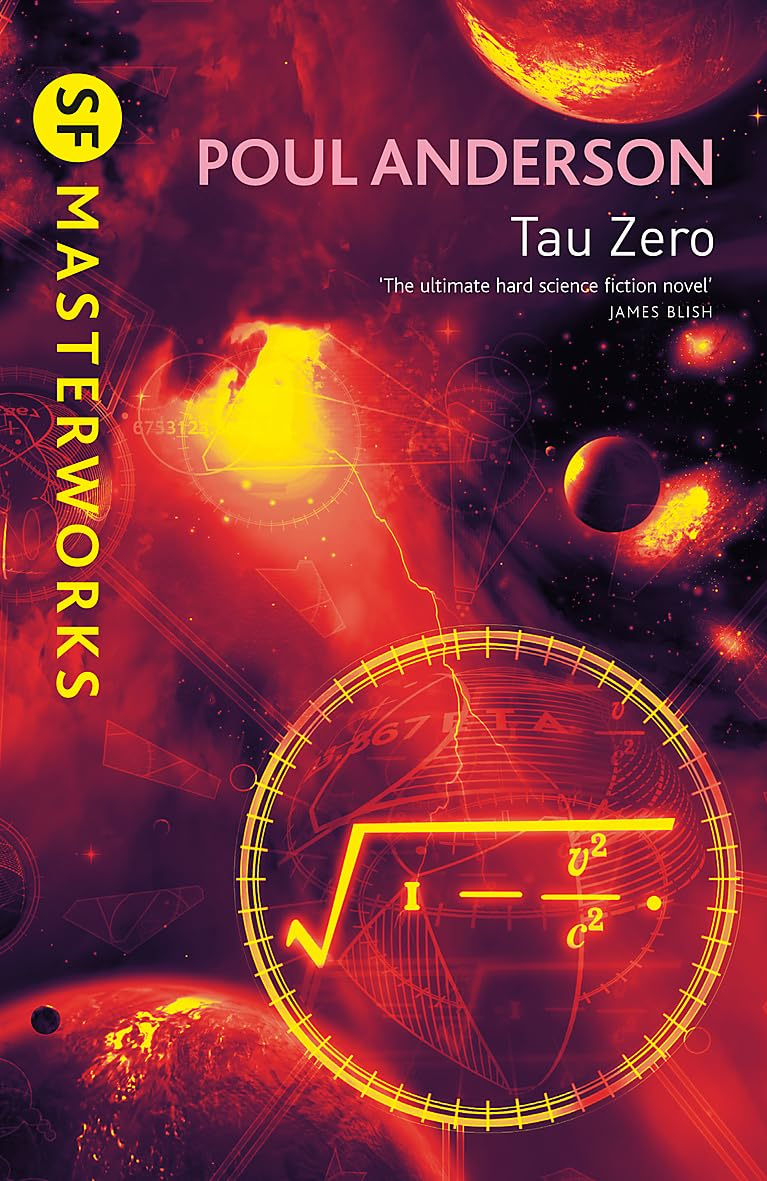
(I am again taking advantage of the decent quality and dirt cheap SF Masterworks editions of books. I found this one for $7.00 at 2nd & Charles.)
The book is centered around a premise from Einstein’s special theory of relativity: the idea that clocks move slower while in motion, and the slowness increases the closer the speed approaches the speed of light. I’ve blogged about this before, noting that it is in principle possible to move fast enough that a journey of a million light years could seem to take ten minutes — even though a million years would pass on Earth!
In the book, a colony spaceship is sent from Earth on a journey to a planet some thirty light years away, which will only be five years for the crew on board, moving at a relativistic speed. But on the way, an unexpected disaster strikes, disabling the drives that will decelerate the ship. With no way to slow down, a daring plan is proposed — go even faster, pushing ever closer to the absolute speed of light, in the hopes of reaching a location where the deceleration drives can be safely repaired. This will involve spending aeons of time relative to Earth, first hundreds of thousands, then millions, then billions of years. Along the way, the crew will have to hold together under the psychological strain of being isolated for years at a time, with no certain future…
To explain the premise a bit more, it’s worth taking a little time to explain the relevant aspects of Einstein’s special relativity again. Here I borrow again from my aforementioned and linked blog post on time dilation. Einstein’s two relativity postulates are, in modern parlance:
- Postulate of relativity. The laws of physics are the same for any observer moving at constant speed.
- Invariance of the speed of light. The speed of light is the same for all observers, regardless of the observer’s own state of constant motion.
The first postulate is an extension of the traditional postulate of relativity given by Galileo: that there is no sense of “absolute motion” or, more specifically, there is no experiment that can be done to detect absolute motion. The only motion that counts is relative motion between observers; no individual observer can perform an experiment that “proves” they are moving as far as the laws of physics are concerned. Galileo and Newton were primarily concerned with the law of mechanics and motion when postulating this, and Einstein further said that the laws of light and electromagnetism must appear the same to any observer, regardless of motion.
The second postulate is, in a sense, a direct consequence of the first, but it is stated separately due to its dramatic departure from tradition. Everyone measuring the speed of light, regardless of their motion with respect to a beam of light — towards it or away from it — will measure the same value. If this were not the case, then we would be able to discern a state of motion that would be in “absolute rest” with respect to the light, which would violate the first postulate.
But how can someone moving towards a beam of light and someone moving away from a beam of light agree on its speed? By disagreeing on lengths in time and space. Relevant to the plot of Tau Zero is the concept of time dilation, often simply described as “time proceeds slower in moving clocks.” Thus a spaceship traveling at a speed near that of light will appear to those on Earth as having clocks that are running significantly slower: in the case of Tau Zero, only five years are expected to pass on a journey that appears to take thirty years on Earth.
How is this reconciled by the people on the spaceship? To them, the distance between the Earth and their destination is shorter, in a phenomenon known as length contraction. Einstein’s relativity demonstrated that time and space are interlinked and that the universe is much, much weirder than we imagined.
Another aspect of relativity worth mentioning here is relativity of simultaneity. In traditional physics, time moves the same for all observers, so everyone can agree on whether two spatially separated events happen at the same time or not. In Einstein’s relativity, however, observers moving at different speeds will disagree on whether those two events are simultaneous, and all of their descriptions are equally valid as far as physics is concerned.
The title “Tau Zero,” incidentally, refers to the time dilation parameter written as the Greek letter tau, which has the form

where v is the speed of the spaceship and c is the vacuum speed of light. As the speed of the spaceship approaches c, tau approaches zero — hence the name! The formula for time dilation says that

where 

The novel is definitely the hardest of hard sci-fi: it takes real physics and constructs a plausible future and its technology from it. The spacecraft of the novel, the Leonora Christine, has an engine that is effectively like an aircraft ramjet. In a ramjet, the speed of the aircraft funnels air into the engine that is used for combustion; in the Leonora Christine, it is low-density interstellar atoms that are funneled in to provide the thrust. The mechanism serves a second purpose, in that the funneling of that low density material prevents it from reaching the crew of the ship and dosing them with radiation that would be almost instantly fatal. This is another nice bit of science realism in the book: although the density of atoms in interstellar space is low — something like one atom per cubic meter — at relativistic speeds one will experience a HUGE number of atoms per second. This also explains the problem that arises when the decelerator breaks in the ship: because the ship is constantly surrounded by lethal radiation, it is not possible to travel outside the ship to repair the decelerator. The devastating but only option the crew can take is to go even faster and try to escape from the galaxy and the local galaxy cluster altogether, into an area of space where the density of atoms is so low that they can safely go out to do repairs.
Tau Zero is, of course, also a novel about how humans respond in the face of unfathomable tragedy and horror. We spend a lot of time meeting the various crew members and experience their struggles to continue on, especially when trapped for years in a cramped metal can with 50 people total. One thing that may catch people off guard in reading the book is how much sexual relationships come into play — there are deliberately 25 men and 25 women on the craft, with the explicit idea that they will naturally figure out how to couple off and eventually have children on the new world that they are heading towards. With isolation and hopelessness overwhelming the crew, sex and romance become tools to placate those struggling the hardest. The characters of the novel were interesting but to me not hugely compelling: they serve more as vehicles to advance the central idea of the book.
One thing that occurred to me while reading Tau Zero is a question about whether the description of what the passengers on the spacecraft observe outside as they relentlessly accelerate even faster. Because motion is relative, the time dilation formulas work both ways: though people on Earth see clocks on the spacecraft running slow, the people on the spacecraft see clocks on Earth running slow! This is the heart of the famous “twin paradox” of relativity: if one twin heads off on a relativistic rocket trip and the other twin stays home, which will then be younger, since each sees the other aging slower during the journey? The resolution of the paradox is that the two twins are not in a symmetric situation: the twin on the rocket must undergo significant acceleration in order to turn around and return to Earth, and that acceleration breaks the symmetry and the rocket twin sees time rapidly advance during it. In Tau Zero, the characters watch the universe age from inside their rocket, and I can’t help wonder how that works, i.e. how does the twin paradox function when the distances traveled are billions of light years and there is a time discrepancy of billions of years? My suspicion is that the relativity of simultaneity comes into play here somehow, but I haven’t quite wrapped my head around it.
It is worth noting that, like many early science fiction novels, it originally appeared as a short story. It was printed as “To Outlive Eternity” in Galaxy Science Fiction in 1967, and was expanded and published in book form in 1970.
Tau Zero is a relatively short novel — I read the whole thing within about a day. It is a classic novel of hard science fiction, and well worth reading for its exploration of the strange and nearly unfathomable implications of Einstein’s relativity.


“In Tau Zero, the characters watch the universe age from inside their rocket, and I can’t help wonder how that works, i.e. how does the twin paradox function when the distances traveled are billions of light years and there is a time discrepancy of billions of years? My suspicion is that the relativity of simultaneity comes into play here somehow, but I haven’t quite wrapped my head around it.”
Apart from the relativity of simultaneity, in this situation you also have to consider the relativistic Doppler effect–although a clock moving relative to you is running slow in the coordinates of your inertial rest frame, if the clock is moving towards you, visually you will actually see it running fast.
Suppose for example the clock is emitting light signals towards you once per second in its own frame, and it’s moving towards you at 0.6c, in which case the time dilation formula says that it only flashes a light once every 1.25 seconds in your frame. But in those 1.25 seconds, it will have moved 0.6c*1.25 = 0.75 light-seconds closer to you, so each subsequent signal takes 0.75 seconds less time to reach you than the previous one, meaning that you actually see those signals coming in once every 1.25 – 0.75 = 0.5 seconds.
So, the visual frequency of flashes is actually sped up by a factor of 2 relative to the frequency in the clock’s rest frame, even though after you correct for light travel times you find the flashes were “really” happening only once every 1.25 seconds in your frame. This is also what you find if you just plug the speed of 0.6c into the relativistic Doppler shift formula. And of course this would apply not just to clock ticks but all forms of visual aging–for example if a ship with human passengers was moving towards Earth at 0.6c for many years, we’d see them aging twice as fast.
BTW, at relativistic speeds there’s another visual effect relevant to Tao Zero: relativistic aberration, where most of the stars/galaxies would get visually clustered in front of you, even a lot of the redshifted stars you’re moving away from, although the ones closest to directly behind you on your flight path would still appear behind you. There’s an explanation on a physics FAQ here, and this blog post on “the myth of the starbow” includes some simulated images along with the comment that at 0.999c “The stars appear hot and blue ahead, in a patch that becomes more concentrated with increasing speed, and that central area is surrounded by a scattered rim of red-shifted stars, shading off into darkness all around.”
Pohl mentions this type of visual effect in Tau Zero in chapter 9: “A hemispheric simulacrum sprang from the darkness at him, the distorted scene he would have witnessed outside on the hull. The stars were crowded forward, streaming thinly amidships; they shone steel blue, violet, X ray. Aft the patterns approached what had once been familiar—but not very closely, and those suns were reddened, like embers, as if time were snuffing them out.”
And later in chapter 13: “The farther stars were coalescing into two globes, fiery blue ahead, deep crimson aft. But gradually those globes contracted toward points and dimmed: because well-nigh the whole of their radiation had been shifted out of the visible spectrum, toward gamma rays and radio waves.”
But Pohl gets the physics of aberration a bit wrong here, saying in chapter 13 that “Aberration could, at most, displace a star 45°”–in fact aberration can shift a star almost directly behind you to appear as it is almost directly ahead, so the displacement can get arbitrarily close to 180°. This is illustrated in the diagram with the shuttle and the red light paths from the physics FAQ link, and the author of the starbow post also has a graph in this post showing how the apparent visual angle Theta of different stars shifts as fraction of light speed (Beta) increases, including the redshifted stars that are really behind you. Pohl’s mistake here may be related to why he imagines that visually you’d see “two globes”, a blueshifted one ahead and a redshifted one behind, when in reality all the visual clustering should happen ahead of you, with the cluster having a brighter center of blueshifted stars and a dimmer halo of redshifted stars.