
Book 20 for my 2025 goal of 30 books for the year! As is now default for me, my link to the book is through my bookshop dot org affiliate account.
I’ve been gearing up lately to plan my next popular science book — if I ever write it — and have been doing some relevant background reading. One thing I wanted to learn more about is the story of the incredible mathematician Emmy Noether (1882-1935), who revolutionized mathematics and physics during the course of her career, even though her accomplishments remained relatively obscure after her death up until the past couple of decades, when historians and science writers worked to introduce her to both the scientific community and the general public.
Remarkably, there was not a detailed history of her life published until late last year: Einstein’s Tutor, by Lee Phillips.
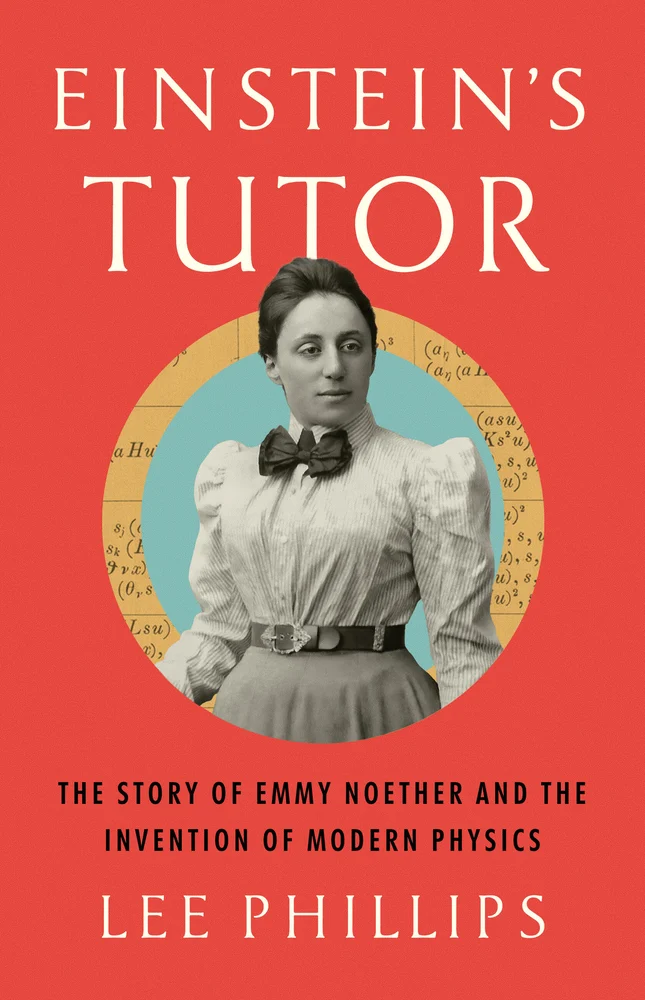
The title refers to Noether’s significant influence on Einstein’s efforts to mathematically formulate his ideas of general relativity. Einstein was not a strong mathematician, so he ended up turning to the mathematicians at the famed University of Göttingen for help. This included Emmy Noether, who was one of several that Einstein turned to; the other was the famous and brilliant David Hilbert.
The book shines a bright light on the superior talents of Noether and the extreme resistance she encountered throughout her entire career due to her gender and her Jewish heritage. Women in Germany were finally allowed to earn PhDs only around the time that Noether was working towards hers, and they were not generally allowed to work as academics even after earning their degrees. Despite the best efforts of some of the most brilliant scientists and mathematicians of her time, Einstein and Hilbert included, Noether often received “special” positions where she even worked without pay. Phillips’ book stresses that it was in the character of Emmy Noether that she didn’t let these obstacles get her down, and happily carried on making fundamental contributions to mathematics and physics — even though she really didn’t have an interest in physics!
Einstein’s Tutor largely focuses on Noether’s most famous contribution to theoretical physics, now known as Noether’s Theorem. This is a theorem of stunning generality that directly relates symmetries in physics to conservation laws. A “symmetry” may be viewed as an operation on a system that leaves the system unchanged. For example: a square can be rotated 90 degrees and it will look exactly the same, with the same orientation, just as a hexagon can be rotated 60 degrees and it will look the same.
In physics, some profound symmetries are symmetries of space and time. The symmetry of space may be loosely stated as “the laws of physics are independent of where you are in the universe,” and the symmetry of time may be stated as “the laws of physics are independent of a change in time.” That is: if we do the same experiment today and then again tomorrow, the results should be the same, because the laws of physics themselves don’t change with time.
Noether brilliantly showed that symmetries in physics are synonymous with conservation laws. The symmetry of space is equivalent to the conservation of momentum, and the symmetry of time is equivalent to the conservation of energy. The symmetry of rotation — that the laws of physics are unchanged under a rotation — is equivalent to conservation of angular momentum.
Phillips explains, in laymen’s terms, the meaning of this theorem and its significance for almost all of modern physics. Particle physics, and the standard model of physics, has many less intuitive conservation laws associated with them, and Noether’s theorem connects each of these conservation laws to a symmetry in the laws of physics themselves. Noether’s theorem has allowed the disparate and bewildering observations of modern physics to be connected together through symmetry. Remarkably, most of these discoveries were made using special cases of Noether’s general theorem and many of the researchers working on them were unaware of its origin in Noether’s work.
The book follows the entirety of Noether’s life and accomplishments, including her flight from Nazi Germany as persecution of Jewish people escalated dramatically and science and math were systematically destroyed in Germany for the sake of political and ideological agendas. There is a disconcerting similarity between what happened there and what is happening now in the United States with universities being targeted for “improper thought.”
It is important to note that there is more to Noether than her now famous theorem — Phillips discusses how she laid much of the foundations of the field of abstract algebra, which is one of the most important branches of modern mathematics. He doesn’t describe these achievements in detail in the main text, but there is a lengthy appendix to the book that covers more of the details of the projects that Noether worked on during her life.
Phillips also describes in detail how Noether, and her famous theorem, helped resolve some troubling problems associated with Einstein’s general theory of relativity. The book doesn’t shy away from discussing how Einstein’s contemporaries helped him develop the mathematics of the theory more than Einstein would acknowledge, as he took sole credit for the invention of general relativity. This isn’t a particular knock on Einstein — neither Noether or Hilbert felt a particular claim to Einstein’s work, and the foundational concepts were all Einstein’s — but it is a reminder that physics is never discovered “in a vacuum,” and one can always trace others who have helped lay the groundwork for amazing discoveries.
This was a fascinating and fun book to read. Noether’s work was largely overlooked after her death, or her particular role in those discoveries was, and it is good to see a book that lays out the important roles she had in physics and mathematics and shines a light on her remarkable personality.


 Skulls in the Stars