
I’ve posted many times on this blog about the work of Ramsey Campbell, and he is not only my favorite horror author but one of my favorite authors of all time. In my opinion, his ability to build a sense of subtle dread in the mundane aspects of modern life is virtually unmatched, and his stories are some of the few that have genuinely unsettled me when reading them.
I recently received a complimentary copy of his recently reprinted novel Incarnate from Flame Tree Press, and the publisher also offered me the opportunity to do an email interview with him, which I jumped at the chance to do — once I decided I had some interesting questions to ask! In this post, I share the full interview, which was a delight to do!
For those unfamiliar, Ramsey Campbell is an English author of horror fiction who has had a long, prolific and ongoing career. His first short story, a Lovecraftian cosmic horror tale, was printed by the classic publisher Arkham House in 1962 and led to his first collection, The Inhabitant of the Lake and Less Welcome Tenants, being released by Arkham in 1964. Though he has returned to cosmic horror throughout his career, he quickly branched out into his own unique styles of horror. It is rather reductive, but I’ve often broadly thought of his work being divided into strange works of supernatural horror and works of psychological horror. His first novel, The Doll Who Ate His Mother, was published in 1976, and since then he has written dozens of novels and countless short stories that have been gathered in numerous collections.
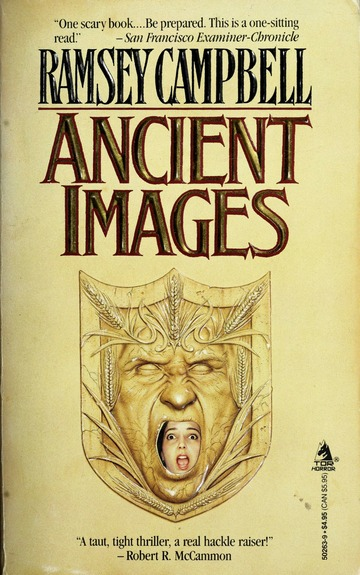
I first came across Campbell through his 1989 novel Ancient Images, and I still have the mass market paperback copy of it that I bought in a grocery store back in the day! Oddly, I have a vivid memory of buying this particular book, which I imagine says something about the influence it had on me.
So without further ado, let me share the interview!
(I have done no editing of the interview other than fixing a couple of small typos.)
Thank you for answering some questions! Feel free to answer as many (or as few) as you like.
The premise of Incarnate — of a dream research experiment gone wrong — seems particularly suited to the era it was written in, when there was a big interest in topics like ESP. Were there any particular real world inspirations or influences for the novel? (Or, for that matter, fictional influences, as you reference Lovecraft’s Dreamlands in the epigraph.)
No, I think the book sprouted from just one seed in an ungainly fashion typical of how I work. It began life as a novel about terminal insomnia, which led me to wonder why the characters would have developed the condition. Once I decided it was a defence against some form of dream invasion, the sleeplessness was left behind and soon jettisoned. Often by the time a tale is ready to be written it has moved so far away from the original notion that I still have the latter unused. Not long ago I found the notes I made back in 1973 for “The Companion”. They were so remote from the published story that I made them into another one, “The Fun of the Fair”.
Incarnate stands out to me from your other novels in that the story is told from the perspective of many characters with intertwining stories; my impression is that most of your novels focus on the perspective of one or two characters. Did this more complicated narrative structure pose any unusual challenges for you or lead to any changes in how you prepared the story?
In fact that structure isn’t so unusual in my novels. The Doll Who Ate His Mother has several viewpoints, as does The Face That Must Die—indeed, the only novel earlier than Incarnate to eschew them is The Parasite (both mass market versions). Later The Overnight had no less than thirteen viewpoints. Thieving Fear had four and kept the characters separate for most of the first half of the book, where letting them see one another brought a shock to at least one reader, the much-missed Joel Lane.
Admittedly Incarnate was more ambitious structurally than its predecessors. Like most of my stuff, it was transformed in the process of writing. I haven’t plotted a novel for many years—I prefer to gather material and have a limited sense in advance of the major events of the narrative—but in those days I did, and sent the publishers a synopsis (that loathsome and thankless task) in advance. My editor at Macmillan in New York was the excellent George Walsh. He was a classicist with a fondness for the unities, and suggested the book should progressively home in on a location and establish one of the characters as central. As you see, I took his advice to the book’s considerable benefit.
Incarnate is an explicit tale about the power of dreams, though many of your stories (The End of a Summer’s Day and Run Through come to mind) very effectively use the logic of nightmares. Is there something in particular about this type of story that draws you back to it?
“Run Through” was based on an actual dream, just about the only tale of mine that is. I value the experience of them—free surrealist films—including nightmares, from which I tell Jenny not to wake me, since its my impression they contain their own release mechanism if they become unbearable. I suppose it follows that similar narratives, even if more logically or consciously constructed, appeal to me. For instance, I’m a great admirer of Ishiguro’s The Unconsoled. The only piece of writing I’ve done that felt like dreaming onto the page was Needing Ghosts, where I came to my desk every morning impatient to discover what might happen next. As Ted Sturgeon said of his tale “It”, it was very easy and I wish I could do it again.
I found Incarnate to touch a little into science fiction in the way it lays out the relationship between dreams and reality. You’ve done a bit of science fiction in the past quite effectively, such as Medusa and one of my all-time favorites, Slow. Are you tempted to do any additional forays into the genre?
Odd as it may sound, I can only write sf if I’m not aware of doing so. I had a few goes back in the mid-seventies, urged by my old friend and agent Kirby McCauley, because there wasn’t then much of a market for short horror fiction. If I was conscious of doing it my style tended to seize up and take on too much weight. I collected the evidence in Inconsequential Tales for anyone who wants to slog through the stories. “Slow” was an exception, and there have been a few others since: “Reminded” in Preston Grassman’s anthology Out of the Ruins, for instance. My old friend Bob Shaw once ruminated on what made Chris Priest’s A Dream of Wessex science fiction and Incarnate horror. He concluded it was Chris’s insistence on the mechanics of the process versus my lack of interest in them.
Incarnate features a very significant subplot about police brutality, a topic that is unfortunately still relevant today. Do you often find inspiration or motivation in contemporary political and social issues?
Often, yes indeed. Even early tales take such themes on: “The Guy” (class antagonism), The Face That Must Die (racism, homophobia and the slide into fascism), The Hungry Moon (religious fundamentalism and the willingness to give up one’s right to question in exchange for a belief system that claims to have all the answers) are just some. The trilogy depicts the growth of an occult society from clandestine meetings in a derelict church to charitable status with a palatial waterfront office. I can’t help thinking such developments have a wider application.
Thinking of stories about dreams, your novella Needing Ghosts is unique among anything I’ve ever read — by anyone — in that it is the only story that left me feeling like I was going a little insane after I finished reading it! (I had to call a friend on the phone immediately to calm myself down.) I was wondering if you could share a little insight into the origins of that tale.
It was more like dreaming onto the page than anything else I’ve ever written. Deborah Beale at Legend had commissioned a novella from me for a series, and I’d determined it had to have a real reason to be written at that length. Eventually I settled on the notion of a narrative that took place across approximately twenty-four hours, and its seed was an idea I’d had waiting in one of my notebooks for development. I set off atmospherically—to some extent I had Böcklin in mind—but when we reached the bus terminal the destination names proved so much stranger than I was anticipating that I could only follow that tendency, and I was coming to my desk every morning eager to discover what would happen next: I genuinely didn’t know. The story virtually wrote itself, and I needed to rewrite it hardly at all. I can only assume my subconscious got completely loose for once—usually it gets on with subtext and resonances while I’m working on the surface.
One aspect of your stories that stands out to me, and is also present in Incarnate, is the often incredibly dysfunctional and hostile social interactions of the characters. Characters are often talking past one another and clearly self-absorbed in their own problems, making it nearly impossible for them to see the threats facing them. How much are these interactions drawn from observations of real-life people?
Not specifically, but I have a sense this is how people often operate, even if my tales stylise the process and have fun with it.
Incarnate is one of a number of reprints of your classic works that Flame Tree Press has been releasing (which also includes the first Campbell novel I read and one of my favorites, Ancient Images). Is there any work in your back catalogue that you are particularly excited for people to have a second look at?
All of them, I self-servingly say, but Incarnate is certainly one, and The House on Nazareth Hill will be.
Thanks for taking the time to answer some questions!
My pleasure! Thanks for asking them!
*********************************************************
And let me say “thank you” again to Ramsey on the blog for taking the time to answer these questions! I asked a lot of questions that were things that I’ve always been curious about and it is a real joy to get some insight into his work. This interview will count as one of the highlights of writing this blog all these years.
Now that I’m in the mood, I’m planning to do more author interviews in the future, so folks should “stay tuned” — I’ve already tentatively got another couple of people lined up! And, of course, I will share more about Ramsey Campbell’s writing as new works come out!


hiiiiiiiiiiiiii