
Book 26 for my 2026 goal of 36 books for the year! Still comfortably ahead with my reading. My link to the book is through my bookshop.org affiliate account, which means I may earn a small commission if you buy from there.
In my reading and blog writing, I tend to focus on lesser known authors and books and shy away from the mega bestsellers. Part of this is as “service”: I like to highlight things that people are less likely to have seen. Part of it however is just my own aversion to join the “hype” in a popular work! This is part of why it took me until 2024 to finally read Mary Shelley’s Frankenstein.
But I became curious about Dungeon Crawler Carl, a now lengthy series of novels by Matt Dinniman named after the first book that came out in 2020. I wasn’t necessarily expecting to get drawn into it, but I was really won over by the story, which went in directions and had more depth than I anticipated!
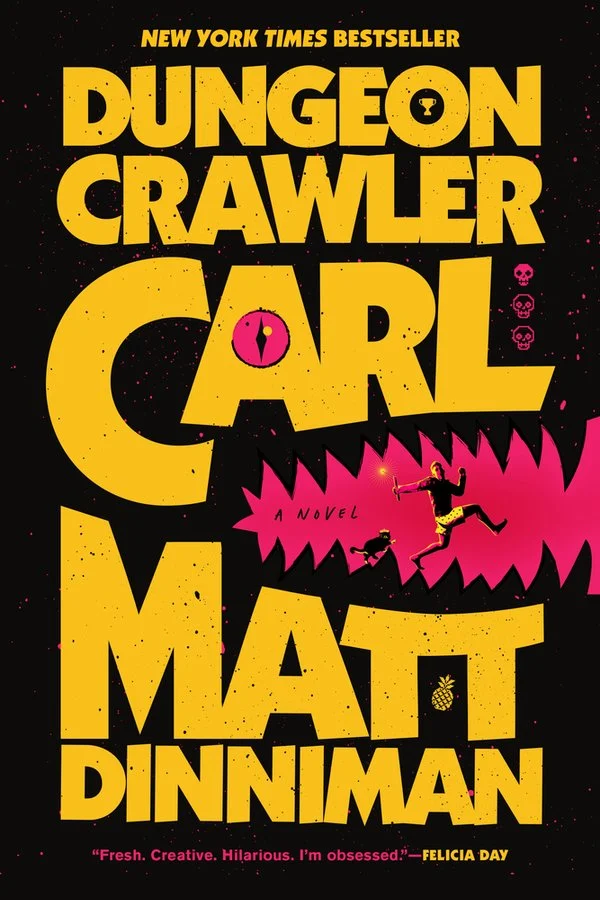
The book is set on present day Earth. Carl runs outside in a winter storm to try to catch his ex-girlfriend’s cat when all the enclosed structures in the world collapse, targets of an invasion by an intergalactic alien corporation. The survivors are given doorways to enter, and Carl has little choice — in his underwear, shoeless, holding a cat — but to seek shelter within.
Carl and the cat Princess Donut find themselves now part of a brutal life or death reality game show. They must venture down through an artificially constructed dungeon full of monsters, treasure and traps, reaching the next level before a timer runs out and their current level collapses. Along the way, a master AI will monitor their activities and give them new skills — and rewards — accordingly. They have an extradimensional inventory where they can hoard their loot and safe rooms where they can rest and eat.
Carl and Princess Donut are really in it just to survive, but if they survive the 18th level of the dungeon — that nobody in the history of the games on countless planets has ever come close to reaching — Earth will be saved and not stripped for all its resources by the corporation. But that is a lot of levels to descend, with ever increasing danger on every level, and they also have to contend with the fact that a key to their survival will be growing a fanbase of viewers from around the cosmos.
If Dungeon Crawler Carl sounds a lot like a computer roleplaying game, with characters gaining levels and skills and achievements, well you’re right! The book series is a mix of an homage and a parody of these sort of games and all the quirks that come with them. A lot of the fun in reading it is seeing all the explicit details of how Carl and Princess Donut level up as they win battles and overcome obstacles. One of the quirks that actual gamers will be familiar with is getting achievements for things that you didn’t actually intend to do! Another more significant quirk is “cheesing” and defeating much more powerful enemies by using unexpected loopholes in the artificial rules of the game.
I must admit that the first third of the book, though entertaining, didn’t quite grab me. That part of the book actually runs like a tutorial level in a videogame: filling in all sorts of information that is necessary but not particularly compelling. Then, without warning, the story becomes much more clever and emotional. We see how intense attention to detail in the rules can be lifesaving, and we find Carl and Princess Donut confronted with moral quandaries and unexpected consequences of their actions. From that point on I was really hooked and finished the rest of the book in a single day to see how it all turned out. (The book ends with them only entering level 3, which explains a lot of how the series can be 8 books and counting.)
Overall the story is very lighthearted but Dinniman, through Carl, never lets us forget that this is a horrific story where literally billions of people died all at once and millions more are dying in a dungeon for people’s entertainment. I feel like Dinniman is giving us a little gentle finger-wagging and ironic meta-commentary on not only his story but videogames in general: “Are you enjoying this? Do you realize that these are intelligent beings with their own lives and dreams that are being massacred?” It isn’t a particularly harsh criticism but more of a way to keep the reader grounded in their humanity.
This does seem to be a significant point of the novel: even in the most extreme situations, you can choose to be good. Without saying too much, this is highlighted in the book through a number of major events. In one of those events, Carl and Princess Donut must decide whether to help other crawlers even though it may put them at a disadvantage. In another event, they meet crawlers who clearly opted not to help others.
This reminds me, incidentally, of one of the earliest artistic choices in a videogame: Richard Garriott aka Lord British designing a particular encounter in the game Ultima V. I’ve written about this extensively before, but the crux of it is this: Garriott realized that he could use any icon for monsters in his game’s dungeons, but those creatures would automatically be hostile. As a twist, he put a room in the dungeon with cages full of children, and if the player opens the cages, the children attack! This outraged playtesters, who said that Garriott was encouraging child abuse. As he later recounted it, however,
If you were that bent out of shape about killing them — which is the easiest way to get out of the room — you could charm them and make them walk out of the room yourself. You could put them to sleep and walk out of the room. You could do any number of things, but the point is that you don’t have to kill them. Admittedly, nine out of ten people who find the kids screaming out around their feet are going to kill them — but you don’t have to kill children to win the game, so there’s a big difference.
(The room remained in the published game. I remember coming across it as a kid.)
And that is the sort of choice that seems central to Dungeon Crawler Carl. Carl is in a precarious situation where he is most likely going to die and helping other people could make that even more likely. But he can choose what sort of person he is going to be, even in this situation.
There is more to the story than just the dungeon! As Carl and Princess Donut become more popular, they draw the attention of the corporation and have to negotiate the equally treacherous terrain of being public figures. There does seem to be a little commentary here on the modern phenomenon of being a “social media influencer” and how the most sensible choice for survival may not be the choice that the audience likes.
It is worth noting that I’ve almost always mentioned Carl and Princess Donut together! The pair form a team and the cat, for reasons I again won’t spoil here, is an indispensable part of it. Cat lovers out there will love the interaction between the two and Donut’s antics, which are definitely cat-like.
The book ends on an obvious cliffhanger, with Carl and Princess Donut descending to level 3, but it also plants the seeds for a number of other twists and mysteries in the future. Dinniman sets up a world where you want to learn more about what’s going on behind the scenes.
This book was an incredible amount of fun, especially for me as someone who has played computer roleplaying games his entire life! I don’t know if I’m going to read the entire series, but I suspect that I’m going to go buy book two this afternoon.


I usually avoid series in any genre but this one has kept me coming back for three books