This is the 31st installment of old school Dungeons & Dragons! There’s nothing special about that milestone, other than me realizing that it’s a lot of posts. Anyway, let’s jump right to it…
X6: Quagmire! (1984), by Merle M. Rasmussen. Here we delve into one of the more obscure members of the E(X)pert series of modules!
I don’t know exactly what first drew my attention to Night of the Big Heat (1959), by John Lymington. I suspect I was browsing through some Wikipedia posts about alien invasion movies, and caught sight of the 1967 film adaptation of the book, which starred none other than Christopher Lee and Peter Cushing, and that drew me to the novel. In any case, I bought a copy well over a year ago and just now finally decided to give it a look!
I really didn’t have high hopes for it when I read it, but this alien invasion story is surprisingly fun, and filled with clever ideas!
Let’s take a look at one of the most obscure books I’ve ever read!
So, I’ve written about the work of Archie Roy before, in particular his novel Devil in the Darkness (1978), a remarkably good haunted house story. In fact, I wrote the introduction for the Valancourt Books edition of the novel, and discussed the remarkable career of Roy, who was not only a novelist but an astronomer and paranormal researcher!
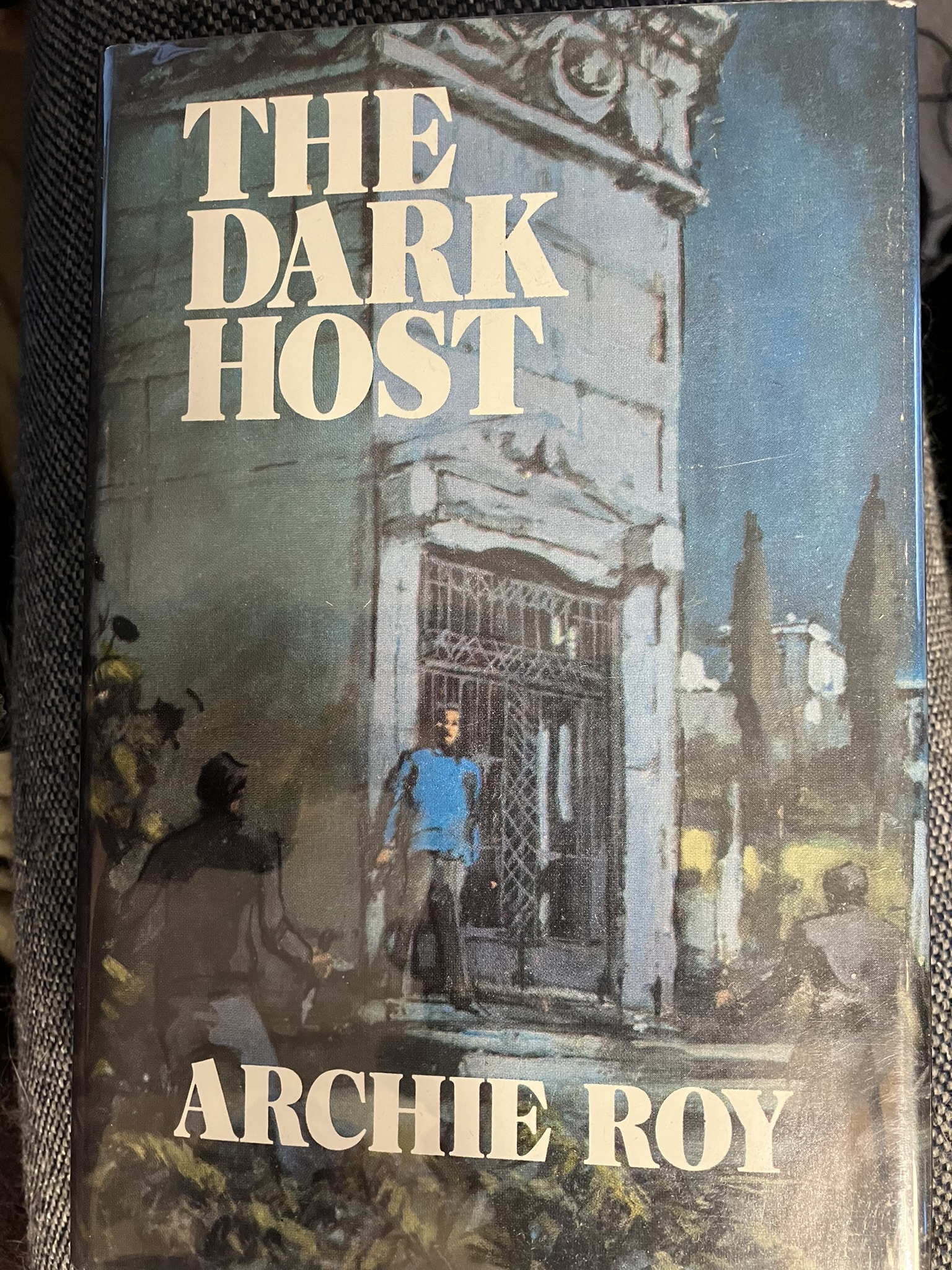
With this in mind, a few months back I decided to track down another Archie Roy novel, and went with the one he wrote just before Devil in the Darkness, titled The Dark Host (1976).
The Dark Host is an unusual thriller, and not a supernatural one, but it definitely has a very macabre twist in it! I enjoyed it greatly, though maybe not for the reasons one would expect!
First of all, I got news that The New York Times may be running the review of my book on Invisibility in the Sunday, June 4th issue! Previously, the review appeared online way back in mid-April. This hasn’t been officially confirmed yet, as far as I know, but I’ll definitely be hunting for a copy on Sunday to see!
Also, just to keep a record of it here, I also did a short segment on CKNW radio in Vancouver yesterday to talk about invisibility! It was a ten minute segment, and I was on my phone doing it, but it was fun — thanks to CKNW for having me on! It turns out that, at least for now, you can hear the bit by going to CKNW’s audio vault and going to June 1, 6:00 am; the segment I’m on starts about 6 minutes in, with Genesis’ “Invisible Touch.”
Also: I totally forgot to share this when it happened, but the first copies of my book arrived on March 6th, 2023, and I made a short unboxing video at the time!
Color can have surprising origins in nature. Most of the time, the color of an object is dictated by the light it absorbs: for example, if you see an object that is blue, that means that it reflects all the blue light shining on it and absorbs all the colors that aren’t blue. But colors can arise from completely different phenomena: rainbows, for example, arise due to the phenomenon of dispersion, i.e. that different colors of light are refracted differently within a raindrop.
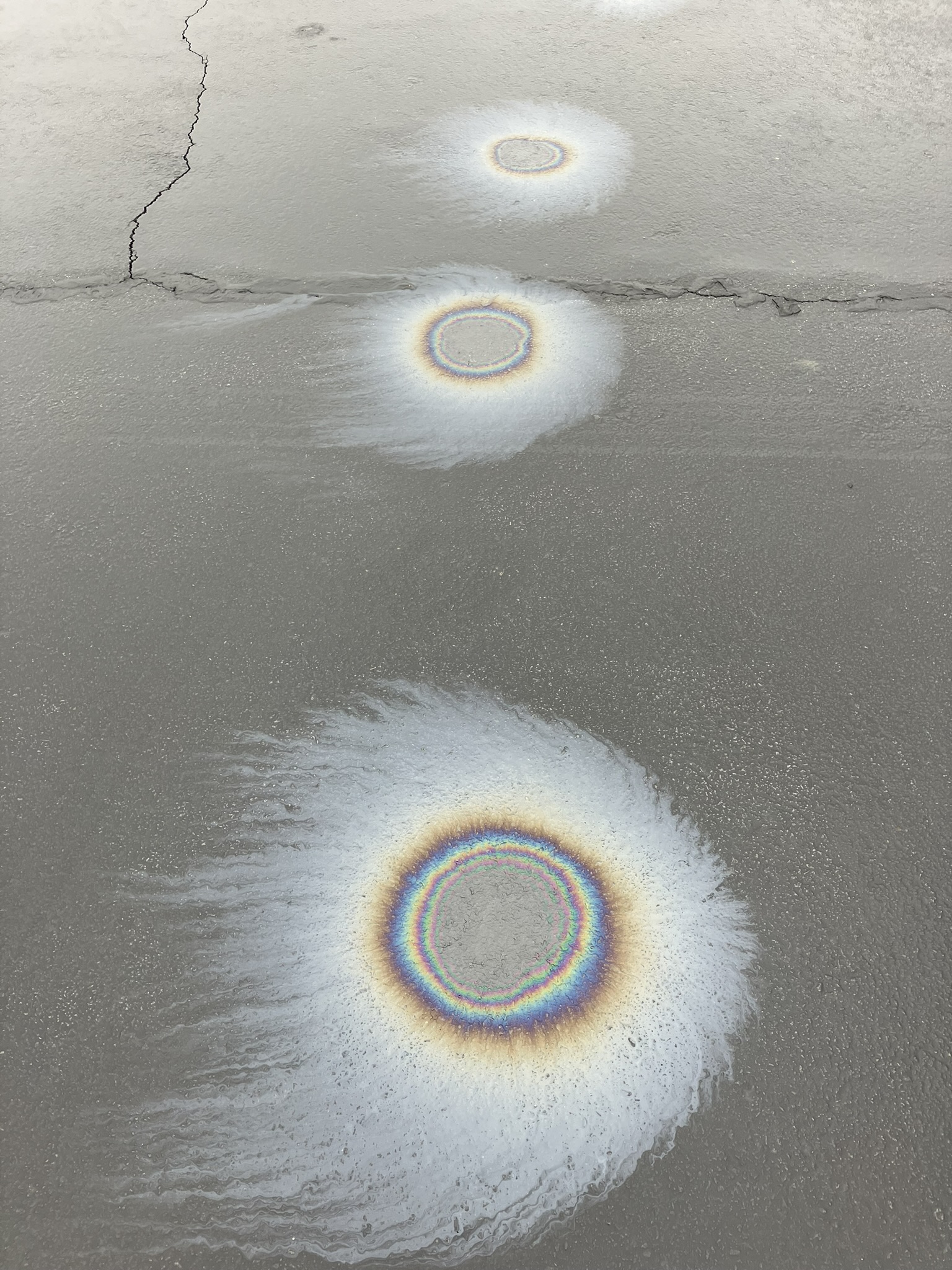
Then we have the not-quite-a-rainbow spectrum of colors that one sees when oil is spread out over the surface of water, such as this photo that I took a few months ago in my neighborhood:
These arise from a completely different effect: wave interference! The oil forms a thin layer on top of the water, and wave interference from the oil-air interface and the oil-water interface can produce constructive interference for colors, depending on the thickness of the oil layer.
Oil slicks are an example of what is generally known as thin film optics, in which unusual optical effects are produced by putting one or more thin layers of material, usually comparable to the wavelength of light, onto a base layer. This is not only a phenomenon seen “in the wild,” in things like oil slicks, but is practically used in optical design and engineering!
Let’s take a basic look at thin film optics and how it can produce bright colors on reflection — or suppress them entirely.
It was a great conversation! It started with me talking about the science of invisibility, and then we were joined by Lisa Yaszek (Regents Professor of Science Fiction Studies in the School of Literature, Media, and Communication at Georgia Tech) to talk about invisibility in science fiction, and then we were joined by Sophia Brueckner (Futurist artist, designer and engineer, Associate Professor at the School of Art and Design, and Co-Director of the Center for Ethics, Society, and Computing at the University of Michigan) to talk about the ethics of invisibility, if it ever becomes a practical technology!
I actually learned a lot from the discussions with Professor Yaszek and Professor Brueckner, and they gave me new things to think about in the way I think about invisibility!
Anyway, please check it out, and thanks to Colin McEnroe and Lily Tyson for having me on the show!
I’m still working on posting something to the blog every day for a certain number of days! Tonight, I’m a little exhausted and don’t have a lot of time to finish a new optics post, so I thought I’d share a couple of videos of me practicing classical guitar. This is partly for me as well as the audience — I need a lot more practice in front of a camera, as I always play worse when I am aware of an audience or recording!
This is an Allegretto by Matteo Carcassi that I happen to like and isn’t too difficult.
(Dedicating this performance to my friend Hannah.)
More science to come! And probably more guitar, too.
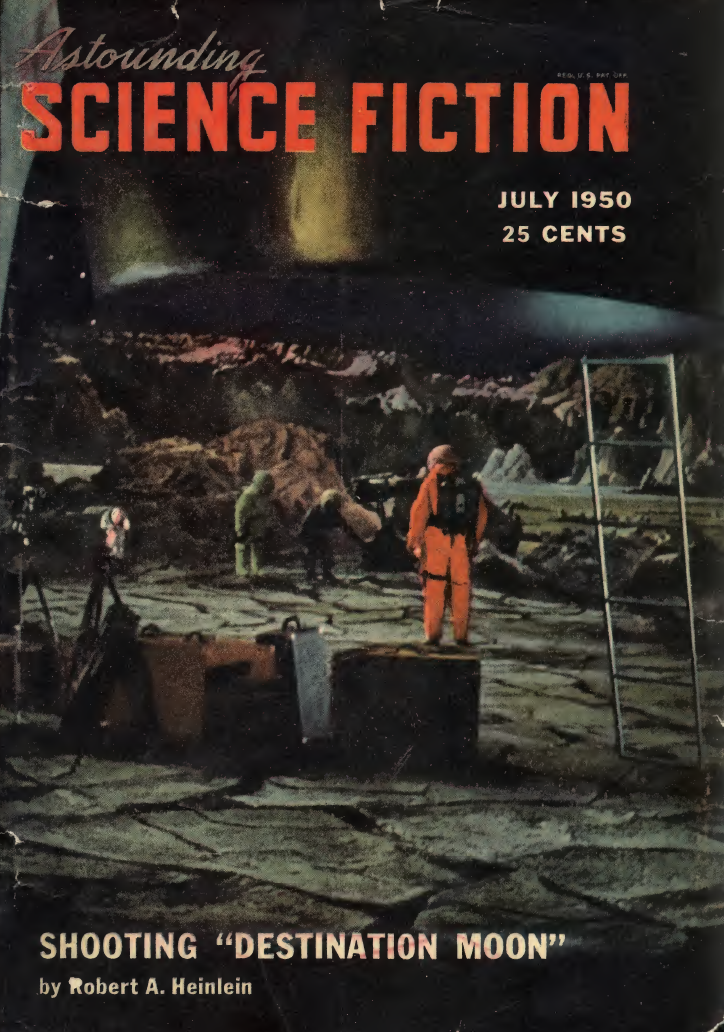
As long as I’ve been having fun tracking down classic science fiction stories that I absolutely love, let me share at least one more! “The Little Black Bag,” by C.M. Kornbluth, first appeared in the July 1950 issue of Astounding Science Fiction. (You can read it on the Archive at this link.)
Cyril M. Kornbluth is one of my favorite science fiction authors, and largely due to three stories, that encapsulate a truly prescient view of the future and an extremely cynical one. In his story “The Silly Season” (1950), strange and nonsensical events worldwide that take up the attention of the newspapers turn out to be a distraction for an alien invasion. This story really anticipates the “noise chambers” that a lot of media companies have become, harping on nonsense issues to distract from serious ones. In his story “The Only Thing We Learn” (1949), a teacher recounts to students the heroic origins of their civilized society, whereas flashbacks show us the horror and brutality that those founders actually achieved. This story warns against the whitewashing of our history, while cynically suggesting that it will repeat itself with another conqueror.
The third story is “The Little Black Bag.” (Severe spoilers from here on out, so please read it first from the link.)
Sometimes you just have to read a book because of its title. This was certainly the case when I decided I wanted to read Prisoner of the Vampires of Mars (1908-1909), by Gustave Le Rouge!
Like, the title has everything! Mars! Vampires! Prisoners! How could I not read it? I put the book on one of my holiday wishlists, and my roommate got it for me this past Christmas. It took me some time to read it, an admittedly my expectations were not particularly high, but I ended up enjoying the book immensely! Let’s take a look at the book, without major spoilers, below.
The fields of optical science and engineering have undergone dramatic changes over the past twenty years. Through most of its history, stretching back for hundreds of years, optics researchers have been asking the question, “what can light do?” Revolutionary discoveries have changed the question to, “how can we make light do whatever we want it to?”
One area where there has been dramatic change in recent years is in the very structure of a beam of light itself. Ever since the invention of the laser, it has been the standard source of light for experiments an applications, far superior to using natural light sources, which must be collimated and filtered to produce a directional and monochromatic beam. Most ordinary laser sources, like a laser pointer you might use to entertain your cats or give a presentation, produce a Gaussian beam, so named because they produce a brightness (intensity) spot shaped like a Gaussian function, as shown below.
On the left: a simulation of the brightness of a Gaussian spot, as if you would see if you looked directly in the beam (don’t do that). On the right: the cross-section of the spot, showing its Gaussian shape.
A Gaussian beam is great for most uses: it is very directional, and propagates long distances without significant spreading, it is very close to being a single frequency wave, which also means it is coherent (more on this momentarily). However, researchers have gradually realized that beams with properties different than a Gaussian beam could show unusual, beneficial, and even seemingly impossible behaviors! These beams are created by modifying, or “structuring,” the properties of the beam spot.
There are a number of properties that can be structured in the transverse cross-section of the beam. The shape of the intensity spot can be changed, the phase of the light wave can be modified, the polarization properties of the light can be manipulated, and the spatial coherence can be adjusted. Let’s look at examples of each of these “structured” light beams, and see what weird things can be done!
The author of Skulls in the Stars is a professor of physics, specializing in optical science, at UNC Charlotte. The blog covers topics in physics and optics, the history of science, classic pulp fantasy and horror fiction, and the surprising intersections between these areas.





 Skulls in the Stars