A hare-y puzzle solved!

One of the really neat things about diving deep into a scientific problem is that you start to spot surprising things in images or videos that nobody else would see! My book on Falling Felines and Fundamental Physics got me really involved in studying videos of cats landing on their feet after a fall, and after the book came out I wrote a whole blog post about a cat flip video that I happened to see online where I spotted some really neat new dynamics in the falling felines problem.

Well, today I again spotted something remarkable in a falling animal video, and in fact I think it answered a question that I had been unable to answer ever since writing the book!

Let me give a little background: cats possess this remarkable reflex, often called the cat-righting reflex or just the cat flip, that allows them to change the orientation of their body in the air and land on their feet whenever they fall from a height. It is a true reflex, and something that comes naturally to them, and they can do it very fast — they can often land on their feet even if dropped from a height of one foot.

Clearly, cats have developed this instinct because they are natural climbers, and inevitably some of them fall from trees. Evolution has “trained” them to possess this reflex so that they can land safely. Even cats falling from skyscrapers at heights of 20 stories or more often survive with only minor injuries.

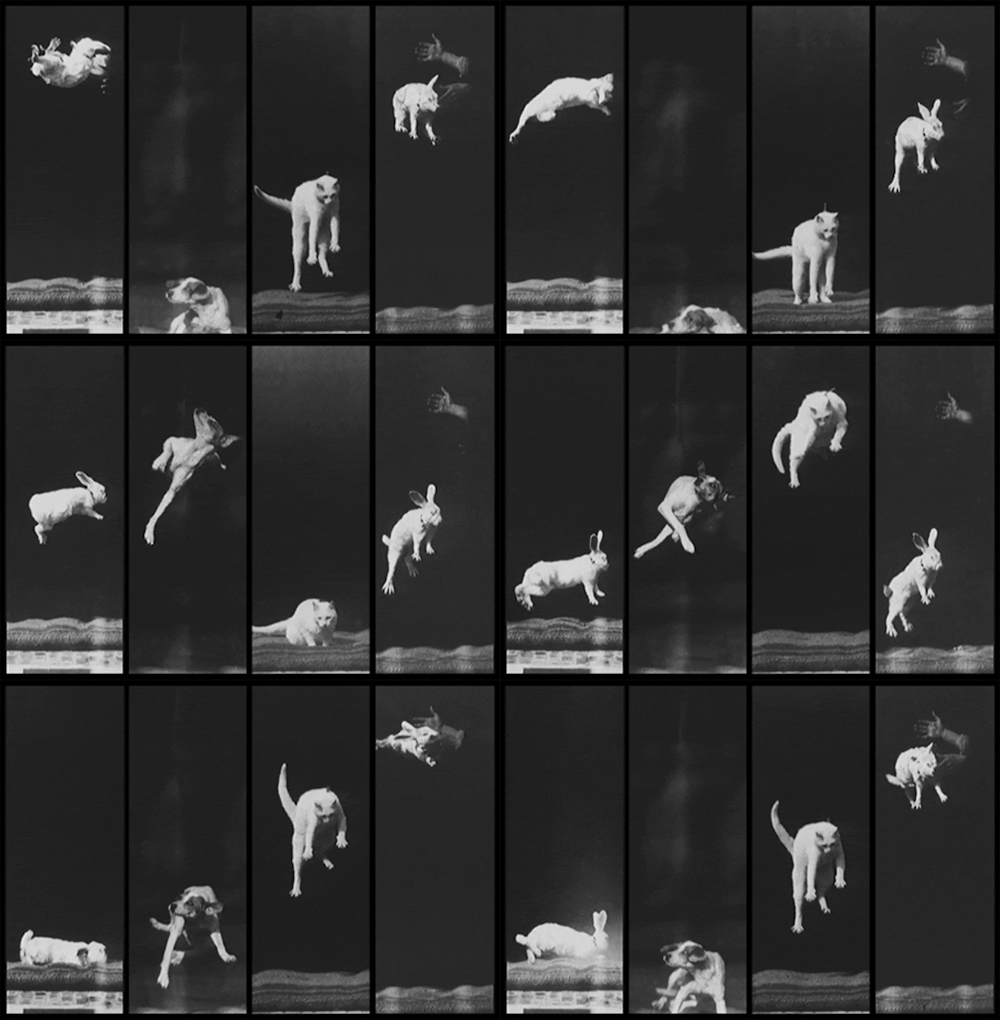
So it is easy to understand why a cat has developed this ability… but it turns out that rabbits can also do it! I found this gif on the internet that demonstrates the abilities of rabbits, cats, and dogs (source unknown, alas). It is quite clear that cats and rabbits have little problem landing on their feet, while the poor dog has a lot more trouble.

In the 1960s, one researcher on the righting reflex used rabbits instead of cats, as their capabilities are so strikingly similar.

The rabbit’s ability poses a bit of a puzzle, though: why would rabbits have developed a righting reflex? To the best of my knowledge, rabbits don’t spend a lot of time up in trees. I’ve mentioned this puzzle a number of times while giving talks on the cat-righting reflex. I made two guesses, both of which were a bit unsatisfying. The first guess is that rabbits, while fleeing from ground-based predators, occasionally run right off of ridges or small cliffs, and the reflex helps them land safely. The second guess is that rabbits, when picked up by aerial predators, wriggle themselves free often enough that the ability to land from a height became an important evolutionary selection process.

Well, thanks to the video I’ll show you, I think I’ve found the answer, and it’s different from my guesses!

Continue reading
Posted in Animals, Physics | 6 Comments

The Invisible Master, by Edmond Hamilton

Here’s another classic science fiction story about invisibility, to celebrate the release of my book on the science and history of Invisibility! This is the third invisibility story I’ve found by Hamilton, making him the most prolific invisibility writer I know of!

skullsinthestars's avatarSkulls in the Stars

I keep finding new invisibility stories! Will I ever come to an end? Stay tuned!

It is pretty clear at this point that stories about invisibility were a huge business in the early to mid 20th century, and every author of science fiction or horror had to get in on the action in some way or another.

For example, I just had to type “Edmond Hamilton” and “invisibility” into a search bar and found Edmond Hamilton’s “The Invisible Master,” that appeared in Scientific Detective Monthly in the April, 1930 issue.

Complete image from the story taken from DarkWorlds Quarterly.

Edmond Hamilton (1904-1977) is another one of those super-prolific science fiction authors who had a huge influence on the field but isn’t broadly recognized like an Asimov, Bradbury or Clarke. I would be hard-pressed to single out a particular story of his that everyone would know, but I’m particularly fond…

View original post 1,627 more words

Posted in Invisibility | Leave a comment

The Little Man Who Wasn’t All There, by Robert Bloch

Continuing the celebration of the release of my book on Invisibility, here’s another post about invisibility in weird fiction, by the author of Psycho!

skullsinthestars's avatarSkulls in the Stars

More invisibility! More invisibility fiction for the gods of invisibility fiction! Or something. Again, blogging about all the invisibility stories I’ve been coming across while finishing my book on invisibility physics.

It seems that pretty much every important author of science fiction and horror has written a story about invisibility at some point. One really just has to google a famous name and the word “invisibility” and see what comes up.

For example, one of my more recent discoveries is “The Little Man Who Wasn’t All There,” by Robert Bloch, published in the August, 1942 issue of Fantastic Adventures.

Robert Bloch was a correspondent of H.P. Lovecraft’s when he was young, and he went on to have his own impressive career as an author of horror. His most famous tale is Psycho (1959), which was adapted into the Alfred Hitchcock movie of the same name.

“The Little Man Who…

View original post 415 more words

Posted in Invisibility, Weird fiction | Leave a comment

War with the Gizmos, by Murray Leinster

Invisibility: The History and Science of How Not to Be Seen, is now available! Here’s another reblog of a post on classic invisibility science fiction.

skullsinthestars's avatarSkulls in the Stars

Yet another post about invisibility in fiction! So many stories I couldn’t mention in my upcoming book on the physics of invisibility, so you get to hear about the stories here.

Time to talk about a real classic of science fiction that also happens to be a classic story about invisibility: War with the Gizmos, by Murray Leinster, first published in 1958.

Murray Leinster (1896-1975) was a stunningly prolific author of science fiction. The bibliography of his work on Wikipedia, which I am sure is not complete, includes dozens of novels alone. War with the Gizmos is a compelling story of an attack on humanity by an utterly unfamiliar species of beings, who may or may not be intelligent and may or may not be from another world. It also features a rather distinct form of invisibility; let’s take a look!


View original post 1,278 more words

Posted in Invisibility | Leave a comment

The Cave of Horror, by Captain S.P. Meek

My latest non-fiction popular science book, Invisibility: The History and Science of How Not to Be Seen, is now available! Here’s another classic blog post about science fiction invisibility.

skullsinthestars's avatarSkulls in the Stars

Yet another post about invisibility in fiction! Will I ever run out of these? I feel like I need to write another book just about invisibility fiction.

So in my last post, I wrote about “Invisible Death”, which appeared in the January 1930 issue of Astounding Stories of Super-Science. On a whim, I happened to browse the rest of the stories, and found another story about invisibility in that same issue. Clearly invisibility was a hot topic in that era.

The new story I found is titled “The Cave of Horror,” by Captain S.P. Meek.

It is a mixture of horror, action, and science fiction, and features run-ins with an invisible monster that has wandered up from the bowels of the earth and is now haunting Mammoth Cave, in Kentucky!


View original post 762 more words

Posted in Invisibility | Leave a comment

New blog post at Yale University Press!

With the book out, my endless advertising blitz has begun! Let me lead off with a blog post that I wrote for my publisher, Yale University Press: How Many Ways Can We Be Invisible? In the post, I talk about a bunch of different science fiction ways authors have attempted to explain invisibility, and how close they got! A short sample:

Invisibilitythe ability to make something invisible to visible lighthas long been assumed by science to be impossible. This changed in 2006, when two groups of researchers published back-to-back papers in the journal Nature demonstrating theoretically that invisibility is, at the very least, plausible.  Since then, there has been intensive research on a variety of different ways in which invisibility might be achieved. So far, a practical demonstration of true invisibility has remained elusive, and it is unclear when, if ever, it will be achieved.

With that in mind, maybe it is worthwhile to turn to science fiction for ideas. Long before it was science fact, invisibility was a regular topic of science fiction, and many famous authors imagined their own ideas of how invisibility might be achieved. There are many more invisibility stories than most people are aware of. We may not find the secret to being unseen in them, but these stories give a fascinating snapshot of the science of their time.

Please check it out!

Posted in Invisibility, Personal | 2 Comments

Invisibility: The History and Science of How Not to Be Seen

Today is the official publication day for my latest non-fiction popular science book, Invisibility: The History and Science of How Not to Be Seen!

As the title indicates, this is a look at the intersection of science and invisibility throughout history, ranging from the earliest attempts by science fiction authors to explain how invisibility might be possible in the 1850s right up to the present day, in which optical scientists have been attempting through theory and experiment to make invisibility cloaks.

Invisibility has a surprisingly long and subtle history in physics. The first real hints of it appeared in the early 1900s, as researchers tried to explain how electrons could be orbiting in an atom without giving off radiation, as classical physics predicted they should. This led to the strange phenomenon of “nonradiating sources,” sources of light radiation that, paradoxically, do not give off radiation. Over the next 100 years, nonradiating sources and other crude forms of invisibility kept being rediscovered, and scientists struggled to find a use for such an interesting phenomenon: it was a “solution in search of a problem!”

In the latter years of the 20th century, invisibility became associated with so-called inverse problems, in which a “cause” is deduced from measurements of an “effect.” Such problems include modern imaging techniques such as MRIs and CAT scans.

I have a personal connection to this work, which motivated the writing of this book in the first place! My own PhD research, completed in 2001, was on nonradiating sources and invisible objects. I like to describe myself as the hipster invisibility scientist — I was looking at such problems before it was “cool.” The book talks a bit about my own work, especially related to my late PhD advisor Emil Wolf, who played his own significant role in invisibility physics.

In Invisibility, I endeavor to explain in plain language how invisibility is predicted to work. In fact, the book ends up being a bit of a history of the physics of light itself, as the history of invisibility is tied closely to our understanding of light. This is a book intended to be read by everyone, and I worked hard to keep it interesting and entertaining! I should add: if you don’t completely understand some physics explanation in the book, that’s okay! Learning science is often about just picking up a little bit of new knowledge at a time. (Feel free to send me a tweet or a comment on my blog here if you want some clarification.)

The book includes quite a bit of discussion of the science fiction of invisibility, as well. Long before scientists started studying the phenomenon, a surprising number of authors attempted to give the fantastical concept a plausible scientific basis. There are so, so many science fiction stories about invisibility, almost certainly more than you’ve heard of! (I say this with confidence because a search of the internet shows that nobody has looked at invisibility in science fiction as thoroughly as I have.)

A little example of invisibility fiction: an illustration for Guy de Maupassant’s 1887 short story “The Horla.”

Throughout the month, to celebrate the release of the book, I will be blogging and reblogging about classic stories of invisibility in science fiction and horror; you can track down the archive of posts here.

The book is not all history; since 2006, invisibility has been an active field of scientific study, and researchers have predicted all sorts of strange phenomena using the tools of invisibility cloaks: optical black holes, optical wormholes, anti-cloaks, perfect illusions, and more! I talk about all of these, and discuss where invisibility physics stands today, and whether someone invisible might be standing behind you right now!

I’m very excited for folks to see this book, which has been a long time coming! It was originally going to be my first popular science book, but I ended up writing my book on Falling Felines and Fundamental Physics first!

Invisibility should be available through the bookseller of your choice (including Target — go figure). Here again is the link to the Yale University Press website, which links to a lot of the popular sellers.

I hope you enjoy it!

*********************

PS yes, the subtitle is a reference to a classic Monty Python sketch; I had to fight a little with the marketing department to get them to keep it as is!

Posted in Invisibility, Personal | 6 Comments

The Monster-God of Mamurth, by Edmond Hamilton

Tomorrow is the day! Invisibility: The History and Science of How Not to Be Seen will be officially released in hardback and e-book! Audio book I believe is coming soon! Here’s a discussion of another classic story of invisibility…

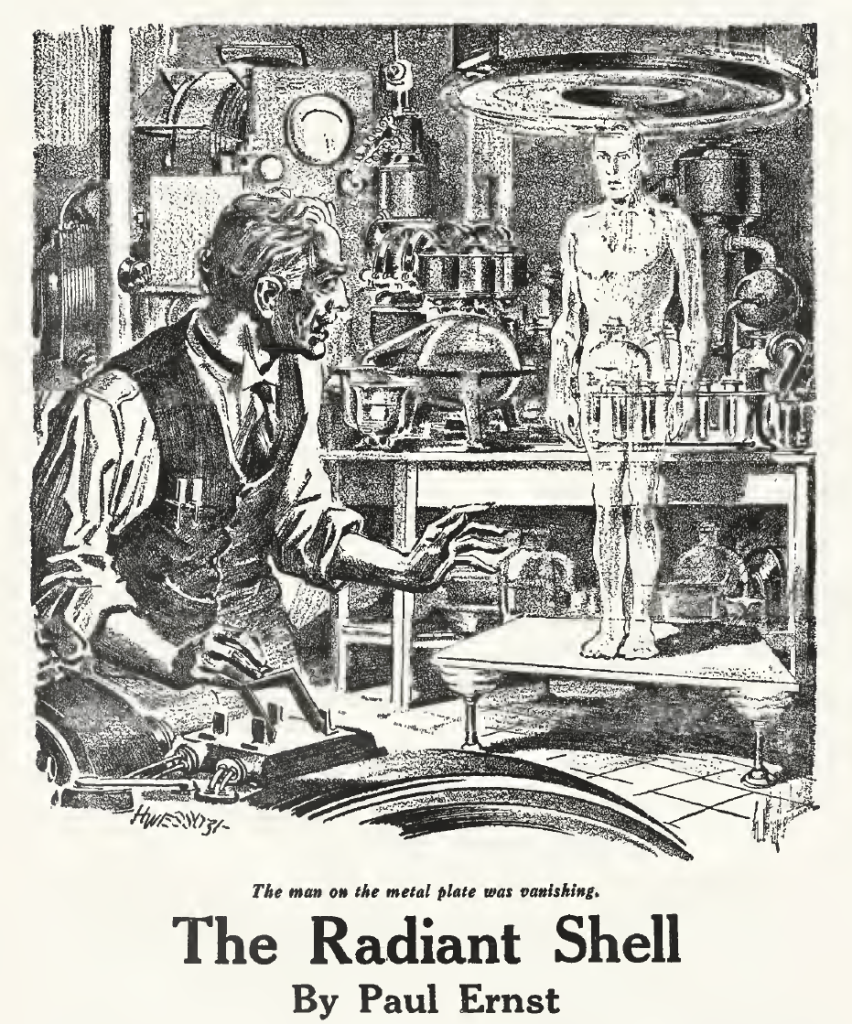
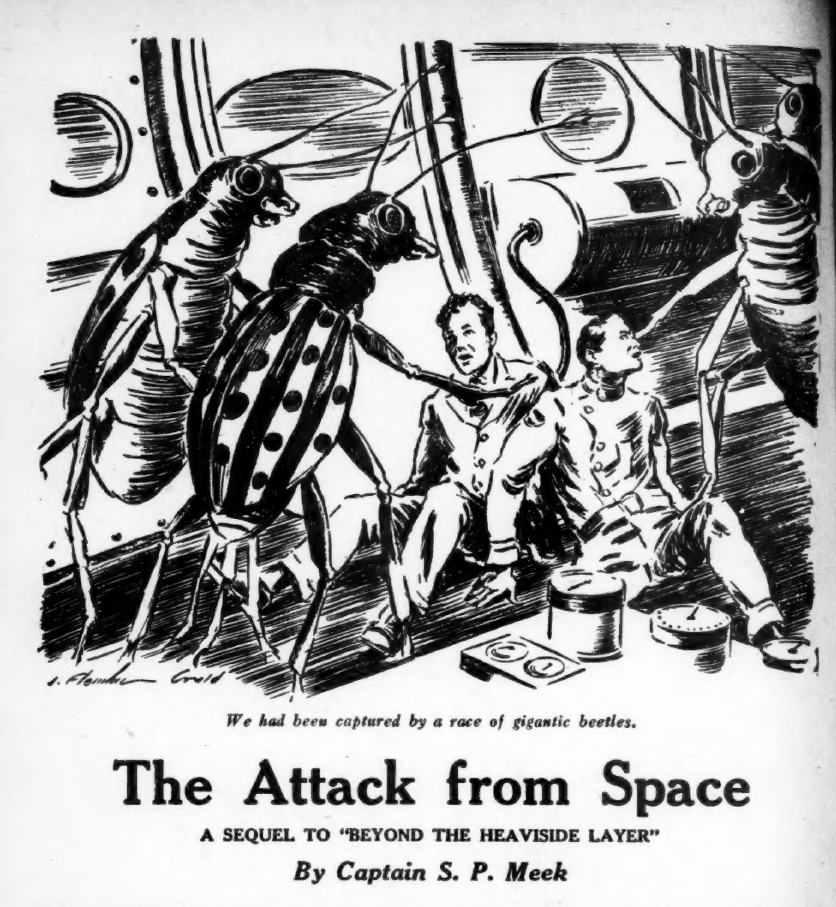
We have run into a few authors who made it a bit of a career to write stories about invisibility, including Captain S.P. Meek, who wrote “The Attack From Space” and “The Cave of Horror,” as well as Victor Rousseau, who wrote “The Invisible Death” and The Sea Demons. We may also add Edmond Hamilton, who wrote “Valley of Invisible Men” that I’ve blogged about previously, but also whose very first science fiction story was “The Monster-God of Mamurth,” published in August of 1926 in Weird Tales!

Hamilton became an incredibly prolific writer for Weird Tales, joining H.P. Lovecraft and Robert E. Howard as regulars, and branched out into other magazines and genres over his productive career. And it all started with an invisibility story!

Continue reading
Posted in Invisibility, Weird fiction | 2 Comments

Invisible Death, by Anthony Pelcher

Tick-tock! My book Invisibility: The History and Science of How Not to Be Seen, will be released tomorrow! Here’s another classic blog post of mine about invisibility in fiction, and I’ll share a new post later tonight!

skullsinthestars's avatarSkulls in the Stars

Back into some posts about invisibility in fiction, based on those stories that I didn’t talk about in my (hopefully) upcoming book about the history and physics of invisibility!

If you’ve been reading this blog recently, you might think that I made a mistake and have reposted something that I posted last week! Because didn’t I just write a post about “The Invisible Death“?

Well, I did, but that was “The Invisible Death,” by Victor Rousseau, which appeared in Astounding Stories of Super-Science in October, 1930, but now we’re talking about “Invisible Death,” which appeared in Astounding Stories of Super-Science in January, 1930!

If you’re confused, well, so was I: I stumbled upon Pelcher’s story while looking for Rousseau’s, but more on that later. Let’s talk about the story and the science of “Invisible Death”!

View original post 604 more words

Posted in Invisibility | Leave a comment

The Elixir of Invisibility, by Henry Kuttner

Two days until my book on the history and science of invisibility is released! To celebrate, here’s another reblog of a post on a classic invisibility story in fiction.

skullsinthestars's avatarSkulls in the Stars

Yet another post about a story of invisibility. I keep finding more for my book bibliography, so I might as well blog about them here!

Invisibility has been a key feature of stories in pretty much every genre of writing. Ambrose Bierce’s “The Damned Thing,” for instance, is pretty much a straight horror tale. H.G. Wells’ The Invisible Man is, of course, classic and even foundational science fiction, and tales like D.W. Hall’s “Raiders Invisible” are really straight up adventure fiction. Invisibility has even been used in romance; the 1895 novel Stella by C.H. Hinton tells the tale of a man who falls in love with a woman who has been turned invisible! (It’s not a very good story, IMHO.)

So it is not surprising to find invisibility used in comedy stories as well, and such is the case with Henry Kuttner’s “The Elixir of…

View original post 876 more words

Posted in Invisibility, Weird fiction | Leave a comment