Continuing my run of stories of invisibility to celebrate finishing the draft of my book on the history and physics of invisibility! I probably should’ve waited to do this until my book is actually out… ah, well.
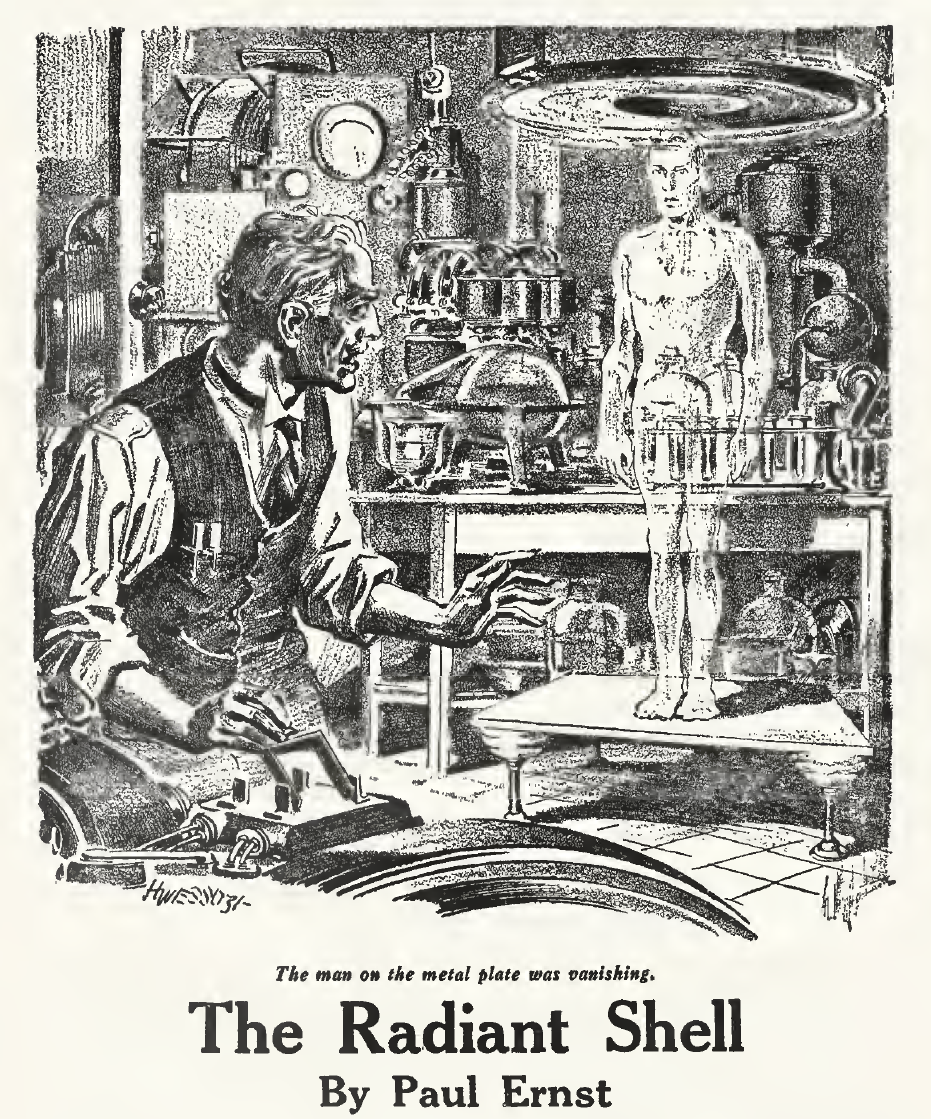
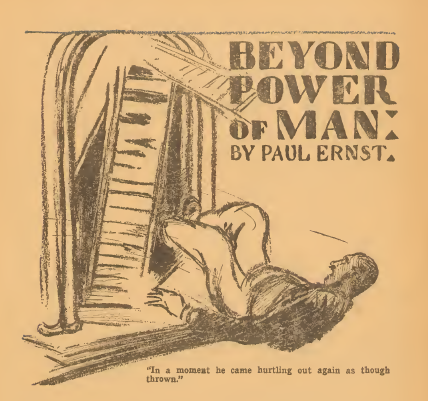
With so many invisibility stories having been written, it was inevitable that I would come across one that seems like a re-run of earlier classics. Such is the case with “Beyond Power of Man,” by Paul Ernst, which appeared in the December 1928 issue of Weird Tales!
This story seems like a striking mishmash of several classic stories about invisibility! Let’s take a look.
Yet another invisibility story! So many invisibility stories.
So, in the list of stories we’ve looked at so far, we’ve seen invisible people, invisible monsters, invisible buildings, invisible cars, invisible dogs, and invisible spacecraft. But you now what we haven’t seen yet? Invisible robots!
Our invisible robots appear in Harl Vincent’s “Terrors Unseen,” which appeared in the March 1931 issue of Astounding Stories. It is not a particularly astounding story, but it does has invisible robots, so let’s take a look!
I keep finding new invisibility stories! Will I ever come to an end? Stay tuned!
It is pretty clear at this point that stories about invisibility were a huge business in the early to mid 20th century, and every author of science fiction or horror had to get in on the action in some way or another.
For example, I just had to type “Edmond Hamilton” and “invisibility” into a search bar and found Edmond Hamilton’s “The Invisible Master,” that appeared in Scientific Detective Monthly in the April, 1930 issue.
Edmond Hamilton (1904-1977) is another one of those super-prolific science fiction authors who had a huge influence on the field but isn’t broadly recognized like an Asimov, Bradbury or Clarke. I would be hard-pressed to single out a particular story of his that everyone would know, but I’m particularly fond of “The Metal Giants,” that appeared in Weird Tales in December 1926. I like big stompy robots!
“The Invisible Master” is more of a mystery story than science fiction, marking invisibility’s foray into another genre of fiction. It also happens to have one of the best and most enjoyable descriptions of invisibility that I’ve yet seen! Let’s take a look at the story, and I’m going to be a bit spoilery this time!
More invisibility! More invisibility fiction for the gods of invisibility fiction! Or something. Again, blogging about all the invisibility stories I’ve been coming across while finishing my book on invisibility physics.
It seems that pretty much every important author of science fiction and horror has written a story about invisibility at some point. One really just has to google a famous name and the word “invisibility” and see what comes up.
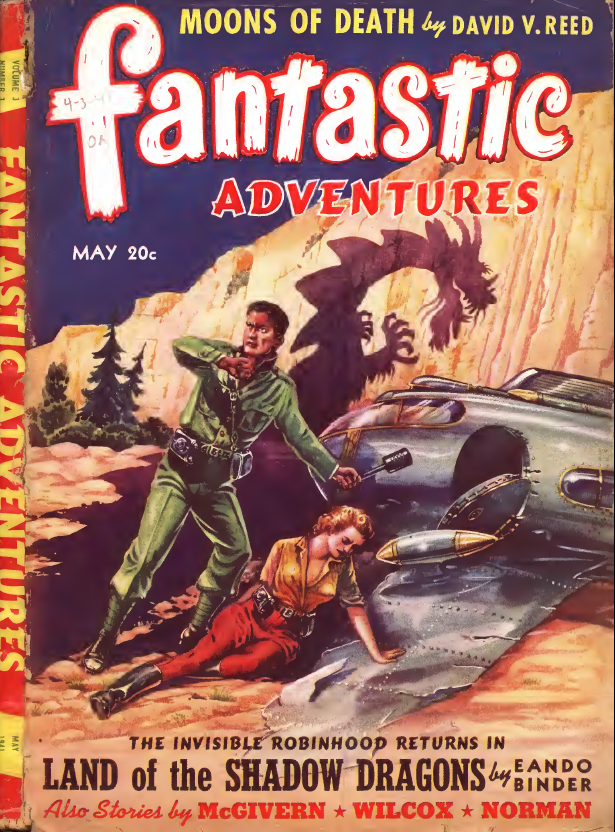
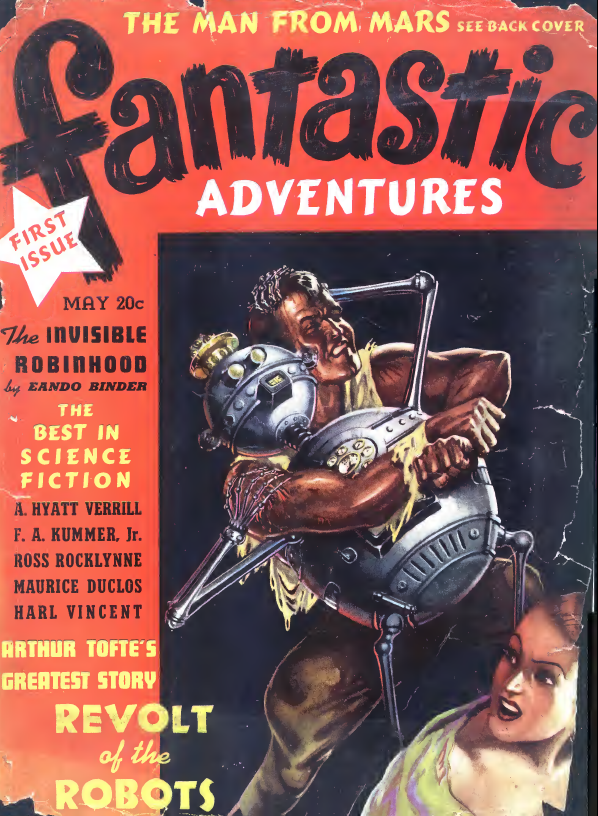
For example, one of my more recent discoveries is “The Little Man Who Wasn’t All There,” by Robert Bloch, published in the August, 1942 issue of Fantastic Adventures.
Robert Bloch was a correspondent of H.P. Lovecraft’s when he was young, and he went on to have his own impressive career as an author of horror. His most famous tale is Psycho (1959), which was adapted into the Alfred Hitchcock movie of the same name.
“The Little Man Who Wasn’t All There” is one of a series of semi-comedic tall tale type stories narrated by the character Lefty Feep. Bloch wrote 22 of these stories between 1942 and 1946.
Yet another post about invisibility in fiction! So many stories I couldn’t mention in my upcoming book on the physics of invisibility, so you get to hear about the stories here.
Time to talk about a real classic of science fiction that also happens to be a classic story about invisibility: War with the Gizmos, by Murray Leinster, first published in 1958.
Murray Leinster (1896-1975) was a stunningly prolific author of science fiction. The bibliography of his work on Wikipedia, which I am sure is not complete, includes dozens of novels alone. War with the Gizmos is a compelling story of an attack on humanity by an utterly unfamiliar species of beings, who may or may not be intelligent and may or may not be from another world. It also features a rather distinct form of invisibility; let’s take a look!
Yet another post about invisibility in fiction! Will I ever run out of these? I feel like I need to write another book just about invisibility fiction.
So in my last post, I wrote about “Invisible Death”, which appeared in the January 1930 issue of Astounding Stories of Super-Science. On a whim, I happened to browse the rest of the stories, and found another story about invisibility in that same issue. Clearly invisibility was a hot topic in that era.
The new story I found is titled “The Cave of Horror,” by Captain S.P. Meek.
It is a mixture of horror, action, and science fiction, and features run-ins with an invisible monster that has wandered up from the bowels of the earth and is now haunting Mammoth Cave, in Kentucky!
Back into some posts about invisibility in fiction, based on those stories that I didn’t talk about in my (hopefully) upcoming book about the history and physics of invisibility!
If you’ve been reading this blog recently, you might think that I made a mistake and have reposted something that I posted last week! Because didn’t I just write a post about “The Invisible Death“?
Well, I did, but that was “The Invisible Death,” by Victor Rousseau, which appeared in Astounding Stories of Super-Science in October, 1930, but now we’re talking about “Invisible Death,” which appeared in Astounding Stories of Super-Science in January, 1930!
If you’re confused, well, so was I: I stumbled upon Pelcher’s story while looking for Rousseau’s, but more on that later. Let’s talk about the story and the science of “Invisible Death”!
I thought I’d take a one day break from invisibility stories to talk about one of my favorite science fiction stories of all time: “Private Eye,” by Lewis Padgett, published in the January 1949 issue of Astounding Science Fiction. It was even the cover story:
The story was written by “Lewis Padgett,” which was one of many pseudonyms used by the husband and wife writing duo of Henry Kuttner and C.L. Moore. I came across this particular tale while researching my last blog post, and was delighted to see that the story had apparently passed into the public domain since the last time I checked — and it includes illustrations! So let’s discuss “Private Eye” and share those original illustrations, and the story itself for you to read!
Yet another post about a story of invisibility. I keep finding more for my book bibliography, so I might as well blog about them here!
Invisibility has been a key feature of stories in pretty much every genre of writing. Ambrose Bierce’s “The Damned Thing,” for instance, is pretty much a straight horror tale. H.G. Wells’ The Invisible Man is, of course, classic and even foundational science fiction, and tales like D.W. Hall’s “Raiders Invisible” are really straight up adventure fiction. Invisibility has even been used in romance; the 1895 novel Stella by C.H. Hinton tells the tale of a man who falls in love with a woman who has been turned invisible! (It’s not a very good story, IMHO.)
So it is not surprising to find invisibility used in comedy stories as well, and such is the case with Henry Kuttner’s “The Elixir of Invisibility,” published in Fantastic Adventures in October 1940.
The original issue cover.
Henry Kuttner (1915-1958) was a versatile professional author for the pulp magazines who could write equally well in science fiction, fantasy, horror, or thriller. He really does seem to be the sort of author who was good enough to write “on demand” fiction for whatever an editor might need. And many of his stories are very, very good: the story “Private Eye,” written in 1949 under the pseudonym of Lewis Padgett which Kuttner often use in projects with his wife C.L. Moore, is one of my favorite science fiction stories of all time. In the future, scientists have developed the ability to look back at any moment in time. This would seem to make murder impossible to get away with, but one man, seeking revenge on a romantic rival, hatches a plan for the perfect murder even under 100% surveillance.
I’ll come back to “Private Eye” in another post, because now I really want to read it again! But what can we say about “The Elixir of Invisibility”?
Did you know that there was a near-total lunar eclipse this morning that could be viewed through most of Canada and the United States? This “Beaver Moon lunar eclipse” was near its peak around 4:00 am EST, and once I heard about it (damn you, Scott) I decided to get up to try to get some photos, and freeze my fingers off in the process. I did the same thing a couple of years ago, when the “super blood moon” rolled through.
So here are a few of my favorite shots. I’m not a skilled photographer, so I spent the better part of an hour tinkering with settings, trying to get shots that matched pretty well what could be seen by eye.
The author of Skulls in the Stars is a professor of physics, specializing in optical science, at UNC Charlotte. The blog covers topics in physics and optics, the history of science, classic pulp fantasy and horror fiction, and the surprising intersections between these areas.