My favorite unusual games of 2022!

I’ve been rather quiet the past week as I’ve been enjoying — and enduring — the holidays with my family. But the end of the year is approaching, and I thought I should do some sort of year-end wrap up. Why not, I thought, talk about some of the fun and quirky videogames I’ve played over the past year? Lots of unusual games have been coming out with unconventional art, game mechanics, and themes, a nice complement to the impressive but familiar AAA games that we see every year. So here’s a rundown on some of the games that caught my attention in 2022. Images are taken from the Steam pages of the games.

Immortality. This has been one of the highest-rated games of the entire year, and with good reason. It was developed by Sam Barlow, building on the design concepts of his earlier interactive film video game, Her Story (2015).

The starting premise is simple enough. An actress, Marissa Marcel, starred in three movies, made in 1968, 1970, and 1999, none of which were ever released, and Marcel’s fate is also unknown. Your task is to figure out what happened to Marcel and why her movies were never released. You have what amounts to a film spooler, and starting with just one movie clip, which you can move through forward and backward at will, you click on interesting objects in a scene, which unlocks new scenes that have some sort of symbolic connection. In this way, you can slowly piece together the tangled story.

At some point very soon in beginning the game, however, something very unexpected happens, and I was totally blown away when it did. Suddenly you find that there is a lot more to the story than you could possibly imagine, and that you, the viewer, may also be becoming part of the story.

The film clips are incredibly well-acted and filmed, and include scenes from the 3 fictional movies themselves as well as behind the scenes shots, screen tests, and more. As the game unfolds, you find that you are unraveling multiple stories layered on top of each other: the plots of the 3 movies, the story of Marissa Marcel, and a deeper, more sinister story that underlies it all.

The two leads Manon Gage and Charlotta Mohlin give excellent performances. The different scenes discovered range from unsettling, or even frightening, to deeply and profoundly moving.

Immortality has an “end game,” but it is likely that you won’t have exposed the full story by the time you reach it. Fortunately, you can keep searching, looking for that hidden clip that will make everything come together. I played 11 hours total.

Continue reading
Posted in Entertainment, video games | 4 Comments

Old School Dungeons & Dragons: Part 29

Let’s recap four more old school Dungeons & Dragons threads that I’ve been posting to Twitter and Mastodon! No time to waste:

Death’s Ride (1984), by Garry Spiegle. This is one of those books that I have owned since I was a teen but curiously never really read in detail before!

Death’s Ride is the second in the CM series of modules, designed for the Companion Rules for D&D. The original Basic Set covered levels 1-3, Expert Set levels 4-14; The Companion Set covered levels 15-25.

Continue reading
Posted in Dungeons and Dragons, Entertainment, Fantasy fiction, role-playing games | 2 Comments

Optics, rain, and car headlights

One of the fun things about being a physicist is that occasionally you end up pondering some sort of everyday phenomenon that you’ve never thought about before and realize that you can explain it with some elementary physics! Some time ago I had one of these little epiphanies and thought I would share it.

Have you ever been out driving at night after a rain storm and found yourself constantly checking to see if your headlights are on, because they don’t look like they’re on? We can explain this very simply with a basic discussion of optical reflection.

First, we can ask: how to you normally notice that your headlights are on at night? If you’re right behind another car, or passing by a nearby road sign or other roadside feature, you can probably see the light from your headlights reflected back at you. But you can also see the reflection of your headlights from the road ahead of you.

In fact, because the pavement is a rough surface, the light from the headlights scatter in all directions when they collide with the road. This is what we call diffuse reflection, and it is the most common type of reflection you see. Most surfaces are not terribly smooth, and so the light hitting it scatters every which way. In the case of the car, some of the light from the headlights bounces back towards you, so you can see, indirectly, that your headlights are on.

But what about when it has rained? If there is enough water on the pavement, it fills in all the little crevices in the pavement, making it effectively a smooth surface, like a mirror. Then you get the elementary case of what is referred to as specular reflection, where the angle of reflection \theta_r is equal to the angle of incidence \theta_i. This means that nearly all the light from the headlights ends up being directed forward, away from the car, and you don’t see any light on the pavement ahead of you.

Since we’re so used to being able to see some light reflected back on dry nights, we might doublecheck to see if our headlights are on!

Of course, if it is actively raining while you’re driving, you’ll often see light scattered off the raindrops themselves, which is why I have stressed that this is an effect that you see soon after it has rained.

Pretty sure this explanation makes sense, though I’ve never seen anyone talk about it before! It’s a nice little example of how a little bit of physics knowledge can often illuminate things you see in daily life (no pun intended).

Postscript: This also gives you an idea of why stealth aircraft are designed to have flat surfaces! Ordinary aircraft, with round bodies, tend to reflect radar waves in all directions, including back to radar defense systems, making them easy to track. Stealth aircraft, with their mostly flat surfaces, tend to reflect radar waves only in the specular direction, which is very unlikely to be in the location of a radar detector!

Posted in Optics, Physics | 2 Comments

An Ode to “The Temple of Elemental Evil”

As readers of this blog know, I’ve been doing #OldSchoolDungeonsAndDragons Twitter threads for several years now, but every once in a while I talk about an old product that is too significant to cover in a short tweet thread! Back in 2019, I did an ode to the Tomb of Horrors; now, it’s time to do an ode to The Temple of Elemental Evil, since I just reread it!

Just look at that amazing cover art, which tells you you’re in for a wild ride:

That amazing cover art is by the late great Keith Parkinson, and I can’t think of any other module cover art that is simultaneously very sinister and nevertheless inviting!

Continue reading
Posted in Entertainment, role-playing games | 5 Comments

“Invisibility” recognized in Publishers Weekly!

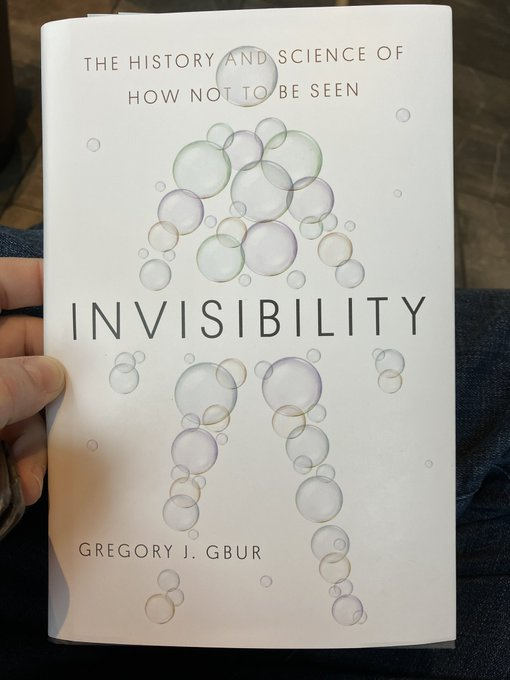
Just a short note: my editor pointed out to me that my book made the “top ten” list of Spring 2023 science books at Publishers Weekly! Saving the relevant part of the page for my own personal record:

This is a nice boost that will hopefully draw more attention to the book, including foreign translations and appearances in bookstores!

Just for the record again: you can pre-order the book at:

Amazon

Barnes & Noble

and other options at my publisher’s website!

Just wanted to share!

Posted in Invisibility, Personal | 2 Comments

The Dark Is Rising, by Susan Cooper

Have you ever remembered a book that you read as a child that you were curious to read again but you can’t remember the name of the book or the author or even enough detail to track it down? That was my dilemma for a few years, as I remembered reading a series of fantasy novels in grade school, one of which featured an evil skeletal horse. Initial efforts to track it down were unsuccessful, as depending on the wording you use on an internet search you either find skeletal horses from Minecraft or the Mari Lwyd from South Wales:

A Mari Lwyd from 2014, via Wikipedia.

About six months ago, however, by some dumb luck I finally found what I was looking for: The Dark Is Rising sequence, five novels written by British author Susan Cooper from 1965 to 1977. The first book, Over Sea, Under Stone, was written much earlier than the others, in 1965; I opted to begin my re-read with the second book, The Dark Is Rising, which was originally published in 1973:

This was the young adult fantasy series to read of my generation; everyone I knew in grade school got around to reading it at some point! But would it hold up for an adult reader?

Continue reading
Posted in Fantasy fiction | 3 Comments

Consider the Platypus, by Maggie Ryan Sandford

As I’ve said a number of times, the pandemic really destroyed my ability to read, and now that I’ve achieved some sense of mental stability again I’m working to catch up on a bunch of the books that I just hadn’t had the energy to read.

This includes science books as well as fiction, and recently I decided to dive into Consider the Platypus (2019), a book by one of my Twitter friends Maggie Ryan Sandford!

This book is a fun exploration of evolution and all its modern developments, told through the descriptions of a variety of animals, from relatively mundane creatures such as cows, dogs and cats to truly unusual beasts such as axolotl, hoatzin and the titular platypus.

Continue reading
Posted in Animals, General science | Leave a comment

Old School Dungeons & Dragons: Part 28

It’s been a while since I did some Old School Dungeons & Dragons on Twitter, but I’ve finally gotten myself back into the rhythm! (I am now also posting the threads on Mastodon, given the instability of Twitter.) Hopefully I’ll keep up the routine. So let’s get started…

X10: Red Arrow, Black Shield (1985), by Michael S. Dobson. This is one I wanted to get my hands on some time ago!

Continue reading
Posted in Dungeons and Dragons, Entertainment, Fantasy fiction, role-playing games | 5 Comments

Physics demonstrations: Oculus Mundi

So, for some reason, my ten year old video on the Barkhausen effect went viral on YouTube the past few weeks, and brought me quite a few new followers there. I thought I’d do a short video to say “thanks for following” to folks and try out a demonstration that I’ve been meaning to get around to for a while related to invisibility.

The video, about the so-called oculus mundi stone, is embedded below.

Oculus mundi (“eye of the world”), also known as hydrophane opal, is a stone that is largely opaque under normal circumstances, but when it is submerged in water, it becomes quite transparent. As noted in the video, the reason for this is that the stone is highly porous in a dry state, and all those pores strongly scatter light that shines upon them, making the stone opaque. The same sort of thing happens with milk, which is a bunch of fat molecules in water: the fat molecules make the light bounce around and generally scatter it away from the liquid. When dumped in water, the pores in oculus mundi become filled with water, and we get a rough “index matching” situation: water has a refractive index closer to opal than air does, so light gets scattered less by the water-filled pores.

I came across reference to oculus mundi while writing my upcoming invisibility book, because Isaac Newton used it as evidence for his hypothesis about the relation between opacity of a material and its microscopic structure. In his own words, from Opticks:

But farther, that this discontinuity of parts is the principal Cause of the opacity of Bodies, will appear by considering, that opake Substances become transparent by filling their Pores with any Substance of equal or almost equal density with their parts. Thus Paper dipped in Water or Oil, the Oculus Mundi Stone steep’d in Water, Linnen Cloth oiled or varnish’d, and many other Substances soaked in such Liquors as will intimately pervade their little Pores, become by that means more transparent than otherwise; so, on the contrary, the most transparent Substances, may, by evacuating their Pores, or separating their parts, be render’d sufficiently opake; as Salts or wet Paper, or the Oculus Mundi Stone by being dried, Horn by being scraped, Glass by being reduced to Powder, or otherwise flawed…

Newton felt that opacity must arise from light getting scattered as it interacts with the gaps between the “least parts” of matter. This is not a general explanation of opacity, but it does work for oculus mundi, milk, and paper. Paper is made up of a bunch of transparent fibers woven together; light gets “trapped” and repelled by these fibers, making the paper look white. If you soak paper in oil, however, for instance if you eat a greasy piece of pizza on a paper place, you’ll find that the paper becomes translucent or even close to transparent.

Hopefully the transition to transparency for the oculus mundi stone is clear in the video; it was much easier to see it in person than it is to see it on the video. Anyway, this is another rather fun little science experiment that one can do at home. Hydrophane opal can be tracked down for sale online for quite cheap.

Posted in Invisibility, Optics, Physics demos | Leave a comment

Nothing but Blackened Teeth, by Cassandra Khaw

Now that I’m back in the book reading habit, I’m also back in the book impulse-buying habit. A few weeks back, I happened to see Cassandra Khaw’s Nothing but Blackened Teeth (2021), on the shelf, and was intrigued.

It is a very short book, really a novella, of 124 pages. That makes it a quick read, and I finished it over the course of two nights.

The premise will summarize why it caught my attention in the first place: a group of friends arrange to rent out a Heian-era mansion in Japan for the wedding of two of them. Though the day starts pleasant enough, there is history between members of the group, and tensions start to build quickly.

Those tensions are nothing, however, compared to the threat that awaits them all. One of them had heard stories that a jilted bride had been buried in the basement of the house, and that every year a maiden had been sacrificed to keep her company. That bride does not rest, however, and she is looking for more companions…

Nothing but Blackened Teeth is a very fast-paced story. It is narrated from the point of view of Cat, one of the guests and a woman with a history of mental illness. Cat is very aware of horror story tropes, and she is constantly pointing out where her companions are making all the wrong choices. It ends up being very meta, in a Scream-movie sense.

My one criticism is that I kinda wish the novella spent a little more time with the characters before everything goes to hell. Their backstories are well thought out and interconnected, but it feels like the main threat manifests just as we’re really digging into their conflicts. But part of the charm of Nothing but Blackened Teeth is that it moves along at a rapid pace, giving it the feel of a TV horror anthology episode.

The supernatural horror is well done, and there are enough twists and turns in its short run to keep readers guessing. Overall, Nothing but Blackened Teeth is a fun creepy story that will keep you entertained for a few nights. I’m curious to look into more of Cassandra Khaw’s work now…

Posted in Horror | Leave a comment