
Okay, let’s look at a really cute physics demonstration that I found in a really unusual place and which has unexpected connections to optical physics! The demonstration in question is set up as follows: attach a string to a 1 inch diameter cork ball, and swing the ball into a stream of falling water from a tap. The result? The ball feels almost magnetically attracted to the stream of water! A photo of my attempt at this is shown below.

Note that the string is at an angle. If it were free to swing, one would expect the ball to fall out of the water till the string is vertical. In fact, one might intuitively expect that the ball would be forced out of the stream of water, but instead it is held within it!
In case you think this is a trick of still photography, here is a gif of the phenomenon.

As we will see, this trick has been around for quite a long time, and it is not only a great nonintuitive demonstration of some fundamental physics but can be used to illustrate a really important technique in optics!
First of all, where did I come across this? Not in any modern physics textbook (though it probably is buried in some of them), but in the August 1908 issue of The Strand Magazine!

The Strand was first published in 1891 and its original run went to 1950; it published short fiction and articles about society, trends and all sort of general interest topics. I’ve had electronic copies on hand because The Strand published some of the most famous authors of its era, including Arthur Conan Doyle, Agatha Christie and H.G. Wells, and I was looking up the latter of these a lot while researching my book on the history of invisibility physics. A few weeks ago, I was hanging out online with friends and while we were chatting I decided to browse old magazine issues for interesting things to share with them. It was in that process that I came across this image in the August 1908 issue of The Strand.
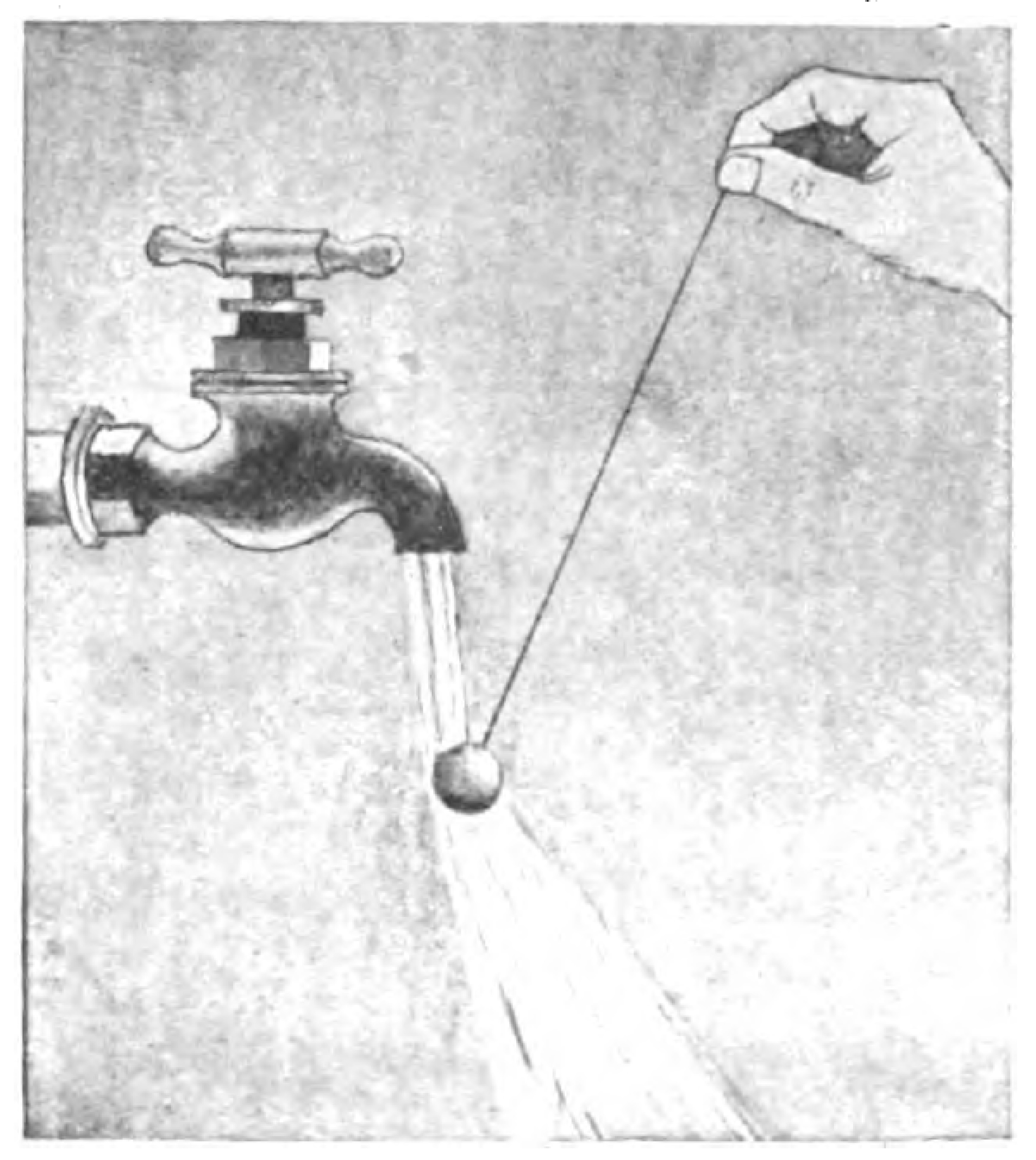
The Strand, like most magazines of the era, liked to receive correspondence from its readers, and this image I found in their regular column “Curiosities,” which shares strange observations by its readers. The text accompanying this image is:
ANOTHER PARADOX .
If a cork ball about an inch in diameter be tied at the end of a thread about a foot in length, and then swung so that it enters a smooth stream of water flowing from a tap at about three inches from the mouth of the latter, it will be found that the ball will remain in the water, and that the thread will make an angle of about thirty degrees with a vertical line passing through the ball. The latter, it should be added, must be thoroughly wetted before this result is produced.-Mr. H. T. Feather , 48, Hill Street,
St. Albans, Herts.
After seeing this, I immediately knew I had to try this! The instructions in the letter are quite specific, so all I really needed to do was get a one inch diameter cork ball. Fortunately, the internet provides, though now the ads I’m served online are a bit weird.

Somehow I was also particularly delighted to see that even the 30 degree angle described by the letter writer matches my own experiment quite well! It’s always fun to see experiments reproduced, even if quite simple ones.
So how does this work — why is the cork ball drawn into the stream of water instead of being repelled from it? I think the answer is in the sketch from The Strand itself — notice that the stream of water wraps around the cork ball and is deflected to the right. The falling water carries momentum, and when it leaves the tap, it is directed straight down. The deflection of water to the right means that the water has acquired rightward momentum, or has experienced a force to the right. According to Newton’s third law, there must be an equal and opposite reaction, so the cork ball experiences a force to the left, pulling it into the stream!
It is important to note that there is, overall, a downward pressure on the ball from the water as well, but because it is attached to the string, that force is canceled out by tension. It is worth noting that the ball won’t just levitate by itself in the stream!
When I saw this curious demonstration, I immediately recognized that it is a rough liquid analog to an important optical technique known as optical tweezing: the ability to trap transparent microscopic particles in a focused beam of light! By maneuvering the focus of the light beam, one can move around the trapped particle, making the system very much “optical tweezers.”
Optical tweezing was first introduced in 1986 by Ashkin, Dziedzic, Bjorkholm and Chu and it has since become a standard technique for optical micromanipulation.
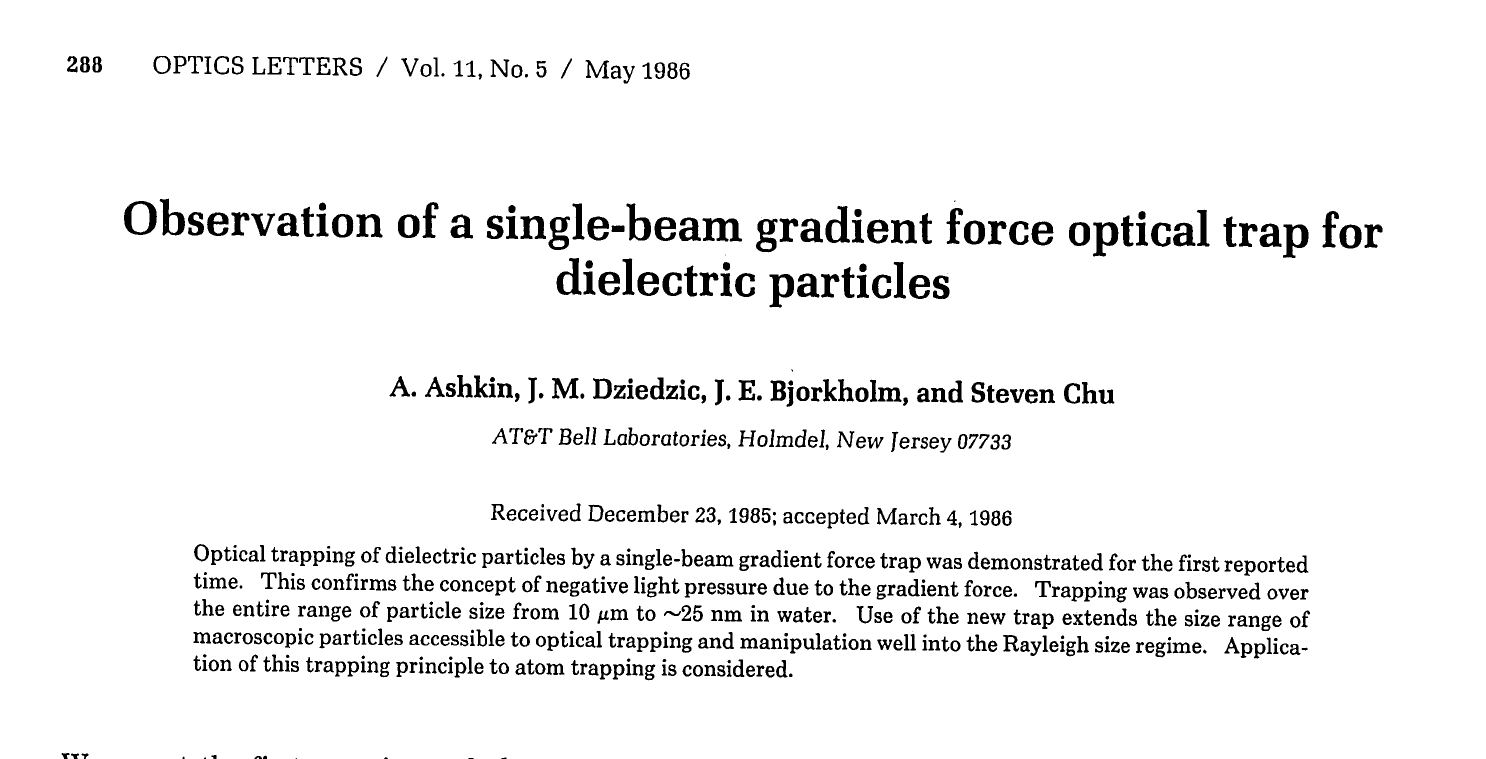
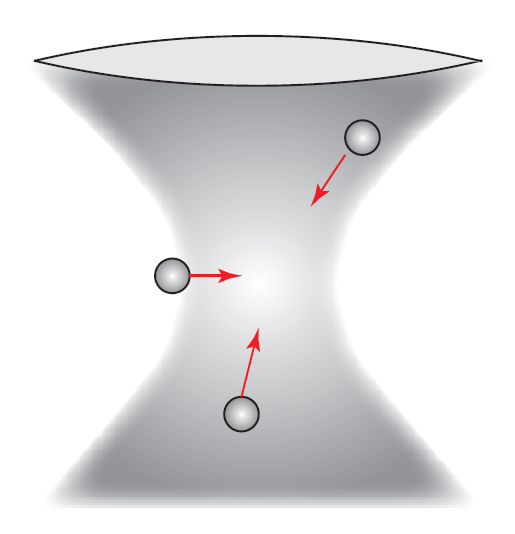
It had been known since the time of James Clerk Maxwell that light carries momentum, and in the 1970s Arthur Ashkin developed the general technique of optical trapping: using beams of light to trap atoms, molecules, and larger particles. It was thought for quite some time that counterpropagating beams were needed to trap a particle in place, because otherwise the force of light would push the particle downstream. But the 1986 collaboration showed that a single laser beam can trap a particle at its focal point, provided the beam is sufficiently “tightly” focused.
The remarkable thing is that the particle will be pulled into the focal region from any direction, even from downstream of the focal point! (Illustration from my Electromagnetic Optics textbook.)
Let us first focus on the force pulling a particle into the focal region from the side. How does this happen? Let us imagine light rays passing into a particle where the rays are more dense (light intensity is higher) on the right. The rays coming from above get refracted inside the particle and are deflected to the side. Because the intensity of rays entering are more intense on the right, more light is deflected to the left than the right, and this means that there is an overall force on the particle to the right by Newton’s third law again! The particle tends to be pulled into the higher intensity region. This force is known as the gradient force.
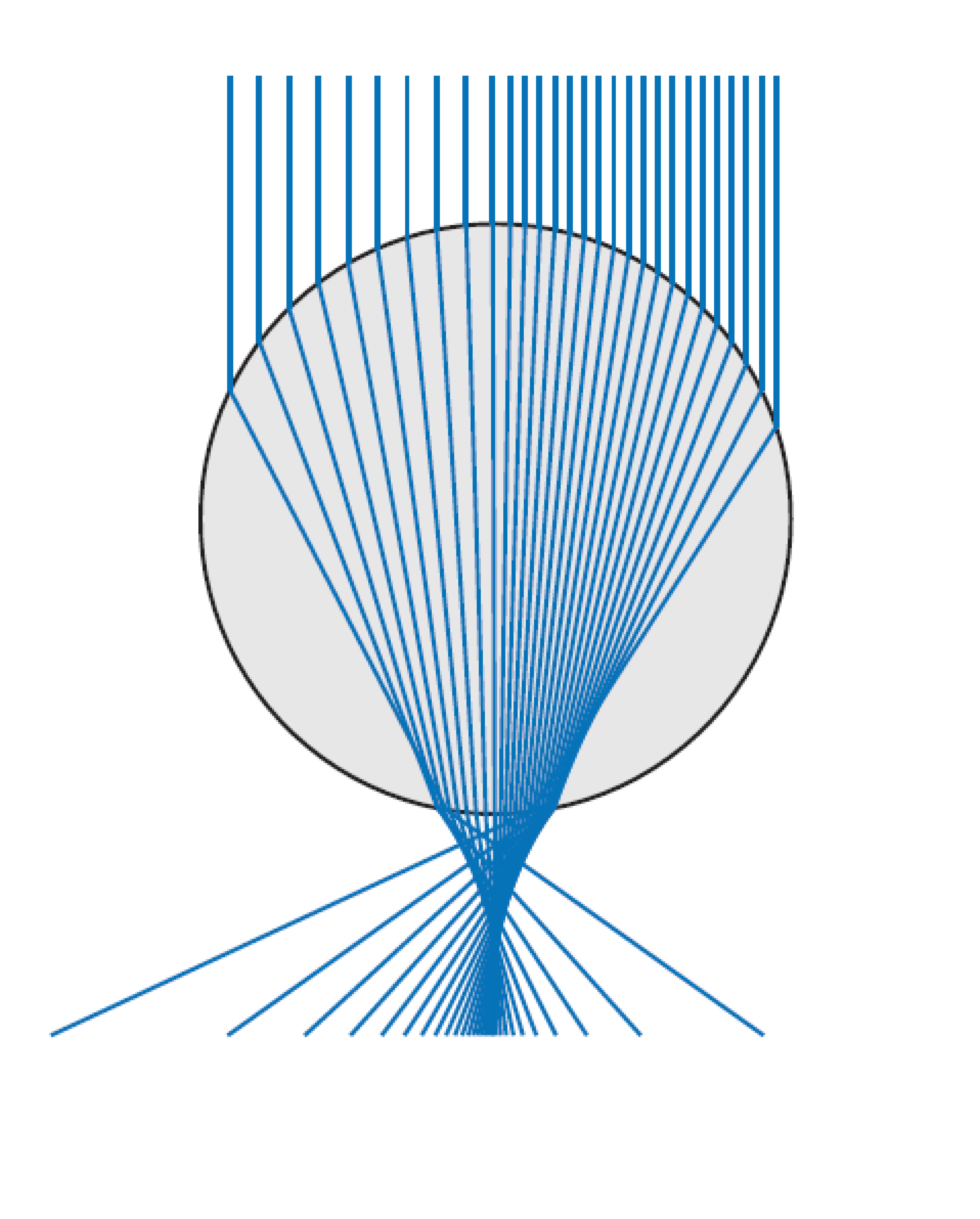
Because particles will also absorb some of the light hitting them, there is still typically a net force downstream pushing the particle away from the lens. If the light is tightly focused, however, meaning that most of the light rays come in from an extreme angle, there is relatively little radiation pressure force and the gradient force can hold the particle and keep it from going downstream.
Hopefully you can see the relationship between the phenomenon of the gradient force here and the cork ball trick from earlier! In both cases, the particle causes a change in the momentum of the incoming material — either water or light — and this causes the particle to be drawn into the region of higher “intensity” (or water flow).
I find it delightful that a simple physics trick noticed over 100 years ago can be used as a way to help explain a complicated optical physics phenomenon!


