
Though my work is primarily in classical wave optics, I maintain an avid interest in quantum physics (see my posts here and here for example) and especially all the weird implications of it, including the various attempts to make the theory philosophically consistent.
Though the theory is mathematically rigorous and agrees with experiment perfectly to this point, our default interpretation of it — usually called the Copenhagen interpretation and first developed in the 1920s — simply cannot be correct! Many attempts have been made to address this issue and philosophically “fix” quantum physics, including the 1957 hypothesis by Hugh Everett III that nowadays is usually referred to as the “many worlds” hypothesis. Everett’s idea seems to imply that there are an uncountably infinite number of universes created at every instant of time, which seems at a glance like it is just replacing one interpretation problem with an even worse one!
In this post, I thought I would discuss the “many worlds” hypothesis and muse over how it works and how it honestly isn’t any weirder than any other interpretation of quantum physics. It’s grown on me over the past few years. Like I said, I am not an expert here, so these are my “musings” more than a rigorous defense. I will along the way however talk about the history of quantum physics and why we need an alternative interpretation, even if “many worlds” turns out not to be the one.
Let us begin by looking at how quantum physics is usually taught to physics students and how it is used by most researchers — the Copenhagen interpretation. Quantum physics began in the early 20th century, usually traced to Albert Einstein’s interpretation of the photoelectric effect. Einstein argued that the effect could best be explained if light, long thought to have purely wave properties, also possessed particle properties; this became the first pillar of what is referred to as wave-particle duality. Then in 1913, Niels Bohr argued that the light emission spectrum of atoms could be explained if electrons were only allowed to exist in certain discrete orbits around the nucleus, meaning that they can only absorb/emit light at isolated frequencies. This discreteness was later explained in 1924 by Louis de Broglie, who postulated that electrons, long thought to be purely particle-like, also possess wave-like properties. This became the second pillar of wave-particle duality: matter acts like a wave. The consequence is that we believe all “stuff” in the universe, be it light, matter, or something else, acts partly like a wave and partly like a particle.
But how exactly does that work? Let us look at the classic Young’s double slit experiment to find out. Below is my illustration of the basic idea.
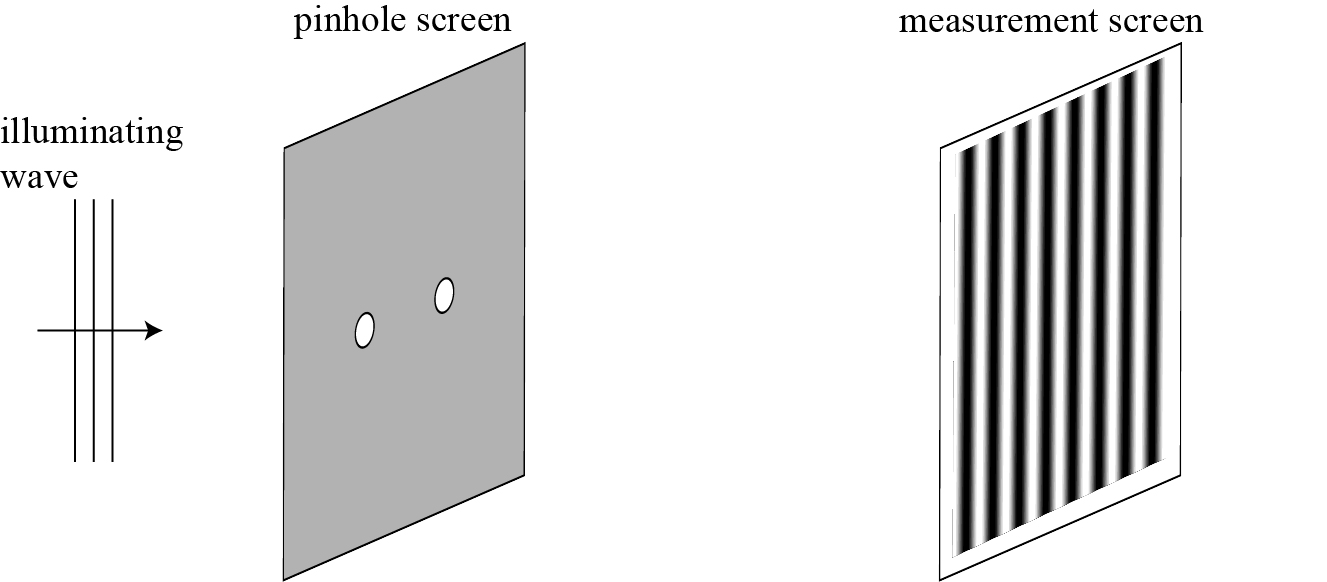
Properly prepared light (I won’t get into what I mean by that here) illuminates a pair of pinholes or slits. If the holes are of a size comparable to the wavelength of light, the light emanating from the holes spreads rapidly as it continues to propagate, and the light from the two holes overlaps and is viewed on a measurement screen some distance away. On the measurement screen, ones sees a pattern of light and dark lines which represent regions of high intensity (brightness) and low intensity, respectively.
Why do these lines appear? Young himself illustrated it beautifully in his 1807 text on physics.
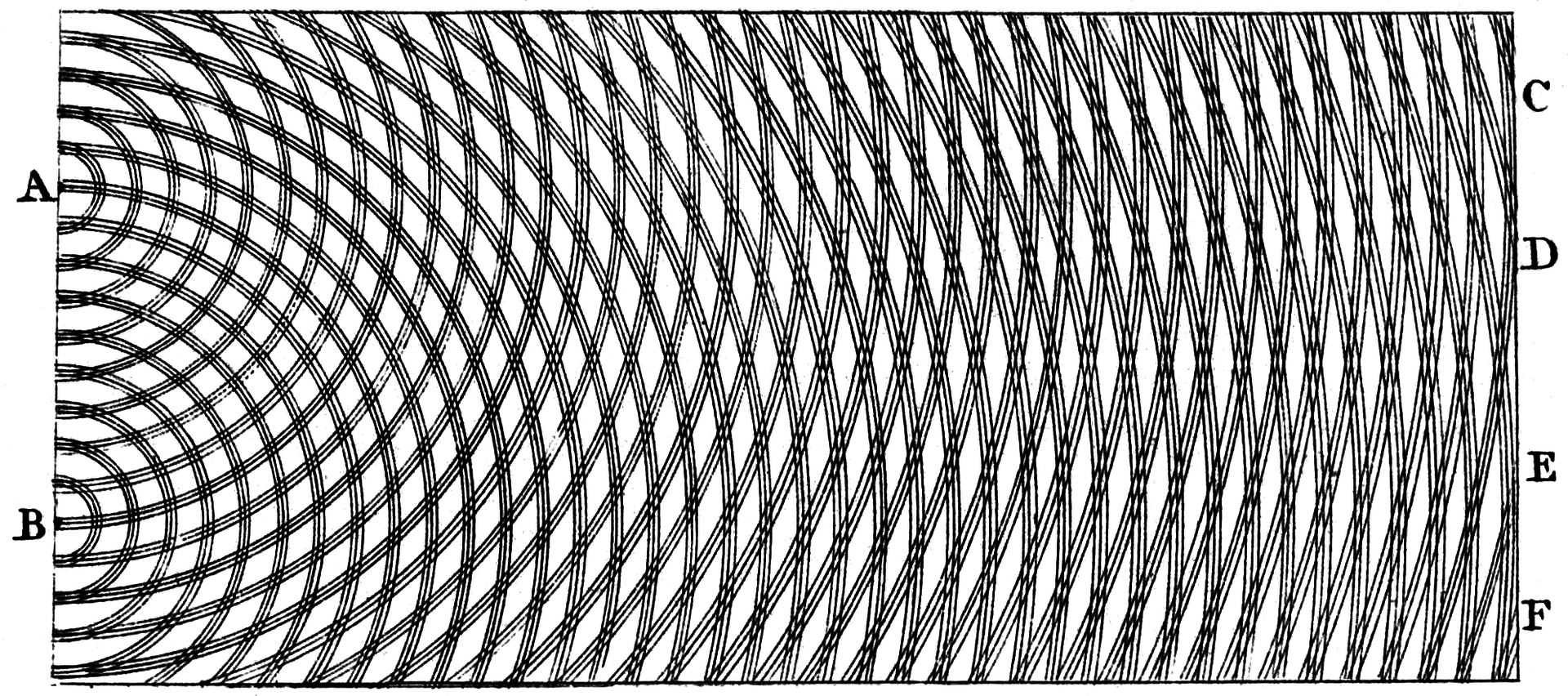
We can imagine the dark rings as regions where the wave is “up” and the white space between as regions where the wave is down. Those regions where the ups and downs of the two waves coincide — two ups or two downs coincide — are regions of high intensity, where the regions where the ups and downs do not coincide — an up meets a down — are regions of low intensity. The beauty of Young’s image is that the low intensity regions are naturally dark in the figure, and are lines that stretch to the points C, D, E, F on the screen on the right.
Young’s double slit experiment was the first conclusive evidence that light has wave-like properties, and this was the prevailing interpretation for almost 100 years until Einstein argued that light also acts like a stream of particles. This raises a natural question, however: what happens if you reduce the intensity of light interacting with Young’s experiment so that one light particle (photon) is passing through the system at a time? This was first tested in an indirect way by Taylor in 1909, and he found that when enough photons pass through the double slit experiment, one still sees the bright-dark interference pattern, even though only a single photon was passing through the system at a time!
With modern detectors, it is possible to see this much more directly and dramatically; the following figure comes from a 2008 paper by Dimitrova and Weis:
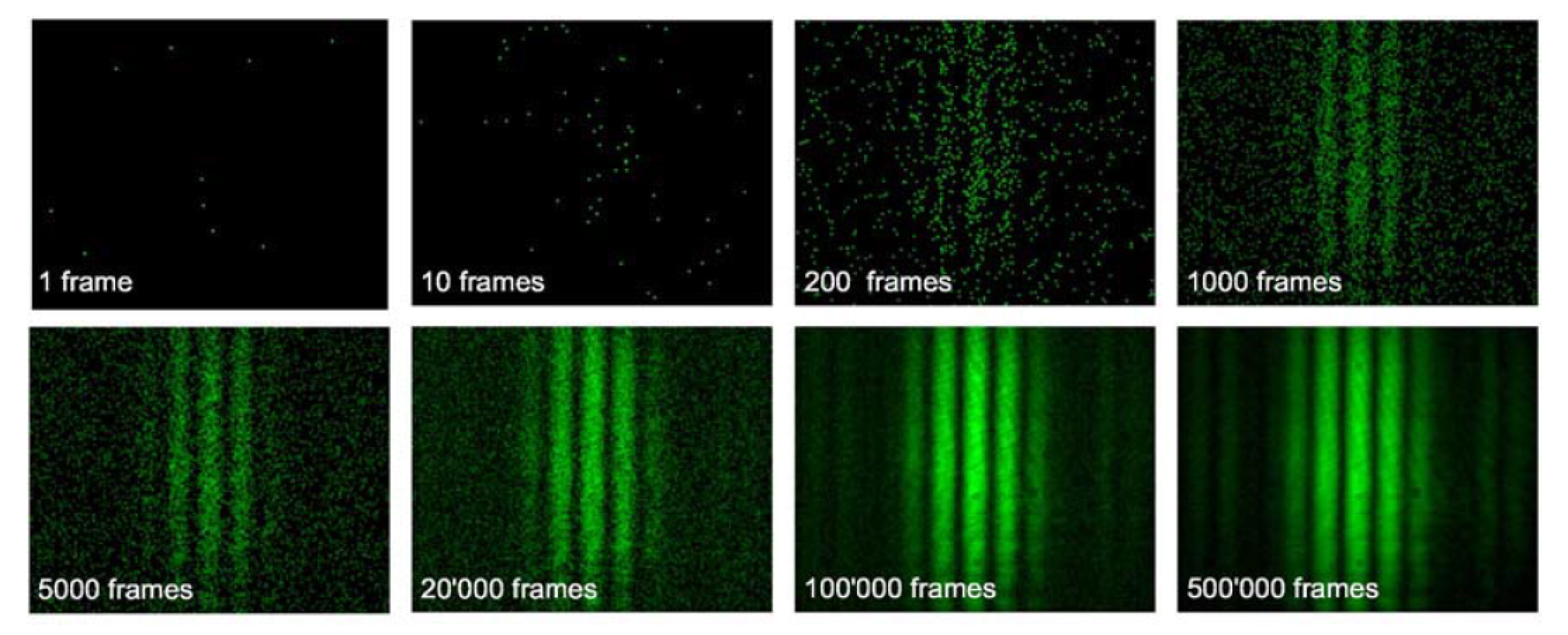
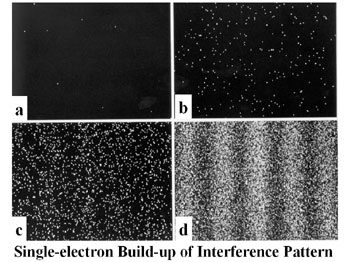
Here, they had a detector that could detect where individual photons hit the observation screen, and they tallied all the hits as time passes. One can see that at short times (a small number of frames), there are just individual dots hitting the screen seemingly at random; however, as photons build up, one can see that they form the Young interference pattern! Evidently, each photon conforms in some way to the overall interference pattern, even though it is not possible to predict where any individual photon will specifically land. One can also do the same experiment with electrons, and the same result is found: individual electrons land seemingly randomly on the screen, but a large number of electrons built up Young’s pattern. The following image is from Tonomura et al. in 1989, showing the electron pattern buildup.
How can we reconcile the fact that particles can build up wave-like interference patterns, even when they pass through a system one at a time? This was a real conundrum for physicists of the 1920s that was finally resolved by Max Born in 1926, who introduced what became known as the “Born rule.” In short, Born argued that each particle possesses its own wavefunction and that the intensity of that wavefunction gives the probability of finding the particle in that particular position. Born won half of the Nobel Prize in Physics in 1954 for this discovery, which appears to be validated by all experimental evidence, “for his fundamental research in quantum mechanics, especially for his statistical interpretation of the wavefunction.”
The Born rule didn’t by itself make quantum physics workable — the question of how that rule should be applied still remained open. Or, to put it another way: when does a quantum object act like a particle and when does it act like a wave?
Figuring out what to make of all these strange observations was a task that Niels Bohr and Werner Heisenberg set themselves on working in Copenhagen in the mid-1920s, and the consensus that built around their discussions and arguments thus became known as the “Copenhagen interpretation.” We can boil down the key parts of this interpretation to two statements (borrowing from Everett’s way of describing it):
- A quantum object evolves as a wave in time and space according to a wave equation. That wave represents all the possible states of the object; the object is not in any definite state at this point.
- When the quantum object is measured by an observer, the wave collapses into a definite state dictated by the allowed measurement results. The outcome is random, and the probability of getting a particular result is dictated by the intensity of the wavefunction for that particular result (the Born rule).
There are a lot of revolutionary, nonintuitive, and confusing ideas in these two simple statements! Let us start with my statement that “the object is not in any definite state” when evolving as a wave. To highlight this, let us imagine a traditional random process: flipping a coin (borrowing from my posts on quantum entanglement for this).

Let us consider the ordinary process of flipping the quarter first: you flip the coin and without looking at it, cover it with your hand. What is the result of the coin flip? Without looking, you don’t know, but you do know that it is definitely either heads or tails underneath your hand: the result is already there, you just can’t see it yet. Furthermore, the process was never truly random: if you were able to precisely measure the trajectory and spin of the coin as you flipped it, you could in principle determine how it would land. The randomness comes from the fact that we are ignorant of all of the processes that the coin undergoes, and the fact that you throw the coin a little differently with each toss means that on average it will be 50/50 heads or tails.
Now let us consider a “quantum quarter” that satisfies the postulates that we stated above. We have to introduce some mathematical notation to describe the wavefunction of the quarter at this point; the wavefunction of the quarter after being flipped but before being looked at would be represented by the expression,

This looks a little strange at first, but I have written the state of the quarter in exactly the form that a quantum physicist would. The combination |〉 symbolizes the quantum state of an object; by |quarter〉 we mean “the general quantum state of the quarter.” aheads represents the amplitude of that part of the wave which represents the quarter landing on heads, and atails represents the amplitude of that part of the wave which represents the quarter landing on tails. The objects |heads〉 and |tails〉 represent the quarter being either heads up or tails up.
Our equation written above, then, states that “the quantum state of the quarter (before measurement) is a combination of the quarter being in the state heads up and the state tails up.”

If it is a fair quarter, we expect that the probabilities of heads or tails are equal, i.e. 1/2 for each. (Where we use 1 = 100% and 1/2 = 50%.) Our quantum state of the quarter may then be written as:
Whenever we describe the state of a particle as being some sum of distinct outcomes, we refer to it as a superposition.
The fact that the weights of the two possible outcomes are one over square root of two rather than over two is the result of the Born rule, which says that the probability of getting a particular outcome is the absolute square of the amplitude of that outcome:

An important takeaway from this discussion is that the quantum quarter is not heads nor tails after being flipped but before being measured: it is in this indefinite superposition state where it has the possibility of being one or the other! When it is measured, the outcome is truly random: we cannot predict in advance whether it will be heads or tails, unlike the classical quarter.
Back in the early days of quantum physics, Einstein, Podolsky and Rosen argued that this idea was truly inconceivable and that the quantum case must be like the classical case: there must be “hidden variables” that dictate the outcome of the coin toss and we simply don’t know how to measure them. This is the meaning of Einstein’s famous tongue-in-cheek statement “God does not play dice.” However, physicist John Bell later demonstrated that one can test the idea of hidden variables, and experiments have shown that quantum physics is in agreement with the Copenhagen interpretation and against any sensible idea of hidden variables.
So what happens after we perform a measurement? Then the wavefunction “collapses,” according to our second postulate, to one of the definite outcomes. If our quarter comes up heads when we look at it, then the wavefunction is now of the form
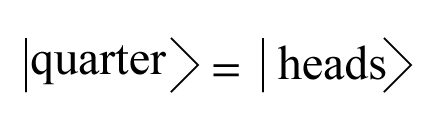
If we don’t do anything else to it, any additional measurements of “heads or tails” will from this point on give “heads.” The “tails” part of the wavefunction has disappeared.
But what causes the “collapse” of the wavefunction? Here is where we run into the problem with the Copenhagen view of quantum physics, and it all boils down to three words: collapse, measurement, and observer. According to our second postulate, the wavefunction collapses when it is measured by an observer.
Let’s start with the problem with “collapse.” The wave equation of postulate 1 is well-defined, but there is no obvious physical mechanism that causes wavefunction collapse. The collapse seems unphysically tacked on to an otherwise well-behaved physical theory. Researchers have attempted to come up with mechanisms for collapse as a random spontaneous process, but there is no clear way to test this or to even come up with a leading candidate for a collapse mechanism.
Then we have the problem of “measurement” and “observer.” The two words together suggest a very human-centric theory of quantum physics, where reality is determined by a human “observer” making a laboratory “measurement.” Some quantum physicists like Eugene Wigner even centered human consciousness in quantum theory! Basically Wigner and others like him suggest that if a human being doesn’t see it, it doesn’t happen: “if a tree falls in the forest…” type of thinking.
For most physicists, however, centering humans in quantum theory represents a bias, not an insight, and there doesn’t seem to be any reason why humans, made of the same “stuff” that everything else in the universe is made of, should be special. What about other living creatures, who also possess brains and senses and consciousness?
This sort of question connects to another famous argument against the conventional view of quantum mechanics, the Schrödinger’s cat paradox. As Schrödinger himself said it in 1935,
One can even set up quite ridiculous cases. A cat is penned up in a steel chamber, along with the following diabolical device (which must be secured against direct interference by the cat): in a Geiger counter there is a tiny bit of radioactive substance, so small, that perhaps in the course of one hour one of the atoms decays, but also, with equal probability, perhaps none; if it happens, the counter tube discharges and through a relay releases a hammer which shatters a small flask of hydrocyanic acid. If one has left this entire system to itself for an hour, one would say that the cat still lives if meanwhile no atom has decayed. The first atomic decay would have poisoned it. The ψ-function [wavefunction] of the entire system would express this by having in it the living and the dead cat (pardon the expression) mixed or smeared out in equal parts.
In other words, we tie the survival of a living creature, in this case a cat, to a radioactive atom that obeys quantum physics. As time passes, the wavefunction of the cat and the atom become entangled, so that the cat ends up in a state that is a mixture of being alive and dead.

At some point, there is a 50% chance that the cat is alive or dead, but according to our Copenhagen interpretation, the cat is both. The combined wavefunction looks like:

If we want to avoid the cat being living or dead, we can say that the cat does the “measurement” and is the “observer.” But where do we draw the line? If we replaced the cat with a single bacterium, which is technically alive, is it the observer, or is it part of the state? How about a virus? We can also go the other way and imagine the human experimenter is shut up in his lab — do we now consider him part of the full quantum state, which only collapses when one of his colleagues wanders in the room to check on him?
States like the Schrödinger’s cat state, where two or more systems are intertwined as a single quantum system, are known as “entangled states.” This concept will be key in our discussion, and for more information I refer to my full series of blog posts on the subject.
These huge questions about the definitions of “collapse,” “measurement,” and “observer” are what makes the conventional Copenhagen interpretation of quantum physics philosophically troubling. We note again that the theory, however, works perfectly well for any practical experiments one sets up, as far as we know: usually, “measurement” in that case refers to whatever lab equipment is doing the measuring and “observer” just refers to the researcher doing the experiment. There is a long-running joke in teaching and doing quantum physics: “shut up and calculate.” This means: don’t think too much about whether the theory makes logical sense, just use it because it works!
This state of affairs is unsatisfying, however, and is possibly a barrier to understanding bigger problems in physics. One huge unanswered question is how to reconcile quantum physics, which describes objects that are very small, with Einstein’s general relativity, which describes gravity and objects that are very massive. Even in Newton’s formulation, the gravitational force between two objects depends on their exact separation, something that appears impossible to know with certainty in quantum physics. So researchers have proposed a number of alternative interpretations of quantum theory that hopefully will make it philosophically consistent and provide insight into outstanding problems.
Here at long last we come to Hugh Everett, III’s ‘many worlds’ interpretation, though the title of his foundational 1957 paper is much more technical and seemingly mundane: “‘Relative state’ formulation of quantum mechanics.”
We have noted that all the problems in the interpretation of quantum physics come from our second postulate mentioned above: a “measurement” by an “observer” causes a “collapse.” Everett takes the bold step of scrapping that postulate entirely and saying that the entire universe satisfies the first postulate: everything in the universe is part of a single wavefunction that evolves in time. There is no collapse: every possibility and outcome evolves simultaneously in the wavefunction. This immediately erases the problem of “where do you draw the line between quantum and classical?” by saying there is no line: everything is quantum.
At first glance, it may not seem like this resolves the “collapse” problem at all: if everything in the universe is a quantum wave, including us, why does it seem like quantum waves collapse when we measure them? Here is where the idea of a “relative state” comes in: Everett argues that in every quantum calculation we have to take into account that we cannot completely separate out the state of the detector from the state of the quantum particle: they are, like Schrödinger’s cat, entangled. To see this, let us imagine a combined detector (D) and quantum quarter state. After our measurement, instead of the quarter “collapsing,” we end up with a combined state that looks something like this:

That is, the combined state now includes both possibilities: the quarter is heads and the detector measures heads and the quarter is tails and the detector measures tails. “Relative state” here refers to the idea that we can only define the state of the quarter relative to the state of the detector.
But how does this eliminate the problem of “collapse,” and why don’t I see a quantum wave that is simultaneously heads and tails at the detector? Here is where we have to finally break away completely from the human-centric Copenhagen interpretation of quantum physics: your consciousness and your perceptions represent a definite state of your brain. Everett’s hypothesis indicates that everything in the universe, including your brain, is part of the quantum system. In the wavefunction above, the detector D is not only the measurement apparatus but also the final state of your brain. You perceive only one outcome to the measurement because your consciousness is tied to one particular outcome of the measurement.
Everett himself talked much more abstractly about this; I understand that he was encouraged to tone down the language of his paper to make it more palatable to other researchers (recall that people like Eugene Wigner were still out there). He talks about a series of measurements being recorded in a “memory sequence,” though he does briefly note the connection to the brain:
These configurations can be regarded as punches in a paper tape, impressions on a magnetic reel, configurations of a relay switching circuit, or even configurations of brain cells.
To attempt to put it another way: the wavefunction evolves with every possible outcome happening simultaneously, but what we call consciousness is apparently tied to one specific configuration of our brain, so we can only perceive one outcome to any measurement.
We thus have that “collapse” is basically an illusion of our perceptions, “observer” is just a reference to a particular recording device, and “measurement” really represents a correlation between one system like our quarter and another system like the device we use to record the state of the quarter.
One big difficulty in swallowing Everett’s interpretation is that is seems to imply an infinite number of universes, and new universes “branching” off every time a “measurement” is made, which is constantly because it involves every interaction of every particle. Philosophically, the idea of an infinite number of universes being created all the time seems at first glance like an even more extreme and untenable explanation than the Copenhagen collapse! The 1970 article “Quantum mechanics and reality” by Bruce Dewitt that brought the theory into the popular consciousness also probably added to the objections because of the use of the term “many worlds” to describe it. (I don’t mean this as a criticism of Dewitt: we’re so far beyond the realm of everyday intuition that any attempt to describe the theory in ordinary language is going to be inadequate.)
For me, there are a few ways to look at things that reduce the objections. First, we note that Everett never argues for an infinite number of universes: he argues for a single universe, but that universe is a quantum universe. From our classical-brained perspective of the world, this implies an infinite number of classical universes, each with a definite state, but that again this seems to be a bias of our own human-centered perceptions. When Einstein’s special relativity came about, it suggested a version of space and time very much at odds with how we viewed the universe to work; we were forced to acknowledge that our perceptions were not the arbiter of what is truly going on. Likely we need to do the same thing for quantum physics.
Second, I find that the whole concept of “branching” universes also to be a bit of a human-centered artifact, though in a manner that is harder to put my finger on. The wavefunction of the universe, if it exists, evolves continuously through all possibilities. “Branching” seems to already imply taking a relative state approach: if we assume we make a measurement at a particular point in time, then we see a discrete splitting at that point in time, but the sharpness of that change appears to me to be an illusion caused by the fact that we’ve already made some definite choices for the state of the wavefunction.
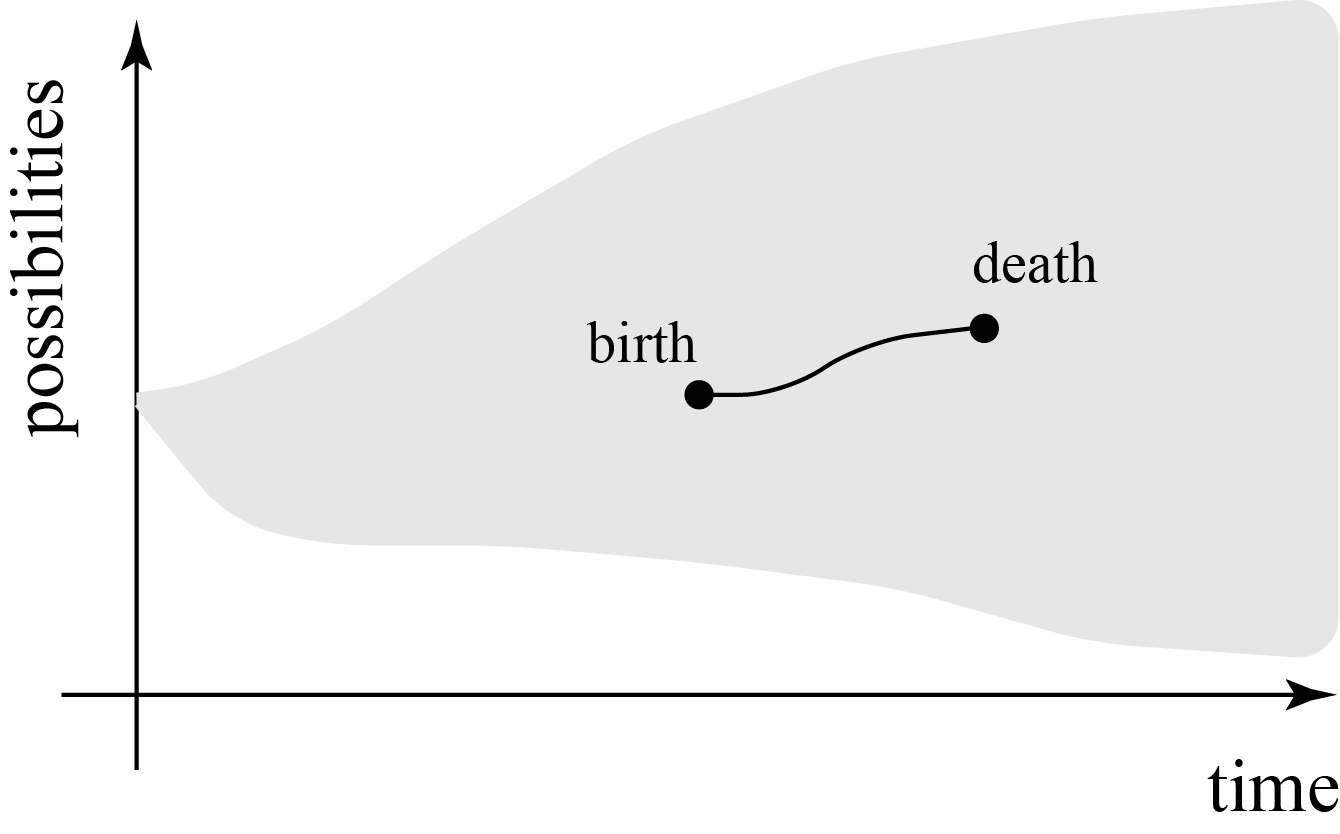
It is worth noting that quantum wavefunctions, as describe by Schrödinger’s equation, tend to behave a little like the spreading of waves and a little like the diffusing of gases. Rather than picturing the “universal wavefunction” as constantly evolving discrete branches, I prefer to view the wavefunction as diffusing through all possibilities continuously as time goes on.
I kinda imagine a very crude picture of the universal wavefunction as something like below: as time passes from the start of the universe, the wavefunction spreads out and encompasses more and more possibilities. Our entire lives are encompassed by a single trajectory through this wavefunction.
There is one other aspect of Everett’s relative state theory that is worth discussing: how it somewhat naturally suggests the probabilistic prediction of conventional quantum physics, i.e. the Born rule. We won’t repeat his argument in detail but just summarize it. First, we recall that each possible state of a quantum wave has an amplitude (like the 

But the amplitude of a quantum wave is in general a complex number, not a non-negative real-valued number, like a true probability must be. Therefore the probability of a particular result must somehow be related to the absolute value of the amplitude. Then, based on the very reasonable requirement that the probability of either event 1 or 2 happening must be the sum of the probabilities of 1 and 2, Everett argues that the Born rule seems to be the only choice.
This derivation by Everett is mostly a plausibility argument and my understanding is that it doesn’t “prove” that the Born rule follows from his relative state ideas, but demonstrates that the Born rule is very naturally the conclusion one draws based on straightforward assumptions. From what I’ve read, people are still debating about the relationship between the Born rule and “many worlds” ideas. Research — and arguments — about different ways to define “many worlds” models for quantum physics are ongoing to this day. Everett’s basic idea becomes less of a solution and more of a path to asking more refined philosophical questions.
Anyway: as suggested in the title of this post, these are all just my musings of how I view the “many worlds” interpretation and why it doesn’t bother me as much as it used to when I first heard about it. The many worlds hypothesis is not a scientific hypothesis, because as far as we know it doesn’t provide any experimentally testable predictions and we thus have no way to find if it is correct or not. However, as John Bell showed with his demonstration that “hidden variables” theories can be tested, there is always the possibility that someone will find out that the non-testable hypothesis can be tested after all.
We end up in the curious situation where we can say that although “many worlds” is not a scientific hypothesis, it is nevertheless really important scientifically, because it shows that there are ways to formulate quantum physics without relying on the philosophically troubling aspects of collapse, observers, and measurements that the Copenhagen interpretation relies on. There are other formulations such as relational quantum physics, pilot wave theory, and QBism. “Many worlds” seems to have an advantage conceptually in that it doesn’t involve a lot of additional assumptions to make it work.
I should stress that I don’t “believe” in the “many worlds” hypothesis, because as a scientist I don’t have to accept any hypothesis that doesn’t have evidence to back it up! Years ago, I heard Douglas Adams speak live when he was on tour promoting his nonfiction book Last Chance to See. After his reading, he took questions from the audience, and one question was “Do you believe in UFOs?” Adams paused for a moment and then said “Let me have a go at this word ‘believe'” which drew much laughter from the audience. He elaborated that it is really irrelevant whether he believes aliens or UFOs exist or not, because they either do or they don’t and his opinion makes no difference for that existence! I feel the same way about quantum interpretations — there is presumably some “truth” out there, but my personal opinion on it isn’t really relevant.
I don’t even have to have a “preferred” hypothesis; I can simply think about the different options and ponder their implications and whether there is a way to sort them out experimentally! This is the real joy of being a scientist: getting to think about weird things!
I hope you’ve enjoyed this bit of a ramble on “many worlds” quantum physics!


Loved these musings! I gotta say I now view the Many Worlds interpretation a little bit different. As a quantum chemist, I don’t really need to look too deep into the interpretation of quantum mechanics; I mostly live in the ‘shut up and calculate’ realm, though it’s a lot of fun to peek into them.
When I first heard of the MWI of QM, my first problem was with mass: where would infinite mass come from to create an infinite number of universes? (again, chemist here), I quickly found out that was not the issue; in fact, that is why (I think, Sean Carroll likes to call it Everettian interpretation and not MW. I like your view of a ‘joint evolution of a quantum universe’, and maybe ‘many worlds’ is as a problematic word as ‘collapse’.
I once heard a physicist say that your academic formation or upbringing set a bias in your view of QM, so if you came from particle physics you were inclined towards Copenhagen whereas if you cam from relativity you were more inclined towards Many Worlds.
All the best!