
Out of all the concepts that have appeared in science fiction, one of the most ‘science fiction-y’ of them all is the idea of teleportation — near instantaneous movement from one location to another, such as the transporters in Star Trek.
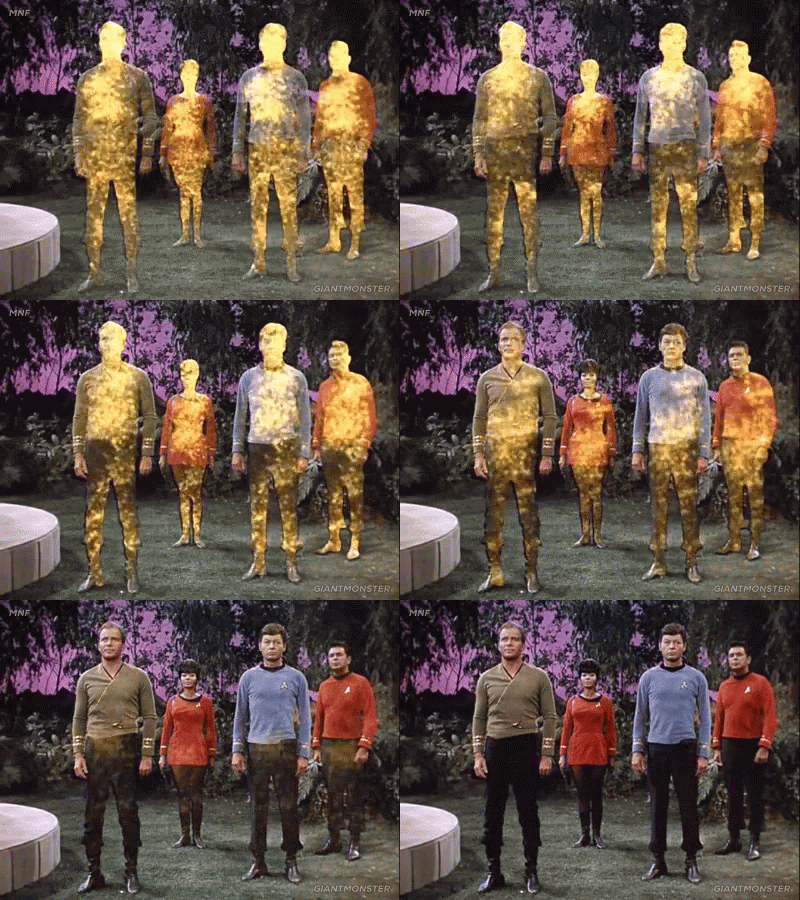
I call this one of the most ‘science fiction-y’ because it seems like one of the most impossible technologies, going against our common sense of how the world and science works! However, it turns out that in the realm of quantum physics, it is possible to “teleport” a quantum state from one particle to another. The idea was first proposed in the 1990s and has been confirmed experimentally. It is a far cry from a Star Trek-like transporter but it is another excellent illustration of how quantum physics breaks our intuition of the universe. In this post, I thought it would be fun to try to explain exactly what it is all about! We’ll use a few formal equations, but the most we’ll do is add and subtract things and substitute from one equation to another.
The first thing we need to do, and this is an important step, is talk about classical and quantum objects and classical and quantum states and the differences between them. We will, for simplicity, consider as an example the humble quarter:

A quarter is an object, and it is one of a class of objects that we call “quarters.” In the classical world, i.e. in the world of our everyday experience, all quarters have similar properties but are not necessarily identical. Some are printed at different mints, some in different years, and even those printed at the same mint in the same year would possess slight imperfections that we could use to distinguish them if we were to look closely enough.
If we consider a “quantum quarter,” imagining a quarter as an elementary particle, we instead can say that every quantum quarter object is exactly identical and indistinguishable. If you and I each took our own personal quantum quarters and stuck them in a box together and shook the box up, when we opened the box we would be unable to tell them apart. This is true of every class (or species) of elementary particle — every electron, for instance, has exactly the same mass, charge, and inherent angular momentum (spin). This may seem like a minor point but will be very important in the discussion of teleportation.
Now let’s talk about states. We may loosely define “state” as part of the overall condition of the object. For most classical objects, the state includes many variables — basically anything you would use to describe what the status of the object is. For a car, its “state” includes whether it is on or off, whether the wheels are turning or not, whether the brakes are applied or not, what speed it is moving, etc. For an ordinary quarter, one of the most useful aspects of its state is whether it is “heads up” or “tails up.” It is, of course, either one or the other. If we flip a quarter and cover it with our hand without looking at it, we know it is either heads or tails even if we personally don’t know which it is.
For a quantum quarter, the situation is quite different! A flipped but unobserved quantum quarter can be a simultaneous mixture of heads up and tails up — we say that the quarter is in a superposition of the two outcomes, which we may mathematically express in the following form:

The combination |…> is known as a “ket” and symbolically represents the state of a quantum object. This state is usually called the wavefunction of the object, because quantum objects have wavelike properties. This expression tells us that the wavefunction of the quarter is a mixture of a “heads” state and a “tails” state with respective amplitudes aheads and atails.
This equation covers one of the big aspects of quantum physics: when a quantum object is allowed to freely evolve, it can exist in a superposition of different definite states. In this case, we say that the quarter is a mixture of heads and tails simultaneously.
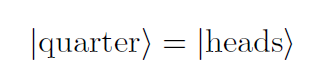
This situation changes when we make a “heads-tails” measurement of the quantum quarter: that is, we peek under our hand to look at whether it is heads or tails. Then we will find that it is one or the other, and subsequent “peeks” will show that it has remained in that state. The process described is what is usually known as collapse of the wavefunction: a measurement of the state of the quarter has forced it to choose one of the definite outcomes. If the quarter measurement gives heads, then we know that the state of the quarter after measurement is
But how do we know which outcome will occur? From what we understand of quantum physics, the outcome is inherently random, and if we were to flip a bunch of quantum quarters that all had the same aheads and atails we would find that the probabilities of getting heads or tails are given by the squares of the amplitudes:

If the quarter is a fair quarter, we expect these two probabilities will be equal to 50%. This interpretation of the wave amplitudes, as relating to the probability of a measurement giving a particular result, was introduced by Max Born to help explain the baffling observations of quantum physics and is therefore known as the Born rule. To the best of our knowledge, the outcomes of quantum measurements are truly random, with the wave amplitudes dictating the probabilities of specific definite results.
One consequence of the collapse of the wavefunction is that the measurement of a quantum particle in general irrevocably changes its quantum state. This again will be important momentarily!
This talk of “quantum quarters” may seem quite over-simplistic, but it is in fact representative of how the simplest quantum systems actually work! An electron, for example, has an inherent “spin” to it; if we were to measure the spin of the electron along a particular direction, we will always find that it is either “spin up” or “spin down.” In this case, the wavefunction of the electron spin might be written as
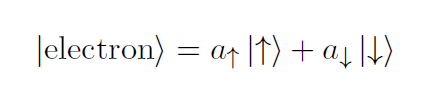
This indicates that the electron is in general a mixture of up and down spins along the axis of measurement. If it seems weird that the spin measurement can only take on one of two values, well, welcome to the strangeness of quantum physics!
A similar description can be used to describe the polarization of a particle of light (photon). The photon will in general be in a superposition of up-down and left-right polarizations, which we can write as
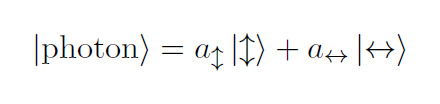
We tend to talk about photons a lot more than electrons in these discussions, because it is much easier to produce, manipulate, and measure photons in quantum experiments.
There is one other aspect of quantum states and measurements we need to discuss: a change of basis. The way we have written the photon state above, it is implied that we are performing a measurement of whether a photon is up-down or left-right. We can also, however, perform a measurement where we look at whether a photon is oriented at +45 degrees or -45 degrees, and we can relate the up-down and left-right states to the 45 degree ones:
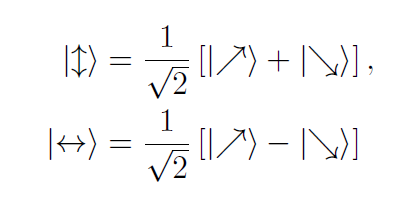
We can substitute into our previous equation for a photon to write its general state in terms of the 45 degree states instead of the up-down, left-right states, and determine the probabilities of getting those results from the Born rule. The important takeaway: the type of measurement we do on the particle will affect the type of results we get and the type of final state we will get. If we measure a photon in the 45 degree states, we will get a photon out that is in one of the 45 degree states. This again is very different from our familiar classical world, where we can usually do a measurement on an object without significantly changing the state of the object.
We need to discuss one more really important aspect of quantum physics before discussing teleportation: quantum entanglement! Let us begin by sticking with “quantum quarters,” but now we imagine two quarters stuck back to back:

If this were a classical pair of coins, we know that after flipping the coins, one will be heads up and one will be tails up. For our quantum quarter pair, if we flip the pair but don’t look at the result, we expect that there will be a superposition of the two outcomes:

This indicates that the state of the double coin is a mixture of the possibilities “coin 1 heads and coin 2 tails” and “coin 1 tails and coin 2 heads.” This is an example of an entangled state: we cannot talk independently about the behavior of one coin or the other: their fates are intertwined! We cannot say for certain whether either coin alone will be heads or tails, but we know for certain that one will be the opposite of the other. The maximally entangled state will be the one where the two amplitudes, and two probabilities, are equal.
For brevity going forward, we’ll write the state in an abbreviated form where we use a single ket to describe both particles together, and “up” and “down” can represent spin, photon polarization, or quarter orientation:

The quantum quarter example does not capture the most significant aspect of quantum entanglement: with entangled electrons or photons, the two particles can in principle be sent to different locations, arbitrarily far away, and remain entangled. Then the measurement of the state of one particle, and the collapse of its wavefunction, will cause the other particle to collapse instantaneously to its corresponding state, regardless of the distance between the particles. This is what Einstein famously referred to as “spooky action at a distance” as an objection to the existing interpretation of quantum physics. However, this spooky action has been found to exist in countless experiments and a large part of why experiments like quantum teleportation were invented was to further test exactly how it works.
Okay, now let’s talk about quantum teleportation! We will only give a loose description of how it works here, to avoid getting bogged down too much in the mathy side of things. The basic scenario is as follows. Let us imagine we have two people, traditionally called Alice and Bob, and each of them has one photon from a perfectly entangled pair, and we call these photons A and B. The quantum state of these two photons is thus:
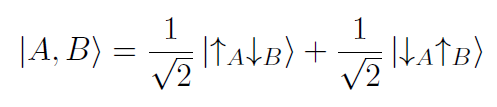
Alice also has a second photon that we will call Q that is in an arbitrary quantum state, i.e.
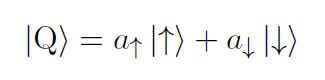
We assume that Alice does not know the exact state, i.e. she does not know the value of the two a‘s. Alice would like to send her quantum state Q to Bob. (We will leave out the obvious choice of her just carefully sending the entire photon to Bob.)
Intuitively, one would argue that Alice simply has to measure the state of the photon and send that information to Bob, and then he could modify the photon in his possession. But measuring a photon gives a random result and does not tell us anything about the value of the a‘s; furthermore, the measurement changes the state of the photon, wiping the original state entirely!
Instead, Alice does the following: she measures her photon A and the unknown photon Q in a simultaneous quantum measurement called a Bell-state measurement. Keep in mind that there are four “definite” states that the two photons could be in, namely

We can measure both photons “up” or both photons “down” or there are two ways we could measure one “up” and one “down.” These are the states we would measure if we directly measured the condition of the two photons.
But just like we can measure a single photon in either an “up-down-left-right” measurement or a “45 degree” measurement, we can measure the two photons together in a different way using Bell states, written as
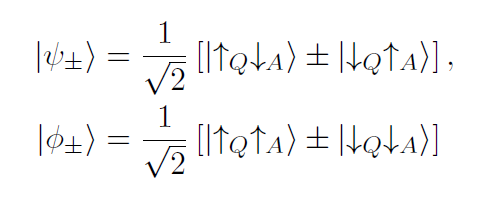
The “plus-minus” signs in the equation indicate we’re talking about two different states in each equation, one with a plus sign and one with a minus sign. These are four different entangled states, indicating a definite relationship between photons A and Q. It is worth noting that measuring which Bell state our photon pair is in does not tell us anything about the state of the photons separately, as there is still a chance for either photon to be “up” or “down.”
If such a measurement is made, the wavefunction of photons A and Q therefore collapse into an entangled state. This means that A and Q are now related to one another, but since A and B are entangled, the wavefunction of Q is now related to B! We may loosely say that some information about Q has now been instantly imprinted upon B — this is the physical process of the “teleportation.”
However, we the wavefunction of A and Q will have collapsed randomly into one of the four Bell states, each of which is different. The implication of this is that although some information has passed from Q to B, the state of B is only exactly the state of Q in one of four outcomes — in the other three it is simply related to Q but still different. However, Alice can send the result of her measurement to Bob through an ordinary communication channel, and Bob can make a transformation on his photon B based on that information that will turn it into an exact copy of Q.
The overall scheme is illustrated, roughly, below. This is the sort of approach that was proposed in the original 1993 teleportation paper [1] and was tested for the first time experimentally in 1997 [2].
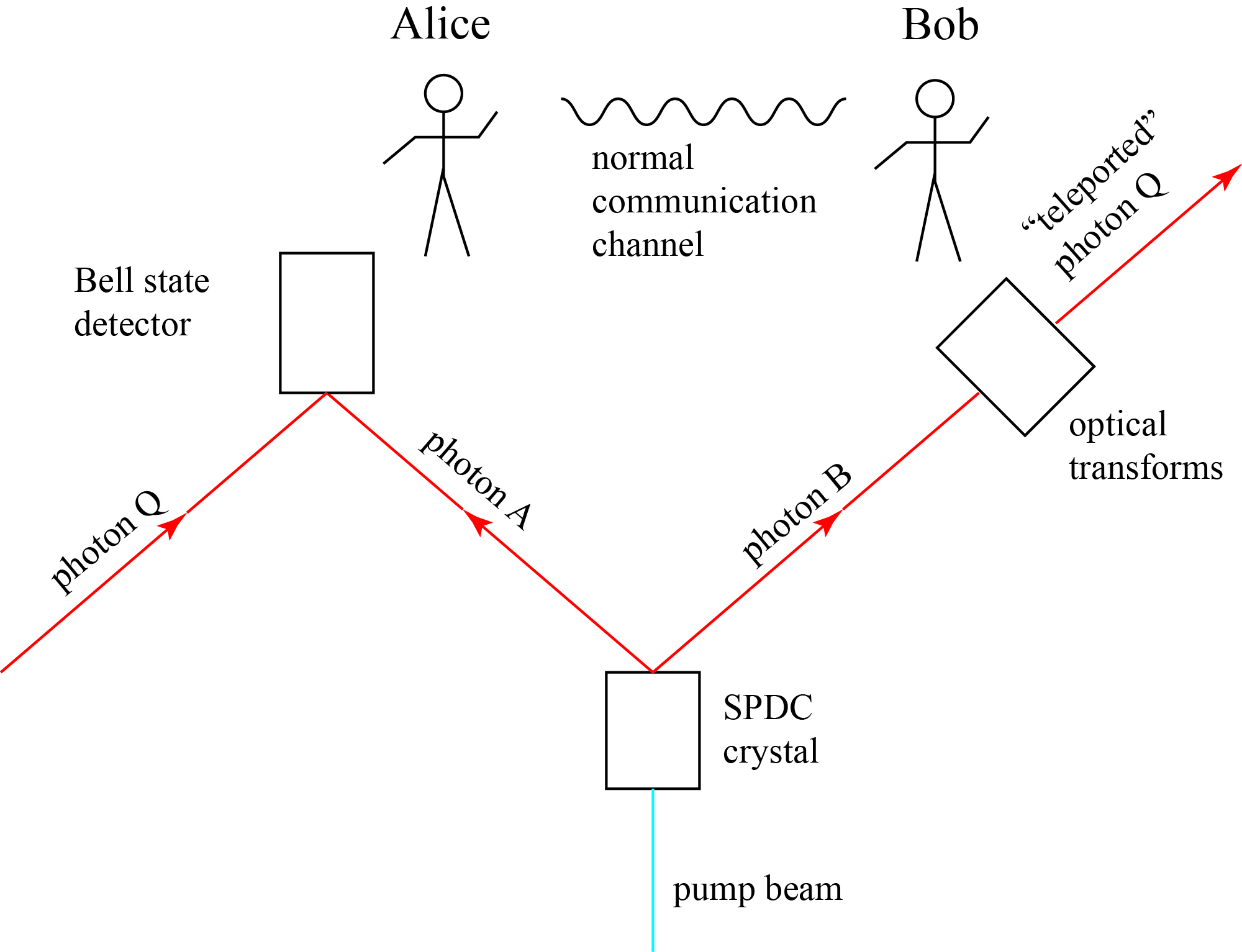
The entangled photons A and B are created from a pump laser beam that passes through a crystal that splits the original photon into two entangled ones through the mechanism of spontaneous parametric down conversion. Photon A is sent to Alice and photon B is sent to Bob.
Alice takes photon A and measures it with the mystery photon Q in a Bell state detector, which effectively entangles all three photons. She sends the result of her measurement to Bob through a normal communication channel, and based on that information he applies optical transforms to turn his photon B into the perfect reproduction of photon Q, whose original state has been erased by the Bell state measurement process. Photon Q has been “teleported.”
Here is where I note again that photons as objects are inherently indistinguishable. The teleported photon Q has all the same properties and in a perfect experiment the exact same state as the original photon Q, which now is in a different state. I did not choose the example of a Star Trek transporter randomly at the beginning of this blog post — this is more or less how such transporters are said to work on the show! They record all the information of the person at the starting point, destroy that person, and then reconstruct them at the destination point. It raises interesting philosophical questions about whether you would be the same person after that transport or not — were you really transported, or duplicated and destroyed? Is it the sum total of information about your physical body that defines you, or is it also the specific atoms that you are originally made of as well? It is very much a Ship of Theseus problem.
Probably fortunately for us, it is a problem we almost certainly won’t have to worry about in practice. Though quantum teleportation schemes can probably be scaled up to a few elementary particles being teleported simultaneously, there is no conceivable way to apply this process to a person or really any living thing. We are just made of too much “stuff” and far too complicated to transport.
This isn’t to say that quantum teleportation doesn’t have potential uses — for long distance quantum communication, it is considered a key technology. In general, sending a single photon over a long distance while preserving its quantum state is very impractical. However, one can create a sequence of “quantum repeaters” that is in effect a series of experiments shown above linked together, the net result of which is to entangle two photons that are very far apart, thus allowing reliable transfer of the state over long distances. Being able to send photon states over long distances is a necessary ability in order to do quantum cryptography.
There are a number of interesting details to note about the experiment as described above; one is the physical necessity of the communication channel. This supplementary information can only be sent on this channel at the speed of light, and the photon state Q cannot be fully realized until this information arrives. Even though the “spooky action at a distance” happens instantaneously, the photon state cannot be transferred faster than Einstein’s relativity allows.
Another detail of note is that the original quantum state Q is destroyed when it is transferred to photon B. This is consistent with a theorem of quantum physics called the “no cloning theorem,” which indicates that it is not possible to perfectly copy a quantum state to have two or more in the same state. This again has the consequence that it is not possible to transfer information faster than the vacuum speed of light.
A particularly big wrinkle in the experiment as illustrated above is that nobody in fact knows how to make an ideal Bell state detector as described! The original 1997 experiment was only able to confirm when a photon was in one out of four of the Bell states, so the experimental efficiency was basically 25%. Later experiments improved this to 50%, but it has been an active area of research to figure out how to make a Bell state detector for photon polarization that is 100% efficient at detecting Bell states while simultaneously close to 100% accurate in teleporting the quantum state. From what I’ve seen, it has been a struggle to get both the efficiency and accuracy high enough for practical applications [3], and there are other subtle issues that arise in the process.
So we can, in principle, teleport simple quantum states! There are a lot of practical issues to overcome, but everyone seems to agree that the science is correct. If and when this becomes a key part of a “quantum revolution” in our technology remains to be seen. But ideas and experiments like these test our understanding of quantum physics and its limits.
**********************************************************
[1] Bennett, C. H. et al. Teleporting an unknown quantum state via dual classical and Einstein-Podolsky-Rosen channels. Phys. Rev, Lett. 70, 1895-1899 (1993).
[2] Bouwmeester, D. et al. Experimental quantum teleportation. Nature 390, 575-579 (1997).
[3] Pirandola, S., Eisert, J., Weedbrook, C. et al. Advances in quantum teleportation. Nature Photon 9, 641–652 (2015).


Very well explained and easy to follow for a simpleton like mysel. Thank you for putting it in a relatable story. Good work.
Thank you!