Weird science facts, July 04-July 17

The Twitter #weirdscifacts from June 20 – July 03 are below the fold!

Continue reading

Posted in Weirdscifacts | Leave a comment

Optics basics: surface plasmons

My goal in my “basics” series of posts is not just to introduce the most elementary topics in optical science, but also to give background on some of the more advanced concepts for future reference.  Much of my own research, and consequently my blog interests, center on nano-optics — the study of the behavior of light on scales much smaller than the wavelength of light — and one specific aspect of nano-optics that has grown tremendously in importance over the past ten years is the concept of a surface plasmon.

Broadly speaking, a surface plasmon is a traveling wave oscillation of electrons that can be excited in the surface of certain metals with the right material properties. Because a plasmon consists of oscillating electric charges, they also have an electromagnetic field associated with them which also carries energy. There’s a lot of terminology to explain in that short definition, and in this post I’ll explain what a surface plasmon is, the properties of surface plasmons, and how those properties make them useful in nano-optical applications.

Continue reading

Posted in Optics basics | 8 Comments

ResearchBlogging editor’s selections: the Peruvian coffee paradox, galactic positioning, going green, the Alpine Fault, and hurricane plankton

skyskull “Dr. SkySkull” selects several notable posts each week from a miscellany of ResearchBlogging.org categories. He blogs at Skulls in the Stars.
  • Peruvian Coffee: Matching Consumption With Production. Though Peru makes and exports awesome coffee around the world, locals primarily drink Nescafé! Krystal at Anthropology in Practice looks at this seeming cultural disconnect, and draws an analogy with Soviet sausages to help explain what is possibly going on.
  • How do we know…? Where we are in the Galaxy. Astronomers seem to have a pretty clear idea of the Sun’s location within the Milky Way galaxy, but how do they know? Niall at we are all in the gutter gives a concise introduction to the science behind our galactic positioning.
  • Going green… literally. Though human beings have devoted a lot of effort to drawing energy from sunlight as a renewable energy source, we’re just amateurs in the process compared to plants! Brian at the Berkeley Science Review Blog describes two recent innovations in the understanding and implementation of plant-like photosynthesis.
  • All quiet on the Alpine Fault? A couple of weeks ago, New Zealand was shaken up by a very strong earthquake. This wasn’t necessarily a surprised, as it is a seismically active area, but what is surprising is how quiet the nearby Alpine Fault has been. Is it “due” for a massive earthquake? Chris of Highly Allochthonous looks at the history of the region and the inevitability of an Alpine Fault earthquake.
  • Can tiny marine plants steer some of the world’s biggest storms? Finally, Vivienne of Outdoor Science looks at a surprising hypothesis — that tiny phytoplankton that permeate regions of the ocean actually have an influence on the location and severity of hurricanes in the region!

Check back next Monday for more “miscellaneous” suggestions!

Posted in General science, Science news | Leave a comment

Henry Kuttner’s The Well of the Worlds

Have I mentioned how much I love Henry Kuttner’s writing?  I’ve reviewed quite a few of his books here — Elak of Atlantis, Thunder Jim Wade, The Time Axis, Destination Infinity — and have greatly enjoyed all of them.  Kuttner (1915-1958) was a versatile writer of the pulp era who could easily jump between styles.  He wrote fantasy, horror, science fiction and adventure stories and managed to compose classics in each genre, though some of his greatest work was written in collaboration with his wife, C.L. Moore.  His science fiction is what he is most remembered for, and the stories are a joy to read, often employing mathematical and scientific concepts in clever, even poetic ways.  Though I’ve been sidetracked by other things of late, I’ve been eager to read all of his novels.

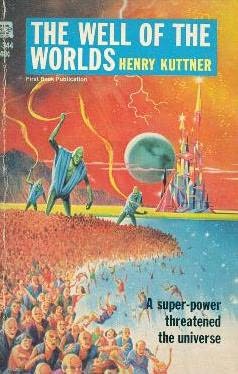
The most recent book of his I’ve gone through is The Well of the Worlds (1952):

(Picture of early edition via Fantastic Fiction.)

So what can I say about ‘Well?  I actually had a hard time getting through the first few chapters, because I found it initially somewhat erratic and unsatisfying, but it picks up significant speed about halfway through (it’s only 125 pages) and I enjoyed it much from then on.  It isn’t quite the same caliber as The Time Axis or Destination: Infinity, but it is still an enjoyable book.

Continue reading

Posted in Science fiction | Leave a comment

The Giant’s Shoulders #27 is out!

The Giant’s Shoulders #27 is up over at Entertaining Research, the third year in a row that Guru has hosted it there!  He has put together a delectable assortment of tasty history of science posts; go check them out!  (And thanks to Guru for being a great and consistent host!)

The deadline for the next edition is October 15th, and it will be held at From the Hands of Quacks.  It will be yet another special edition: the broad theme of the carnival will be on visuals and representation in the history and philosophy of science, technology, and medicine. Entries can be submitted through blogcarnival.com or directly to the host blog, as usual!

Posted in General science, Science news | Leave a comment

Weird science facts, June 20-July 03

The Twitter #weirdscifacts from June 20 – July 03 are below the fold!

Continue reading

Posted in Weirdscifacts | Leave a comment

Vote for kitty Sasha!

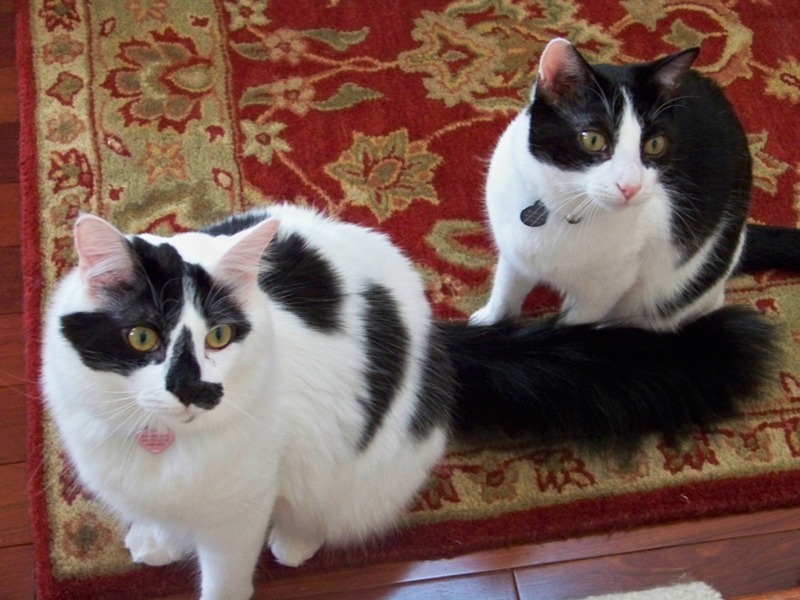
I can’t resist doing a mini-bleg: vote for our kitty Sasha as cutest pet in the American Express Cutest Pet Photo Contest!  The pic you’re looking for is:

Voting runs to 10/1/2010, and you can vote every day for Sasha!  We’re way behind (I’m pretty sure folks are gaming the system), but the benefits of winning aren’t trivial — we could win a $2000 gift card.

The only catch is that they ask for an email on first voting.  They aren’t verifying emails, however, so you can put pretty much anything in to thwart future correspondence.  You will lose out on a chance for a $375 gift card if you don’t use your own email, though.

At this point, it’s partly about pride for me — Sasha is way cuter than some of those other animals, and deserves more votes!

(Okay, I’m done begging — back to science blogging!)

Posted in Animals, Personal | Leave a comment

ResearchBlogging editor’s selections: wee beer beasties, war mathematics, guillotines for snow, and nematode bomb sniffers

skyskull “Dr. SkySkull” selects several notable posts each week from a miscellany of ResearchBlogging.org categories. He blogs at Skulls in the Stars.

  • Spontaneous fermentation: the role of microorganisms in beer. The brewing of beer by necessity employs the action of microorganisms, specifically yeast. In the past, however, when the concoctions were not prepared in a sterile environment, other wee beasties could infiltrate the mix, including antibiotic-forming bacteria! In a fascinating post, Katie Kline of EcoTone discusses early brewing processes and their contaminants, both good and bad.
  • The mathematics of war. War might seem like the last place for a mathematician, but Aimee of misc.ience discusses recent research done using “open source intelligence” — and some counter-intuitive conclusions that are drawn from it!
  • Snow, water, digital imaging, metamorphism…and a guillotine! How does a geoscientist measure the dissolution/melting and precipitation/freezing of water in a thick layer of snow? By using a guillotine, of course! Anne Jefferson of Highly Allochtonous discusses this unusual-sounding technique.
  • Detecting explosives with nematodes. Nematodes — which include the creatures that cause heartworm in dogs — are just plain icky. As Michael Long of Phased explains, however, they may play a future role in bomb detection technology!

Check back next week for more miscellaneous suggestions!

Posted in General science, Science news | Leave a comment

Kitty fostering success!

Almost two weeks ago, I noted the arrival of two foster kitties in our home: Brewster and Breyer!  Well, I’m happy to say that we dropped them off at their new hopefully “forever home” this evening!

This was all done with the help of (and helping) Terry who runs F.U.R.R. — Feline Urgent Rescue and Rehabilitation.  We’ll almost certainly be fostering some more cats in the near future, and I’ll keep folks posted on events as they progress.

In the meantime, here are some final shots of Brewster and Breyer, so I can remember how sweet they are!

Posted in Animals, Personal | 1 Comment

Whittaker breaks the irony meter (1910/1953)

I’m currently working my way through E.T. Whittaker‘s monumental A History of the Theories of Aether and Electricity (1910), among other things.  Whittaker’s book is a very comprehensive study of electricity and aether that stretches back from the seventeenth century up to the beginning of the twentieth, and it really is excellent — I’ve already learned a lot, and am only 20 pages into it!  (I loved a fascinating tidbit about the first experimental measurement of magnetic field lines, demonstrating the poles of the magnet — I’ll come back to this in a future post.)

However, as I’ve blogged about previously, there is one glaring weakness in Whittaker’s treatment.  In his second volume of the ‘History, released in 1953,  he almost completely discounted Einstein’s contribution to the theory of special relativity!  While discussing the “relativity theory of Poincaré and Lorentz,” his primary statement regarding Einstein’s work is:

In the autumn of the same year, in the same volume of the Annalen der Physik as his paper on the Brownian motion, Einstein published a paper which set forth the relativity theory of Poincaré and Lorentz with some amplifications, and which attracted much attention.

Whittaker is much more generous towards Einstein’s general theory of relativity, and gives him the credit, but his dismissal of Einstein’s contribution to special relativity is puzzling.  I’ve speculated that Whittaker was perhaps a bit miffed that his life’s work on the aether was made obsolete in 1905 by Einstein before it was even published; it may also be that Whittaker genuinely didn’t completely grasp the philosophical implications of Einstein’s contribution.

So what is the irony in this?

Continue reading

Posted in ... the Hell?, History of science, Physics | Leave a comment