Is there anybody… out there?

Over the past week, a lot of blogs have revived a venerable scienceblog tradition: inviting those who “lurk” on the blog (read without posting) to de-lurk and say “hi”!  I’ve never tried to do that, but it seemed like a nice idea to fill some time while I’m working on my next science-y post.

I’d love to hear from you!  Feel free to post a comment saying a little about yourself, how you found yourself at this blog, and what sort of topics interest you.  Heck, even if you’ve posted comments somewhat regularly here, you should also feel welcome to say hello!

(Title of post comes from here, if you’re wondering.)

Posted in Personal | 49 Comments

ResearchBlogging editor’s selections: Eclipse in the Odyssey, photons still bosons, and soccer GPS

Check back next Monday for more “miscellaneous” suggestions!

Posted in General science, Science news | Leave a comment

Hummingbirds are back!

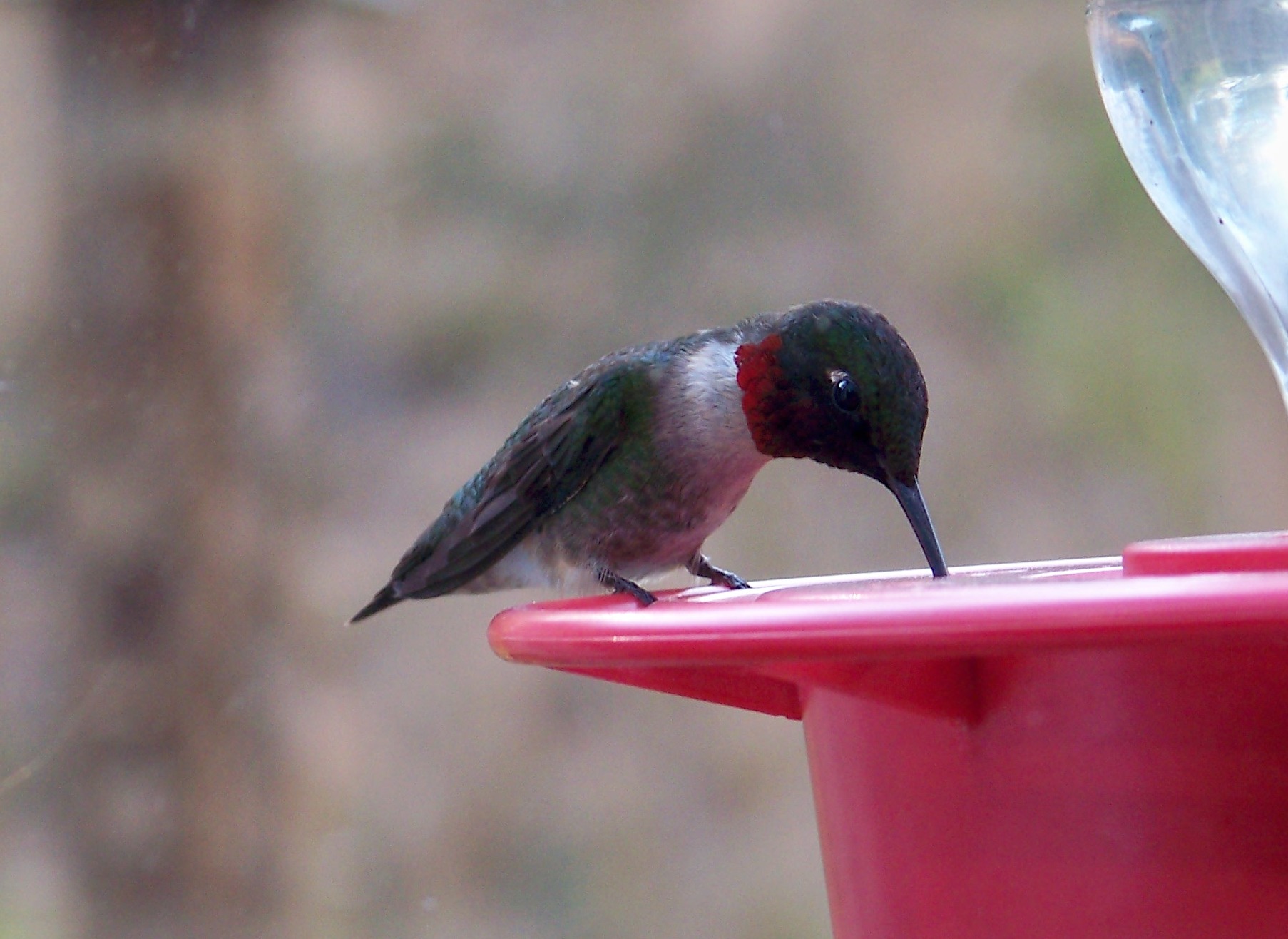
The hummingbirds are back around, and drinking from our window-based feeder!  I managed to get a really clear shot of one of them:

The image is so clear, in fact, that if you zoom in on the full, hi-res version, you can actually seen the side of the house reflected in the hummingbird’s eye!

This shot was a bit of quirky luck: I had seen the birds buzzing in and out of the feeder several times during the day, but they usually take off when they see me moving in the house.  On a random whim, I suddenly decided to grab the camera and stand, motionless, pointing at the feeder, just in case one went by.  This was really a long shot, since they come by perhaps several times a day at most, but within a minute of me standing there, the fellow pictured above stopped in for a drink!

Posted in Animals | 2 Comments

Richard Marsh’s The Goddess: A Demon (Valancourt edition)

With the release of the Valancourt edition of Richard Marsh’s The Goddess: A Demon, I thought I’d repost my earlier review of the book, with some modifications specific to this edition.

I’ve read a lot of the books of Richard Marsh (1857-1915) over the past few years, and have yet to be disappointed in his work.  Marsh’s breakthrough work was The Beetle (1897), and he produced many other clever and atmospheric tales of weird fiction, including the bizarre horror tale The Joss (1901) and the silly social commentary The Magnetic Girl (1903).  Sadly, most of these books were forgotten and neglected early in the 20th century.

Valancourt Books has been doing a wonderful job reprinting Marsh’s work, with the added bonus of scholarly introductions and often reproductions of the original covers.  Their most recent release is Marsh’s The Goddess: A Demon (1900):

Let’s take a look at it…

Continue reading

Posted in Horror, Mystery/thriller | 1 Comment

Invisibility physics: Kerker’s “invisible bodies”

(This is a continuation of my “history of invisibility physics” series of posts.  The earlier posts are: Part I, Part II, Part III, Part IV, Part V, Part VI)

The history of invisibility physics truly began with the concept of radiationless motions of charged particles, as described by Ehrenfest in 1910 and Schott in 1933.  There are many more discoveries associated with these and related phenomena, which would eventually be referred to as nonradiating sources.

I would like to jump ahead in the history a little bit, however, and discuss a paper published in the Journal of the Optical Society of America in 1975 by Milton Kerker, entitled, “Invisible bodies”.  The article, relatively unknown today, is the first article to describe an object which is invisible in the true sense of the word — although the object itself is microscopic!

Continue reading

Posted in Invisibility, Optics | 17 Comments

ResearchBlogging editor’s selections: Soothing troubled waters, zombie stars, risky business with oil, visual recognition, and time and power

  • Pouring oil on ‘troubled waters’. Historically, sailors believed they could calm choppy water by pouring oil on it, and small-scale tests indicate at least a partial truth to this.  Could the Gulf oil spill have a similar effect?  In a fascinating post, Kevin at Deep Sea News describes the history and science of this odd idea.
  • Night of the living dead stars. We know that stars can gobble up smaller objects with their gravitational fields.  At his eponymous blog, Professor Astronomy looks at the evidence that a “dead” white dwarf star has recently gobbled up a dwarf planet!
  • Inevitability and Oil, Pt. 1: the inherent risk for accidents in complex technology. We all know that BP screwed up big time in the Gulf, but are we learning the wrong lessons from the accident by making them the only villain?  Hannah at Culturing Science discusses the disaster in terms of commonly-used theories of risk.
  • Putting visual recognition software to the test. How close are we to having computers that can identify objects visually as well as a person?  Not very close at all, apparently; Greg Fish at Weird Things describes research on the effectiveness of visual recognition software.
  • Standardized time and power relations. Finally, Krystal at Anthropology in Practice takes some time to talk about time, and how forced changes in culture and politics can affect a people’s perception of it.

Check back next week for more “miscellaneous” selections!

Posted in General science, Science news | 4 Comments

Swimming (well, kneeling) with stingrays!

This past week I’ve been rather quiet about blogging and tweeting because I’ve been on vacation with the Wife and some of her family in Myrtle Beach, SC. We just returned yesterday and had a quite nice time, though like many vacations I feel perhaps even more exhausted than before we left!

There were many nice aspects to the trip, but for me the highlight was a stop at Ripley’s Aquarium.  The aquarium itself it relatively small, and most of the exhibits can be passed through within an hour, even at a leisurely pace.  Nevertheless, they have a few really neat opportunities there, including an extra behind-the-scenes tour one can take that culminates with a hands-on encounter with their resident stingrays!  The Wife and I did the Swim With Stingrays Tour, and included with the event was a nice CD of pictures of our experience.

Continue reading

Posted in Animals, Travel | Leave a comment

“On the decline of mathematical studies, and the sciences dependent upon them”

I was browsing the internet a few weeks ago, and came across an opinion piece lamenting the poor state of mathematical education and the detrimental effect it has had on science.  The provocative piece starts as follows:

It is a subject of wonder and regret to many, that this island, after having astonished Europe by the most glorious display of talents in mathematics and the sciences dependent upon them, should suddenly suffer its ardour to cool, and almost entirely to neglect those studies in which it infinitely excelled all other nations.  After having made the most wonderful and unhoped-for discoveries, and pointed out the road to more; suddenly to desist, and leave these to be cultivated, and the road to more to be explored, by other nations, is very remarkable.  It seems as strange as the conduct of a conqueror would be, was he to conquer all the countries around him, and then tamely to suffer his own and the subjugated ones to be possessed, governed, and cultivated, by those whom he had conquered.

It is a very great disgrace for a nation like this, which can proudly boast of a superiority over all others in arts, arms and commerce, to suffer the sublimest sciences, which once were its greatest pride and glory, to be neglected.  Surely a much more solid fame accrues to a people from their superiority in talents than in arms.  Athens is as celebrated for its learning as its commerce or its victories.  It cannot be owing to any want of importance in the sciences themselves that they are neglected; the discoveries made in them are of the most astonishing nature, and such as seemed absolutely beyond the reach of human intellect.  By the marvellous assistance of the mathematics from the simple law of gravity are deduced the orbits of the planets and satellites, their distances, the times of their revolutions, their densities, quantities of matter, and many other remarkable properties too well known to be enumerated.  Were it not for them, mechanics, optics, hydrostatics, geography, and other branches of natural philosophy, would hardly have been known as science.  It is possible that discoveries more wonderful and of greater utility than those already made by the help of mathematics, may some time or other be effected, should some great genius once point out the way.  It is the opinion of many philosophers, that the various forms and diversified properties of bodies are owing to the various laws of attraction and repulsion which their constituent particles exercise upon each other.  Should these laws ever be discovered, we shall become as well acquainted with the structure, affinities, and mutual operations of boides, as we are with the revolutions and actions of the planets upon each other.

As you probably have noted already from the style of writing, this is not a particularly recent article.  In fact, this call-to-arms in favor of mathematics education was written in 1804!

Continue reading

Posted in ... the Hell?, History of science | 5 Comments

ResearchBlogging editor’s selections: Grandpa vs. the oil, inadvertent cloud-seeding, faith and science, and hip-hop evolution

Check back next Monday for more “miscellaneous” selections!

Posted in General science, Science news | 1 Comment

A mini milestone…

In the midst of all the work I’ve been doing lately, I almost completely overlooked the fact that I’ve passed the 400,000 page view milestone!  It was less than a year ago that I hit the 300k mark, so I’m apparently doing something reasonably well.  Thanks to all who stop by and read!

Posted in Personal | 8 Comments