Edward Bulwer-Lytton’s The Coming Race

I’ve described the work of  Edward Bulwer-Lytton (1803-1873) before.  He was a highly prolific author who was highly influential in a number of fields, although his overly romantic prose is often ridiculed these days.  Nevertheless, Bulwer-Lytton’s work survives to this day, and he has written a number of classic horror stories as well as the Titanic of his day: The Last Days of Pompeii, which I discussed in detail in this post.

Bulwer-Lytton also left his mark on science fiction, in his very odd novel The Coming Race (1871).  The story, about the narrator’s journey deep beneath the surface of the earth, where he encounters a powerful utopian society, is one of the earliest science fiction novels.  I can’t say it’s the most compelling book I’ve ever read, but it is fascinating from a historical perspective and bad science perspective.  Let’s take a look…
Continue reading

Posted in Weird fiction | 3 Comments

Spot the math errors!

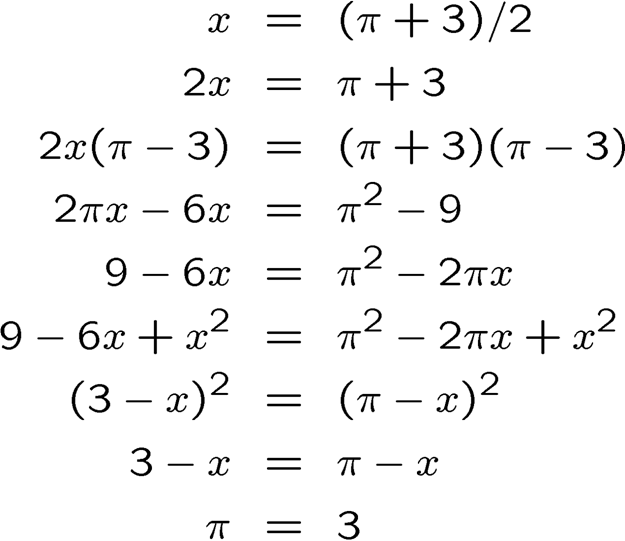
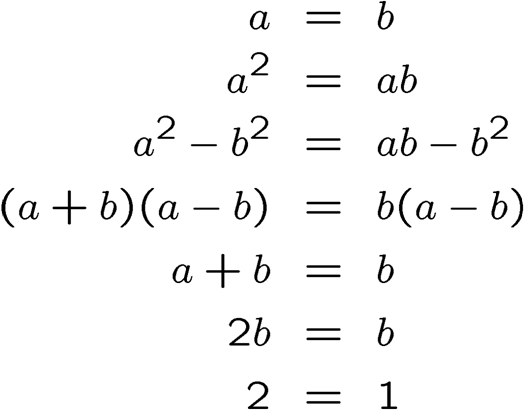
Via StumbleUpon, I came across this short text page which lists three mathematical ‘proofs’ which seem to violate common sense, listed below.  The first is:

2equals1

The second one is:

piequals3

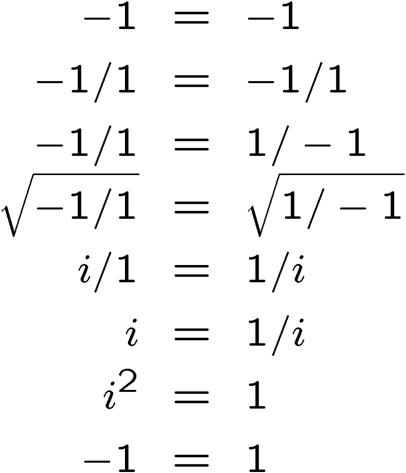
The third one is:

neg1equals1

Each of these proofs is (intentionally) wrong!  They highlight classic fallacies in mathematical thinking.  See if you can figure out where, in each of them, the proof goes wrong, and then look for the answers below the fold…

(Note: the third proof involves the ‘imaginary number’ i = \sqrt{-1}.  If you’re not familiar with it, you can safely skip that problem, as it is closely related to one of the others.)

Continue reading

Posted in Mathematics | 86 Comments

You know who blogs might have stopped? HITLER!!!

This was just so entertaining I had to comment on it.  Via The Huffington Post, we learn that the Nobel winner in literature, Jean-Marie Gustave Le Clezio, suggested that blogs might have prevented Hitler’s rise to power in Nazi Germany:

The spread of information on the Internet has given the world a new tool to forestall conflicts, Nobel literature prize winner Jean-Marie Gustave Le Clezio said Sunday.

In his Nobel lecture to the Swedish Academy, the 68-year-old Frenchman said an earlier introduction of information technology could even have prevented World War II.

“Who knows, if the Internet had existed at the time, perhaps Hitler’s criminal plot would not have succeeded – ridicule might have prevented it from ever seeing the light of day,” he said.

Between this and recent research in the science of vision that suggests that FPS video games actually improve vision (I blogged about it here), my whole existence is rapidly being validated at the highest levels of science and society!

In all seriousness, though, it is nice to see blogs acknowledged by distinguished persons as a potentially powerful and positive force.

Posted in Politics | 3 Comments

Get your ass to… Venus?

Some time ago, I did a post about the sword-and-planet stories centered on the planet Mars, such as Burroughs’ classic John Carter of Mars series.  Earth’s other neighbor has also been the inspiration for a significant amount of fantastic fiction, and I’ve at long last come back to do a post about adventure stories set on Venus!

Continue reading

Posted in Weird fiction | 6 Comments

Turning a problem into a solution: aquatic clean energy from vortex-induced vibration?

ResearchBlogging.org
About a week ago, I came across an intriguing article on telegraph.co.uk, entitled, “Ocean currents can power the world, say scientists.”  Such a title is an immediate eyebrow-raiser for me, knowing the propensity of the news media to (a) overhype scientific results to the point of absurdity, and (b) fall for lots of suspicious “free energy” claims (see, for instance, Bob Park’s excellent book, Voodoo Science).  The work reported on here, though, undertaken by researchers in the Department of Naval Architecture and Marine Engineering at the University of Michigan, is based on legitimate science, and was recently published in the Journal of Offshore Mechanics and Arctic Engineering.

The researchers have developed a new device which can effectively extract energy from ocean and river currents, even at low flow rates.  The technique, dubbed VIVACE (Vortex Induced Vibration Aquatic Clean Energy), takes advantage of a physical phenomenon known as vortex induced vibration (VIV) to drive the motion of a cylinder.  This energy of motion is then converted to usable electric energy.

The phenomenon of VIV, its history, and its possible use as an environmentally-friendly and cheap energy source are discussed below.

Continue reading

Posted in Physics | 4 Comments

12 days until The Giant’s Shoulders #6!

We’re less than a half-a-month away from the deadline for The Giant’s Shoulders #6, to be held at Rigorous Trivialities on December 15th.

Entries can be submitted through blogcarnival.com or directly to the host blog, as usual!

I’ve also initiated a contest to design a new banner for the TGS blog!  If you feel inspired to work on a banner image that represents in some way the history of science/classic science, take a look at the TGS website for more details.

Posted in Science news | Leave a comment

Edgar Rice Burroughs’ Venus series

I’ve talked a bit about Edgar Rice Burroughs’ sword and planet adventures before; in particular, I’ve discussed his ‘Barsoom‘ (Mars) series briefly and did a post on the first two books on his ‘Pellucidar‘ (Hollow Earth) series.  In preparation for another massive literature survey post, I decided to read Burroughs’ fantasies set on yet another planet: Venus!  The series, describing the adventures of scientist/adventurer Carson Napier when he crash lands on Venus, consists of four books: Pirates of Venus (1934), Lost on Venus (1935), Carson of Venus (1939), and Escape on Venus (1946).  (There is also a posthumously published story, Wizard of Venus, which I haven’t read.)

The novels are interesting and distinct for a number of reasons.  First, the ‘Venus’ series was initiated much later than the other adventures Burroughs is known for, and represents the last series he would start (though he continued to write Tarzan, Barsoom, and Pellucidar books at the same time).  Perhaps because of this, the Venus series seems a little more mature and a little less spectacular than its predecessors.  Whereas David Innes, for instance, had completely dominated Pellucidar in the span of two books, Carson Napier is more or less on the run throughout the four books.

Let’s take a tour through Burroughs’ fictional version of Venus, and meet its inhabitants!

Continue reading

Posted in Adventure fiction | 2 Comments

The auto industry – a play

I’m workin’ on some spiffy new posts.  In the meantime, I note that a commenter, JasonF at Balloon Juice, wrote up the auto industry conundrum as a play in three acts.  It’s quite excellent: read it here.

Posted in Politics | Leave a comment

Holiday cards for ‘geeks’

I’m still in holiday mode and not in scienceblogging mode, but I’ll hopefully be back in the swing of things next week.  In the meantime, via Americablog, I present ‘Christmas and holiday cards for geeks‘.  A sample:

Posted in Silliness | 2 Comments

Happy Turkey Day!

I’m using the day as an opportunity to get some work done on my textbook.  We managed to eat our Thanksgiving dinner without kitten interference, as they were too tired to notice.  Later, however, the fiancée got up to make a turkey sandwich for her mother, and kitty chaos resulted:

turkey1s

First only three of the kitties demanded food, but soon Simon hopped up on the island to get in on the action:

turkey2s

Soon after, the kitties pounced, and the pictures of the horrifying aftermath are not for the faint of heart…

Posted in Animals | 4 Comments