Two new reviews of Invisibility!

Yesterday was quite the day for book reviews for my book on the history and science of invisibility! First, James Gleick wrote a very nice and thoughtful review of the book for the New York Review of Books; a screenshot for posterity is shown below.

The article requires registration to read, but you can register for free to do so. (I did.)

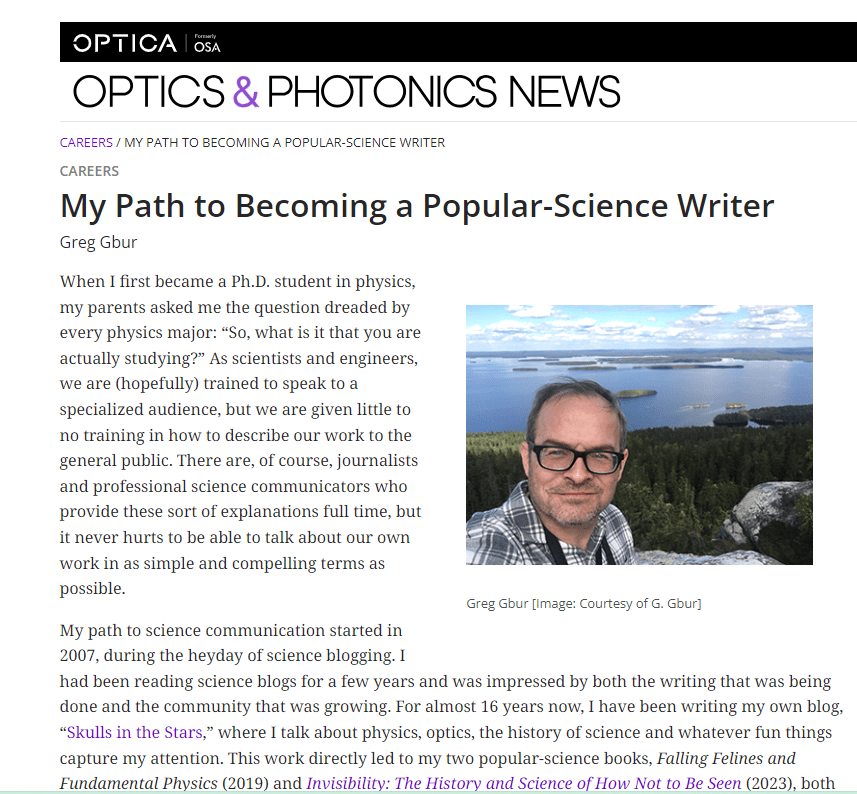
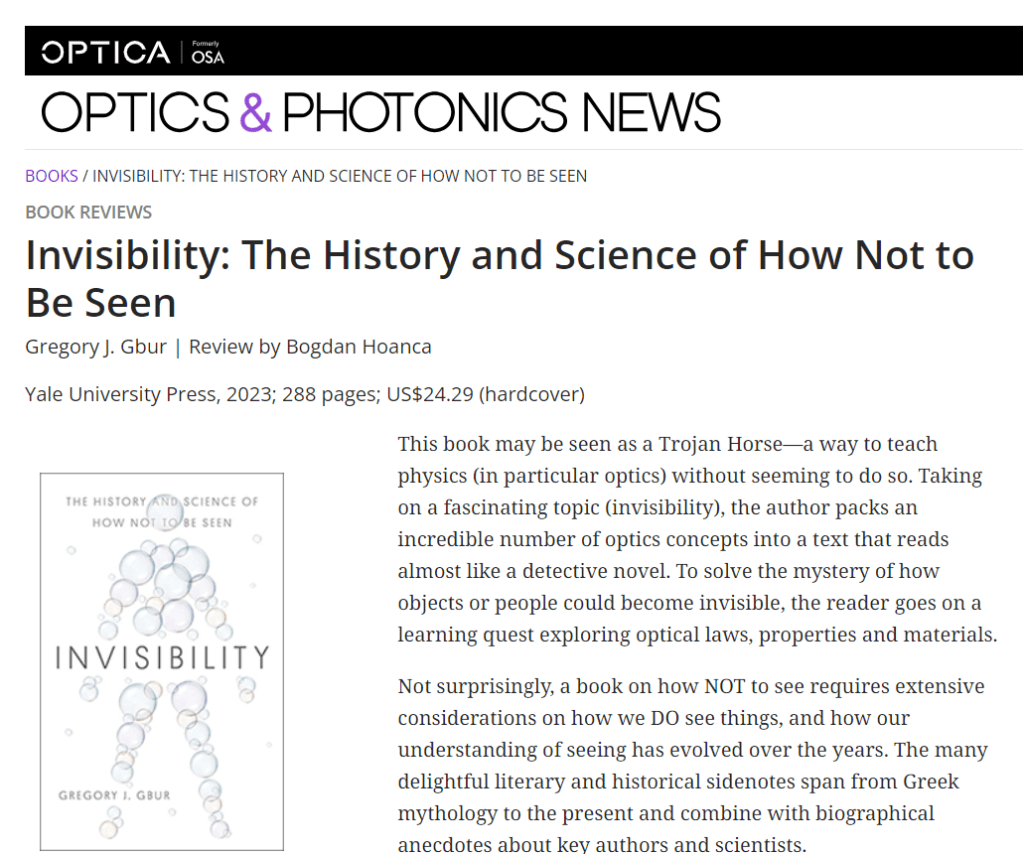
The second review appeared in Optics & Photonics News, the news magazine for my favorite optics organization, Optica. Again, here’s a screenshot:

This review was particularly glowing, and that makes me happy!

Just wanted to share; more science and fiction blogging to come in the near future.

Posted in Invisibility, Personal | 1 Comment

How fast can we communicate with light and radio waves?

I’m pretty forgiving about reading mildly inaccurate physics stuff, especially when it’s in science fiction stories, but every once in a while I read a real zinger that nearly causes me physical pain. Recently I was reading an article about Wi-Fi when I came across this paragraph:

This was in an otherwise fascinating article about how engineers are developing light-based Wi-Fi, called Li-Fi, which would in essence just be a lamp in your room that would communicate to your wireless device through a light sensor. Fluctuations in the light, undetectable by the human eye, would carry the information.

You can see why I was in pain from the first sentence: “Since light travels much faster than Wi-Fi radio waves, data speeds are significantly faster.” The problem with this is that, in air, the speed of visible light and the speed of radio waves are basically identical and equal to the vacuum speed of light.

I point this out not to pick on the author of the article — writers are very busy, and sometimes a sentence gets poorly worded or some concept non-essential to the story gets honestly misunderstood, and we’ve all made mistakes like that at some point. (You’ll notice I don’t even link to the article.)

But I thought it was a good excuse to ask and answer the question: what does determine the data speeds of our communications devices, and why is light a better option than radio? And if it is a better option, why haven’t we done it already? So let’s take a look!

Continue reading
Posted in Optics, Physics | 4 Comments

70% off of Invisibility on Audiobooks.com through end of July!

Just a quick note: I lost track of this announcement when I first got it: my Invisibility book is 70% off in audio form at Audiobooks.com through the end of July. If you’ve been keen to get a copy in audiobook, this seems like a great opportunity.

I apparently get full royalties for all copies regardless of the discount, so feel free to indulge!

Posted in Invisibility, Personal | Leave a comment

Interview about Invisibility at Ars Technica!

A little more book news to tide the blog over until I write some new physics posts: around the time the book first came out, I was interviewed by Jennifer Ouellette for Ars Technica about the book, and that interview just came out today! You can read it at this link, or click on the image below.

Posted in Invisibility, Personal | Leave a comment

Virtual Invisibility book event at Malaprops!!!

Some more book news: I will be doing a virtual book event about my book Invisibility: The History and Science of How Not to Be Seen on Wednesday, August 23 at 6:00 pm EST!!!

The event is free but registration is required. I’m hoping to get a good audience for it so please consider attending and spreading the word! Also, if you haven’t gotten my book yet and would like to, please consider getting it through Malaprops, which is a great bookstore worth supporting!

Posted in Invisibility, Personal | Leave a comment

The story of the electron (1901)

When we are taught the history of physics, it is quite common for major discoveries to be introduced in an abbreviated form that loses much of the very interesting context. We are told “Scientist X discovered Y in year XXXX,” but are often not told about the tortured path of investigations that lead up to Y and the numerous questions that were answered by the new discovery.

A great example of this is the discovery of the electron! The electron was officially discovered in 1897 by British physicist J.J. Thomson using experiments on cathode rays (mysterious “rays” emanating from the cathode in a vacuum tube), in which he was able to estimate both the mass and the charge of electrons. That description is quite abridged, however, and there was a long philosophical discussion about the existence of electrons preceding its discovery and a lot of mysteries that were suddenly unraveled by its existence.

I was thinking about this a lot recently due to two factors. The first is that I wrote a blog post on an early inadvertent test of special relativity investigating the apparent mass of electrons. That paper by Kaufmann gave me a sense of how radical the discovery of the electron was at the time and how eager people were to determine all of its properties. The second factor was… a mistake? Kaufmann’s relativity paper came out in 1901, and was in German, and was about electrons; my first attempt to track it down led me to a 1901 paper by Kaufmann in German about electrons, and I started translating it. About halfway through translation, I realized that the paper was not the one I was looking for, but it was so interesting that I finished translating it anyway!

The paper in question was a public lecture that Walter Kaufmann wrote on “The development of the concept of electrons,” and it is a timely overview of the history of the concept and everything that had been learned since its formal discovery! It is such an interesting read I thought I would share my translation in its entirety in this blog post, with my own annotations and explanations to provide context when needed.

Continue reading
Posted in History of science, Physics | Leave a comment

“Invisibility” reviewed at Nature!

My book Invisibility: The History and Science of How Not to Be Seen has been out for about 4 months now, and activity around it has settled down a lot. So it was a lovely surprise when my friend Liza on Twitter pointed out that it was just given a short review in Nature today, as one of “five of the best science picks!”

The short review can be read at this link, but it might be behind a subscription paywall, so here’s the relevant text about Invisibility:

In 2006, two independent groups of physicists speculated on how to design an ‘invisibility cloak’ by guiding light around an object and then on its way, as if it had met no obstacle. Within six months, this proposal was demonstrated experimentally using microwaves rather than visible light. “The future of invisibility is very hard to see,” admits surprised physicist Gregory Gbur at the end of his tantalizing analysis of the phenomenon, ranging over more than 150 years and including science fiction such as The Invisible Man (1897) by H. G. Wells.

This was really nice to see, and made my day! I put a lot of time and thought into this book, so it’s nice to see some recognition of it come back to me.

PS hopefully you’re not all tired of hearing about the book, but I am using these blog posts to also keep track of the various bits of positive press for my own personal enjoyment!

Posted in Invisibility, Personal | Leave a comment

Sister, Maiden, Monster, by Lucy A. Snyder

One of the absolutely wonderful things that has come from social media, in spite of the many, many downsides (RIP Twitter), has been getting acquainted with and becoming online friends with a lot of great writers. One of those writers I am happy to have met is Lucy A. Snyder, a versatile writer of science fiction, fantasy, and horror. I’ve blogged in the past about one of her short story collections, While the Black Stars Burn (2015), and I believe I wrote about her more recent collection Garden of Eldritch Delights (2018) for Dead Reckonings; both were excellent and filled with truly powerful and weird tales.

So I was delighted to see that Lucy not only has a new novel out — Sister, Maiden, Monster (2023), but that it is very widely available on the shelves in bookstores! I finally got my copy a couple of weeks ago.

It is a relatively short novel and proceeds at a rapid pace. I started reading it on a trip on a Monday afternoon and finished it on the plane on the flight back on Tuesday morning, devouring the last few pages as my plane pulled up to the gate. It is a beautifully, horrifically written book, and I enjoyed it immensely.

Continue reading
Posted in Horror | Leave a comment

What is the Mössbauer effect?

So a few weeks ago I described a 1960 experimental test of time dilation in Einstein’s special theory of relativity that applies the Mössbauer effect to measure precise changes in the frequency of gamma rays. I only briefly described the Mössbauer effect in that post, and it’s a simple enough and interesting enough effect to elaborate upon in a separate post, so here we are!

In short, the Mössbauer effect is the absorption of a gamma ray by an atomic nucleus in a crystal such that the momentum of the gamma ray is absorbed by the entire crystal array, rather than the single nucleus that absorbed the gamma ray. Why this is significant is a longer story, which we now discuss.

Let’s begin with a discussion of spectroscopy and how photons of different energies can be use to study different parts of the structure of atoms. I’ve talked many times about the Bohr model of the atom, usually pictured something like the image below.

The Bohr model. a photon is emitted when an electron “jumps” from one orbit to another.

In the days before we discovered quantum physics and the structure of the atom, researchers couldn’t understand why atoms seemed to absorb and emit light only at very specific discrete frequencies. Niels Bohr proposed a model of the atom in which electrons can only orbit the nucleus at special orbits, labeled by a number n, and would emit or absorb a single photon in jumping from one state to another.

Simulation of the emission spectral lines of hydrogen in the visible spectrum, via Wikipedia. These lines are observed by collimating light coming from a hydrogen source and dispersing it through a prism. An ordinary thermal source would produce a rainbow!

This picture of electrons “orbiting” the nucleus would quickly be supplanted by a picture of electrons as extended waves enveloping the nucleus, but the basic principle introduced by Bohr — of discrete states for electrons and a discrete emission spectrum — holds up. People still use the term “orbits” to describe the states of the electron, despite its inaccuracy, because it gives a decent enough image.

Continue reading
Posted in Physics | Leave a comment

1901: Kaufmann measures relativity and doesn’t know it

The special theory of relativity has been extensively tested ever since Albert Einstein formulated it in 1905, and is essential in understanding numerous fields of physics, from astrophysics to nuclear physics to particle physics. Recently, I’ve been exploring some of these experimental tests, like the 1960 laboratory test of time dilation.

What surprised me, however, was learning about a 1901 experiment that provided evidence of special relativity before Einstein introduced it! Most physicists are familiar with the 1887 Michelson-Morley experiment that failed to find any variation of the speed of light and really spurred a lot of the work on relativity theory, but this 1901 research is something that one doesn’t see in textbooks.

So, of course, I had to translate the paper, which is in German, and write a blog post about it! For those who want to read my translation, the pdf is here; the original in German can be read on Wikisource. The paper is by Walter Kaufmann, and has the translated title, “The magnetic and electrical deflectability of the Bequerel rays and the apparent mass of the electrons.” It appeared in Nachrichten von der Gesellschaft der Wissenschaften zu Göttingen – Mathematisch-Physikalische Klasse of the year 1901, page 143-155.

Continue reading
Posted in History of science, Relativity | Leave a comment