Optics basics: reflection

It’s been some 5 years since I wrote my last “Optics basics” post!  The goal of that series of posts was to introduce some of the most fundamental concepts in optics in a non-technical way, in part so I wouldn’t have to constantly reexplain them in more advanced posts.

I’ve covered most of the topics that I would truly call “basic” — hence the long time since the last post — but I realized that I missed one concept that is truly fundamental: the law of reflection!

It may not seem like there’s much to say about reflection, but we’ll see that isn’t the case.  Many interesting things can happen when light reflects off of a surface — the challenge will be to include as many as possible while keeping this post short!

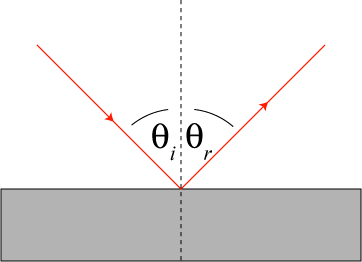
So what is the law of reflection?  Well, the classic law of reflection states that the angle that a ray of light reflects off of a smooth, flat surface (the angle of reflection \theta_r) is equal to the angle at which the light is incident upon the surface (the angle of incidence \theta_i).

lawofreflection

Continue reading

Posted in Optics basics | 4 Comments

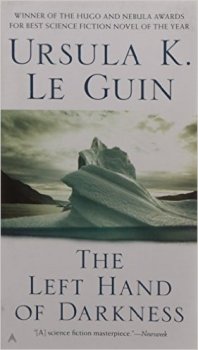
The Left Hand of Darkness, by Ursula K. Le Guin

After reading the epic Foundation series of novels by Asimov, I was in the mood for a change of pace in science fiction.  I turned to another brilliant author, Ursula K. Le Guin, and her classic 1969 novel The Left Hand of Darkness.

lefthandofdarkness

I vaguely remember being told about this novel when I was in college, though I didn’t read it then. At the time, the description that I was given was more or less “a book entirely about linguistic, social and cultural details.”  This description isn’t completely inaccurate, but The Left Hand of Darkness is so much more — it is a fascinating study of a culture that is completely alien to our own, thanks to one, single, fundamental, biological difference in its humans.

Continue reading

Posted in Science fiction | 3 Comments

Pepper’s last optical illusion: metempsychosis

A month ago, I shared the lengthy, odd and sometimes dramatic history of the illusion commonly known as “Pepper’s ghost,” which I believe is more properly called the “Pepper-Dircks ghost.”  In researching this post, I uncovered a wealth of fascinating information and trivia related to Pepper, Dircks, and their work, which continues to serve as fodder for posts.

For instance: “the ghost” is not the only optical illusion that John Henry Pepper (1821-1900) developed! Much later in his life, when the ghost had lost some of its novelty, Pepper worked on and patented a clever new illusion, which he called “metempsychosis.”

So what is metempsychosis?  In this post, we take a look!

Continue reading

Posted in History of science, Optics | 1 Comment

Foundation’s Edge, Foundation and Earth, by Isaac Asimov

Been rather preoccupied recently with life, but I finally have a moment to catch up on a bit of my book blogging, including discussing the “final” two books of Asimov’s classic Foundation series, namely, Foundation’s Edge (1982) and Foundation and Earth (1986).  I have previously written about the first book Foundation as well as the complete trilogy of books, finished in 1953.

foundationpair

I wrote “final” in quote above because, although these are the final two books chronologically in the fictional Foundation universe, they are not the last two books that Asimov would write.  Two prequels to the original novel would follow: Prelude to Foundation (1988) and Forward the Foundation (1993).  But Edge and Earth would be the last novels that would advance the history of the Foundation and hint at its ultimate fate.

Continue reading

Posted in Science fiction | 1 Comment

Twitter Weird Science Facts: Full Year and Final Volume!

This is it — the last regular installment of my Twitter weird science facts! I’ve done a full year of weirdscifacts, averaging one fact per day for the entire year (though I’ve had to play catch up on missed days quite often).  It’s quite a lot of work to find and post reliable facts every day, even with the amount I’ve got backed up, so I won’t be continuing the series at this time.  You can always read the whole series of this year, and past years, by clicking this link.

Read below to learn about the long history of dropping balls to signify time, as in this 19th century image!

ENGLAND - MAY 28:  Engraving taken from the ?Illustrated London News?. The first national electronic time service was introduced by Sir George Bidell Airy (1801-1892), Astronomer Royal and director of the Royal Greenwich Observatory from 1835 to 1881. A master clock, verified each day by stellar observation, sent electric impulses to clocks throughout the country via the growing network of telegraph wires providing for public and railway use. The time ball at the Strand received the impulses hourly from the Central Telegraphy Station of the Electric Telegraph Company.  (Photo by SSPL/Getty Images)

Engraving from the “Illustrated London News”. 

Continue reading

Posted in General science, Weirdscifacts | 3 Comments

19th century optics FAILs

My recent post on the Pepper-Dircks ghost didn’t include even close to all of the interesting tidbits it could have!  There are so many things to learn from the story of the ghost, including some lessons about optics.

For example: in my post, I included two illustrations of the illusion at work from sources of that era.  One came from the 1868 book The World of Wonders

Pepper's illusion in action, from The World of Wonders (1868).

Pepper’s illusion in action, from The World of Wonders (1868).

… and the other came from an 1877 edition of Harper’s Magazine.

One last parting phantom, via Harper's Magazine, vol. 55 (1877).

One last parting phantom, via Harper’s Magazine, vol. 55 (1877).

The images are so similar that I’m guessing the latter was based off of the former.  However, both of them are wrong!  They incorrectly show how the ghost works and how it would appear in the configuration as shown.

So what’s the problem? If you like, take a moment to look at the image or images above and see if you can work it out for yourself!  Then read on below…

Continue reading

Posted in ... the Hell?, History of science, Optics | Leave a comment

Isaac Asimov’s Foundation Trilogy

I’ve recently been trying to become more acquainted with science fiction as a genre, as most of my life I’ve been focused primarily on horror fiction.  A natural and obvious place to place some emphasis is on classic works from the golden age of science fiction, and a natural and obvious place to start there is with the work of Isaac Asimov.  A few weeks ago, I read Asimov’s Foundation (1951), and blogged my thoughts about it.

Asimov has written seven books set in the Foundation setting; I figured that I would be content reading the first one, to get a feel for it, and then move on to other authors and other series…

… and, as of today, I’ve started reading the fifth of the Foundation novels.

As the first three books, Foundation (1951), Foundation and Empire (1952), and Second Foundation (1953), form the original trilogy, and I thought it would be worthwhile to blog my thoughts on the trilogy as a whole.

foundationtrilogy

The Foundation trilogy tells an epic, galaxy-spanning story over the course of some 400 years, telling the early history of what is known simply as, well, the Foundation.  Some 12,000 years into the existence of a powerful galactic Empire, a mathematician named Hari Seldon predicts, using a new and advanced mathematical science known as psychohistory, the collapse of the Empire within 300 years and a galaxy-wide Dark Age to follow lasting some 30,000 years.  The collapse of the Empire is inevitable — the actions of quintillions of humans in the Empire possess a momentum that cannot be overturned in time to avoid disaster.

Continue reading

Posted in Science fiction | 6 Comments

Twitter Weird Science Facts, Volume 19

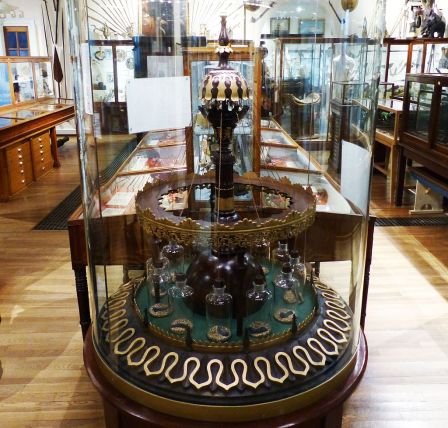
Happy Holidays!  Nearing completion of a full year of facts!  Read on to learn what this strange leech-based device was designed to do.

tempest_prognosticator

Continue reading

Posted in General science, Weirdscifacts | Leave a comment

Michael Faraday meets “The Ghost”

My most recent blog post, concerning the history of the Pepper-Dircks Ghost, was extremely long but didn’t even include all the fascinating aspects of its history.  For instance: the ghost was such an incredibly effective illusion that it even drew celebrities of all types to see it.  From Pepper’s own True History, for example, we have the following description from the May 20th, 1863 edition of The Times:

Yesterday morning, by special command. Professor Pepper had the honour of delivering his ghost lecture before their Royal Highnesses the Prince and Princess of Wales, and the Prince and Princess Louis of Hesse, who were attended by the Countess of Macclesfield, Baroness Von Schenck, Major Teesdale, and Captain Westerweller. The distinguished party were received by Professor Pepper, and after being conducted round the galleries passed to the large theatre, where a commodious Royal box had been prepared for their reception. At the conclusion of the lecture, by the invitation of Professor Pepper, they went behind the scenes, and examined with much interest the machinery and appliances for producing the Polytechnic ‘ghost.’ At the conclusion, their Royal Highnesses graciously thanked the directors of the institution, and after shaking hands with Professor Pepper, retired.

The illusion also drew scientific luminaries to its presence, including one of my scientific heroes, Michael Faraday (1791-1867), who played a major role in demonstrating that light, electricity, and magnetism are all part of one single related phenomenon, electromagnetism.  Faraday visited Pepper’s theater sometime before his death and, as Pepper recounts,

Very few persons could understand how the ghost was produced, although many persons wrote about and explained it; even the distinguished philosopher, Michael Faraday, when I took him behind the scenes, said, with his usual love of truth: “Do you know, Mr. Pepper, I really don’t understand it.” I then took his hand, and put it on one of the huge glass plates, when he said, ” Ah ! now I comprehend it; but your glasses are kept so well protected I could not see them even behind your scenes.”

This seems very like Faraday to me! He was a humble man and not particularly sophisticated when it came to abstract thought, but he could pick up quickly on experimental techniques.

Posted in History of science, Optics, Physics | 1 Comment

Dircks and Pepper: A Tale of Two Ghosts

It is often told that in the 1860s, John Henry Pepper used science and technology to invent a ghost.

Or did he?

This is the surprisingly tricky question that we will try to answer in this lengthy post.

It is a somewhat sad and recurring theme in science that many discoveries are not named after the actual people that discovered them.  In fact, this phenomenon is so common that it has a name — Stigler’s law.  Appropriately, Stigler’s law was, in fact, first discovered by Robert Merton.

This effect is not necessarily the result of deception or injustice.  The history of science is complicated, and it so happens that things are often “discovered” multiple times before their significance is truly appreciated and recorded by the scientific community. One example is Snell’s Law, which describes how the direction of light changes when it crosses the boundary between two different transparent materials.  Named for Willebrord Snellius who observed it in 1621, it was noted by English astronomer Thomas Harriot twenty years before, and in fact had been first discovered by Persian mathematician Ibn Sahl in 984.

In the case of “Pepper’s ghost,” the issue is weighing the relative contributions of two discoverers who each made important contributions. There are in fact two key inventors whose roles must be examined: John Henry Pepper (1821-1900) and Henry Dircks (1806-1873).  Their story inextricably entwines science, engineering, legal theory, and entertainment.

Continue reading

Posted in History of science, Optics | 1 Comment