
I’ve been enjoying a bit of reminiscing about my childhood lately, hunting down old copies of role-playing games I enjoyed in my youth as well as exploring newer games that have come out since then. One thing that has changed dramatically since my gaming days is the proliferation of types of dice. Most human beings never go beyond ordinary 6-sided dice, which we in the gaming world call a “d6.” Classic Dungeons & Dragons players, however, are familiar with the d4, d6, d8, d10, d12, and d20.
But these days, there are even more imaginative varieties! I’ve starting collecting dice of every shape and size, and my current collection is shown below, in order¹:
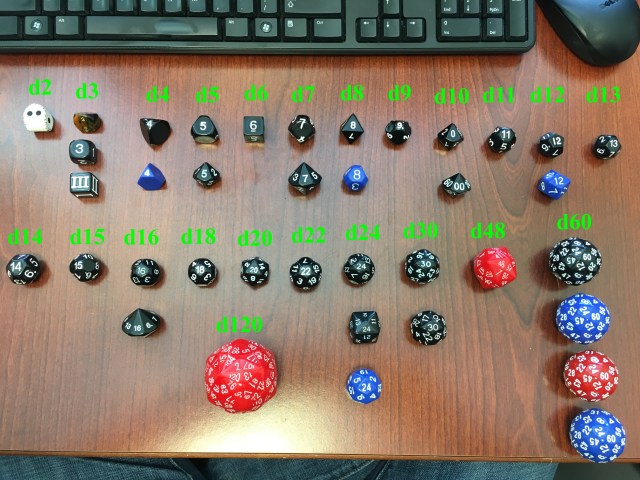
This is a really amazing variety of dice! This is my “special dice” collection in its entirety, and includes some duplicates (don’t ask how I got 4 identical d60s), but in some cases, such as the d7, d12 and d24, there are varieties in shapes even with the same number of faces!
This variety got me wondering: how does one design dice with a weird number of faces? What mathematical strategies does one use to make them? What other types of dice are possible? And, perhaps most important: are these dice “fair”?
I thought it would be fun to answer these questions with a blog post, in which we discuss the geometry of dice!
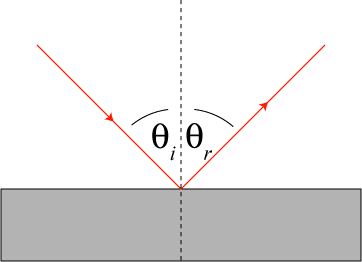
 ) is equal to the angle at which the light is incident upon the surface (the angle of incidence
  ).
).





 Skulls in the Stars