Though the introduction of optical invisibility cloaks in 2006 caused a huge sensation around the world in both the media and the general public, arguably even more significant to the optical science community is the technique used to design cloaks.
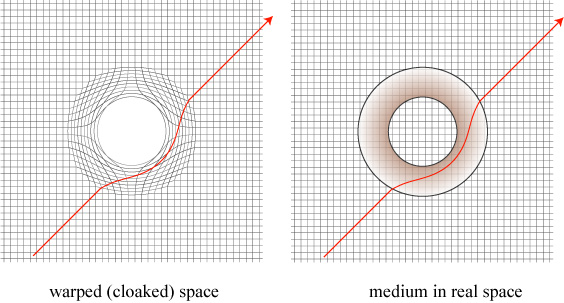
The original cloaking papers took advantage of the observation that a physical warping of space can be simulated by an appropriately-designed material medium. To design a cloak, we first figure out how we want to bend space around a cloaked region, and then it is relatively straightforward to figure out the medium that simulates that bent space.
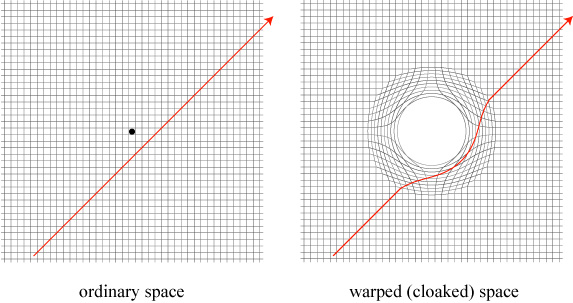
How does this work? Let us imagine that we have an ordinary, unbent, region of space. To design an invisibility cloak, we imagine poking a pointlike hole in that space and stretching it to make a void. Physically, that void is completely inaccessible — it lies outside of ordinary space. This is illustrated below. Ordinary space is on the left, with a ray of light and the point that gets stretched into a void on the right. The ray gets bent away from the void thanks to the distortion of space.

Once a (hypothetical) warping of space is designed to achieve the desired effect, in this case cloaking, there is a systematic process to determine what sort of material will provide the same effect in our ordinary (unwarped) space.
This strategy of designing optical devices by a virtual warping of space is known as transformation optics, and it has been implemented for a number of crazy applications, from optical illusions to optical black holes. It can also be used to make more mundane but highly important devices, such as 90-degree bends in fiber optic cables that produce no loss. An optical fiber “traps” light inside of it by total internal reflection (see here for explanation), which works very well except at sharp bends or “kinks” in the fiber, where light can leak out. If we create a 90-degree bend by warping space, however, as illustrated below, the light will in principle be redirected without loss!

The tools of transformation optics were readily taken from those of Einstein’s theory of general relativity, where gravitational fields actually induce a warping and distortion of space and time. With this connection, it was quite natural for researchers to ask whether various types of astrophysical phenomena, both real and hypothetical, could be simulated for light using exotic optical materials.
In 2007, the most spectacular of these possibilities was proposed* by a group of researchers from the U.S., the U.K. and Finland. They suggested that it is possible to use transformation optics to design an optical wormhole — a tunnel for light between distant points in space! A longtime staple of science fiction stories, such wormholes (also known as Einstein-Rosen bridges) would provide a hidden tunnel for light that allows it to travel from one region to another. At first glance, as we will see, this would seem impossible, as a wormhole is an extra-dimensional region of ordinary space, and we can’t add extra dimensions to our three-dimensional space just by the use of weird materials. Or can we? It turns out that it is not only possible, but that the construction is far simpler than you might imagine.
Continue reading →










 Skulls in the Stars