
This is another look, and deep dive, into my favorite quantum optics experiment that I blogged about quite a few years ago! At that time, I focused on the classical wave aspects of the problem; this time, I want to focus on the truly weird quantum aspects.
There are a lot of weird results in quantum physics, but one of the weirdest in my humble opinion was discovered thanks to a statement by Paul Dirac in his book The Principles of Quantum Mechanics,
“each photon then interferes only with itself. Interference between different photons never occurs.”
To explain this statement, we first refer to the classic double slit experiment first performed by Thomas Young in 1807, in which he demonstrated that, contrary to the scientific consensus at the time, light has wavelike properties. In the experiment, light goes through a pair of slits, spreads out as it emerges from those slits, and forms a pattern of light and dark stripes on a measurement screen. Young himself illustrated this process as shown below.
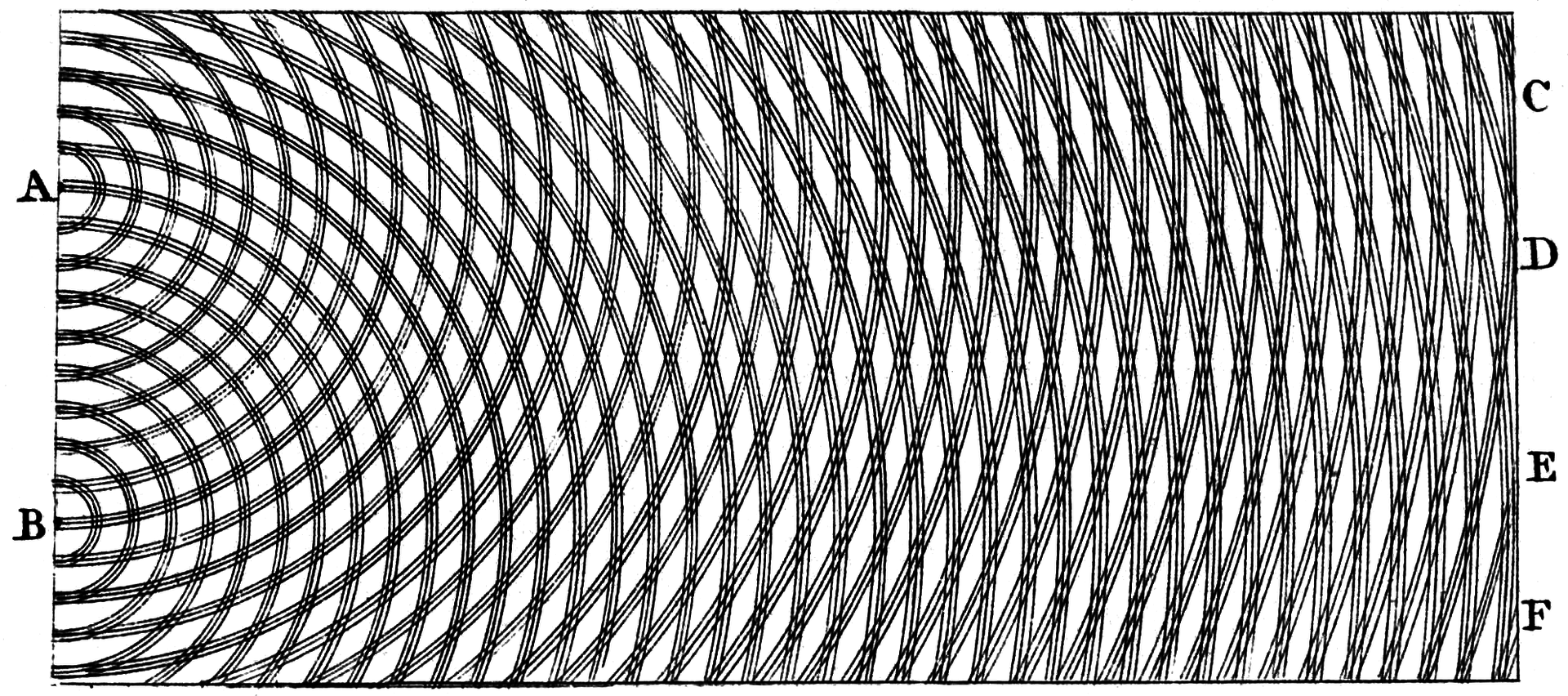
The slits are A and B, the circular ripples emanating from them represent the waves, and the points where those waves are out of phase — one wave is “up” while the other is “down” — show up to the eye as dark lines and stretch to points C, D, E, and F, where on an observation screen one would see dark bands. Between those points, the light adds constructively and one gets light bands.
The idea that “light is a wave” would stand untouched for nearly a century, until in 1905 Albert Einstein argued convincingly that light also acts like a stream of particles. Counterintuitively, you can also use Young’s experiment to show this! Imagine that one uses a very weak source of light such that only one photon passes through the double slits at a time. At a detector, one will see a single spot of light where each photon lands. But if one tallies a large number of photons over time, the wave interference pattern reemerges! An example of this was done experimentally1 in 2008, and the results are shown below.
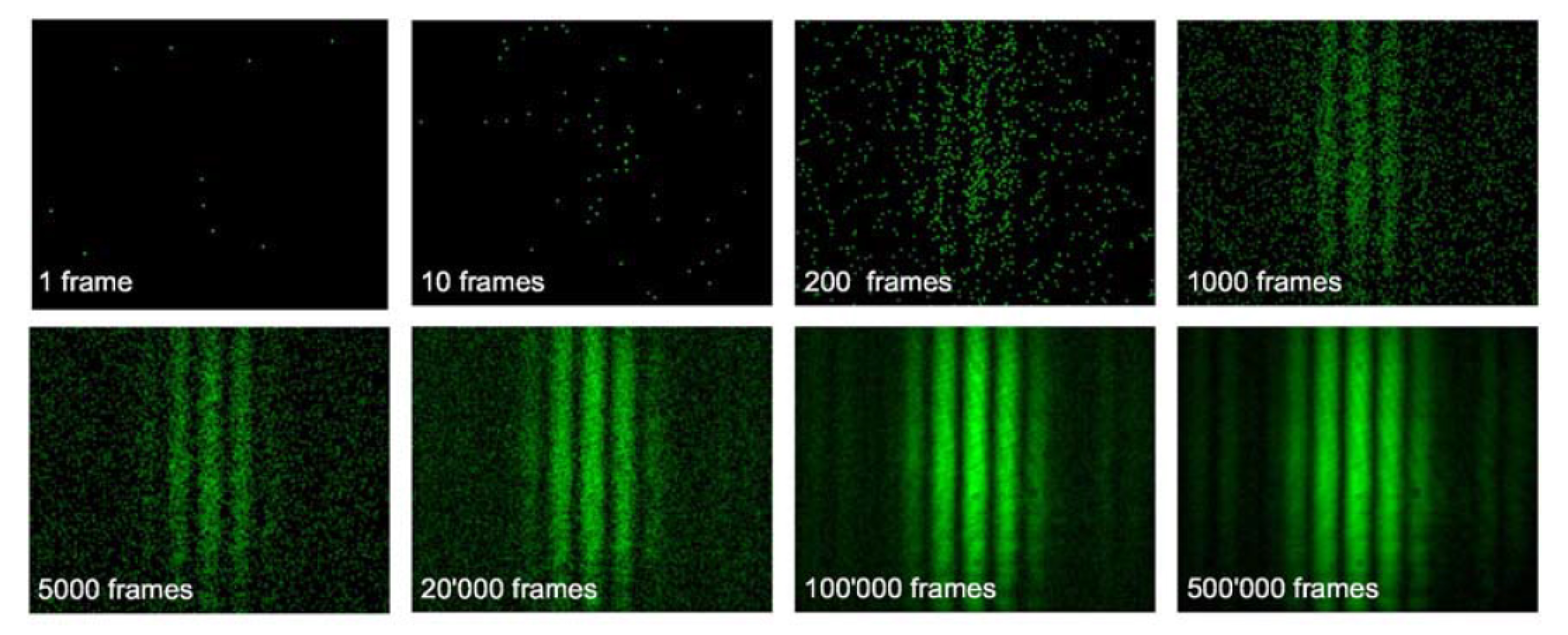
The sequence shows the tally of “hits” on the detector as time passes. At first you see only isolated dots, but eventually the tally of those dots leads to the bright and dark fringes we associate with Young’s wave demonstration.
What, exactly, do the wave properties of light represent? It was Max Born who, in 1926, postulated that the wave basically represents the probability that a photon appears in a particular location, and this Born Rule has been vindicated by numerous experiments. Born himself won the Nobel Prize in Physics in 1954 for this work.
This leads us back to Dirac’s statement: “each photon then interferes only with itself.” Because the interference pattern will arise even if only one photon at a time goes through Young’s slits, it was a natural conclusion that the wave interference that is seen is due to the wave of each individual photon interfering with itself and not with the waves of other photons!
But is this the only possibility, or is it possible for different photons to interfere with each other? This was the question that was asked by the brilliant quantum optics researcher Leonard Mandel and his colleagues in the 1960s, and the answer that they found still boggles my mind to this day.
We begin by talking about the 1962 paper by Magyar and Mandel2, and we will describe the experiment and its interpretation primarily using classical (wave) physics. The first obvious question that arises: how do you guarantee that you are interfering two different photons? The answer is straightforward: you bring together two beams of light that are generated by completely different light sources. No interference effects are produced by a single beam in isolation, so if you see interference effects when both beams are present, you — apparently — are seeing interference between different photons. The sources are light were taken to be a pair of masers — Microwave Amplification by Stimulated Emission of Radiation — which were the precursor to lasers.
It is important to note that it was already obvious to scientists at that time that if you interfere two independent sources of light that you will on average see no interference fringes. This is obvious in day to day activities as well — when you have multiple lights on in your house, you don’t see interference fringes form where the light overlaps on the walls or ceiling!
But note the emphasis: “on average.” A laser or a maser is a very nearly monochromatic (single frequency) source of light, which puts out a nearly perfect sinusoidal electric field wave like the one pictured below.

Interference effects like Young’s experiment rely on this simple wave behavior: it is the interference of two waves with a definite phase relationship between them that leads to interference fringes.
But every source of light has random fluctuations within it that results in random fluctuations of the emitted wave. Even if we start with two light sources that are in phase (have ups at the same point in time), they will eventually drift out of phase and back into phase and out again. This is illustrated below for a perfect sine wave superimposed with a realistic fluctuating wave.

In this simulation, the waves that start in phase drift out of phase and then back into phase again, and so forth.
Most detectors of light and microwaves are very slow detectors and will only detect the average behavior of the light wave averaged over many up-and-down cycles. The detectors, in essence, average out any interference effects. However, if we use a very fast detector and only measure the interference over a short time while the waves have a definite phase relationship to each other, we should see interference fringes!
A schematic of the experimental setup of Magyar and Mandel is shown below. Two identical masers (I wrote lasers on this old figure) produce microwaves that are reflected at mirrors and interfere on a photocathode in an image tube. The light intensity is converted to a stream of electrons, which propagate to the other end of the tube and produce a TV-like image on a luminous screen that is then recorded by a camera.
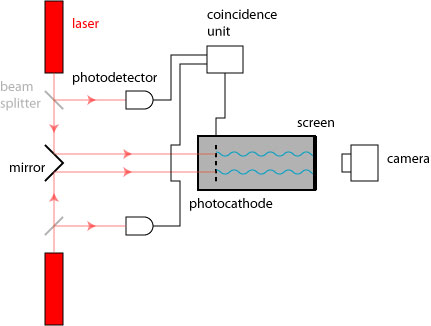
There are some practical issues that the experimental setup had to overcome. Though the two masers were triggered at the same time, their output consists of a string of random bursts of light that may or may not coincide in time on the photocathode. To address this, Magyar and Mandel split part of the output from each maser with mirrors to photodetectors whose signals were then sent to a coincidence unit. Only if a packet from each maser arrived at the same time was an image collected.
Why use a photocathode instead of directly imaging the interfering photons? The photocathode allowed them to reject any non-coincident light bunches as well as only measure the interference effects for a short duration of time on the order of nanoseconds. When not measuring, the image tube possessed a bias voltage that repelled the electrons from the fluorescent screen, preventing unwanted noise in their data.
The experimental results showed weak but significant interference between the maser light sources! A photograph of one such interference pattern is shown below.

Because the fringe visibility is rather low, this image is almost a Rorschach test for fringes — you can see them or not! They also did a microphotometer tracing of the light intensity in a horizonal cross-section of the pattern, shown below, which shows the weak but unmistakable interference fringes.

Magyar and Mandel had therefore shown that it is possible to see interference fringes between two independent sources of light. One might naturally conclude that we are therefore witnessing interference between different photons, though Magyar and Mandel astutely did not claim any such thing in their paper — with good reason, as we now will see!
To describe what happened next, we turn to the introduction of the 1967 paper by Pfleegor and Mandel3 that is our next topic of discussion. Referring to the 1963 results, they wrote
The demonstration, a few years ago, that two light beams derived from two independent lasers can give rise to observable interference fringes led to a certain amount of debate. The discussion centered in part on the appropriate description of the state of a laser field, and on the question whether the experiment disproved a famous statement of Dirac that “… each photon interferes only with itself. Interference between different photons never occurs.”
To describe the debate in simpler terms, Magyar and Mandel showed that two beams of light consisting of many photons produce interference, but did not show in particular that two different photons were interfering with each other. What would happen if the experiment were repeated, but with only one photon passing through the experimental system at a time with high probability? This is analogous to the aforementioned discussion of Young’s experiment with single photons. In Young’s experiment, the wavefunction of an individual photon passes through both slits, resulting in an interference pattern that can be detected when sufficient photons are counted.
Naively, we expect that no interference would be observed in the Magyar and Mandel experiment if done with single photons, since interference requires waves from both sources and we would imagine that a photon wave comes from one source or the other. But what actually happens experimentally? This is what Pfleegor and Mandel tested; a schematic of their experiment is shown below.
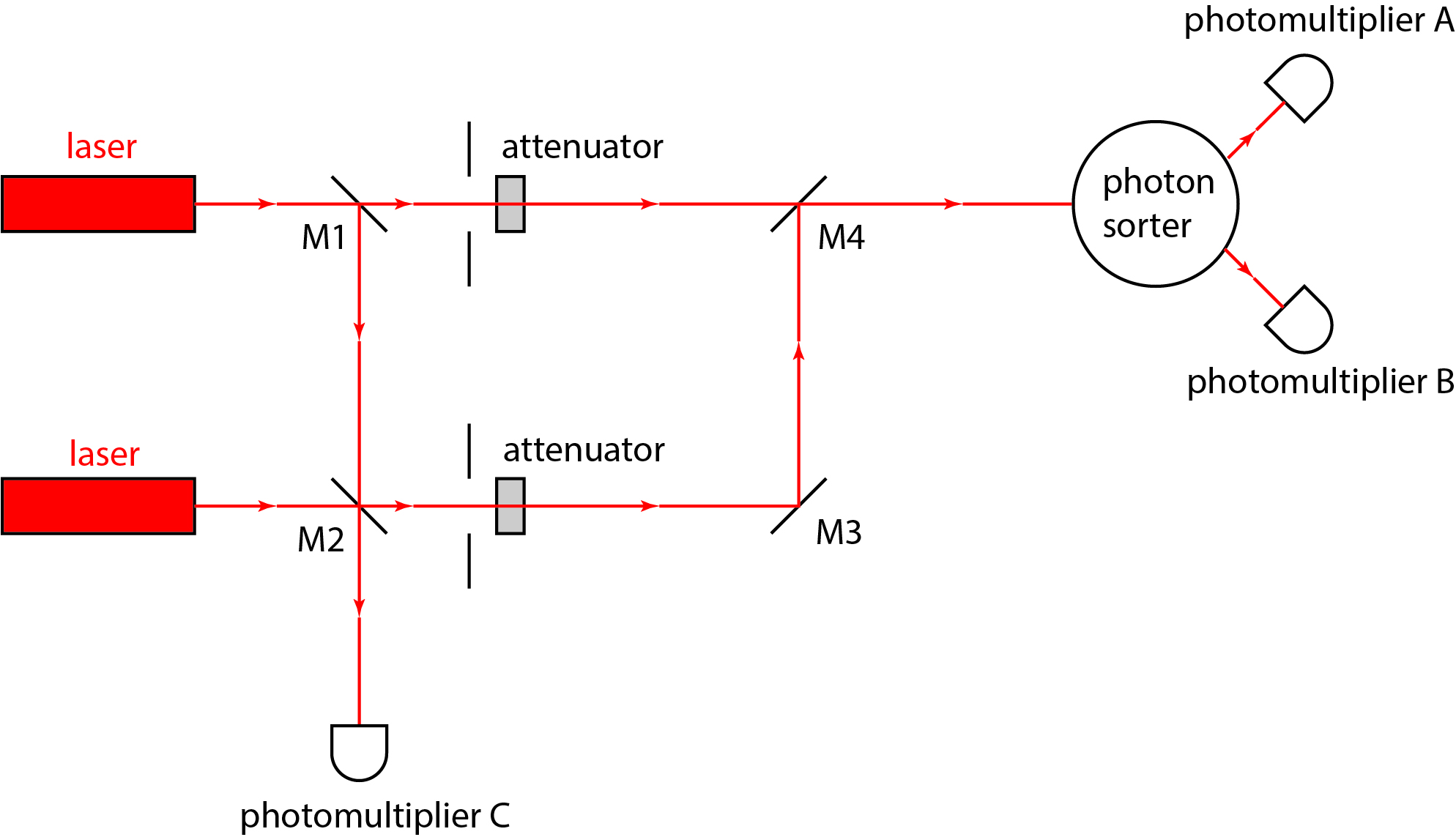
The basics of the experiment is very much the same as the Magyar and Mandel experiment: light from two independent lasers is brought together using mirrors to a detector that can measure the interference pattern. The first big difference is the presence of the attenuators: these are strongly absorbing materials that absorb most of the light incident upon them, and they were chosen such that, on average no more than one photon, total, is in transit through the system at a time.
The light sources in this experiment were steady state lasers that output light continuously. However, their frequencies still randomly fluctuate and any significant difference in frequency could erase interference effects. “Mirrors” M1 and M2, really just thin sheets of glass, deflect part of the continuous laser beams to photomultiplier C, where the frequency difference of the light beams was measured. The interference measurements were only taken when that frequency difference was below a certain threshold.
Astute observers might note that part of light from the upper laser could reflect off of M2 and follow the same path as the light from the lower laser; because M1 and M2 are just glass, however, very little of that light actually contributes to the lower path.
Mirror M3 is a conventional mirror, reflecting all the light, and M4 is a half-silvered mirror that reflects 50% of the light upon it, thus treating the upper and lower paths equally.
The “photon sorter” requires extra discussion, because measuring an interference pattern in this case was a unique challenge. As in the Magyar and Mandel experiment, the measurements must be taken over an exceedingly short period of time, and over that period of time Pfleegor and Mandel estimated that at most 10 photons would be detected. That number of photons is much too small to build up an observable interference pattern as done in the previous work, so another approach was needed.
I stared at the image of their device for quite a while before it suddenly hit me how it worked, and I was absolutely stunned at their brilliance! The basic device is a selection of thin glass slabs, alternating rectangular and trapezoidal, as I try to illustrate below.
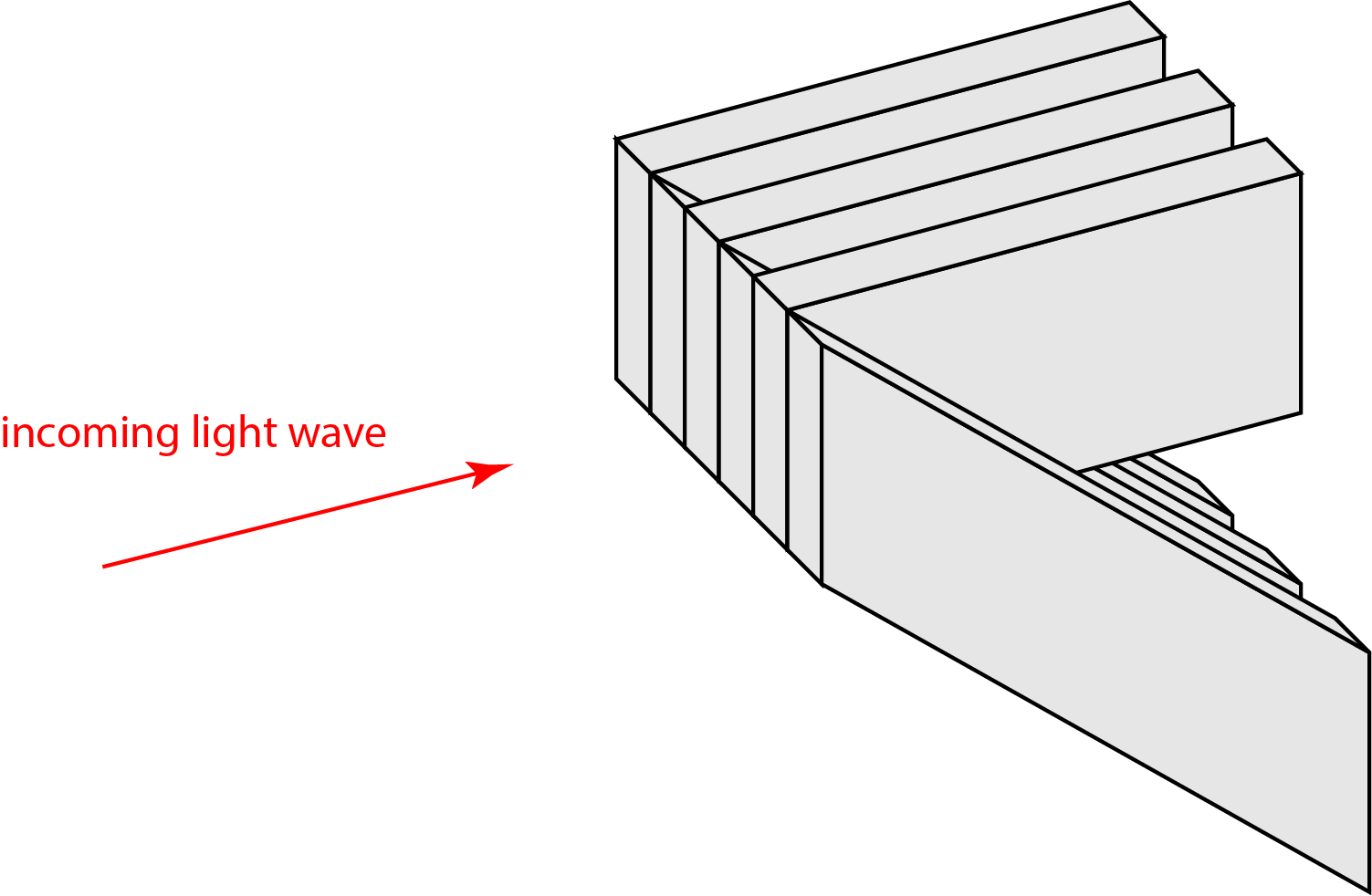
In this perspective image, the light wave (or photons, depending on your point of view) are coming from the left. How does this help detect interference? First, let us look at the side view of these glass slabs, and imagine that a photon is following a slightly angled trajectory into the slabs.
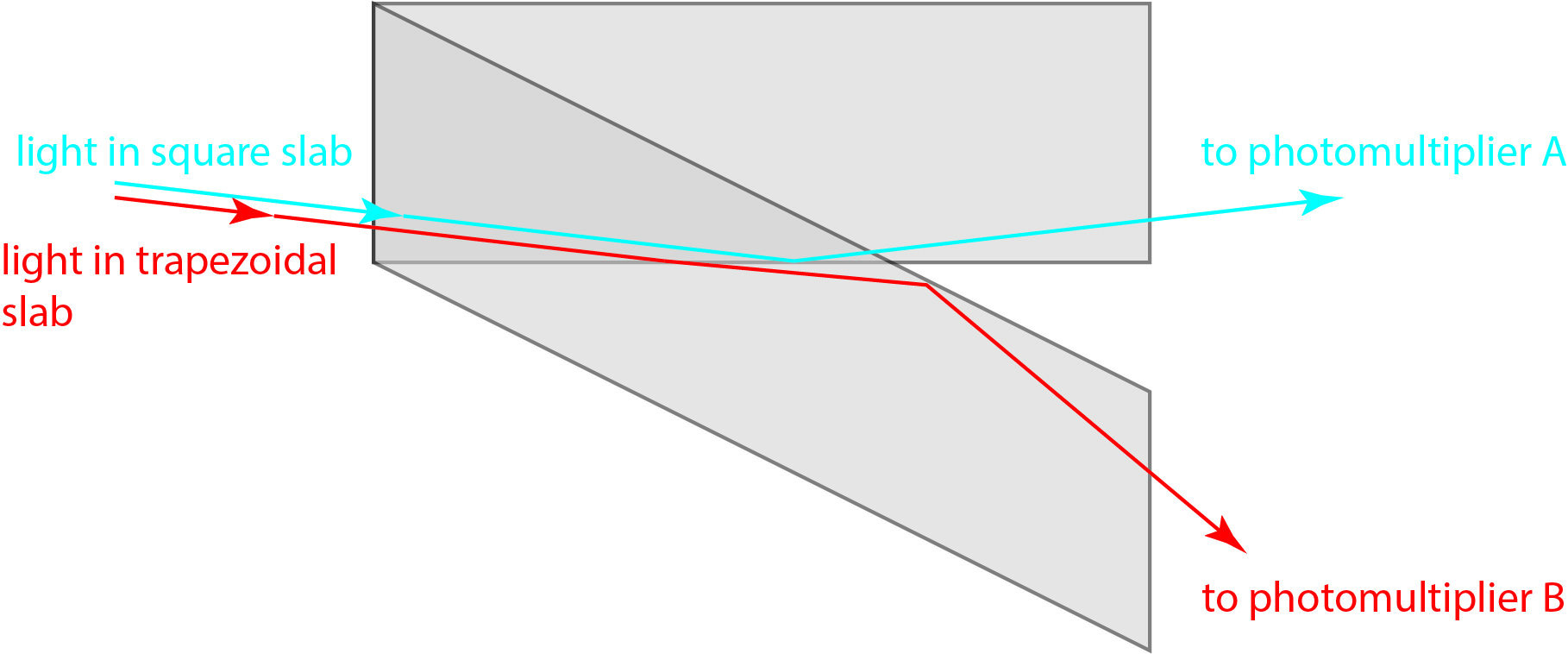
Light that enters the square slab will, by total internal reflection, be deflected upwards, towards photomultiplier A. Light that enters the trapezoidal slab will be deflected downwards, towards photomultiplier B.
Now let’s look at the slabs from the front, and imagine that the thickness of the slabs is matched to the bright/dark fringe interference pattern of the light impinging on it, shown below them.
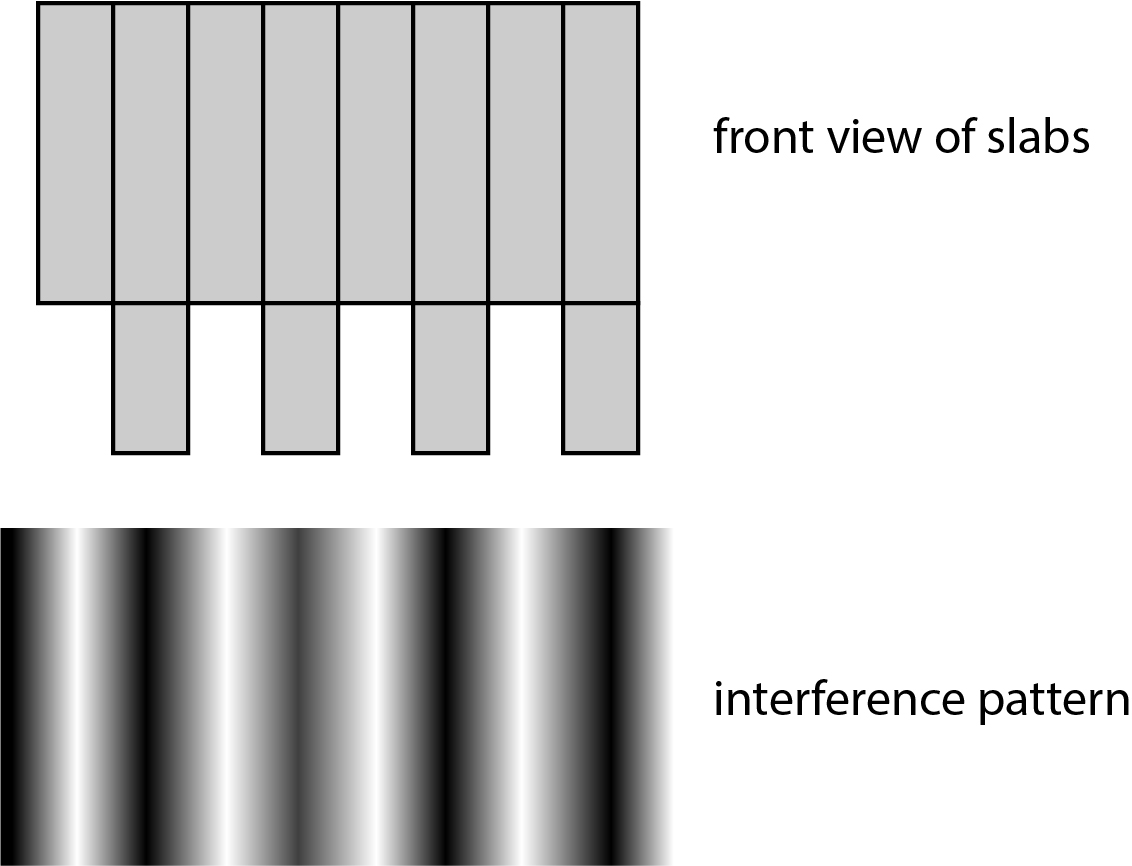
Recall that the interference pattern represents the probability that a photon appears at that particular location. If the interference pattern is aligned this way with the slabs, we expect all the photons to enter the square slabs and therefore all of them to go to photomultiplier A, and no photons to go towards photomultiplier B. We cannot predict the exact position of the pattern for each measurement, however, but if the bright fringes are instead aligned with the trapezoidal slabs, we expect all photons to go to photomultiplier B!
If there is no interference at all, we expect photons to be equally distributed among photomultiplier A and photomultiplier B. If there is interference, we expect to see an excess of photons at one or the other photomultipliers — this is, in fact, what Pfleegor and Mandel observed.4 Photons in the experiment tended to cluster in one or the other photomultipliers, indicating the presence of interference fringes, even when a single photon is in the system at a time! In the conclusion of the Pfleegor and Mandel paper, they write
Surprising as it might seem, the statement of Dirac quoted in the introduction appears to be as appropriate in the context of this experiment as under the more usual conditions of interferometry.
It is hard to overstate how strange this result is, even for people who are familiar with some quantum physics. Even though the interference experiment was designed to show interference of light between two separate sources, that interference still shows up even one there is only one photon present. That single photon’s wavefunction carries the interference effects borne of coming from both sources. If we think of the wavefunction as being a physical, propagating wave associated with the photon, we have to say that the photon wave came from both laser sources.
To make this even more mind-boggling, keep in mind that there appears to be nothing in principle5 that limits how far apart the laser sources can be. In the Pfleegor and Mandel experiment, the sources were likely on the same optical table, but we could just as easily imagine them being a mile apart from one another, or a light year. It very much becomes impossible to reconcile the typical naive picture of the wavefunction as being part of the physical emission process of the photon… how could a photon be simultaneously emitted by two incredibly distant places at the same time?
It should be stressed that there is nothing in these results that actually is in conflict with the mathematics of quantum physics. Pfleegor and Mandel themselves performed a theoretical analysis of their experiment and found their analysis in agreement with their observations. But what the Pfleegor and Mandel paper does, at least for me, is challenge our conventional interpretation of quantum physics and strongly hint at other possibilities.
For example: one long persisting interpretation of quantum mechanics is the “pilot wave” theory, that imagines that the quantum particle is guided by the wave. Again, the Pfleegor and Mandel experiment doesn’t fully rule out pilot wave interpretations, but it makes them strange enough that their usefulness in “explaining” quantum physics seems weaker.
In contrast, the “many worlds hypothesis” of quantum physics seems more plausible in light of this experiment. The idea of the wave coming from both sources at once can be interpreted as a reflection of a universal wavefunction where all possibilities are reflected in the wave properties at once.
Ideas like Carlo Rovelli’s relational quantum mechanics also seem much more reasonable in light of this approach. My understanding of relational quantum mechanics is still limited, but the broad strokes of it is that the wave properties of quantum particles are a reflection not of the particle itself, but of the information or lack thereof that we have of the object. In the case of this experiment, there is a lack of information about where the photon originated and this is manifested in the formation of an interference pattern.
In fact, it is somewhat of an unofficial rule in quantum physics that “indistinguishability implies interference.” In Young’s experiment, our lack of knowledge of which slit the photon passes through is connected to the appearance of interference fringes. If we were to modify the experiment to detect the photon’s exact path, we would find that the interference pattern becomes less prominent the more certain we know the path. In the Pfleegor and Mandel experiment, the lack of knowledge of which source the photon comes from results in an interference pattern.
As for Pfleegor and Mandel, they restrict their conclusions largely to this perspective; indeed, I believe this perspective largely came from Mandel’s work! They wrote:
In terms of photons, the experiment raises one or two interesting questions of interpretation. Whereas, in a conventional interferometer with a half-silvered mirror
it is possible (if undesirable) to think of each photon as going partly into each beam, this point of view is even less valid here, since the beams originate in two separate sources. It seems better to associate the interference with the detection process itself, in the sense
that the localization of a photon at the detector makes it intrinsically uncertain from which of the two sources it came.
I could go on for ages pontificating about the meaning of this experiment, and that’s why I love it so much! It challenges the way we are taught to think about quantum physics and I find myself thinking about what it could all mean on a regular basis. But for now, I think I’ve pondered enough and I’ll end the post here!
*******************************************
- T.L. Dimitrova and A. Weis, “The wave-particle duality of light: A demonstration experiment,” Am. J. Phys. 76 (2008), 137.
- G. Magyar and L. Mandel, “Interference fringes produced by superposition of two independent maser light beams,” Nature (London) 198 (1963), 255.
- R.L. Pfleegor and L. Mandel, “Interference of independent photon beams,” Phys. Rev. 159 (1967), 1084.
- There is also the possibility that the fringes might have the bright spots directly over the boundary between square and trapezoid, but these cases just reduce the overall strength of the measured signal.
- In practice, of course, it becomes exponentially harder to make the experiment work the further apart the sources are, but there is no reason to think that the physics changes fundamentally as the distance increases.


Fascinating story, thank you. I wonder what you think about the De Broglie and Silva short article (Phys Rev 1968) about the experiment. In particular, that paper claims that “… there exist interference fringes in the apparatus even if there is no photon that permits one to detect them.” If I understood correctly, this claim is different from the pilot wave theory (or is it exactly this) ? Thank you.