A short promotional post: Math Methods is available on Amazon!

At the risk of turning this blog into a series of shameless self-promotions (perhaps it is already too late), I should note that my textbook is now available on amazon.com!

I wasn’t paying close attention, because Amazon originally showed it as being released at the end of February, but it seems it got released in the middle of the month instead.

In what seems to be good news: even though it’s only been on the market for a short time, as of this writing Amazon has only one copy left in stock!  The book is either selling well or they didn’t bother to stock any copies!  (Also, how is it that there are already 2 “used” copies being sold — at $20 higher cost than a “new” one?)

P.S.  For instructors out there who might be considering using the book in a class: there will be a solutions manual, which I am currently trying to finish!  It’s taking some time to compile the solutions from old homeworks that I’ve used in class.  Hopefully within the next month I’ll have the manual available through the Cambridge site.

Posted in Optics, Personal | 6 Comments

My interview on Peer Review Radio!

Those who follow me on Twitter have already heard this, but for those who haven’t: I was interviewed by Adrian Ebsary for an episode of Peer Review Radio that was broadcast on Tuesday!

The episode is titled, “Go sing it on the mountain — communicating science online”, and I pontificate in it on the history of science, open science, and of course online science communication.  I’m in great company, as the other interviewees are Bora Zivkovic, Chris Gunter, and Marie-Claire Shanahan.

Give it a listen if you have a chance, and let me know what you think!  To be honest, I haven’t listened to the finished episode myself yet — I’m afraid to find out what I sound like!  (I’ll be listening over the next couple of days.)

It was my first official radio interview, and it was a lot of fun! Thanks to Adrian for inviting me!

Posted in General science, History of science, Personal | 8 Comments

Weird science facts, February 23 — March 1

I’m getting tantalizingly close to having posted a full 365 days of #weirdscifacts on Twitter!  Here are the past week’s facts:

347. Feb 23: Paleontologist C.D. Walcott (1850-1927) was inspired to study Cambrian strata when his wagon hit & split open a sandstone fossil rock. Lots of scientists have had their careers dictated by odd chance: we’ve mentioned previously physics Nobel prize winner Chadwick, who intended to study math but accidentally sat in on the physics entrance exam!  Walcott’s career was literally determined by a bump in the road.  (Source for #weirdscifacts [pdf, p. 5])

348. Feb 24: Largest recorded beaver dam: 2790 ft long, in Northern Alberta, Canada. That is, for the record, over nine football fields in length!  It was obviously made by multiple families of beavers working together.

349. Feb 25: In 1929, Werner Forssmann put a catheter into his own heart, tying up a nurse who tried to stop him! With the catheter in place, he then walked himself up to the X-ray room to take an image and prove that he had accomplished his goal.  (h/t for last #weirdscifacts to @JenLucPiquant and @io9, and this article)

350. Feb 26: Getting X-rays from scotch tape! I wrote a blog post on the subject some time ago.  When tape is peeled, electric charges are separated between the peeled and unpeeled portions.  In a vacuum, the electrons can “jump” back across the gap, and release X-rays upon deceleration.  Don’t worry — under ordinary circumstances (ordinary atmospheric pressure), there are no X-rays released.

351. Feb 27: The cousin of the Schrodinger’s cat thought experiment: quantum suicide!

352. Feb 28: The Campbell-Stokes sunshine recorder — invented in 1853 and still used today. With a wooden bowl and a glass sphere, you too can record the intensity of sunlight over the course of the day! (h/t @patrickneville)

353. Mar 01: “Cactus Walking On 20 Legs Found In China“. This ancient creature was a type of spindly worm, and is only known through the fossil record.  Did it actually “walk”?  We don’t know for sure.  Nevertheless, it is a very weird creature. (Post by @rkrulwich)

Posted in Weirdscifacts | 3 Comments

The Saga of the Scientific Swindler! (1884-1891)

When reading of the achievements of a giant of scientific thought such as Einstein, Feynman or Darwin, it is far too easy to envision the person, and scientists in general, as some sort of being above the worries of daily life.  The reality, of course, is that scientists are subject to the same emotions and problems as the rest of humanity: they can be irrational at times, angry at others.  Scientists can be fleeced by a clever con-man — and can even become the con-man themselves.

In the 1880s, a fascinating chain of letters appeared in the magazine Science and in other publications, including the New York Times.  The scientific community was being victimized by a clever confidence man, who was working his way into members’ trust and then stealing from them.   The exploits span at least 7 years and stretch over much of the United States.  Most surprising about it, however, is that the con artist was so successful because he was apparently trained as one of their own.

In this post we’ll trace the path of this mysterious swindler and the chaos he wreaked upon the scientific community.  Along the way, we’ll get a glimpse of the social interactions of scientists at the time and their very human nature, for good and ill.

Continue reading

Posted in ... the Hell?, History of science | 53 Comments

Weird science facts, February 16 — February 22

I’ve been working on another history of science post, but it is taking quite a bit of effort, so I haven’t posted anything on the blog since last week’s Twitter #weirdscifacts!  Sorry if it seems like I’m all weird science facts, all the time, but new posts will be coming soon.

Incidentally, you may notice that I’m really, really close to having done a full year’s worth of #weirdscifacts!!! I’d like to present some pretty weird stuff for the final week, so if you’ve got something bizarre to share, please let me know.

340. Feb 16: Another fun Komodo dragon fact: young smear themselves w/ feces to avoid being eaten by adults. Komodo dragons are not above eating their young, but they are averse to eating poo.

341. Feb 17: Lesson concerning self-experimentation: Reichelt’s 1912 disastrous & fatal Eiffel Tower parachute test. The amazing thing is that Reichelt was given permission to run the test using a dummy.  He ostensibly had arrived at the tower to do such a test, but revealed his intention to do the jump himself at the last minute.  Impulsiveness + skydiving = bad idea.

342. Feb 18: Abraham Lincoln tried to square the circle! (by @divbyzero)  “Squaring the circle” refers to the classic mathematical problem of drawing a square with the same area of a given circle using only a compass and a straightedge.  The problem in this form goes back at least as far as the ancient Greeks, though even earlier mathematicians tackled closely related ideas.  It was proven to be impossible in 1882, but unfortunately Lincoln didn’t live long enough for the revelation.

343. Feb 19: The man who stuck his head in a particle accelerator. (h/t @patrickneville)  Considering the beamline of an accelerator is, in essence, carrying a beam of radiation in it in the form of ultra-high energy particles, it is considered a bad idea to stick any part of the body into the beam.  The fact that safety mechanisms were not present to prevent such an occurrence is amazing in itself.

344. Feb 20: Highest g-force survived by a human: 46.2g (!), c. 1950.  Intentional test by pilot John Stapp. Keep in mind that this is equivalent to suddenly becoming 46.2 times as heavy!  Stapp would be subject to rapid accelerations/decelerations via rides on a rocket sled.  To consider how crazy this is, before Stapp’s work the human body was thought to be able to survive 18 g’s at most.

345. Feb 21: Telescopes can, and have been, made out of big pools of spinning liquid mercury. Mercury is highly reflective, and when a dish of it is spun the surface forms a perfect parabola, ideal for image formation.  A giant mercury mirror is much, much cheaper than a solid mirror; the disadvantage is that the mercury mirror can’t be tilted, for obvious reasons.

346. Feb 22: Bloop!  ‘Nuff said. This one also counts as a #creepyscifacts!  In 1997, an unidentified, extremely loud low frequency sound was detected in the ocean.  The signal seems to have been produced by a living creature, but was louder than any known animal can produce.  The online promo material for the movie Cloverfield tied the “Bloop!” to the movie’s monster.

Posted in Weirdscifacts | 4 Comments

Weird science facts, Feb 09 — Feb 15

Here are the Twitter #weirdscifacts for the past week, delayed a day due to the publication of The Giant’s Shoulders yesterday!

333. Feb 09: The sucker-footed bat! (Actually stick to things via sweat, not suction.) Animal appendages come in an amazing variety of forms; here we have a bat that literally sticks to surfaces!

334. Feb 10: Komodo dragons will eat animal intestines, but only after swinging them around to fling out feces. (This fact was a big, big hit on Twitter!)

335. Feb 11: The Dana Octopus Squid uses flashes of light from photophores to blind & disorient its prey.

336. Feb 12: The odd behavior of superfluids, which will climb up the sides of their containers! Superfluids are cryogenic liquids that exhibit quantum-mechanical behavior on a macroscopic scale — this is, in essence, quantum physics that we can see with the naked eye!

337. Feb 13: Cryoseisms, aka “frostquakes”. (h/t @patrickneville via @Allochthonous @rockbandit)

338. Feb 14: Properly focused, 2 square meters of sunlight can melt steel & rock! This is a remarkable video — 2 square meters of sunlight is, as the video says, enough to illuminate a trio of sunbathers.  There is enough energy there, however, to produce extreme temperatures.

339. Feb 15: Record distance for free-space optical communication? 183 miles by heliograph — in 1894. A good portion of my research involves communication by laser beam over long distances through the atmosphere, which is marred by atmospheric turbulence.  It is very odd to realize that the U.S. Signal Corps managed to communicate over huge distances with simple heliographs — essentially mirrors used to reflect the Sun’s rays.  Of course, the Signal Corps was not trying to send megabytes of information in a matter of seconds.

Posted in Weirdscifacts | Leave a comment

The Giant’s Shoulders #32

Welcome to the 32nd edition of the History of Science blog carnival, The Giant’s Shoulders!  We had an incredibly large number of entries this month, not all of which could be accommodated, so without further ado let’s get to them!  They are roughly sorted by field of study.

Continue reading

Posted in General science, History of science | 10 Comments

“Why is water considered ghost-proof?” (1884)

Did the title of this post catch your attention?  It caught mine immediately when I came across the identically titled “letter to the editor” in an 1884 issue of Science.

As regular readers know, I occasionally like to browse the issues of old science journals looking for unusual content worth blogging about.  My search is almost never in vain — there’s tons of intriguing stuff out there that’s been mostly forgotten about.

Science was founded in 1880, and like many journals starting out struggled to find readership, funding, and cutting edge content (like Physical Review, that I’ve talked about previously).  Though a disadvantage for the magazine at the time, it is now a benefit for historical-minded bloggers like me, because many quirky results found their way into its pages.

Such is the case with, “Why is water considered ghost-proof?”, a short letter by Lester F. Ward that appeared in the January 2nd, 1885 issue of Science.  It is a letter that is both more and less than it appears (more science, less supernatural), but also serves to highlight some other interests of the scientific community in the era.

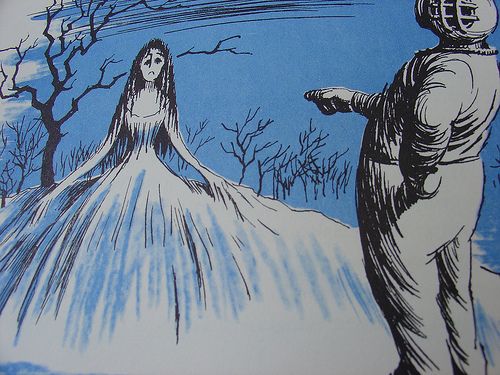
Illustration for the ghost story, “Water Ghost of Harrowby Hall“, by John Kendrick Bangs.  Illustration from Alfred Hitchcock’s compliation Haunted Houseful (source).

Continue reading

Posted in ... the Hell?, History of science | 13 Comments

Jennifer Ouellette’s The Calculus Diaries

Calculus plays a rather paradoxical role in modern society: much of our modern technology and science depends upon it, but amongst the general public it is feared, even despised, and treated almost as magic.

This is really a problem, as not only do our future physicists and engineers need to know calculus, but ignorance of math amongst the public and policymakers can lead to misinformed opinions and very bad decisions.

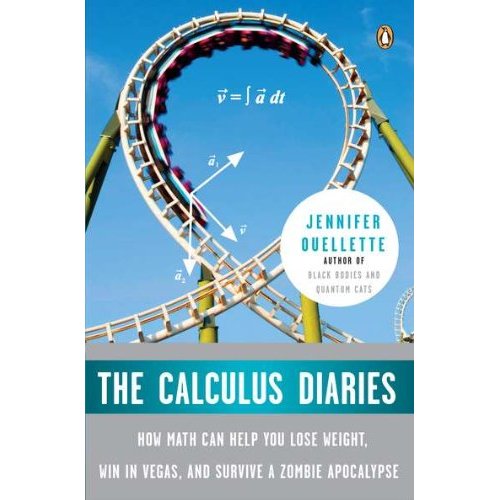
Jennifer Ouellette, the author of a number of popular physics books and the great blog Cocktail Party Physics, decided to try and do something about it: she learned calculus herself and wrote a book about it!  This was a remarkable and brave decision, as Jennifer has an admitted “math phobia”.  After a year of learning the concepts, and how they apply to real-world situations, she wrote The Calculus Diaries (2010):

This is not your typical book on mathematics: it doesn’t try and teach the subject to the reader like a textbook would (thankfully), but rather tries to explain the ideas behind it and why those ideas are important in today’s world, and fun!  This makes The Calculus Diaries a great book to give someone an appreciation of the math, or even get them excited about it.

Continue reading

Posted in Mathematics, Physics | 3 Comments

Weird science facts, February 2 — February 8

Below are the Twitter #weirdscifacts for the previous week!

326. Feb 02: Daguerre’s photographic process was made “free to the world” in 1839 — w/ exception of Great Britain. Daguerre was competing with British scientist Talbot to perfect the photographic process, and he ended up patenting his invention in England to prevent being “scooped”.  A week later, France (which had then acquired the rights from Daguerre) declared it a process “free to the world”, which by law excluded England!  This unfortunate outcome is said to have hindered British photography research for years.

327. Feb 03: Neutron star density: a sugar cube-sized piece would roughly have mass of entire human population. We all learn in grade school that atoms are mostly “empty space”; this leaves a lot of room for them to be compressed.  When a relatively light mass star runs out of fuel and collapses under its own gravitational “weight”, becoming a tightly-packed aggregate of electrons, protons and neutrons known as a white dwarf.  A star of larger mass possesses larger gravitational “weight”, and can squeeze the electrons and protons together to form neutrons, leaving an even denser object known as a neutron star.  As this fact demonstrates, such objects are incredibly dense: with a mass between 1.35 and 2.0 solar masses, a neutron star might have a radius of only 12 km!

328. Feb 04: The Bay of Fundy has a tidal range (difference in high/low tide) of 55 feet. If it isn’t clear, this means that the difference in water elevation between high and low tide is some 55 feet — perhaps the height of a four-story building!  This is the largest tidal range in the world, statistically tied with Ungava Bay.

329. Feb 05: A classic: Mercury is a liquid so dense that cannonballs will float in it. This can be understood by Archimedes’ principle: “Any object, wholly or partially immersed in a fluid, is buoyed up by a force equal to the weight of the fluid displaced by the object.”  Mercury has a room temperature density of 13.53 g/cm³, while solid iron has a density of 7.87 g/cm³.  Since Mercury has almost twice the density of iron, the iron will float at a level halfway submerged, as seen in the video.  Mercury is even denser than lead: 11.34 g/cm³.

330. Feb 06: The Casimir effect: in which quantum fluctuations in vacuum exert a pressure! In our current understanding of quantum physics, even empty space is never truly empty: so-called “virtual particles”, pairs of particles and anti-particles, constantly wink into and out of existence, unobserved.  Even though they are unobserved, however, their effects can be felt.  When two metal plates are brought close together, the area between them has the creation of these virtual particles hindered.  Because more virtual particles are created outside the plates, a net pressure is created that pushes the plates together.

331. Feb 07: The fungus that turns carpenter ants into zombies

332. Feb 08: The odd case of Phineas Gage, who survived an iron rod passing through his head. Gage may not even have lost consciousness when the 1.25” iron rod went through his skull and brain!  The case revised doctor’s views of traumatic brain injuries and provided some of the first insights into behavioral changes brought about by such injuries.  (Link to a classic @scicurious post.)

Posted in Weirdscifacts | 1 Comment