Many thanks to Jasper for putting together an excellent carnival, and best wishes for the continuing success of the blog!
The next edition will be hosted by myself right here at Skulls in the Stars on February 16th. Submissions can be sent to me or submitted through blogcarnival.com by the 15th.
We still desperately need new hosts! We’re happy to have folks who have hosted before do so again, so please let us know.
Here are the Twitter weird science facts for the week!
298. Jan 05: China’s treacherous Yellow River: est. 1.5k floods (millions killed) & 26 course changes in 2.6k years. The Yellow River is especially dangerous because of the high proportion of silt in it, which continuously raises the level of the river bed. Historically, levees were built to accommodate the raising river, and the breaking of these levees has lead to the catastrophic flooding and course changes. In 1938, in the second Sino-Japanese war, Chinese soldiers broke the levees to hinder the progress of the advancing Japanese; the flooding is estimated to have killed over a half million people.
299. Jan 06: The vampire finch? A finch is an unlikely blood sucker, but a certain species has developed the habit of opportunistically feeding on the blood of other birds.
For those wondering where my science-related posts have been these days, I have at least a partial answer: I have a guest post on the Scientific American guest blog on, “Invisibility: After several years of research, it’s just gotten weirder”! From the introduction:
Is it possible to hide something within an invisible cloak? It has already been over four years since the first groundbreaking theoretical papers on invisible cloaking devices were published, stirring up a near frenzy in the physics and optics communities. Since then, new results have come at a rapid and genuinely surprising pace, and news articles on the recent developments have been a bit overwhelming, even for a worker in the field. In this post, I thought I’d take a look at some of the fascinating results that have been published on invisibility, giving some perspective on how far we’ve come and how far we have to go!
I try and summarize some of the more unusual theoretical results about “cloaking”, showing how far researchers’ imaginations have taken the field. Give it a look; for those who may have arrived at this blog from the SciAm guest blog post, you can find more of my writings on invisibility in my archives.
Entries can be submitted through blogcarnival.com or directly to the host blog, as usual. Let’s see some great history of science blogging!
In other news, we still need more hosts for upcoming editions of the carnival; if you’re interested, please leave a comment or contact one of the organizers directly.
It can take an author many years of writing to establish their own unique voice and style. Their early works are often a fascinating “what if” scenario, giving a glimpse of directions a well-known novelist may have alternatively taken. The author Martin Cruz Smith is best known for his Arkady Renko series of mystery thriller novels including Gorky Park and Red Square; before this, however, in 1977, he wrote a horror novel titled Nightwing:
A horror tale that may be crudely summarized as part of the “When animals attack” genre, its inspiration is obvious: Peter Benchley’s Jaws was released in 1974 and the blockbuster movie came out in 1975. There was a huge demand for similarly themed stories, and I can almost imagine Martin Cruz Smith’s thought process: “You want stories about killer scary animals? Well, suck-on-this!”
Despite its somewhat derivative nature, Nightwing is actually a nicely-crafted and quite compelling novel. It has some genuinely creepy elements to it that transcend the otherwise rather limited genre.
I will quickly wear out my welcome with all my self-patting-on-the-back, but I can’t help point out that today was in essence a book trifecta for me! I already mentioned receiving the first copy of my book in my previous post. I also received today a pdf offprint of a review article I co-wrote with Taco Visser of the Free University, Amsterdam, that has appeared in Vol. 55 of Progress in Optics!
On top of those noteworthy milestones, I was delighted to learn today that one of my blog posts, on Kerker’s invisible bodies, was selected to be included in the fifth edition of The Open Laboratory!
Three book-related achievements in one day! I don’t think I’ll top today accomplishment-wise for some time. To celebrate, I’m adding two new badges to my sidebar, including a link to my book and a badge indicating my status as a judge of Open Lab. I’m starting to accumulate as many badges as a banana republic despot, but I can’t help myself.
And this will be my last self-congratulatory post for a while, at least until my next book, “Dr. SkySkull is Perfect in Every Damn Way”, is published.
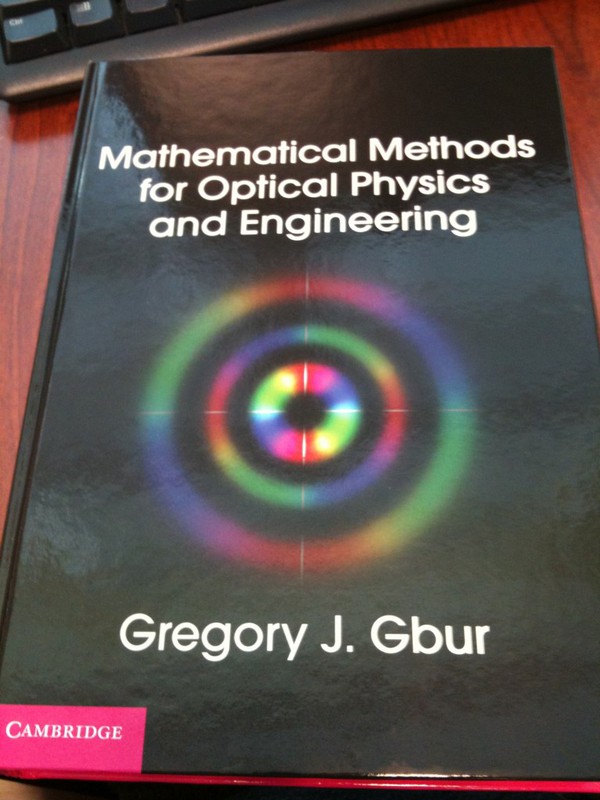
This morning was a personal milestone for me: the very first copy of my new textbook, Mathematical Methods for Optical Physics and Engineering, arrived at my office!
I’m very excited, obviously! The book is now available through Amazon.co.uk for those in Europe; it should be available at the end of January on Amazon.com in the United States. You can also look it up on the Cambridge website. Now I’ve got to finish my draft of the solutions manual for it…
We’ve entered a new year for my Twitter #weirdscifacts! The previous week’s facts are below:
291. Dec 29: In the late 19th century, paleontologist O.C. Marsh speculated that stegosaurus had a second brain in its rear! This was no so crazy at the time as it perhaps appears now. Marsh noted that stegosaurus has a large canal in the hip region of the spinal cord, and this canal was significantly larger than the animal’s brain. Because of the smallness of dinosaur brains, it was thought that perhaps a large animal like stegosaurus needed a second brain in the rear area to control reflexes back there. This is no longer believed, but the canal’s purpose is still unclear.
293. Dec 31: Placobdelloides jaegerskioeldi, a leech that only lives in the anus of hippopotamus. (h/t @DrBondar) This is obviously a very specialized leech. It has not been studied very much, due to the obvious dangers of not only working with hippos, but rooting around in a hippo’s rear-end!
294. Jan 01: Start New Year’s weird facts with a bang! The Tunguska blast and other similar events. It is really striking, and a little frightening, how frequently meteorite airbursts occur with energies in the kilotons of TNT or higher.
296. Jan 03: Vampire bats: a 40g bat can drink 20g of blood in 20 mins — and pee most weight away in 2 mins. These bats are remarkably adapted: they drink so much blood that they can’t even fly with it all, but their bodies quickly absorb the nutrients and pee out the leftover liquid.
297. Jan 04: Soldiers can collapse a bridge simply by marching across it: ex. Angers Bridge, 1850. Such bridge collapses are an example of mechanical resonance. Bridges, buildings and other structures tend to have characteristic frequencies of vibration, and external forces that vibrate in synch can produce massive oscillations of the structure that can lead to failure. The most famous example of this is the original Tacoma Narrows Bridge, which collapsed due to wind forces in 1940.
In the case of the Angers Bridge, the resonance was induced by soldiers marching in lockstep across it. The disaster led to soldiers being advised to break step when crossing bridges, though evidently this rule had been implemented by much earlier military groups and later lost.
I’m currently away from home at a meeting, so blogging is necessarily light. I’ve been thinking lately, however, about various scientists and people of reason throughout history that I just flat out admire, and got to wondering which of them I would most like to meet in a social setting and just sit down to chat with. And maybe a beer. So I thought I’d turn this post into a readership poll: which scientist(s), living or dead, would you most like to have a beer with?* (Or wine, or dinner, if you’re not into beer!)
For me, I’ve got three perhaps unconventional types that stand out:
Reginald Scot (1538-1599). Scot was born and lived in Kent in the U.K., in a time of rampant fear and ignorance. Witch-hunts were depressingly common, and tens of thousands were killed as witches during the era from 1480-1700. Reginald Scot was a shining beacon of reason in this very dark time: after successfully defending and rescuing an accused witch in 1581, he set out to prove that witchcraft did not exist! He published The Discoverie of Witchcraft in 1584, a stunningly ballsy move in an era when the existence of witches was church and government doctrine and arguments to the contrary were very nearly heresy. He made powerful enemies in the process: James the 1st, of the King James Bible, became king of England in 1603, and was himself a fervent believer. He wrote his own book, Daemonologie, in 1597 in large part as an answer to Scot’s. James ordered that Scot’s book be burned, but Scot himself fortunately escaped his wrath, having died in 1599. It would be fascinating to talk to Scot about what it was like being essentially alone in his rational beliefs. Also, he would appreciate a good beer: his first book,A Perfect Platforme of a Hoppe-Garden (1574), led to Kent becoming the hop-producing center of England!
Sophie Germain (1776-1831). Sophie was a brilliant mathematician in an society which could not and would not allow women to be educated as men. Born into a wealthy Parisian family, she taught herself the works of Newton and Euler (learning Latin in the process) while sheltered at home from the French Revolution. Prohibited from attending the École Polytechnique when it reopened in 1794, she obtained the lecture notes and began submitting her homework under a male pseudonym, “M. LeBlanc”. Her brilliance attracted the attention of the famous mathematician Lagrange, who became her mentor. Germain went on to make significant contributions to the mathematical theory of elasticity and number theory. The great mathematician Gauss got to know Germain as “LeBlanc” through correspondence as well, and was impressed with the “man’s” talents. He was even more impressed and gracious when he learned her true identity when she took steps to protect him during a French invasion of Germany; you can read this correspondence in my post here. It would be a delight to chat with Sophie about mathematics and her struggles as a woman in mathematics in that unforgiving era.
Michael Faraday (1791-1867). I’ve talked plenty on this blog about Michael Faraday, who was one of the greatest scientists of his time and one of the top experimental scientists ever! He started life as the son of a blacksmith, and was essentially prohibited from the upper class world of scientific investigation. While working as an apprentice bookbinder, his requests for a menial job at the Royal Society were ignored but he started his own experiments in the bookshop, eventually attracting the attention of the preeminent chemist Humphrey Davy. From there, working as Davy’s assistant and personal valet, Faraday would go on to complete the unification of electricity and magnetism, demonstrate the relationship between magnetism and light, and make fundamental discoveries in chemistry, among others. He was an excellent lecturer, and gave numerous Christmas presentations to students at the Royal Institution. He was an activist who wrote letters in favor of cleaning the Thames. He was also a visionary, making intriguing speculations on the nature of atoms and on the unification of the fundamental forces. I can’t say how cool it would be to just get to chat with him about his views on physics, society, and the natural world in general.
That’s my dream of perfect scientific social encounters! (Not counting my thesis advisor, who is awesome and I’ll be having dinner with in 10 minutes.) Now it’s your turn — who would you love to grab a drink with, and why? Let me know in the comments!
****************
* This post was inspired by Carin Bondar’s regular interview question: If you could have 3 guests for dinner, who would they be?
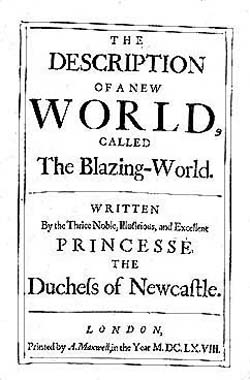
It is somewhat fascinating to note that certain genres of fiction have their beginnings much earlier than generally appreciated. Two years ago, I blogged about Edward Bulwer-Lytton’s unusual 1871 novel, The Coming Race, a utopian novel that counts as one of the earliest science fiction stories ever written. In researching that post, however, I came across a proto-science fiction tale that is much older: The Blazing World, by Margaret Cavendish:
As one can see from the title page, this work is much older than The Coming Race — it was first published in 1666! Though there wasn’t even much “science” in that era, The Blazing World is arguably one of the earliest science fiction novels ever written.
The author of Skulls in the Stars is a professor of physics, specializing in optical science, at UNC Charlotte. The blog covers topics in physics and optics, the history of science, classic pulp fantasy and horror fiction, and the surprising intersections between these areas.

 A finch is an unlikely blood sucker, but a certain species has developed the habit of opportunistically feeding on the blood of other birds.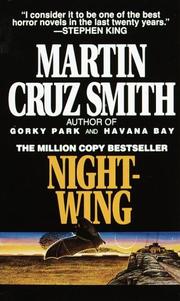


 Skulls in the Stars