I’ve talked a lot about polarization recently, including the story of how the best polarizing material was discovered on accident and how modern polarizers made from that material really changed science and technology in a major way. Along the way, I stumbled across the scientific paper that introduced the earliest polarizing device — the Nicol prism. Invented by the Scottish geologist and physicist William Nicol in 1828, it became the standard method of developing polarized light for many years. It is a fascinating device that uses two distinct and unusual optical phenomena together in a clever way, and thought it would be worth discussing his paper and his fascinating invention.
To begin, as I did in the aforementioned posts, let me first say a few things about polarization. Light is a transverse electromagnetic wave, which means it consists of an electric field and a magnetic field, both oscillating perpendicular to the direction the wave is travelling, as illustrated roughly below.
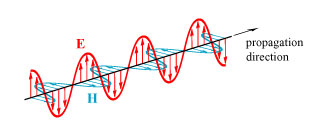
We usually use “E” to represent the electric field and “H” to represent the magnetic field (don’t ask me why we use “H” — I don’t know). As a transverse wave, there are always two distinct ways that a light wave can oscillate. For convenience, we’ll call them “up-down” and “left-right.” We can also describe them by any pair of directions perpendicular to travel, however, such as “upper right-lower left” and “upper left-lower right.”
Continue reading