R.W. Wood’s lecture demonstrations (1897-1905)

With all the concerted efforts into popularizing science that goes on these days, it is quite easy to forget that some of the best scientists throughout history put a lot of effort into making their knowledge accessible both to students of the arts and laypeople alike. Physicists in particular are often viewed as “keepers of secret knowledge” who study phenomena outside the ken of mortals and who are unwilling or unable to make this knowledge accessible to others.

A perfect counterexample to this perception is the great physicist Michael Faraday (1791-1867) , who over the course of many years presented the Christmas Lectures at the Royal Institution, targeted at nonspecialists and young people. Two of these lectures, “The Forces of Matter” and “The Chemical History of a Candle”, have been reprinted and are still available today; I will be blogging about them in detail in the near future (hopefully). Faraday in fact put much effort and thought into his public presentations; long before he was a recognized scientist and had any opportunity to speak to an audience, he observed other lecturers and took elaborate notes on the “do’s” and “don’t’s” of lecturing.

Another example of a distinguished scientist working very hard on presentation is Robert Williams Wood (1868-1955). Wood is best known today for his work in optics, particularly in the study of infrared and ultraviolet light. As we have seen previously on this blog, however, Wood was also active in popularizing science: he co-authored two science fiction novels, The Man Who Rocked the Earth (1915) and The Moon Maker (1916). He also was quite skilled at setting up simple demonstrations of optical effects; I’ve previously discussed his 1902 illustration of a simple form of invisibility. Between the years 1897 and 1905, Wood in fact published a number of short articles suggesting simple lecture hall demonstrations of a variety of physical phenomena; in this post, we’ll take a short look at these demonstrations.

Continue reading

Posted in History of science, Physics | 1 Comment

5 days until The Giant’s Shoulders #27!

There’s only 11 days left before the deadline of the next edition of The Giant’s Shoulders history of science blog carnival!  It will be held at Entertaining Research, and the deadline for entries is September 15th.  Entries can be submitted through blogcarnival.com or directly to the host blog, as usual!

Posted in General science, Science news | 1 Comment

Weird science facts, June 6-June 19

The Twitter #weirdscifacts from June 06 – June 19 are below the fold!

Continue reading

Posted in Weirdscifacts | 1 Comment

Making molecular motors (video)

My friend and colleague, Dr. Charles Sykes of Tufts University, recently sent me a link to an  interesting video his research group has put together!  Dr. Sykes’ group has been studying the behavior of complex molecules on surfaces at low temperatures.  They use scanning tunneling microscopy to image and interact with the molecules on the surface, with the ultimate goal of making nanoscale machines, i.e. machines consisting of a single molecule!

Their research video describes the techniques, science, and challenges in developing such molecular motors:

Let me know what you think of the video, or contact the Sykes group directly!

Posted in General science | Leave a comment

ResearchBlogging editor's selections: age of the Earth, hacking quantum cryptography, American camels and free kick physics

skyskull “Dr. SkySkull” selects several notable posts each week from a miscellany of ResearchBlogging.org categories. He blogs at Skulls in the Stars.

  • When a few million years don’t mean much… Recent investigations have revised scientific estimates of the age of the Earth by several million years! Greg Fish at weird things explains the nature of the revision and reassures us that, although important, it doesn’t indicate major problems in our understanding of Earth’s history.
  • Hacking commercial quantum cryptography systems by illumination. “Quantum cryptography” has been much touted as a “near perfect” system for secure communications, using the laws of quantum mechanics to make any attempt to eavesdrop immediately detectable. However, recent research has shown that existing systems can be hacked by the judicious application of a bright, classical light source! Olexandr Isayev at isayev.info explains the strategy, and how its discovery will actually help produce more secure cryptographic systems in the future.
  • Dirty browsers — determining a menu for North America’s fossil camels. Starting with the fascinating history of the U.S.’s attempt to use camels as military animals, Brian Switek of his eponymous blog segues into a look at the fossil remains of America’s own native camel species.
  • Free kick physics, Roberto Carlos style. The 1997 winning free kick of Roberto Carlos in soccer is legendary, but nobody knew how it was actually possible! Michael Gutbrod of A Scientific Nature explains how such amazing curved shots have been shown experimentally to be a consequence of the Magnus effect.

Check back next week for more “miscellaneous” suggestions!

Posted in General science, Science news | Leave a comment

Physical Review Letters gives a WARNING!!! (1958)

Though scientific knowledge has increased by leaps and bounds throughout the course of human history, human nature itself hasn’t changed very much!  Looking through the old scientific journals, one can find arguments and conflicts that are still in some form still playing out today.  A few months ago, I described an 1804 paper titled, “On the decline of mathematical studies, and the sciences dependent upon them,” which laments England’s loss of competitiveness due to lack of comprehensive mathematics education; the arguments in the paper might have been written today.

A week ago, I was browsing the archives of Physical Review Letters, which is in essence the most prestigious physics-only journal in existence.  (Papers in Nature and Science are considered more prestigious, but those journals cover all scientific topics.)  Getting a paper into PRL is considered a great achievement — it supposedly indicates that your research is a significant scientific advance of very broad importance that should be published rapidly.  The prestige is so great, in fact, that it is very tempting for researchers to submit work that is not quite appropriate for PRL, on the off-chance that it can be “snuck in”.  This results in an excessive amount of papers being submitted to the journal, overwhelming its editors and its peer-reviewers, and can be a real hassle.

I suspect the top journals in every field see this sort of problem, but surely this wasn’t a problem for PRL in the heyday of physics, when the journal was first initiated, right?

Volume 1, issue 1 of Physical Review Letters came out on July 1st, 1958; in the February 1st, 1959 issue of PRL (vol. 2, p. 80), an editorial appeared with the very ominous title, “A WARNING”.  The text of this editorial is presented in its entirety below.

Continue reading

Posted in ... the Hell?, History of science | Leave a comment

Conservation mode/growing pains

What Christina said:

We’re putting scientopia basically in to conservation mode to conserve resources until we get hosting issues squared away. So we’ll have no commenting on new posts for a bit.

This isn’t a sinister plot to stifle dissenting opinions — as you may have noticed, we’ve been having some issues lately!  If you want to comment on any new posts I write in the near future, you can always email me at:

skullsinthestars *the*at*thingy* skullsinthestars.com.

You can also “tweet” me at @drskyskull.

Posted in ... the Hell? | Comments Off on Conservation mode/growing pains

Weird science facts, May 23-June 05

The Twitter #weirdscifacts from May 23 – June 05 are below the fold!

Continue reading

Posted in Weirdscifacts, [PhysicalScience] | Leave a comment

Kitty fostering: Brewster and Breyer!

I’ll be doing more physics blogging in the near future — I promise!  Work is keeping me quite busy at the moment and I haven’t had much spare time or energy to investigate topics in depth.  Hopefully that will change in the future, but for now I thought I’d share some other news — we’re fostering two sweet kitties!

Last week, the wife and I were at the local PetSmart, where we met Terry who runs F.U.R.R. — Feline Urgent Rescue and Rehabilitation—  a rescue shelter that specializes in so-called feral cats and socializing them for homes.  We went and visited Terry’s “kitty lodge” and learned about the daily operations of the shelter, and are still contemplating volunteering!

In the meantime, we couldn’t help but agree to foster a couple of cats! Every cat that can be fostered makes more room for the shelter to rescue another animal, which made it hard for us to resist. Our new houseguests are handsome brothers named Brewster and Breyer!

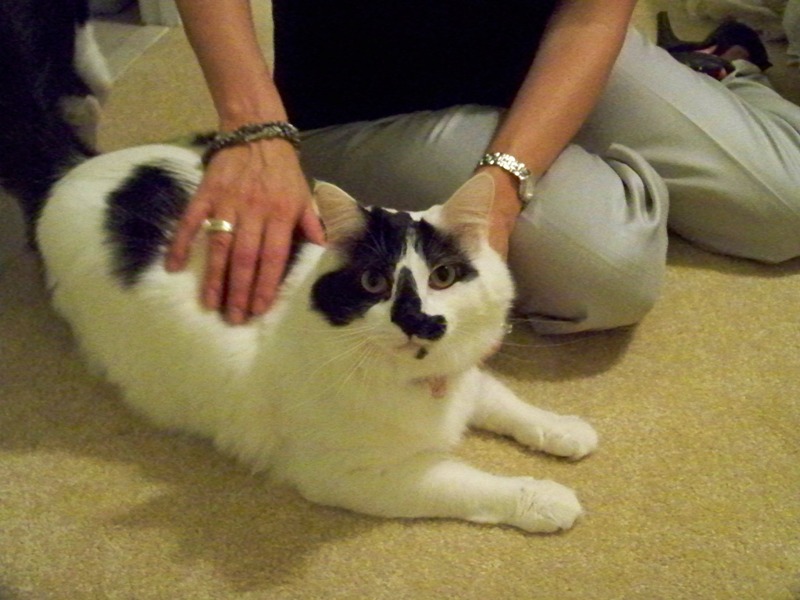
Breyer is a big boy, though not all of that size is due to long fur (he’s a little round right now):

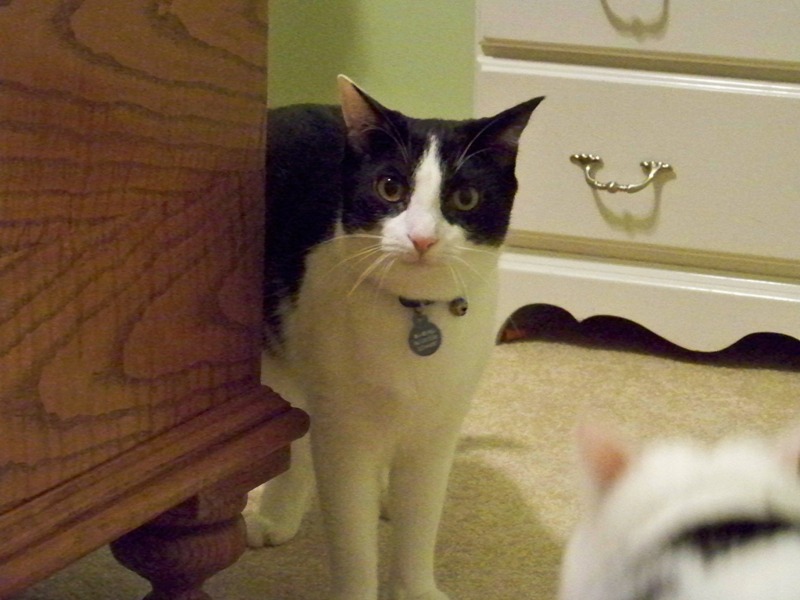
His brother is Brewster is a smaller, short-haired cat, and clearly takes his cues from big bro:

Both boys were a little scared when we first got them home, but within half a day they turned into the most lovable kitties you could imagine:

(I actually had a hard time getting pics of them, because they spent most of their time rolling around on their backs right in front of me or rubbing up against me.)

For those who are already doubting that we’re actually “fostering” and not “adopting”, as in some previous attempts, let me state that the wife and I are allergic to short-haired cats, and therefore can’t keep these two.  They are adorable, however, so if you know anybody in the vicinity of Charlotte that would be interested in adopting these two lovely boys, please point them towards Terry at F.U.R.R.!  You can also donate to F.U.R.R. here.

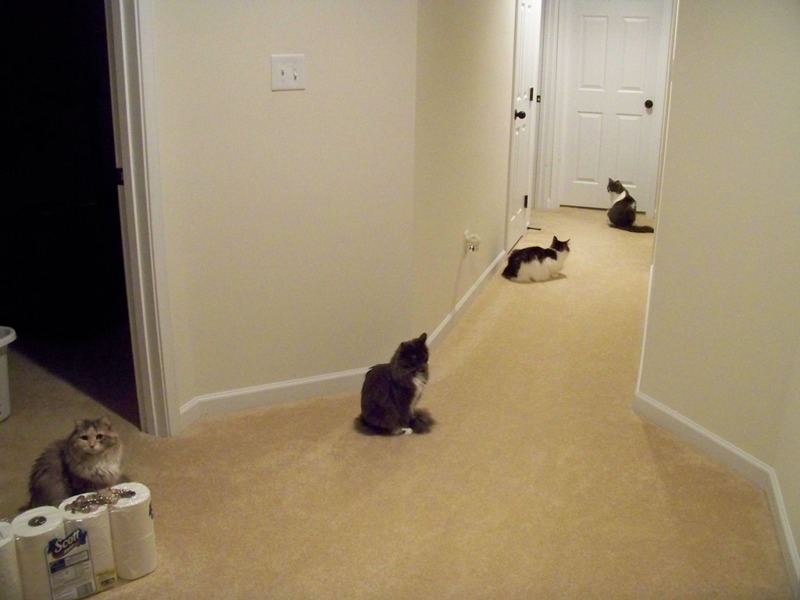
Incidentally, if you’re wondering how the other cats are handling things, let’s just say they’re curious and a little nervous right now.  Here’s a picture from outside the guest room we’re keeping the boys in:

Posted in Animals, Personal, [Etc] | 5 Comments

ResearchBlogging editor's selections: measuring gravity, measuring magnetism, antiseptic spices and Goya's bullfighting

skyskull “Dr. SkySkull” selects several notable posts each week from a miscellany of ResearchBlogging.org categories. He blogs at Skulls in the Stars.
  • Measuring Gravity: Ain’t Nothin’ but a G Thing. Gravity is one of the fundamental forces of nature, but also one of the most difficult to measure precisely; a recent experimental measurement of the gravitational constant has shown significant deviation from the accepted value. Chad Orzel at Uncertain Principles looks at a variety of recent gravitational measurements, and explains the implications of the recent discrepancy.
  • Snapshots of magnetic fields. While we’re talking about things that are hard to measure, let’s talk about magnetic fields! Magnetic fields are extremely difficult to measure with nanoscale precision and in the time domain, in marked contrast to measurements of other quantities. Joerg Haber of All That Matters discusses recent techniques for measuring such fields.
  • Spices as antiseptics… maybe. Spices can add lots of “zing” to your food, and make some people suffer while eating it, but do they serve an even more important biological function? Thomas Kluyver at Thomas’ Plant-Related Blog looks at the evidence that the use of spices has served an antiseptic purpose in food preparation, and the limitations of that evidence.
  • Tauromaquia Today. And now for something completely different! Bécquer Medak-Seguín of Hispanic Studies Forum discusses a dispute in the interpretation of artist Goya’s collection of etchings on bullfighting, La Tauromaquia.

Check back next Monday for more “miscellaneous” selections!

Posted in General science, Science news, [Etc] | 1 Comment