I’ve mumbled various random things in the past about my upcoming textbook project; this week, I finally got approval from the publisher to start hyping it on the blog. (Actually, they never prohibited it, but I just got around to asking them last week if it was okay.)
Announcing: Mathematical Methods for Optical Physics and Engineering, by Greg Gbur, to be published by Cambridge University Press! The raw image that I have submitted to be turned into beautiful cover art is shown below:
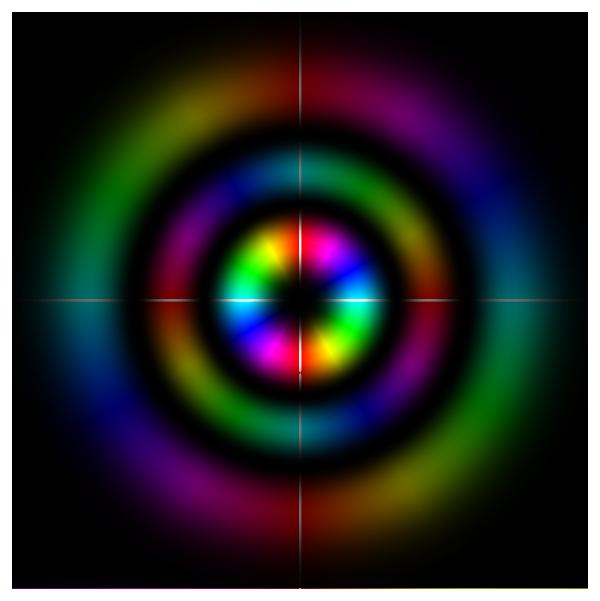
(I’ll leave it for the readers to guess what the image represents; feel free to speculate in the comments.)
There are plenty of “mathematical methods for physics” books out there — why did I feel the need to write another one? Well, I’ve been teaching a graduate course on mathematical methods in my department for five years — and actually taught one while still a grad student, too. My department focuses on optical science and engineering, so most of the students I get are (a) interested specifically in optics, and (b) often coming from an engineering background with much less abstract mathematics.
Most mathematical methods for physics books are geared towards a general student of physics. This was a bit irksome for both me and the students while I taught the class, because optics requires a slightly different set of mathematical tools, in particular more emphasis on signal processing, integral transforms, and Green’s functions.
Furthermore, math methods books typically draw from a wide variety of physical topics for exercises and examples. This is, in my opinion, sometimes futile — for most students, examples drawn from general relativity (or even statistical mechanics) are no better than abstract mathematical ones.
Optics has become a significant field of science in its own right, with dedicated schools in Arizona, Rochester, Orlando, and Charlotte (my home base). Plenty of other departments of physics and engineering have a strong focus on optical science. I decided to take a stab at revising the curriculum for those optics-centric programs, and introduce my own mathematical methods book that would complement an optics undergraduate or graduate education.
One of the biggest problems in teaching mathematics is making the connection between the math itself and the application of said math. To try and address this, (almost) every chapter begins with an introductory application for the technique to be studied, and ends with a more detailed study of how the math is used in solving an optical problem. I’ve tried to pick optical problems that don’t typically appear in other optics textbooks, for instance: the Talbot effect, Zernike polynomials and aberrations, optical vortices, X-ray crystallography, computed tomography, and even optical cloaking! I’ve also taken the unusual step of including essay questions in the exercises: read a given scientific paper and answer questions about its relation to the given mathematical topic.
Though academic optics programs are becoming more common, I’m hoping the book will catch the attention of instructors teaching general math methods for physics courses. I’ve tried really hard to approach many of the traditional topics from a slightly different angle. I’m endeavoring to pass through a very narrow opening between “qualitative understanding” and “mathematical rigor” — I only include the rigor when it genuinely helps in applying the given methods.
I’ve also tried to make this book a little more portable! Most math methods books are well over 1000 pages, but mine is targeted at 850.
Obviously, this book won’t be for everybody, and probably won’t appeal to many of the readers of my blog, for instance those interested in non-technical explanations of optical phenomena! (This project was conceived long before I started a blog; my next writing project will be a more popular science/history book.) Hopefully everyone will benefit from my efforts, however — over the next few months, I’ll write non-technical descriptions of many of the optics examples that I’ve used in the book. I’ll also give more descriptions of the book and the process of finishing the book at time progresses.





 Skulls in the Stars