
Couldn’t resist posting a short note that my textbook now has an Amazon page! The cover image hasn’t been added yet, so I may have to take matters into my own hands and put it up myself:
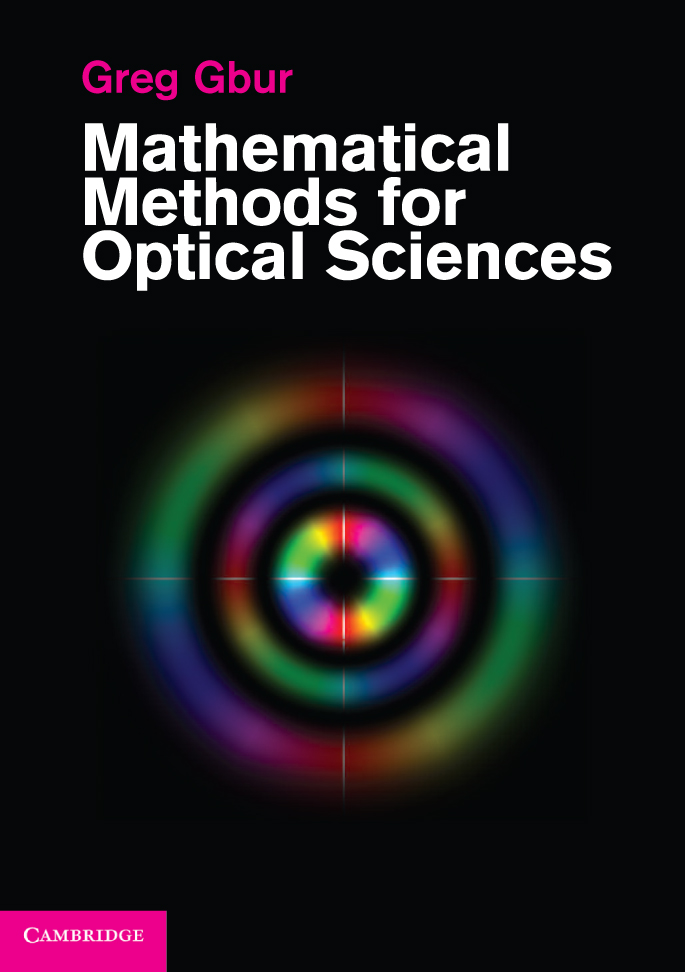
Couldn’t resist posting a short note that my textbook now has an Amazon page! The cover image hasn’t been added yet, so I may have to take matters into my own hands and put it up myself:
No matter how much Richard Matheson I’ve read — and I’ve read a lot — it always turns out that there’s a bit more out there that I’ve managed to miss!
If you aren’t familiar with Richard Matheson‘s name, you’re nevertheless familiar with his work — starting in 1950, he has penned countless science fiction and horror tales, many of which have been filmed as major motion pictures and Twilight Zone episodes. I did a “horror masters” post on him some time back, noting his most memorable works such as Duel, Nightmare at 20,000 Feet, I am Legend, and The Shrinking Man. He also was a significant influence in the creation of The Night Stalker movies and television series in the 1970s, having penned the screenplay of the two films.
Matheson is a prolific writer who has written in many genres, but unfortunately many of his novels have been hard to find. Recently, though, I stumbled across a reprint of a novel of his that I hadn’t read before, Shadow on the Sun (1994):
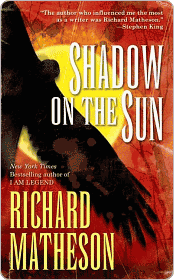
The novel was written during his “western” phase of writing in the 1990s, during which he wrote a number of novels about gunslingers. Shadow on the Sun is set in the Wild West, but it is also a horror novel!
Check back next week for more “miscellaneous” selections!
I swear that I’m not going through journals looking for old versions of the Mythbusters‘ experiments! After blogging about old scientific papers on myths such as “finger in the barrel” and “Archimedes death ray“, I figured I’d pretty much tapped out historical mythbustin’ papers. Scientists of every era, however, have an eye for the weird, so I suppose it was inevitable that I found another paper with a connection to modern mythbusting!
The paper in question is “Memoir on the Incombustible Man; or the pretended phænomenon of incombustibility,” from volume 32 of the Philosophical Magazine from 1808, by Louis Sementini, M.D., chief Professor of Chemistry in the Royal University of Naples.
What this paper describes is an in depth series of experiments, performed by Dr. Sementini upon himself, on the science of fire eating!*
The Giant’s Shoulders #22 is up over at The Lay Scientist! Thanks to Martin for assembling it!
The next edition is something of a special one: it will be hosted by Kevin Zelnio over at Deep Sea News, and will be a special “oceans edition” of the carnival, dubbed “The Leviathan’s Shoulders“! All ordinary entries will still be accepted, but bloggers are encouraged to submit posts on the history of science that deal specifically with oceans and ocean life! (I’ve already got my entry planned.) Entries can be submitted through blogcarnival.com or directly to the host blog, as usual.
We’re contemplating a number of special editions for TGS over the next year, though their existence will depend largely on the turnout of the first one — let’s make it a truly big “Leviathan”!
My friend Damon over at Internal Reflections blog asked that I spread the word about this, as there is one day left to submit ideas. The easiest thing for me to do is quote him directly:
Peter Emmel just notified me that the White House has put forth a request for information (RFI) for new “Grand Challenges” for the 21st Century. In essence they are soliciting ideas for a new “Moon Shot.” There are no formal formatting instructions, and anyone can participate. It is essentially a public opinion poll on how research dollars will be spent… So speak up! The main PR site is here, but more detailed information is available from the original press release.
Got a great idea of what the U.S. should be spending its research funding on? Send it to the White House!
I’m currently working my way through the book The Master of Light: a Biography of Albert A. Michelson (1973), written by one of his daughters, Dorothy Michelson Livingston. I typically find the beginnings of biographies to be rather slow-moving, with some sort of statement like, “There was little to indicate in his/her childhood what a great scientist he/she would become,” but this is definitely not the case for Michelson — his life story is interesting starting pretty much at birth!
I thought I’d share another anecdote from the book that I found fascinating: Michelson’s meeting, at a young age before he was famous, with the President of the United States Ulysses S. Grant!
Finally, let me point out this interesting little post by Roberta at Journal Watch Online, regarding Inuit contributions to the study of climate change!
Check back next week for more “miscellaneous” selections!
I’m in the midst of a few new science blogging posts, though all of them involve me doing a lot of research and learning about things I don’t know as well as I thought I did! In the meantime, I thought I’d share a few miscellaneous bits of personal news.
First, thanks to Personal Demon for the gifts! In the mail yesterday, I received from him the first xkcd compilation, volume 0:

and the following xkcd t-shirt, which I will probably wear to class on Monday:
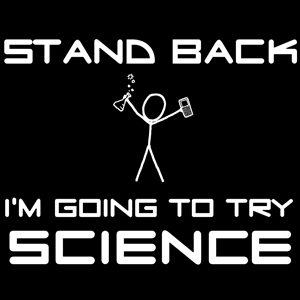
I’m not sure what I’ve done to earn such gifts, but they are appreciated!
In other news, my “official” book cover was sent to me by Cambridge University Press yesterday:
The only change I might request is the use of my full name, with middle initial, as suggested by my wife. (I do find it amusing that the cover is essentially the image I sent them, with some text thrown on. Apparently I’m an awesome book cover designer.) Let me know what you think!
Speaking of books, a friend of mine, Brad Craddock, has made it to the quarter finals of the Amazon Breakthrough Novel Awards (ABNA), with his book Alice’s Misadventures Underground! He now needs some help in the form of some nice reviews to help move the book into the next round. Quoting from his email,
In the next few days (or weeks) until April 25, Amazon is asking for reviews of the first 5,000 words or so of each entry novel. Feel free to tell the truth, but be generous and nice overall since lots of glowing reviews may help me move to the next round.If you have a kindle you can read the first few thousand words and rate the book. I think you can also download it, even if you don’t have a kindle. In any case, any reviews you make can help. If you’ve read the entire book, you can comment on that as well.Here’s the link (copy and paste in the address window):and here’s the instruction page:and here’s the contest info:And if you haven’t bought the book yet and want to, here’s the link:
For those familiar with Lewis Carroll’s Alice’s Adventures in Wonderland, I can recommend Brad’s entertaining take on the tale.
A book publisher could also use your help: Valancourt Books, which specializes in lovely reprints of rare and long out-of-print texts, has had some major computer problems that has put their efforts on hold until they can scrounge up enough money for a replacement. They would really appreciate it, and you would too, if you could throw some support their way by purchasing one or more of their excellent titles. I’ve reviewed many of them on my blog, including the excellent works of Richard Marsh, Bertram Mitford, and Marie Corelli, and have yet to find a book I didn’t like.
Did I mention that I’m now a tenured Professor? I got the official letter on Wednesday of this week, and posted on Twitter, but I wanted to mention it on the blog as well for those non-Twitter followers. The amusing thing is that the letter is dated April 1st; I have disturbing visions of being told six months from now that it was all a joke…
Finally, let me note that we’ve got a new houseguest! A few weeks ago we put up a bluebird house outside of our front window, though we were worried that it was already too late in the season to get a resident. Our fears were unfounded, however:
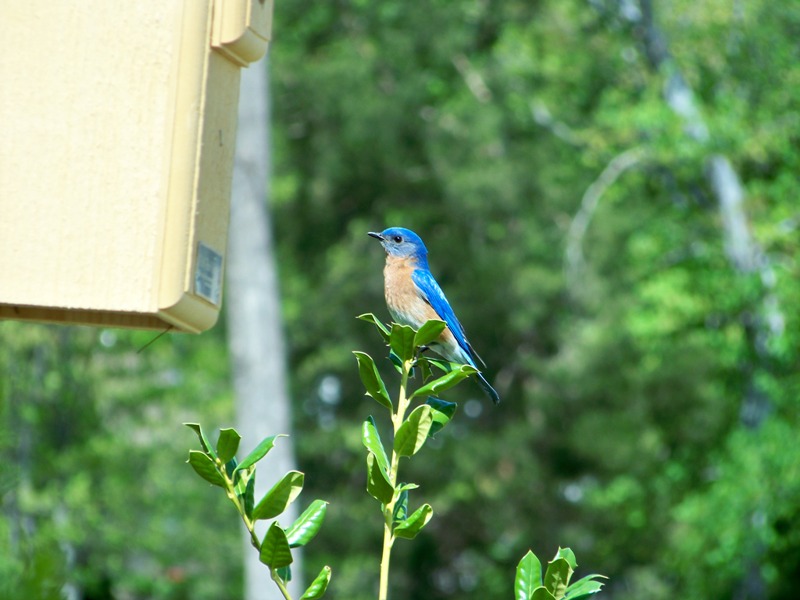
Fortunately, the bluebirds don’t seem to shy about having their picture taken, unlike the woodpecker who pops by now and again at our feeders…
Finally, I’ve gotten to read some new Robert E. Howard! Well, not new — Robert E. Howard committed suicide in 1936 — but new to me, anyway!
For those who are unfamiliar, Robert E. Howard (1906-1936) was a Texas author who wrote fantasy, adventure, and horror fiction for pulp magazines such as Weird Tales. He is best known for his creation Conan the Cimmerian, though he wrote a large body of memorable work and introduced many fascinating heroes. For instance, the title of this blog, “Skulls in the Stars”, is a title of a story of Howard’s about his character Solomon Kane, a puritan adventurer and justice-seeker.
Most of Howard’s other works have fallen into obscurity, overshadowed by the popularity of Conan, but in recent years compilations of some of them have been released. I recently picked up a compilation of Howard’s modern desert adventures, titled El Borak:
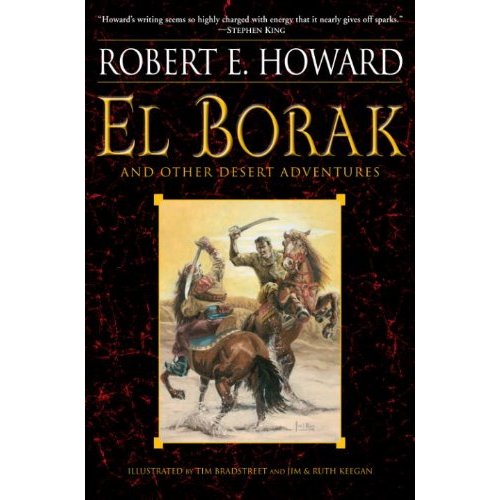
“El Borak” is the Arabic name of American adventurer Francis Xavier Gordon, and the bulk of the tales, though not all, focus on his adventures. The tales are stories of action and intrigue set in the deserts and mountains of the Middle East, stretching all the way to Afghanistan.
 The author of Skulls in the Stars is a professor of physics, specializing in optical science, at UNC Charlotte. The blog covers topics in physics and optics, the history of science, classic pulp fantasy and horror fiction, and the surprising intersections between these areas.

