The movie 2012… stoopid before it even comes out

You know, I’m not in principle against a film based on the premise that the world will end in 2012 as prophesized by the ancient Mayans, even though the idea is complete bunk.  What does bug me is that the film is by Roland Emmerich, and looks to be another noisy, incoherent mess heavy on special effects and almost bereft of plot or character development.  (See Godzilla, The Day After Tomorrow, 10,000 BC, etc.)

I had to laugh, though, when I saw this trailer on television the other day.   The text of the trailer declares,

The Mayans warned us

We should have listened

Waitaminit — the film is, in essence, about the end of the world, involving the destruction of pretty much everything on the planet.  How would listening to the Mayans actually help at all in such a circumstance?  How are we supposed to prepare for the end of the world, “duck and cover”?  Hide under the kitchen table?  Build enough spaceships to fly everyone to the moon?

This sort of incoherent trailer does not bode well for the film, in my opinion.  Then again, has there ever been a film about global catastrophe that has been any good?  Looking through the recent list of choices — Armageddon, The Day After Tomorrow, Deep Impact — I can’t say there are any that are particularly memorable.  Really, there have been so many movies involving mass destruction in the past few years that I’m totally desensitized to it.

Posted in ... the Hell?, Entertainment | 10 Comments

ResearchBlogging editor’s selections: Replicating historical sites, dating the universe, zombies, vampires and werewolves, oh my!

  • Replication. teofilo at Gambler’s House talks about an interesting proposal for preserving delicate historical sites: build exact replicas of them!  Replicas of smaller artifacts could also be used to resolve disputes of ownership amongst various countries.
  • Universe lets age clue slip. Greg Laden, at the eponymous Greg Laden’s blog, describes recent astronomical observation that extends the known age of the  universe.  He manages to explain the discovery in a very terrestrial context!
  • Blood and brains — can vampires survive a zombie apocalypse? We all know that the odds of humans surviving a zombie apocalypse are pretty bleak, but what about vampires?  Southern Fried Scientist over at Southern Fried Science describes some mathematical modeling that was done to look at the survivability of the #1 undead predator during an outbreak of the #2 predator.
  • Werewolves of London, Ontario. Neurocritic over at The Neurocritic talks a bit about another classic monster — the werewolf — and the psychological basis of lycanthropy.  Stories of people believing that they’re animals go back a long way…

Finally, as long as we’re on the subject of monsters, and Halloween is so recently behind us, let me point to my own contribution: Boo! The optics behind “ghost” imaging.

Check back next Monday for more “miscellaneous” highlights!

Posted in General science, Science news | 1 Comment

Boo! The optics behind “ghost” imaging

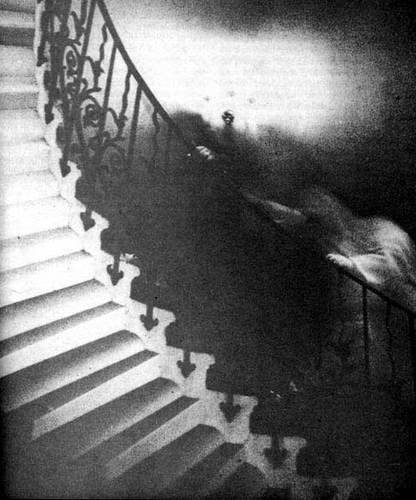
ResearchBlogging.orgHalloween seemed like the perfect time to talk about an unconventional sort of optical imaging, referred to as “ghost” imaging.  I should point out at the beginning, however, that I’m not talking about this sort of ghost imaging:

tulipstaircaseghost

Don’t get too disappointed, however!  Ghost imaging is in fact a fascinating and relatively new technique in which a detector can produce an image of an object that it cannot see!  The physics behind this effect is somewhat subtle, and resulted in at least one minor controversy since its introduction.  Let’s take a look at it…

Continue reading

Posted in Optics | 2 Comments

Halloween treats 2009

It’s time again for my yearly dose of Halloween chills, courtesy of some classic horror stories!  The 2007 edition can be found here, and the 2008 edition can be found here.  Have a happy Halloween!

The Willows, Algernon Blackwood.  This tale is long, but is one of the absolute classics in the genre of “cosmic horror”, and one of the major inspirations for H.P. Lovecraft’s work.  Two men, canoeing down an isolated stretch of the Danube, escape rising flood waters by sheltering on a small island on the river.  They soon realize, though, that they have stumbled within reach of beings from outside of time and space — beings that threaten their lives, sanity and souls.

Number 13, M.R. James.  A visitor to Viborg decides to lodge at the Golden Lion, and chooses to stay in room 12, which has a lovely view of the street.  At night, however, his room seems smaller, and on the building across the street he can see shadows of the occupants of room 13 — a room which doesn’t exist during the day…

The Shadows on the Wall, Mary Wilkins Freeman.  A story of domestic horror.  A family struggling to recover from a terrible tragedy finds their efforts hindered, and haunted, by the presence of a shadow on the wall without a source.

Mysterious Maisie, Wirt Gerrare.  A very unsettling story about a woman who takes a job as a maid but finds herself a prisoner of a cult-like group that have unpleasant plans for her.  These plans involve a mysterious visitor to the home who seems not quite human… (Only available through archive.org; you can download the story collection or read it online at the link.)

The People of the Pit, A. Merritt. Explorers of the northern Alaskan wilderness happen across a man who has crawled until his hands are little more than ragged stumps!  He tells a story of a deep pit, a lost city within it… and the people of the pit.

Posted in Horror | 4 Comments

The “curse” of success in science

(This post may seem like boasting just as much as it seems like complaining, for which I apologize in advance.)

Those who are regular readers of this blog may have noticed that things have been a little quiet again for the past couple of weeks.  It turns out that I’ve been almost entirely buried under a mass of bureaucratic tasks, which I’ve managed to dig myself out from under, at least for a while.

As a graduate student and post-doc, I always marveled at how senior researchers would burden themselves with a large number of bureaucratic tasks, such as journal editing, academic committees, article reviewing, proposal reviewing, and conference organizing.  I confidently reassured myself that I would never allow such tasks to bog me down and take away from my true academic love, namely research.

What I hadn’t counted on is the fact that, as I’ve become more established and well-known in my field, I’ve made friends with lots of people who are journal editors, conference planners, and book publishers.  I end up refereeing some 20 papers a year for journals, simply because I’m friends with a large number of editors.  This year, I’ve taken a rather high-up role in the organizing of a major optics conference, primarily because two friends asked me if I could help them out.

I can’t complain too much, because it is quite flattering to be asked to help with these things, and it is quite interesting to see how things work behind the scenes at journals, conferences and publishing houses.

It may be a little too enlightening, however.  When I was younger, there were a number of conferences I attended where I thought to myself, “Who organized this mess?”  Today I realize that it was probably someone like me: a person hesitantly agreeing to accept an organizing role and now scrambling to get the pieces to fit together as a coherent whole.

The situation is analogous to growing older in general.  As children, we tend not to worry about things too much because the “grown-ups” are in charge and will take care of everything.  Then, inevitably, you suddenly realize one day that you are now the grown-up — and nobody gave you an instruction manual for the job!

Posted in ... the Hell?, General science | 7 Comments

ResearchBlogging editor’s selections: autumn leaves, relativistic rockets, galaxy-size telescopes, and human origins

  • Fall Colors and Autumn Leaves. Before you go out to view the fall foliage this year, take a look at this post by David Bradley at SciScoop Science Forum!  Researchers are seeking an explanation as to why leaves in the U.S. mainly turn red, while in Europe they mainly turn yellow.
  • When you can’t wait for relativistic rockets. Before you start packing your bags for your intergalactic vacation, you should read this post by Greg Fish at weird things.  He discusses the hype and reality behind an article in Popular Mechanics on a new proposal for relativistic rocket flight, and its connection to the LHC.
  • When telescopes get really, really big. Rita Tojeiro at we are all in the gutter describes the use of gravitational lensing to probe the earliest and most distant parts of our universe, essentially turning entire galaxies into telescopes!
  • Reexamining Ardipithecus ramidus in Light of Human Origins. Finally, Eric Michael Johnson at The Primate Diaries takes a critical look at one new interpretation of human origins to arise from Ardi, and shows that the lure of a good narrative often leads people to speculate beyond the available evidence.

Check back next Monday for more “miscellaneous” highlights!

Posted in General science, Science news | Leave a comment

Lord Rayleigh on Darwin

There are lots of fascinating connections one can uncover by browsing the history of science.  In my search for Lord Rayleigh’s invisibility research, I happened across a paper titled, “Insects and the colours of flowers,” published in Nature 11 (1874), 6.  This comment by Rayleigh is short enough to be reproduced in full:

There is one point connected with Mr. Darwin’s explanation of the bright colours of flowers which I have never seen referred to.  The assumed attractiveness of bright colours to insects would appear to involve the supposition that the colour-vision of insects in approximately the same as our own.  Surely this is a good deal to take for granted, when it is known that even among ourselves colour-vision varies greatly, and that no inconsiderable number of persons exist to whom, for example, the red of the scarlet geranium is no bright colour at all, but almost a match with the leaves.

Continue reading

Posted in General science, History of science | 2 Comments

ScienceOnline 2010!

As Bora has noted, registration for ScienceOnline 2010 is now open — and I’ll be there!

I was worried for a bit, because interest in the conference is high, and there are limited spots available, but I managed to get in just fine.  I won’t be presiding over any sessions this year, but I’m looking forward to hearing what people have to say, catching up with all the friends I met last year, and finally meeting in person folks that I’ve only traded bytes with.

Hope to see lots of you there!

Posted in Personal, Science news | Leave a comment

The Man Who Rocked the Earth, by Arthur Train and Robert Williams Wood

A few posts ago, I noted that physicist R.W. Wood was one of the earliest scientists to contemplate issues of invisibility.  While researching his work, I noted that he was also a science fiction author, having penned two books with Arthur Train, The Man Who Rocked the Earth (1915) and The Moon Maker (1916).

I was immediately intrigued; scientists are often stereotyped as unimaginative and humorless types, and are certainly not considered to be artistic enough to write a novel!  This of course is an unfair generalization; there are plenty of science-types who can write a great science fiction story.

So what about Wood — did he have the skills to write science fiction?  I would say yes!  I really enjoyed MWRE; it captured my interest from the first moment and kept it throughout.  The writing is crisp and to the point: it probably didn’t hurt that Wood’s coauthor Arthur Train was already established as a writer of legal thrillers.

The novel tells the story of world-changing events influenced by a mysterious and seemingly all-powerful scientist known as “Pax”.  Pax gives humanity an ultimatum: either change its ways and end all wars, or face worldwide destruction.

Continue reading

Posted in Science fiction | 11 Comments

ResearchBlogging editor’s selections: placebos, climate change, and charge-shift bonds

This week’s posts all got me thinking about familiar ideas in a whole new light:

  • Deconstructing the placebo. The placebo effect is so well-known that it is almost taken for granted at times.  However, it is known that placebos have become more effective in recent years.  At Neuroskeptic, blogger neuroskeptic talks about research that suggests we must look at the idea of placebos in a new light.
  • Food and climate change – save or doom the world while eating. Here’s another thing to worry about with respect to climate change!  Benno Hansen at Think About It describes how the food choices we make can contribute to the greenhouse effect.
  • Climate Change – what’s worse than the heat? Speaking of climate change, Christie at Observations of a Nerd talks about a problem worse than global warming: the acidification of the oceans that will come with it.
  • An Unrecognized Type of Chemical Bonding. How have I missed this before?  Most of us have heard of ionic and covalent bonding in chemistry, but Michael at Phased describes a third, relatively unknown form of chemical bonding: charge-shift bonding.

Check back next Monday for more “miscellaneous” highlights!

Posted in General science, Science news | Leave a comment