ResearchBlogging Editor’s selections: False primates, hot jupiters, comet controversies and clever corvids

(Cross-posted at ResearchBlogging.org News.)

  • Suminia getmanov: A false primate: Over the past few months, you have probably heard a lot about “Ida”, a magnificently-preserved fossil of a 47-million year old primate.  You may not have heard about the fossils of 260-million year old primate-like suminia, which is some 200 million years older than the first primates.  A Primate of Modern Aspect discusses what is known about these creatures, and the implications for evolution.
  • Cthonian Ftargn!: Over at Supernova Condensate, Invader Xan tells us about the recently proposed and observed class of “hot Jupiter”-like planets, known as “Cthonian planets”.
  • Was there a comet impact in AD 536? Maybe:  In AD 536, some sort of catastrophic event caused widespread famine and a drop in global temperatures, confirmed by tree ring data and what little historical accounts exist.  The most obvious suspect is a massive volcanic eruption, but other evidence suggests that a comet impact may be the culprit.  Emma at We are all in the gutter describes the controversy and the evidence on each side.
  • Those clever corvids:  Confirming my suspicion that birds are planning to take over the world, Mo at Neurophilosophy discusses the astonishing tool use of rooks, a relative of the crow.  The videos are not to be missed!
Posted in General science, Science news | Leave a comment

8 days until The Giant’s Shoulders #14!

Here it is: your monthly reminder that deadline for The Giant’s Shoulders is coming up, to be held at The Dispersal of Darwin! There are 8 days left to submit before this month’s deadline. Entries can be submitted through blogcarnival.com or directly to the host blog, as usual!

Posted in General science, Science news | Leave a comment

Animals keep getting smarter…

I’m totally fascinated by stories and research on animal intelligence.  The closer researchers look at animal behavior, the more they’re surprised by unexpected cognitive abilities.

A wonderful case in point: researchers have recently shown that rooks (a relative of crows) can solve problems on a level that is nothing short of astonishing (h/t my postdoc advisor, from BBC News):

One of Aesop’s fables may have been based on fact, scientists report.

In the tale, written more than 2,000 years ago, a crow uses stones to raise the water level in a pitcher so it can reach the liquid to quench its thirst.

Now a study published in Current Biology reveals that rooks, a relative of crows, do just the same when presented with a similar situation.

The team says the study shows rooks are innovative tool-users, even though they do not use tools in the wild.

Another paper, published in the journal Plos One, shows that New Caledonian crows – which like rooks, are a member of the corvid group, along with ravens, jackdaws, magpies and jays – can use three tools in succession to reach a treat.

There are accompanying videos on the BBC site, which are quite spectacular.  Stories of ravens solving problems and using tools are not new, but this story is quite amazing because of the indirect nature of the solution and the connections which the rook must make to arrive at that solution.

The cognitive abilities of birds are quite frightening!  The wife and I are planning ahead and trying to placate them with lots of bird feeders in the backyard on the off chance they decide to take over.

Also via my postdoc advisor is this charming little anecdote from Holland.  In eastern Holland is a fascinating nature park called Apenheul (“ape hill”), in which the smaller primates are allowed to roam free and interact with the visitors1.  The article from Het Parool is in Dutch, so I will quote my former advisor’s email:

Among the different brands of monkeys that are allowed to roam free there are so-called berber monkeys. The gorillas of course aren’t. But they get fed at certain hours, and one of those berbers likes to watch that and simply takes a seat among the other spectators. After the feeding show he or she simply heads back to his part of the zoo.

The picture from Het Parool is rather priceless:

monkey

*****************************************

1 I had pictures from Apenheul, but I foolishly checked my camera on the return flight from The Netherlands and had my memory card swiped from it.

Posted in Animals | 8 Comments

Marie Corelli’s Ziska

(I’ve had a backlog of fiction I’ve wanted to blog about, and a lack of energy for physics blogging thanks to heavy work on my book.  I’ll get back to science-y posts in a few days.)

1897 was a very good year for Gothic fiction!  That year saw the publication of Bram Stoker’s Dracula and Richard Marsh’s wildly successful The Beetle, which I’ve blogged about previously.  Even more works were published that year, however, which thankfully have been resurrected in recent months by the good folks at Valancourt Books.  A couple of days ago, I finished their edition of Marie Corelli’s Ziska: The Problem of a Wicked Soul:

ziska

The novel tells a story of supernatural romance and revenge, set in Cairo and set against the backdrop of ancient Egypt.  I found it an very enjoyable and atmospheric read and am glad it has been rediscovered after so many years of neglect.

Continue reading

Posted in Horror | 1 Comment

Meet your new ‘content editor-at-large’ for ResearchBlogging.org!

If you ever browse through ResearchBlogging.org for posts about the latest state-of-the-art scientific research, you might be interested to know that there are now a collection of “content editors” who will be summarizing the  most noteworthy posts in their field each week on the news page.

And the “editor-at-large” who reads and highlights the posts in the miscellaneous “less traveled” fields in ResearchBloggging is… me!

My first post, and the inaugural “editor’s selections” post, went up on Monday.  I’ll be posting there every Monday for the foreseeable future, and will probably start cross-posting them here.

Posted in General science, Personal | 7 Comments

The Time Axis by Henry Kuttner

The more I read of Henry Kuttner, the more ashamed I am that I didn’t read all of his works long ago!  Henry Kuttner (1915-1958) was a versatile writer of pretty much every genre of weird fiction imaginable: science fiction, horror, fantasy, adventure, and things that defy ready classification.  His is undeniably one of the most influential science fiction writers of the early 20th century, and many of his short stories are beautiful and classic.

I’ve been using this blog as an excuse to read more of Kuttner’s work, though I don’t really need one!  I’ve previously written about his foray into sword-and-sorcery fiction, in his Elak of Atlantis stories, and his exploration of adventure stories, with Thunder Jim Wade.  All of these are short stories, however, so I finally got around to reading one of his novel-length works, The Time Axis (1948):

thetimeaxis

(picture of an early edition via Fantastic Fiction.)  The book is currently available in an excellent quality albeit rather plain edition by Wildside Press, and can also be read online.

It’s great!  Like a lot of Kuttner’s work, it manages to blend a pulp adventure tale together seamlessly with a science fiction story, and gives the reader a sense of awe and wonder that is altogether rare in fiction.

Continue reading

Posted in Adventure fiction, Mathematics, Weird fiction | 7 Comments

Biltmore Estate… and Rick Springfield!

This weekend, the wife and I took a trip up to Asheville, NC, to see the historic Biltmore Estate… and see a Rick Springfield concert! The trip was an absolute blast, and I thought I’d share some pictures of the Estate grounds, as well as of the concert itself.

Biltmore consists of a massive home of some 250 rooms and grounds of some 8,000 acres , and it is the largest privately-owned residence in the country.  It was built in the 1890s for George Washington Vanderbilt, who had inherited a fortune from his railroad tycoon father and grandfather.  Vanderbilt was a celebrity of his time, and built the home in part to escape from the chaos of New York City and the attention he received there.   Vanderbilt died in 1914, leaving his wife Edith the master of the estate.  In 1930, at the height of the Great Depression, daughter Cornelia opened the estate to the public so that the tourist draw could increase the area’s local revenue.  The house remains in family hands, and is now a wonderful tourist attraction.

Continue reading

Posted in Entertainment, Travel | 8 Comments

The Linkin’ Log: August 2, 2009

Over the weekend, the wife and I went to Asheville, NC,  to visit the Biltmore Estate and see a concert, which I will post about tomorrow.  In the meantime, I thought I’d share a few tidbits from around the internet that caught my attention:

  • In what counts as one of the stupidest things I’ve seen in a while, a tow truck driver in upstate NY hit a car and then crashed into a swimming pool because he was simultaneously texting on one cell phone and talking on another one.  A natural question to ask: what part of his body was left to steer with?
  • If that isn’t enough of the stupid: Bill O’Reilly recently decided to demonize my adopted home town of Amsterdam, The Netherlands, as a drug-infested city on the brink of societal collapse.   A Dutchman put together a nice YouTube video showing the hellhole that is downtown Amsterdam, with statistics of the U.S. and Holland for comparison.  Of course, I have a feeling the stats will be lost on someone of O’Reilly’s intellectual caliber
  • Finally, via Cosmic Variance, a link to a wonderful video!  At the World Science Festival 2009, Bobby McFerrin demonstrates the universal nature of the pentatonic scale:
Posted in ... the Hell?, General science | Leave a comment

Scientific cranks: Going strong since at least 1891

It is easy to assume that scientific crankery is a relatively new phenomenon, perhaps fueled by the completely non-intuitive, sometimes intimidating nature of many modern scientific theories.   In physics, for instance, most cranks spend their time attacking Einstein’s theories of relativity and the theory of quantum mechanics, both of which go against “common sense.”

While browsing the older journals, however, I came across an example of crankery from 1891, well before the advent of “modern” physics!  The crankery practically jumped off the page at me as I was skimming the table of contents in the Philosophical Magazine.  An image of the page in question is below; see if you can spot what caught my eye (click to enlarge):

contents

Does anything strike you?

Continue reading

Posted in ... the Hell?, History of science, Physics | 7 Comments

Another short note — and goldfinches!

Just a quick note again — I’m still quite swamped with work, even after getting my proposal done.  Now I’m working feverishly on my book, as I want to have a first draft completed by the end of August.  I’ve also got to put my tenure package together at the same time, with the same deadline.  I’m still planning to post, but I’ll probably be pretty sporadic for a while — when I get home at night, I’m pretty bleary-eyed from staring at equations all day!

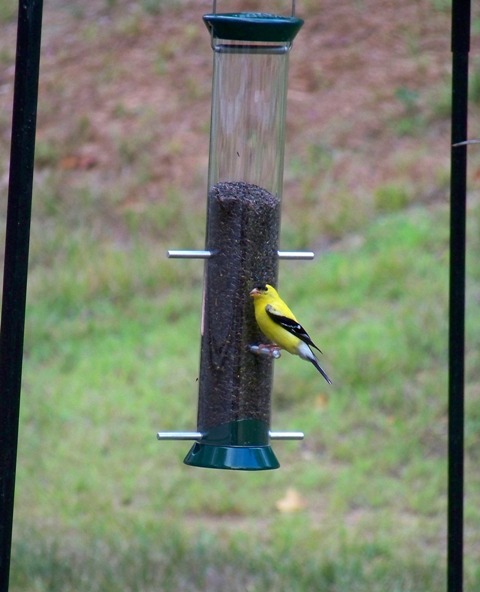
In the meantime, here’s some pics of some of our backyard visitors.  A male goldfinch, caught with thistle in his mouth:

goldfinch_m

and the female, getting her fill:

goldfinch_f

Posted in Animals, Personal | 3 Comments