“Deterministic vortices evolving from partially coherent fields” in Optica!

Some exciting personal and optics news: I just had a paper published in the prestigious journal Optica with my student Wenrui Miao and my colleague Yongtao Zhang on “Deterministic vortices evolving from partially coherent fields.” The paper is open access, so you can read it for free from anywhere, if you are so interested.

Optica has a rather high standard for publication — your work has to be considered broadly significant to optics and, obviously, well presented and correct. So this is a big deal for me, and I thought I would share a short non-technical description of what the paper is about!

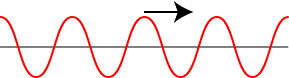
So, this paper is about mixing two subfields of optics: coherence theory and singular optics, which are two of my theoretical specialties. Let’s start with a little discussion of singular optics. Light is a wave, and if you try to visualize a wave, you will most likely imagine something like shown below.

We have a snapshot in time here of a wave like a wave on a string, with repeated wiggles up and down as it travels to the right. If it oscillates at a single frequency, it is known as a monochromatic (“single color”) wave, and in much of optics we study waves that are at least approximately monochromatic. This works for lasers, but not with normal light sources like light bulbs or the sun — more on this momentarily.

Continue reading
Posted in Optics, Personal | Leave a comment

An Ode to Empire of the Petal Throne

In addition to my long Twitter threads about Old School Dungeons & Dragons products, I’ve written a couple of “odes” to particularly good and influential products, namely Tomb of Horrors and Temple of Elemental Evil.

Now I want to do a shoutout to one of the oldest of RPG products, and one of the hardest to find in the wild! I am talking about the (almost) original edition of Empire of the Petal Throne, published by TSR in 1975. I have previously said, jokingly (I hope), that I would kill someone to get a vintage copy of this game; this summer, when I got a nice performance bonus, I decided to just go ahead and get one for myself, which was not cheap but not as expensive as you might think!

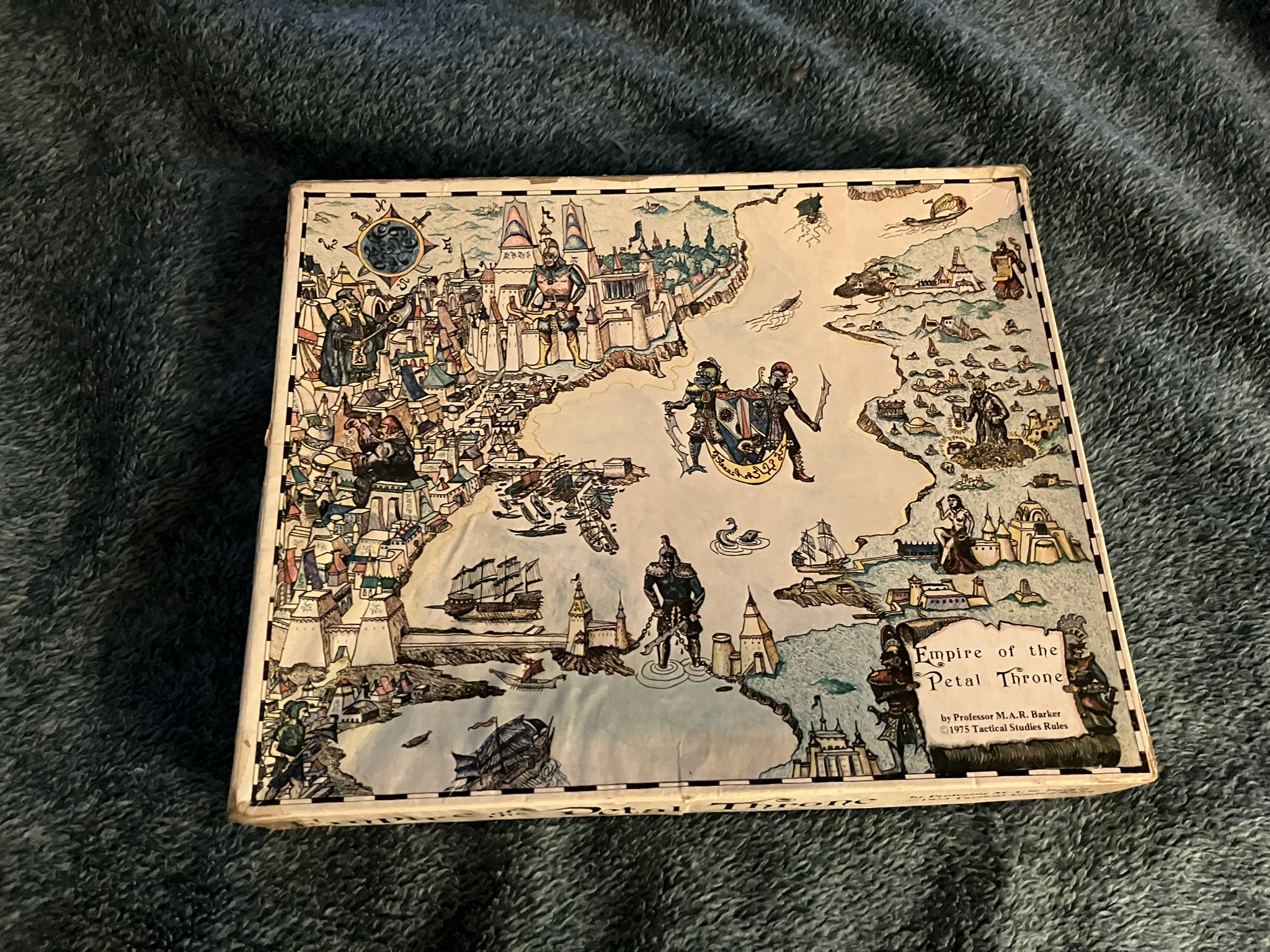
I’ve previously done an Old School thread on Petal Throne, but wanted to revisit it now that I have my own copy. This post will be a mix of my original thread plus photos of my acquisition. Let’s begin with the box:

Just take this cover image in for a moment. This is one of the most gorgeous and creative covers I’ve ever seen for an RPG product — a stylized map of the lands of the Empire. This alone made me want to own a copy of this game, because this image isn’t included in any reprints of the game.

Continue reading
Posted in role-playing games | 2 Comments

Camp Damascus, by Chuck Tingle

One thing I’ve long believed is that truly powerful stories, the ones that stay with you, are the ones that are truly about something meaningful to the author. As a general rule, no great stories are purely “entertainment,” even though they might appear to be so at first. A great example of this is the collection of Conan stories by Robert E. Howard, which really set the standard for pulp fantasy adventure. I recall reading an intro to a Conan collection once that referred to the stories as “pure entertainment,” but that isn’t true: Howard’s noble barbarian stories were a reaction to the organized crime and corruption he saw living in oil boom Texas in the 1920s. Howard developed a very negative opinion of “civilization” in general, which he saw as bringing more harm on a massive scale than it did benefits, and it is impossible to miss this view reading the stories once you’re made aware of it. I personally think that Howard’s views, whether you ascribe to them or not, contribute greatly to their power.

I was thinking of this while reading the excellent and moving Camp Damascus by Chuck Tingle, published earlier this year.

Camp Damascus is Tingle’s debut horror novel, and it is a fun, compelling, and moving story about a Christian gay conversion camp that is far more — and worse — than it seems.

Continue reading
Posted in Horror | 1 Comment

16 years of Skulls in the Stars!

Just a quick note that I’ve been blogging now for 16 years, as of today, as WordPress reminded me!

It’s wild that 16 years is almost 1/3 of my life that I’ve been writing this blog, and no plans to stop! This week, I’m prepping for my talk at the Natural Sciences Museum and then at Malaprop’s Cafe, so please check those events out if you want some content for me in the meantime.

Posted in Personal | Leave a comment

Invisibility talk at Natural Sciences at Raleigh!

Wanted to announce that I’ll be doing a Science Cafe at the North Carolina Museum of Natural Sciences this coming Thursday, August 17th, at 7:00 pm!

It will be both an in-person event as well as a livestream on YouTube, so I hope to “see” folks there one way or another! I’m putting together a new presentation on the history of invisibility, and hope to bring along some weird science demos to show off, so it should be fun!

Posted in Invisibility, Personal | Leave a comment

A “remarkable lightning stroke,” 1879

One of the fun things about reading early science journals and magazines is finding anecdotes about unusual phenomena that are sent in by readers and published. While I was writing my previous blog post about Tyndall and Mayer, I came across a letter in The Popular Science Monthly from 1879, simply titled, “Remarkable lightning stroke.” The letter, written by Robert F. Jackson, Jr. from Macon, Georgia, on May 20, 1879, is a fascinating lightning event, and I reproduce the letter in full below.

There recently occurred in our city a case of stroke by lightning which, no doubt, from its strange freaks, will be of interest to the readers of The Popular Science Monthly. It took place in a grocery store, and two persons were the sufferers. The bolt, after tearing up the eaves of the house, entered it on the side, leaving a smutty stain between the cracks. It bulged out the side of the shop for several feet, put out the lamp, knocked down many articles from the shelves, took off the tops of several lamp-chimneys resting on them, completely tore off the paper wrappers of many small cakes of soap, and finally emerged at the corner of the room, tearing off several planks. In the passage of the current from one division of the shelves to the other, it either split the dividing boards or passed under them, partially fusing the nails and charring the adjacent wood. But what makes the stroke most remarkable is the way in which it affected the two men who were struck. One of them, Ware, was stunned for a few moments, had his pipe knocked from his mouth several feet away, and was left with a red, sore scar across his cheek and a paralysis of his arms, which latter remained for about two hours. Still more strangely did it deal with the other man, Bullard, who was resting upon the show-case opposite Ware. The current passed up his arm, under the armpit, down the right side of the body to the thigh, leaped across to the inner side of the left leg, and passed down the leg to the foot. It made a red bunch and sore mark upon the body, singed the hair from both legs, and left the sufferer unconscious for more than twenty-four hours. Both have fully recovered, with the exception of a little soreness. In both cases we noted the spiral direction of the current. The house was low, in a depressed situation, and protected with a rod.

Lightning was an unending source of fascination for early pre-1900s researchers, and it seems that any story of a strange lightning strike could be published in the scientific journals. I have previously shared a story of an 1880 observation of ball lightning, and an article asking the curious question, “Are beech trees ever struck by lightning?” from 1889. This was not just a problem of scientific interest, of course, as lightning can kill, and famously killed one person researching it.

Lightning rods have mitigated much of the danger to buildings from lightning strikes, but still about 28 people die each year in the U.S. due to lightning, so it is still not to be taken lightly.

Posted in ... the Hell?, History of science | Leave a comment

Me on science writing in Optics & Photonics News!

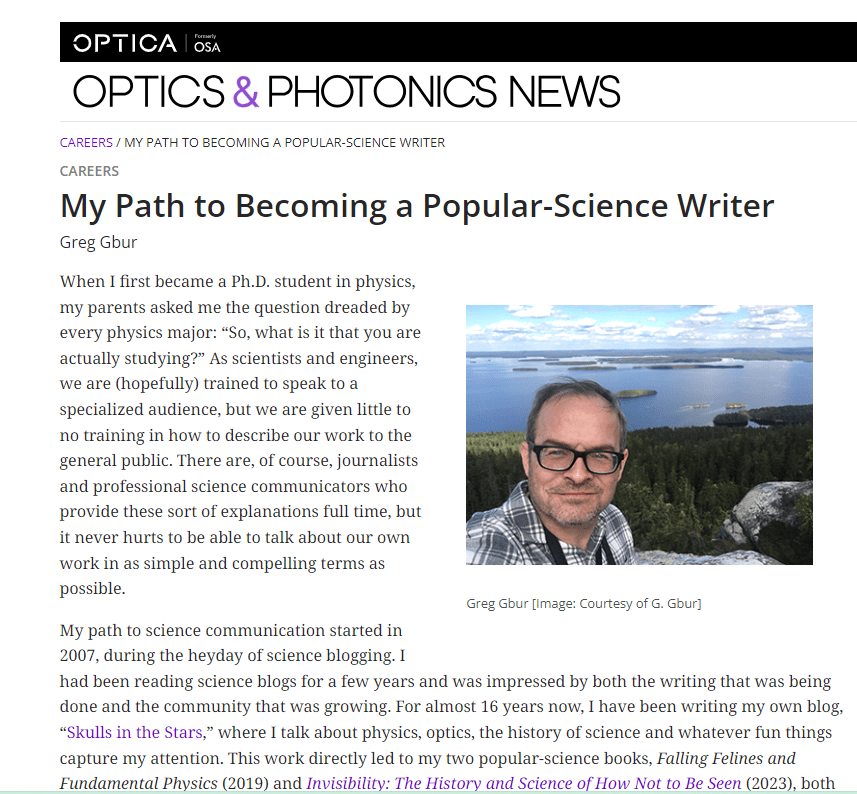
A couple of months ago, the folks who run Optics & Photonics News at Optica, the optical society, asked if I could write a post for their “careers” blog about my path to writing popular science books. Well, the post is now published! I’m not sure if there’s a subscription wall or not to read it, but I wanted to share the info here either way.

Posted in Personal | Leave a comment

John Tyndall rescues Julius Mayer, 1862

I’ve been thinking again recently of the remarkable story of Julius Robert Mayer (1814-1878), the German physician and scientist who was the first person to truly discover the principle of conservation of energy. Most physicists associate James Prescott Joule with the discovery, though Joule in fact independently discovered the principle in 1843, a year after Mayer. I’ve written about Mayer’s life and work before in some detail, but today I wanted to focus on how Mayer’s life was nearly destroyed by political attacks on his work, and how he was saved by the truly outstanding and brilliant efforts of the Irish physicist John Tyndall in 1862.

Julius Robert Mayer, from a 1905 German biography by Dr. S. Friedlaender.

First, let me briefly review the background. Mayer began his professional career as a medical doctor in 1840, but instead of setting up a private practice right away he opted to travel as a ship’s doctor on a vessel heading to the East Indies. In that day, bloodletting was still an accepted treatment for illness, and Mayer was struck by the fact that the venous blood of the sailors was bright red while in Indonesia, much more like arterial blood.

Mayer realized that the blood was redder because less oxygen was being used to heat the body in the warmer climate. This observation got him thinking about processes of cause and effect, and how effects must pass down from one event to another, sometimes in a way that could not easily be recognized. This was the impetus for the discovery of the conservation of energy.

Continue reading
Posted in Uncategorized | Leave a comment

Two new reviews of Invisibility!

Yesterday was quite the day for book reviews for my book on the history and science of invisibility! First, James Gleick wrote a very nice and thoughtful review of the book for the New York Review of Books; a screenshot for posterity is shown below.

The article requires registration to read, but you can register for free to do so. (I did.)

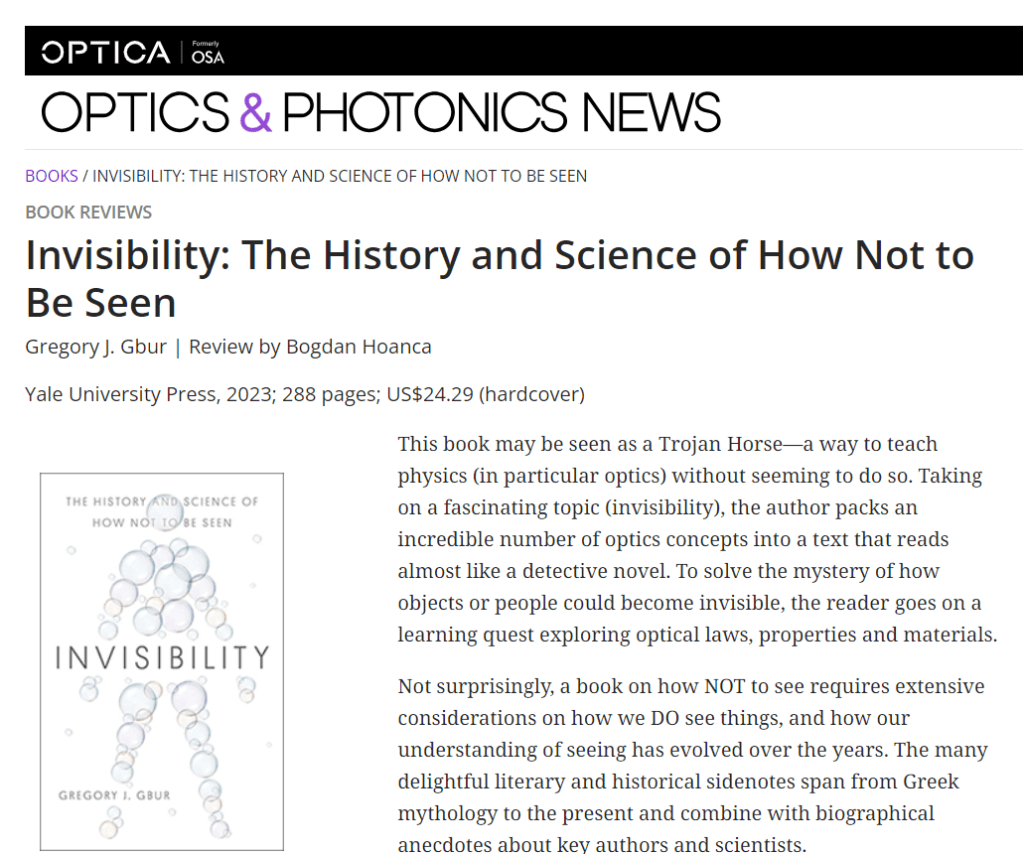
The second review appeared in Optics & Photonics News, the news magazine for my favorite optics organization, Optica. Again, here’s a screenshot:

This review was particularly glowing, and that makes me happy!

Just wanted to share; more science and fiction blogging to come in the near future.

Posted in Invisibility, Personal | 1 Comment

How fast can we communicate with light and radio waves?

I’m pretty forgiving about reading mildly inaccurate physics stuff, especially when it’s in science fiction stories, but every once in a while I read a real zinger that nearly causes me physical pain. Recently I was reading an article about Wi-Fi when I came across this paragraph:

This was in an otherwise fascinating article about how engineers are developing light-based Wi-Fi, called Li-Fi, which would in essence just be a lamp in your room that would communicate to your wireless device through a light sensor. Fluctuations in the light, undetectable by the human eye, would carry the information.

You can see why I was in pain from the first sentence: “Since light travels much faster than Wi-Fi radio waves, data speeds are significantly faster.” The problem with this is that, in air, the speed of visible light and the speed of radio waves are basically identical and equal to the vacuum speed of light.

I point this out not to pick on the author of the article — writers are very busy, and sometimes a sentence gets poorly worded or some concept non-essential to the story gets honestly misunderstood, and we’ve all made mistakes like that at some point. (You’ll notice I don’t even link to the article.)

But I thought it was a good excuse to ask and answer the question: what does determine the data speeds of our communications devices, and why is light a better option than radio? And if it is a better option, why haven’t we done it already? So let’s take a look!

Continue reading
Posted in Optics, Physics | 4 Comments