Old School Dungeons & Dragons: Part 15

Time for another roundup of my twitter threads on old school Dungeons & Dragons products! Let’s jump right in:

The Complete Fighter’s Handbook (1989), by Aaron Allston. I haven’t yet touched any of the “handbook” supplements that were made for 2nd edition AD&D!

Continue reading →

Posted in Dungeons and Dragons, Fantasy fiction, role-playing games | 1 Comment

The Anniversary of the Laser at Cambridge University Press – Part 2!

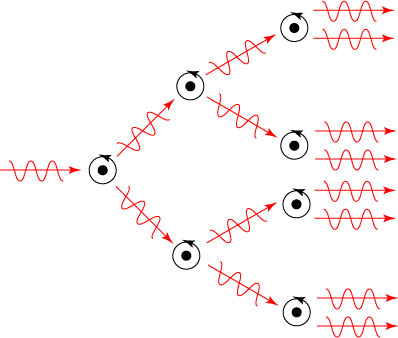
As promised, here’s the link to part 2 of my two-part series of posts at Cambridge University Press on the 60th anniversary of the laser! This post features a discussion of the basic ideas of how a laser works, like stimulated emission that can create an “avalanche” of photons:

Please give it a read! You can read part 1 here.

Posted in Optics, Physics | Leave a comment

The Anniversary of the Laser at Cambridge University Press – Part 1!

On May 16, 1960, Theodore Maiman of Hughes Research Laboratories was the first person to create the now ubiquitous and important source of light that we know as the LASER – Light Amplification by Stimulated Emission of Radiation. This year marks the 60 year anniversary of this achievement, and for this occasion I wrote a blog post for Cambridge University Press on the history of the laser!

Please check it out over at the CUP blog! This is part 1 of 2, and part 2, which describes a bit about how a laser works, will appear at the CUP blog later this week. I will of course post a link to that article, as well.

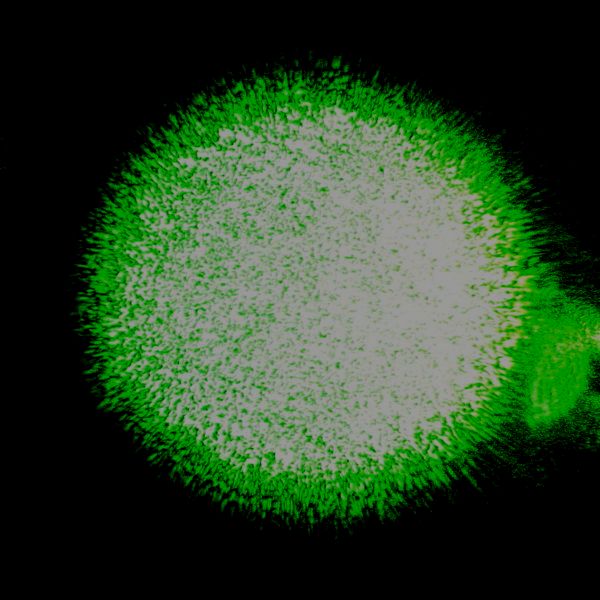
A photograph of laser speckle, just to give the post a little visual!

Posted in History of science, Optics | Leave a comment

The first news report of the laser (1960)

So this year is the 60 year anniversary of the invention of the laser, which was finally accomplished by Theodore Maiman on May 16, 1960 (mark your calendar!).  I recently wrote a blog post about the physics and history of the laser to commemorate the occasion; I will share a link to it when it appears.

But one thing I came across while working on the post? The first newspaper article announcing the discovery! The article, written by Ralph Dighton for the Associated Press, was syndicated and appeared across the country around October 16, 1960. Of course, coming from such an important source of news, I’m sure it was a very subdued and unsensational take on the disc… oh, no.

I thought I should write a short post sharing some of the most lurid highlights from the article, which really made me chuckle.

Continue reading →

Posted in ... the Hell?, History of science, Optics | 2 Comments

Old School Dungeons & Dragons: Part 14

Okay, time for a round of Old School Dungeons & Dragons, taken from my twitter posts! Things are moving a little slower due to the craziness of the world distracting me, but let’s look at a few classic items!

Cardmaster Adventure Design Deck (1993), by Rich Borg. One of the most fascinating categories of items in the pre-internet days is game aids, designed to help DMs run and organize adventures.  The Cardmaster Deck is one that I hadn’t heard of until I saw it for sale recently.

Continue reading →

Posted in Dungeons and Dragons, Entertainment, Fantasy fiction, role-playing games | 2 Comments

Forgotten Milestones in the History of Optics: video!

Okay, here’s one more classic video from my regular seminar series: Forgotten Milestones in the History of Optics! This was one of the earliest semi-popular seminars I put together.

More videos and posts to come!

Posted in History of science, Optics | 1 Comment

How Not To Be Seen: the video!

Continuing my series of uploaded videos, tonight I recorded a version of my How Not To Be Seen: The history and science of invisibility seminar, which I’ve given and revised for probably close to ten years now!  I’ve shared links to versions before, but this is the most recent and up-to-date version, based on a lecture I gave at the University of Chicago last fall.

I was feeling a little scatterbrained during the recording, so I fumbled my speaking a couple of times; I hope it isn’t too distracting!

More videos to come! It looks like I’ll be home for quite a while, so there’s lots of science to be shared! As I’ve noted before, my next videos will be significantly shorter.

Posted in Invisibility, Optics | Leave a comment

Vortices in beams of light and vortex coronagraphy video!

I while ago, I shared slides from a talk I gave at the Charlotte Amateur Astronomy Club on “Vortices in beams of light and vortex coronagraphy.” Now that I, like everyone else, am more or less homebound, I thought I would record it as a video for folks to hear what I actually would say during such a talk!  This will be the first of hopefully a few more popular science videos I will make and share while social distancing.

Note: This one is based on a formal seminar I gave, so it’s a bit long and a bit technical (though no math). Future videos will be shorter and hopefully sillier.

Posted in Optics, Physics | Leave a comment

Old School Dungeons & Dragons: Part 13

Here’s my latest wrap-up of twitter-posted old school Dungeons & Dragons threads! Going to post these more frequently, with fewer entries, because my last few posts were over 4000 words each!  So without further ado…

The Dragonlance Game (1988), by Michael S. Dobson, Scott Haring and Warren Spector.  Here’s a boardgame that was a huuuuge deal when it came out, but I was somehow unaware of until I saw a used copy come by recently! It probably wasn’t on my mind when I was a teen, as I was into RPGs, not board games.

Continue reading →

Posted in Dungeons and Dragons, Entertainment, Fantasy fiction, role-playing games | 3 Comments

Ruby Payne-Scott and the mystery of sunspots

This post is in belated honor of International Women’s Day 2020, March 8th, and highlights an important woman physicist who I was unaware of until recently!

I think almost everybody is familiar with the phenomenon of sunspots: relatively dark patches on the surface of the sun that come and go somewhat unpredictably and can range in size from diameters of tens of miles to diameters of 100,000 miles.
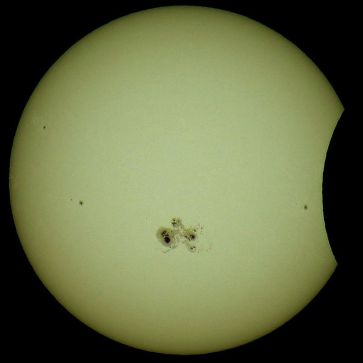
Sunspots visible during solar eclipse of October 23, 2014. By user Tomruen via Wikipedia.

Sunspots are colder than the rest of the sun’s surface, 3,000-4,500 K compared to the average surface temperature of 5,780 K, which gives them their darker appearance. You may also have heard that a large amount of sunspot activity can have effects on Earth, potentially screwing up our radio communications devices.  But sunspots have also been (and remain so, to some extent) a relatively mysterious feature of the sun. A key piece of the puzzle to explaining what they are and where they come from came from experiments undertaken in the 1940s by a trio of researchers, one of whom — Ruby Payne-Scott — was one of the very first women to work in radio astronomy and an important founding member of that entire branch of astronomy. In this post, we’ll talk about Payne-Scott and her remarkable work on sunspots.

Continue reading →

Posted in History of science, Physics, Women in science | 1 Comment