Chladni patterns, now in color!

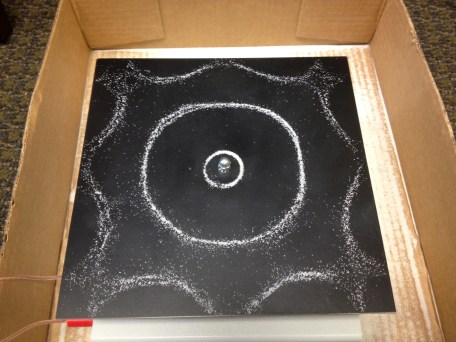
One of my favorite physics demonstrations to perform at local schools, conventions, and expos is the production of Chladni patterns, such as the one shown below.

I’ve blogged about these patterns before. They are formed by vibrating a metal plate at one of its special resonance frequencies, which causes the plate to form standing waves.  These waves have some locations — antinodes — where they vibrate a lot, and other locations — nodes — where they don’t vibrate at all.   By sprinkling sand over the plate, the sand will be pushed to the nodes allowing the otherwise invisible vibrations to be visualized.

This technique is remarkably old, first published by German physicist Ernst Chladni in 1787; the patterns created are therefore known as Chladni figures.  Chladni used a violin bow to excite his plate, but today we can use a speaker and frequency generator to produce the effect more readily.

I’ve been doing Chladni pattern demos for nearly five years, and when I recently did them again at a local school, I decided to spice things up with colored sand, to produce multicolored patterns.   This results in lovely things such as the pattern below!

This became a bit of an art project for me, and I spent a couple of hours over the past few days making pretty colored Chladni patterns!  I thought I would share the results here. In addition, I learned a little bit more about the physics of these patterns that I will share along the way.

Continue reading

Posted in Physics, Physics demos | 3 Comments

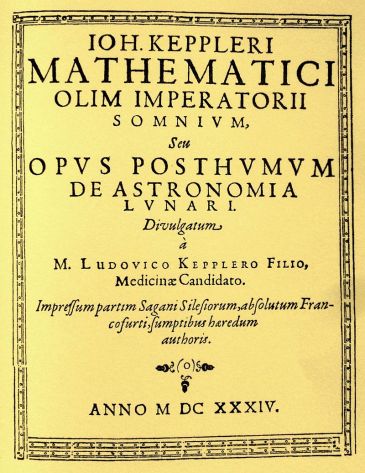
Somnium, by Johannes Kepler

I’ve had an interest for a while in ridiculously old science fiction, such as Margaret Cavendish’s 1666 novel The Blazing World, as well as science fiction written by prominent scientists, such as Simon Newcomb’s His Wisdom the Defender (1900), Robert Williams Wood’s The Man Who Rocked the Earth (1915), and Fred Hoyle’s The Black Cloud (1957). But if I want to combine “ridiculously old” and “prominent scientist,” there’s no book that can beat Somnium, written by Johannes Kepler in 1608!

Often billed as the earliest science fiction novel, Somnium provides probably the earliest descriptions of a journey to the Moon and the beings that live there. But is it really science fiction? Let’s take a look at it more closely…

Continue reading

Posted in Physics, Science fiction | 3 Comments

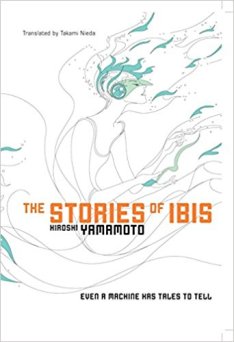
The Stories of Ibis, by Hiroshi Yamamoto

I have a long backlog of book blogging to do, but I had to jump and do the back of the queue first.  Every once in a while I read a book that is so thought provoking and moving to me that I have to write about it right away while the multitude of ideas are fresh in my mind. That book for me is Hiroshi Yamamoto’s The Stories of Ibis (2006), which I just finished yesterday.

The novel is set in a future in which the human population, and its civilization, has collapsed.  Artificial intelligence, in the form of androids and robots, is now the dominant intelligence on the planet, with its own massive cities, technology, and civilization.  Humanity scrounges a living in small communities around the world, making regular raids of android supply trucks and warehouses for needed supplies.  They have never forgiven the AI for rebelling against them in the distant, almost legendary, past.

Continue reading

Posted in Science fiction | Leave a comment

The Cadaver of Gideon Wyck, by Alexander Laing

Got a few physics blog posts in the pipeline, but in the meantime I’m still catching up on a lot of book blogging!

I’ve had The Cadaver of Gideon Wyck (1934) in my library for some time, as I picked up the new Valancourt edition when it first came out in 2016.  However, I got side-tracked in my first attempt to read it, as the book has a very slow, methodical start. I am happy that I came back and finished it, though, as it is a quite unique and weird novel, albeit with some flaws that I discuss below.


As noted on the back cover, the book was lauded by none other than famous horror author Robert Bloch, who called it “A genuine tour de force… grisly and evocative.”

The book is depicted as a true manuscript penned by a student (known as David) at a rural medical school who has opted to share what he knows of horrific events that have recently occurred, as he has concerns that the “climax could yet be my own death.”  The story centers around the cruel and brilliant doctor Gideon Wyck, who seems to be the focus of numerous disturbing events in the town.  It is whispered that he performed an unnecessary amputation on a patient, and that patient now raves that devils are trying to steal his soul through the stump of his arm.  Babies begin to be born in town with hideous deformities, and Wyck supervised the medical care of the mothers.  When Wyck is found dead under impossible circumstances, everyone in town is a suspect, including the narrator — and the deformed children continue to be born. Can David unravel the various threads of the mystery before even more horrible things happen — and before he loses his own life?

Continue reading

Posted in Horror, Mystery/thriller, Science fiction | 1 Comment

City of Darkness, by Ben Bova

I’ve recently been in a mood to shop used bookstores as well as read obscure science fiction. This dangerous combination has resulted in me purchasing a number of books by well-known authors that have been forgotten, probably for the best. I have decided to add a new category of book blogging to my blog categories, namely “I read it so you don’t have to.”

The first of these that I purchased is City of Darkness (1976), by famed sci-fi author Ben Bova.

As the book cover indicates, the book is set in a — utopia? dystopia? — in which all major cities have been closed and sealed under domes due to rampant pollution and disease. However, every two months of the year, New York City is opened up to tourists, and the city comes alive in a wild recreation of what it must have been like in its heyday.

Continue reading

Posted in I read it so you don't have to, Science fiction | 2 Comments

Larry Blamire’s More Tales of the Callamo Mountains

Larry Blamire is a very good writer. That is the first thought that came to mind when I sat down to blog about his recently published collection, More Tales of the Callamo Mountains (2017).

As the name suggests, this collection is a followup to Blamire’s excellent Tales of the Callamo Mountains, which came out a decade earlier.  It is a set of fourteen stories set in the haunted fictional Callamo Mountains that explore ordinary frontier folks’ encounters with the unknown, the horrific, and the monstrous.  And as I have already hinted, the stories are very, very good.  I was one of many fans of the original who hoped for, and cajoled Blamire about, a second volume, and we were not disappointed.

Continue reading

Posted in Adventure fiction, Horror | Leave a comment

Connecting a PS2 to an HDMI TV

This past week I had an incredible urge to play the original Katamari Damacy videogame on my old Playstation 2. Unfortunately, the PS2 does not play well with modern HD TVs, as the allowable video modes for the PS2 are often not supported.  If you try and plug in a PS2 to a new TV, even using the more advanced component cables, you probably won’t get anything.

Fortunately, you can buy a cool PS2 to HDMI converter these days, such as the one shown below, for only about $16.

Unfortunately, the instructions that come with the converter are a little misleading and incomplete, and there doesn’t seem to be an online resource that includes all the info you need to set it up properly. Even though it isn’t hard, there are a few pitfalls: it took me a few tries to figure out exactly what I needed to do in order to get it to work.

I thought I would post the instructions here, both for anyone who wants a one stop explainer as well as for myself, so I don’t forget!

Continue reading

Posted in Entertainment | 71 Comments

RIP Fluff, 2011-2018

Losing a beloved animal friend is always hard, but it is even harder when they are taken from you too soon.  Last night, unexpectedly, our beloved kitty Fluff passed away at the age of 6.

Fluff in December.

He apparently passed very quickly, and without any warning signs. He had just had a vet checkup the week before, and even the morning he passed he was energetic and happy.  It seems likely that the cause of his death was a congenital heart or brain defect that caught up with him suddenly.

It is impossible to truly convey in words what a special kitty Fluff was.  He was a perpetual kitten, looking for and giving love to whomever he could.

Continue reading

Posted in Animals, Personal | 6 Comments

Fred Saberhagen’s Swords Trilogy

At the end of 2017, we were treated to the news that Amazon was planning a new series based on Tolkien’s classic Lord of the Rings series. The response on the internet seemed to be a bit of a collective groan, as the last Hobbit movie just came out four years ago, and the last of the epic Lord of the Rings movies was only 15 years ago.  Many, including myself, asked: aren’t there any other epic fantasy series that could be adapted instead?

Of course there are many. One example that I think would have a lot of promise for an incredible screen adaptation is Fred Saberhagen’s Book of Swords trilogy, which I finished reading a week ago.

The trilogy, called first Swords here, first appeared over 1983-1984; of course I came across it after I finished reading Saberhagen’s Berserker and became curious about his other works.

The series is a lot of fun! There are some things I think are lacking, which I discuss in this post, but overall it is an enjoyable and intriguing read.

Continue reading

Posted in Fantasy fiction | 2 Comments

Non-Stop, by Brian Aldiss

I often come across classic books to read through unexpected, even surprising, avenues. An example of this is Non-Stop (1958), by Brian Aldiss, which I just finished reading the other day and enjoyed immensely.

I only learned about Non-Stop because it ended up being the inspiration for the very first science fiction role-playing game, Metamorphosis Alpha, a classic in its own right.  (I discussed Metamorphosis Alpha in a recent blog post.)  It is a magnificent and unusual science fiction novel, and well-worth reading. Some thoughts follow.

Continue reading

Posted in Science fiction | 4 Comments