The Southern Reach trilogy, by Jeff VanderMeer

I’m not entirely sure why it took me three years to read Jeff VanderMeer’s Southern Reach trilogy.  One of his earlier novels, Finch, is on a very short list of “best books I’ve ever read.”  I suspect that I simply read the name “Southern Reach” and it somehow evoked images of the Southern United States in a weird way that didn’t appeal to me, and I just never got around to looking at the books.  Until, that is, I read the first description of the upcoming movie version of the first book, which instantly intrigued me.  Over the course of about 5 days, I read all three books of the trilogy.  They’re that good.

It is hard to find the right words to describe these novels.  Bewildering, intricate, confusing, surreal, thoughtful, haunting, poetic, horrific, terrifying, beautiful?  It is all these things, and more.

Continue reading

Posted in Horror, Science fiction, Weird fiction | 1 Comment

Chills, by Mary SanGiovanni

I’ve been in a bit of a funk the past few weeks and haven’t been reading much.  What I needed to get myself back on track was a nice solid bit of horror fiction, and fortunately I had on hand the most recent novel by Mary SanGiovanni, Chills.

As is made clear from the cover image and the title, Chills centers on a danger that originates in the coldest weather.  A team of detectives and investigators race, in the midst of a blizzard, to solve a series of grisly murders and prevent future ones from occurring.  However, they soon learn that even worse things are happening, and that there are unnatural things in the whiteout…

Continue reading

Posted in Horror | Leave a comment

The geometry of weird-shaped dice

I’ve been enjoying a bit of reminiscing about my childhood lately, hunting down old copies of role-playing games I enjoyed in my youth as well as exploring newer games that have come out since then.  One thing that has changed dramatically since my gaming days is the proliferation of types of dice.  Most human beings never go beyond ordinary 6-sided dice, which we in the gaming world call a “d6.” Classic Dungeons & Dragons players, however, are familiar with the d4, d6, d8, d10, d12, and d20.

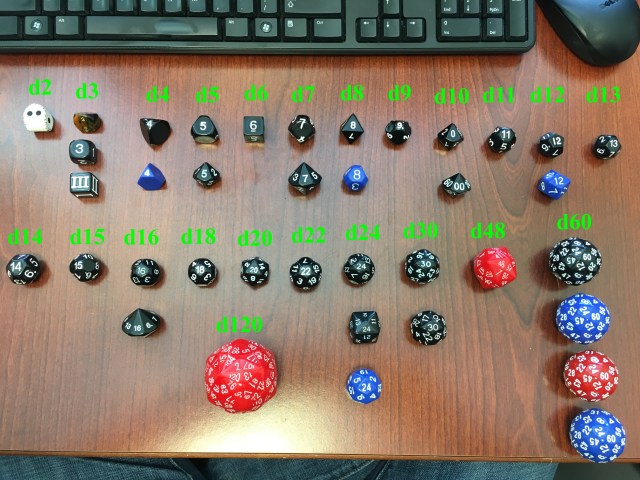
But these days, there are even more imaginative varieties!  I’ve starting collecting dice of every shape and size, and my current collection is shown below, in order¹:

This is a really amazing variety of dice! This is my “special dice” collection in its entirety, and includes some duplicates (don’t ask how I got 4 identical d60s), but in some cases, such as the d7, d12 and d24, there are varieties in shapes even with the same number of faces!

This variety got me wondering: how does one design dice with a weird number of faces? What mathematical strategies does one use to make them? What other types of dice are possible? And, perhaps most important: are these dice “fair”?

I thought it would be fun to answer these questions with a blog post, in which we discuss the geometry of dice!

Continue reading

Posted in Mathematics, role-playing games | 19 Comments

Optics basics: reflection

It’s been some 5 years since I wrote my last “Optics basics” post!  The goal of that series of posts was to introduce some of the most fundamental concepts in optics in a non-technical way, in part so I wouldn’t have to constantly reexplain them in more advanced posts.

I’ve covered most of the topics that I would truly call “basic” — hence the long time since the last post — but I realized that I missed one concept that is truly fundamental: the law of reflection!

It may not seem like there’s much to say about reflection, but we’ll see that isn’t the case.  Many interesting things can happen when light reflects off of a surface — the challenge will be to include as many as possible while keeping this post short!

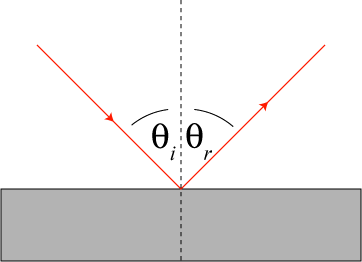
So what is the law of reflection?  Well, the classic law of reflection states that the angle that a ray of light reflects off of a smooth, flat surface (the angle of reflection \theta_r) is equal to the angle at which the light is incident upon the surface (the angle of incidence \theta_i).

lawofreflection

Continue reading

Posted in Optics basics | 4 Comments

The Left Hand of Darkness, by Ursula K. Le Guin

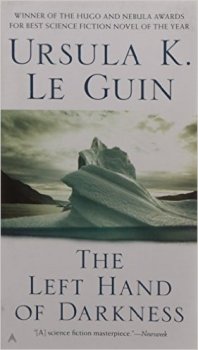
After reading the epic Foundation series of novels by Asimov, I was in the mood for a change of pace in science fiction.  I turned to another brilliant author, Ursula K. Le Guin, and her classic 1969 novel The Left Hand of Darkness.

lefthandofdarkness

I vaguely remember being told about this novel when I was in college, though I didn’t read it then. At the time, the description that I was given was more or less “a book entirely about linguistic, social and cultural details.”  This description isn’t completely inaccurate, but The Left Hand of Darkness is so much more — it is a fascinating study of a culture that is completely alien to our own, thanks to one, single, fundamental, biological difference in its humans.

Continue reading

Posted in Science fiction | 3 Comments

Pepper’s last optical illusion: metempsychosis

A month ago, I shared the lengthy, odd and sometimes dramatic history of the illusion commonly known as “Pepper’s ghost,” which I believe is more properly called the “Pepper-Dircks ghost.”  In researching this post, I uncovered a wealth of fascinating information and trivia related to Pepper, Dircks, and their work, which continues to serve as fodder for posts.

For instance: “the ghost” is not the only optical illusion that John Henry Pepper (1821-1900) developed! Much later in his life, when the ghost had lost some of its novelty, Pepper worked on and patented a clever new illusion, which he called “metempsychosis.”

So what is metempsychosis?  In this post, we take a look!

Continue reading

Posted in History of science, Optics | 1 Comment

Foundation’s Edge, Foundation and Earth, by Isaac Asimov

Been rather preoccupied recently with life, but I finally have a moment to catch up on a bit of my book blogging, including discussing the “final” two books of Asimov’s classic Foundation series, namely, Foundation’s Edge (1982) and Foundation and Earth (1986).  I have previously written about the first book Foundation as well as the complete trilogy of books, finished in 1953.

foundationpair

I wrote “final” in quote above because, although these are the final two books chronologically in the fictional Foundation universe, they are not the last two books that Asimov would write.  Two prequels to the original novel would follow: Prelude to Foundation (1988) and Forward the Foundation (1993).  But Edge and Earth would be the last novels that would advance the history of the Foundation and hint at its ultimate fate.

Continue reading

Posted in Science fiction | 1 Comment

Twitter Weird Science Facts: Full Year and Final Volume!

This is it — the last regular installment of my Twitter weird science facts! I’ve done a full year of weirdscifacts, averaging one fact per day for the entire year (though I’ve had to play catch up on missed days quite often).  It’s quite a lot of work to find and post reliable facts every day, even with the amount I’ve got backed up, so I won’t be continuing the series at this time.  You can always read the whole series of this year, and past years, by clicking this link.

Read below to learn about the long history of dropping balls to signify time, as in this 19th century image!

ENGLAND - MAY 28:  Engraving taken from the ?Illustrated London News?. The first national electronic time service was introduced by Sir George Bidell Airy (1801-1892), Astronomer Royal and director of the Royal Greenwich Observatory from 1835 to 1881. A master clock, verified each day by stellar observation, sent electric impulses to clocks throughout the country via the growing network of telegraph wires providing for public and railway use. The time ball at the Strand received the impulses hourly from the Central Telegraphy Station of the Electric Telegraph Company.  (Photo by SSPL/Getty Images)

Engraving from the “Illustrated London News”. 

Continue reading

Posted in General science, Weirdscifacts | 3 Comments

19th century optics FAILs

My recent post on the Pepper-Dircks ghost didn’t include even close to all of the interesting tidbits it could have!  There are so many things to learn from the story of the ghost, including some lessons about optics.

For example: in my post, I included two illustrations of the illusion at work from sources of that era.  One came from the 1868 book The World of Wonders

Pepper's illusion in action, from The World of Wonders (1868).

Pepper’s illusion in action, from The World of Wonders (1868).

… and the other came from an 1877 edition of Harper’s Magazine.

One last parting phantom, via Harper's Magazine, vol. 55 (1877).

One last parting phantom, via Harper’s Magazine, vol. 55 (1877).

The images are so similar that I’m guessing the latter was based off of the former.  However, both of them are wrong!  They incorrectly show how the ghost works and how it would appear in the configuration as shown.

So what’s the problem? If you like, take a moment to look at the image or images above and see if you can work it out for yourself!  Then read on below…

Continue reading

Posted in ... the Hell?, History of science, Optics | Leave a comment

Isaac Asimov’s Foundation Trilogy

I’ve recently been trying to become more acquainted with science fiction as a genre, as most of my life I’ve been focused primarily on horror fiction.  A natural and obvious place to place some emphasis is on classic works from the golden age of science fiction, and a natural and obvious place to start there is with the work of Isaac Asimov.  A few weeks ago, I read Asimov’s Foundation (1951), and blogged my thoughts about it.

Asimov has written seven books set in the Foundation setting; I figured that I would be content reading the first one, to get a feel for it, and then move on to other authors and other series…

… and, as of today, I’ve started reading the fifth of the Foundation novels.

As the first three books, Foundation (1951), Foundation and Empire (1952), and Second Foundation (1953), form the original trilogy, and I thought it would be worthwhile to blog my thoughts on the trilogy as a whole.

foundationtrilogy

The Foundation trilogy tells an epic, galaxy-spanning story over the course of some 400 years, telling the early history of what is known simply as, well, the Foundation.  Some 12,000 years into the existence of a powerful galactic Empire, a mathematician named Hari Seldon predicts, using a new and advanced mathematical science known as psychohistory, the collapse of the Empire within 300 years and a galaxy-wide Dark Age to follow lasting some 30,000 years.  The collapse of the Empire is inevitable — the actions of quintillions of humans in the Empire possess a momentum that cannot be overturned in time to avoid disaster.

Continue reading

Posted in Science fiction | 6 Comments