The Giant’s Shoulders #39 is out! (Part one!)

Part one of The Giant’s Shoulders #39 history of science blog carnival, which was delayed for a few days, is up at the blog Mammoth Tales!*  Thanks to John McKay for posting and hosting, despite having some serious work to get done!

Part II of this edition of The Giant’s Shoulders should be up tomorrow; I’ll update the link as soon as it is.  The next edition will be hosted at Stranger in an Even Stranger Land, by Gurdur!  As usual, submissions can be posted to blogcarnival.com or sent directly to the host blog.

* The link above takes you to the main Mammoth Tales blog page; some quirk in the blogging software there is making the permalink unworkable!

Posted in General science, Science news | 8 Comments

The universe ripped me off!

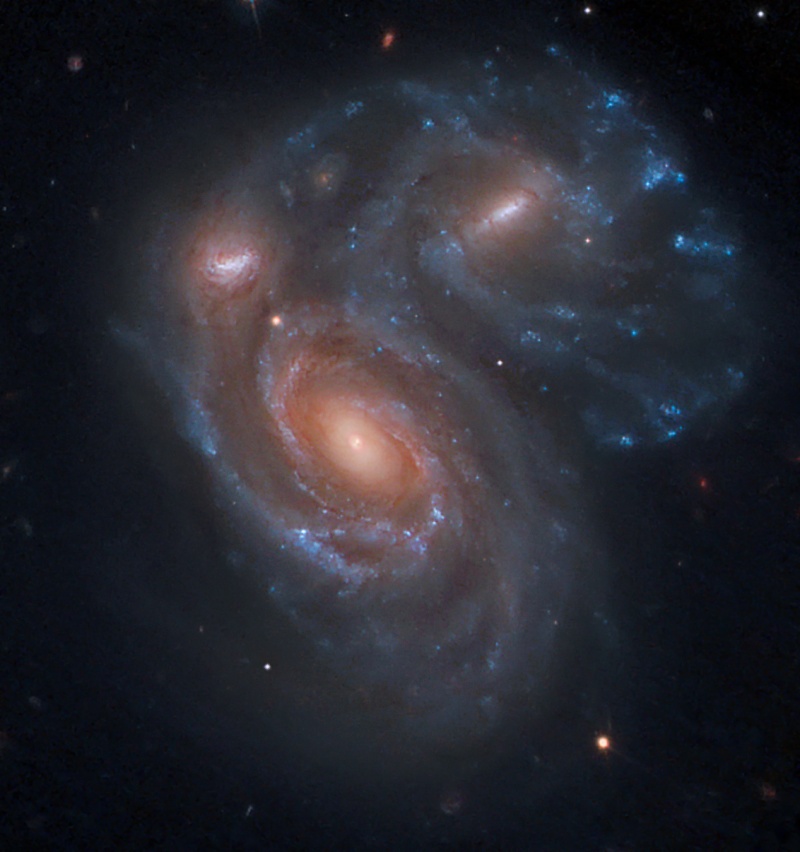
Yesterday, Dr. Matthew Francis (of the very interesting and worth-checking-out physics blog Galileo’s Pendulum) pointed me to NASA’s astronomy picture of the day, Arp 272, which consists of two colliding galaxies (center and upper right) with a third likely interacting galaxy (upper left).  The trio lies some 450 million light years away from us, and the picture is perhaps 150 thousand light years across:

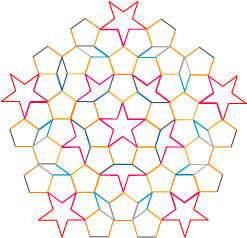
In addition to being an awesome astronomical phenomenon, the picture is quite reminiscent of something very familiar to me.  Not sure what I’m talking about?  Check out my avatar icon, which I made from scratch and have been using since 2007:

Clearly, the universe has ripped me off!  Now I need to figure out how to sue the universe for copyright infringement…

This isn’t the first physics “look alike” for my avatar.  Some time ago, @scimomof2 sent me the following:

This is an aberration-corrected transmission electron microscopy (TEM) image.

These are some great examples of pareidolia, in which one imagines significant patterns in essentially random phenomena.  Seeing images in clouds is a classic example of pareidolia, though I wouldn’t use my own cloud-watching as a “normal” case.

Posted in ... the Hell?, General science, Silliness | 4 Comments

Weird science facts, September 14 — September 20

Been a busy week for me, and posting has been light.  I haven’t neglected the Twitter #weirdscifacts, however!

550. Sep 14: Have you ever heard of a turtle without a shell? Cantor’s giant softshell turtle is a real oddity: the absence of a shell for protection means that it spends most of its time buried under sand.

551. Sep 15: 1st t-rex skeleton ever discovered was missing a rib for yrs, recently rediscovered!  An odd story of rediscovery: the historic skeleton had a rib unaccounted for that was only recently stumbled upon.  (h/t @SUEtheTRex)

552. Sep 16: Escaped pet birds are teaching wild birds to speak english! I really think we should teach a bunch of parrots Rick Astley songs and set them free in the wild.  We could end up having a permanent RickRoll naturally develop!  (h/t @arikia)

553. Sep 17: It actually takes light from the Sun between 4 and 7 hours to reach Pluto. (8 minutes to reach Earth.)  I had an overestimate of the Sun-Pluto distance in my original tweet, now corrected here.

554. Sep 18: Via @tdelene, Giant African land snails literally eating the stucco off of homes in Miami.

555. Sep 19:  In 1784, Immanuel Kant declared: “There will never be a Newton for the blade of grass.” 25 yrs later, Charles Darwin was born. (via @rmathematicus)  Poor predictions are infamous in the sciences!   Another example we’ve discussed is Lord Kelvin’s failed guess, as he said in 1902 of aeronautics: “No balloon and no aeroplane will ever be practically successful.”

555a. Via @sarahkendrew: 1 in 5 Koreans is named “Kim”, and it’s been that way for 1500 years!  The trivia that 1 in 5 Koreans is currently named “Kim” isn’t really a #weirdscifacts; the fact that researchers traced this back 1500 years places it squarely in the “weird science” category.

556. Sep 20: Macellum of Pozzuoli – due to bradyseism, this ancient ruin has submerged & raised several times.  A “bradyseism” is a rather gentle raising and lowering of a region’s elevation due to underground volcanic activity.  At the Macellum, it was noted that the higher parts of the columns possessed markings from mollusks, demonstrating that the area was underwater at one point — and clearly had been built while still above water!

Posted in Weirdscifacts | 1 Comment

Weird science facts, September 7 — September 13

Here are the week’s Twitter #weirdscifacts!

543. Sep 07: The “massacre of Monkey Hill“.  In this insightful post by @ericmjohnson on the evolutionary origins of collective violence, the massacre is described.  In 1930, a newly-installed colony of 140 baboons had been installed in the London Zoo.  A single incident amongst the primates sparked a cycle of violence that eventually left two thirds dead.

544. Sep 08: Geologist William Buckland (1784-1856) would wear his academic gown to do field work.  We’re talking about wearing an academic gown to do geological work out in the field — climbing, digging, and hiking in all sorts of adverse weather!

545. Sep 09: Man gets $75k for completing proof of “enormous theorem”, which runs 15,000 pages.  I had read about this theorem years ago, but couldn’t remember the details for #weirdscifacts!  Tip o’ the hat to @edyong209 for reminding me.

546. Sep 10: Jupiter’s “Great Red Spot“: a storm that could fit 2-3 Earths within it that has been going 300 years! Most everyone knows about the “Great Red Spot”, but many may not have grasped its significance — it is essentially a massive hurricane that is larger than the Earth and has been going since before the founding of the U.S.!

547. Sep 11: September 11, 1881: The landslide of Elm.  Before the World Trade Center attacks, September 11th was known for another man-made tragedy, an unusual landslide triggered by human activity.  (via @rmathematicus and @david_bressan)

548. Sep 12: Modern glacier theory was introduced to skeptical scientists by hunter Jean-Pierre Perraudin in 1821. Science can have its occasional blind sides!  Geologists of the early 1800s were still working under the theory that the massive boulders found around the landscape in parts of Europe were remains of the biblical flood.  Perraudin, a hunter in the region, noted that the rocks were often obviously associated with scratches in the land that led right to glaciers.  In 1815, he suggested to scientist Jean de Charpentier that the rocks had been placed by receding glaciers, but Charpentier dismissed him. In 1821, however, an engineer Ignace Venetz visited the region, and was convinced by Perraudin’s speculations.  Ironically, Venetz eventually convinced Charpentier of the validity of the hunter’s novel theory.

549. Sep 13: Arabic numerals were initially banned in some parts of Europe, due to fears of manipulation & fraud.  The numerals were originally developed in India and made their way to the Middle East, where they became heavily used in commerce; from there they made their way to Europe. The simplicity of the numerals, however, led to fears that they could be changed easily in documents.  They were banned for a time in Northern Italy before presumably their usefulness overrode the fears.  (h/t @rmathematicus)

Posted in Weirdscifacts | 2 Comments

Two ghost stories: “The Man in the Picture” and “Isis”

It seems that ghost stories have been told since the beginning of speech itself, and have held a special place in the imagination of people for just as long.  It is hard to characterize what sets a “ghost story” apart from other tales of horror — the stories can be extremely varied in their locations, characters, and hauntings.  As a guideline, I would say that a ghost story is one that is concerned with the negative effects of past actions and events on the present day; however, it’s probably best to say that a ghost story is like pornography: “I know it when I see it“.

The late 1800s and early 1900s were a golden age for ghost tales, with authors such as M.R. James and E.F. Benson producing numerous classics.  In our more skeptical modern times, horror’s center of gravity has shifted away from ghostly encounters,  but occasionally authors pay tribute to the classic style.

I recently read two of these stories: The Man in the Picture (2008), by Susan Hill, and Isis (2009), by Douglass Clegg:


Both books are small hardcovers: 150 pages for Hill’s book, 113 pages for Clegg’s.  Due to their size and similarity I thought it would be worthwhile to talk about them together in this post.

Continue reading

Posted in Horror | Leave a comment

New post: Weird science facts, August 31 — September 06

Here are this week’s Twitter #weirdscifacts! Due to a death in the family, I was traveling and had a difficult time finding facts on some days, but thankfully others stepped in to help me out, and we have two for September 2nd!

536. Aug 31: Bizarre fish evolved for the oceans, but lives on land! 

537. Sep 01: Fire tornadoes — enough said.  (h/t @discoveryplace)

538. Sep 02: The echidna has a four-pronged penis; it uses two prongs each mating, and swaps sets between matings. (via @larwe, who added: “You might call it the original Swiss Army Penis.”)  The link contains perhaps an even more bizarre revelation: the sperm of the echidna will work together to reach their target, traveling in groups!  Because a female can be inseminated by multiple sperm at once, it is an evolutionary benefit for the sperm to work together.  I imagine it somewhat like bicyclists in the Tour de France drafting off of one another!

538a. This rare genetic disorder, caused by intense inbreeding, is known as Polygamist’s Downs.  (via @stevesilberman)

539. Sep 03: A felt-tipped marker helped the Apollo 11 astronauts leave the moon & get home.  (This is number 8 on list of “myths” about the moon landing.  This story is true, though it was modified to promote the “space pen”.)

540. Sep 04: Valles Marineris canyon system of Mars — 8x longer, 10x wider & 4x deeper than the Grand Canyon.  Thanks in part to the lower gravity, everything is bigger on Mars!  We’ll see more examples of this in future posts.  Keep in mind that, roughly speaking, 320 Grand Canyons could fit in this Martian canyon system.

541. Sep 05: c. 1930, a volcanologist Frank Perret survives in the path of a pyroclastic flow.  I’ve known about this story for a long time, but couldn’t remember the details! (and a Google search didn’t find it!)  A pyroclastic flow from the same mountain killed some 30,000 people in the city of St. Pierre years earlier — Perret was extraordinarily lucky.

542. Sep 06: Project Mohole, the 1960 attempt to drill through the Earth’s crust to the Mantle!  Though the project didn’t succeed, give this some thought — they were trying to drill into the molten region of the Earth!  It was still an impressive technological achievement that brought back much useful scientific data.

Posted in Weirdscifacts | 7 Comments

Ancient swords, modern nanotechnology

ResearchBlogging.orgThough science and technology in the modern era have accomplished things that our ancestors couldn’t even dream of, it is still worth remembering that the ancients weren’t dummies.  Through a combination of ingenuity, observation, determination, and probably a lot of luck, these people managed to develop a number of surprising technologies — many of which have been lost to history and have proven surprisingly hard to reproduce today. Among these lost inventions are Nepenthe, an ancient Greek antidepressant, Greek fire, an early Byzantine version of napalm, and Roman concrete.

Last week, a tweet by Dr. Rubidium drew my attention to research on another mysterious ancient technology — Damascus steel.  Renowned and practically legendary for its strength, flexibility, and ability to retain a sharp edge, Damascus steel was forged into weapons and armor in the Middle East from roughly 300 B.C.E. to 1700 C.E.  The precise technique of its forging was lost, but many of the weapons survive.  In 2006, researchers at Technische Universität Dresden performed an analysis of a piece of Damascus steel and found that it contains traces of very state of the art modern nanotechnology!  Could this be the secret of the steel’s strength?

The paper is old, in blog terms — five years — but is fascinating and provides some interesting scientific food for thought.  For those reasons, I thought I would take a look at what we know of Damascus steel and what revelations the modern study brings.

Continue reading

Posted in General science, Physics | 14 Comments

Weird science facts, August 24 — August 30

Here are the Twitter #weirdscifacts for the past week!

529. Aug 24: Avg density of the planet Saturn is so low, it would float in a (sufficiently large) bucket of water. Of course, there are some major caveats to this — that bucket of water would also have to be in the gravitation field of an (even more massive) planet or star, or the word “float” would be meaningless!  The point, however, is that Saturn is a very low density planet.

530. Aug 25: Vredefort crater — 300 km in diameter, largest known impact crater on Earth (asteroid probably 5-10km).  This is significantly larger than the Chicxulub crater, which is thought to be the asteroid impact that doomed the dinosaurs!

531. Aug 26: Turning orange from eating too many carrots? In this post by @scicurious, she confirms an anecdote told to her by her father!  I’m expecting that in her next post, she’ll prove that if you make that face for too long, it will stay that way.

532. Aug 27: Paricutin, the volcano that grew out of a Mexican cornfield in 1943.  In one of the most amazing geological events in human history, the farmer and his family actually witnessed the volcano’s growth from a fissure in the ground.  Within a week, it was five stories tall!

533. Aug 28: A case of scientific illiteracy: the Charlotte amoeba panic of 1965! This post by @spacearcheology highlights a mystery involving my current home town!  It seems that, in the 1960s, a number of radio stations throughout the country played pranks by breathlessly announcing that an amoeba was loose in town.  The mystery: there seems to be very little record of this “panic”, which suggests that it wasn’t major.  Radio stations were cited by the FCC, however.

534. Aug 29: Would it help to nuke a hurricane? Remarkably, someone has done the math.  (via @motherjones)  Nukes have been suggested for all sorts of rather… unconventional… ideas.  We’ve noted previously that it was suggested that nukes could be used to carve out new shipping harbors!

535. Aug 30: February, 2000: the RRS Discovery rides an onslaught of rogue waves.  The excerpt is from the book The Wave, that I just started reading.  The Discovery crew got more than they bargained for, fighting for their lives to stay afloat in a truly monstrous storm.

Posted in Weirdscifacts | Leave a comment

Mock the Movie: Mega Python vs. Gatoroid!

I’ve been quite busy at work today, but it would be remiss of me not to mention another Twitter Mock the Movie event planned for tonight, in which we will Twitter mock SyFy’s very own Mega Python vs. Gatoroid!

The rules for Mock The Movie are simple…

  1. Start following @MockTM on twitter.
  2. Start watching Mega Python vs. Gatoroid today, August 31st, at 9PM EST.  You can find it on Netflix.
  3. Once you’ve got Mega Python vs. Gatoroid going, tweet your snarky comments to @MockTM.  Directing our tweets to @MockTM will keep our followers from being overwhelmed with our snark!

A log of the evening’s snark will presumably be posted at the Mock the Movie home at The JAYFK!

Posted in ... the Hell?, Silliness | Leave a comment

August 27, 1883: The island of Krakatoa blows up

Today, August 27th, marks the grim anniversary of one of the most devastating volcanic eruptions in recorded history: the final explosion of the island of Krakatoa in 1883.  The eruption — and the tsunami that was generated by it — is estimated to have killed some one hundred thousand people, and it has even been speculated in Simon Winchester’s 2003 book Krakatoa: The Day the World Exploded that the eruption led to the political downfall of the Dutch Indonesian colonies.

An 1888 lithograph representing the eruption of Krakatoa (source).

On his Scientific American blog History of Geology, David Bressan has relayed some of the eyewitness accounts of the devastation.  I thought it would be interesting to describe some of the first published scientific accounts of the event, and the struggle to understand it in its aftermath.

Continue reading

Posted in General science | 4 Comments