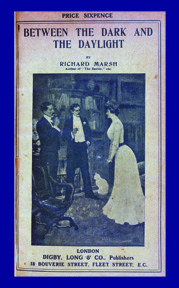
John Jacob Astor’s A Journey in Other Worlds

The exploration of old and relatively unknown science fiction can be rewarding on many levels.  In addition to seeing the author’s vision of the future, one also gets a snapshot of the accepted science of the time, usually riddled with surprising misconceptions.  When the author himself is famous for reasons other than writing, the book has in a sense hit the “trifecta of interesting”.

Such is the case with A Journey in Other Worlds, published in 1894:

The author of the book is John Jacob Astor IV (1864-1912), American millionaire and inventor, builder of what eventually became the Waldorf-Astoria Hotel in New York — and one of the wealthiest victims of the 1912 sinking of the RMS Titanic .

The book is a science fiction adventure, following the exploits of a handful of intrepid explorers as they take the first interplanetary voyage, visiting Jupiter and Saturn.  The tale is set in the far future, but also amusingly filled with 19th century mores and views.

(Images from original edition of book, via Project Gutenberg.)

Continue reading

Posted in Science fiction | 4 Comments

Weird science facts, July 13 — July 19

Back from Toronto, and working on some more posts.  In the meantime, here are the past week’s Twitter #weirdscifacts!

487. July 13: Half he, half she. A rare chimeric butterfly has been born in London.  (via @lucasbrowers)

488. July 14: Technicolour toad spotted after 87 years.

489. July 15: Lobsters that buzz?  (post by @doctorzen, h/t @jenlucpiquant)

490. July 16: Canadian physician Wilder Penfield, known for evoking vivid memories through direct brain stimulation.  (h/t to @Namnezia!)

491. July 17: French chemistry teacher and balloonist de Rozier became the 1st known air crash fatality in 1783. 

492. July 18: Apropos to recent journalistic scandals: the 1835 “great moon hoax“.  (via @beckyfh and @rmathematicus)

493. July 19: Temperatures on Mercury can range from -280 F to 800 F — in a single day.   Of course, a “single day” on Mercury is 58 earth days.  Nevertheless, the range of temperatures on Mercury is quite remarkable.

Posted in Weirdscifacts | Leave a comment

The Giant’s Shoulders #37 is out! (The Wunderkammer Edition)

The Giant’s Shoulders #37 is up at Providentia, and is a veritable cabinet of curiosities!  Many thanks to Romeo Vitelli for putting together an excellent edition of the carnival!

The next edition will appear on the Longitude Blog on August 16th.  Entries are due by the 15th of the month, and can be submitted directly to the host blog or through BlogCarnival.com.

Posted in General science, Science news | Leave a comment

Spiders and the electric light (1887)

(Digging through my archive of historical papers for short topics to blog about while I’m away on business.)

In the modern era, we are very conscious of the impact of humanity on nature — even though we are often very reluctant to do anything about it.  Whether it be the problem of human encroachment on the territory of endangered species, the threat of global warming on the ecology of a region, or the effect that new technology (such as wind power) can have on native flora and fauna, we can have an impact on nature in sometimes surprising ways.

We have had a significant influence on the natural world since even before recorded history, but it is only very recently that we became aware of this.  Looking back through old scientific journals, one can find examples where new technological developments have brought about an unexpected response from nature.  One such example is a short letter published in Science in 1887, which I reproduce in its entirety below.

Continue reading

Posted in ... the Hell?, Animals, History of science | 1 Comment

Weird science facts, July 6 — July 12

Currently out of town at a meeting in Toronto, as the following picture should hopefully demonstrate:

Nevertheless, the Twitter #weirdscifacts must go on!  Here are the previous week’s posted facts:

480. July 06: In 1875, William Lowthian Green, eventual Hawaiian Finance Minister, proposed shape of continents came from tetrahedral geometry.  Before the advent of continental drift and modern plate tectonics, this geometrical explanation for the arrangement of continents and oceans was seriously considered.  (h/t @nialldeacon)

481. July 07: The bizarre mathematical conundrum of Ulam’s Spiral.  Prime numbers, which superficially seem relatively random in their appearance in the integers, show surprising patterns with the proper arrangement. (h/t @jenlucpiquant)

482. July 08: First evidence of a fish using a tool??!! O_o (via @carlzimmer)

483. July 09: How WW2 bombers inadvertently changed English weather.  So many bombers were traveling over Europe during the war that their contrails (vapor trails) may have changed the surface temperature.  The effect is small, and not certain, but interesting to contemplate.  (via @edyong209)

484. July 10: Scientists create touchable holograms? A number of people immediately (and sarcastically) noted what a boon this could be for the porn industry!

485. July 11: Canadian inventor Sandford Fleming developed standard time in 1876 after missing a train in Ireland.  My “welcome to Canada!” weird science fact!  Fleming missed a train due to a confusion between a.m. and p.m. on a train schedule.

486. July 12: Bad pine nuts leave behind bitter taste for weeks! (via @sciencegeist and @geernst ) This was also discussed in a great scicurious post!

Posted in Weirdscifacts | Leave a comment

A short travel note…

I was hoping to queue up a few blog posts for the next week, but didn’t manage to find the time to do so.  I’m traveling to Toronto for a meeting for the next few days, so the blog will probably be rather quiet this week.  When I get back, however, I’ve got lots of stuff to talk about- and hopefully will have some nice Toronto pics to share!

Posted in Personal, Travel | Leave a comment

8 days until the deadline for The Giant’s Shoulders #37!

This is the regular monthly reminder that there’s only 8 days left until the deadline for the 37th edition of The Giant’s Shoulders, the history of science blog carnival!  If you’ve got a history of science post you’ve been thinking about writing, now’s a good time to get started; entries can be submitted directly to the host blog or through BlogCarnival.com.

The edition will appear at Romeo Vitelli’s psychology blog Providentia on July 16th!

Posted in General science, Science news | Leave a comment

Weird science facts, June 29 — July 05

Been a crazy week and a holiday week, but the Twitter #weirdscifacts just keep on coming!

473. June 29: In 1897, J.J. Thomson introduced the electron as a particle; in the 1920s, his son G.P. helped prove the electron is a wave!  Both men received the Nobel Prize for their respective achievements.

474. June 30: Water boatman insect sings at 99db by rubbing its penis against its abdomen!  If you’re wondering how loud that is, it is a sound level comparable to a passing subway train.  (h/t @nialldeacon)

475. July 01: Global warming leading to unusual bear love? Grizzly-polar bear hybrid! (h/t @drugmonkeyblog)  I fully expect to see a Syfy channel original movie “Polgrizz”, about a killer Grizzly-polar bear hybrid terrorizing a resort community.

476. July 02: The golden eagle hunts goats larger than itself, and other animals, by dropping them off a cliff

477. July 03: Saccharin, discovered in 1879 when a chemist ate lunch but forgot to wash his hands before. Bad lab procedure, but a huge discovery!

478. July 04: Cosmic rays, first discovered on the top of the Eiffel Tower!  (My recent Scientific American post!)

479. July 05: Papuan weevil has screw-in legs!  That’s not an exaggeration — the weevil has a screw-and-nut style joint socket!  (via @physorg_com)

Posted in Weirdscifacts | 2 Comments

Paris: City of Light and Cosmic Rays on Scientific American guest blog!

If you’ve been waiting for another in-depth blog post from me on physics and the history of science, wait no longer — just don’t look for it here!

I’ve written a post for the Scientific American Guest Blog that went up this morning, titled “Paris: City of Light and Cosmic Rays”.  It describes a little-known set of experiments that were performed at the top of the Eiffel Tower on radioactivity in 1910, experiments that provided the first evidence for radiation coming from outer space — cosmic rays!  Weaved into the narrative is a little bit of the history of the Eiffel Tower itself, and an explanation of why experiments such as this one were important for the tower’s survival.

As a bonus, if you’re curious to read the original paper describing the experiments, I attach my English translation of the original German paper here.  The translation was done using Google translate and Babelfish, with revisions by myself to fix the clunky English.

Let me know what you think of the SciAm article, either here or there! Thanks again to Bora Zivkovic for letting me write for the guest blog!

Posted in History of science, Physics | Leave a comment

My day as a shark biologist!

(Alternate title: The old physicist and the sea)

One of the wonderful things about being active in science communication is that you get to meet very interesting people who are involved in a variety of fascinating research activities.  If you get very lucky, you might even get a wonderful opportunity to participate in some of those activities!

One great opportunity recently presented itself, thanks to David Shiffman aka “WhySharksMatter” on Twitter who blogs at Southern Fried Science.  David does research on shark biology, ecology and conservation, and also works on the South Carolina Department of Natural Resources coastal shark survey.  The latter role involves going out on the water in the coastal areas around Charleston, SC to catch and survey the sharks that hang out there.   They’ve been taking volunteers out on their day-long trips to help out with the work, and last week I got a chance to go out and survey some sharks!

I thought I’d share some pictures and thoughts on the experience, with the caveat that I’m not a marine biologist and might screw up some details.  My wife came along and we turned the trip into an extended weekend in Charleston; in another post, I may share some of the pictures from our other adventures!

Continue reading

Posted in Animals, General science | Leave a comment