Madness on canvas: art in horror fiction

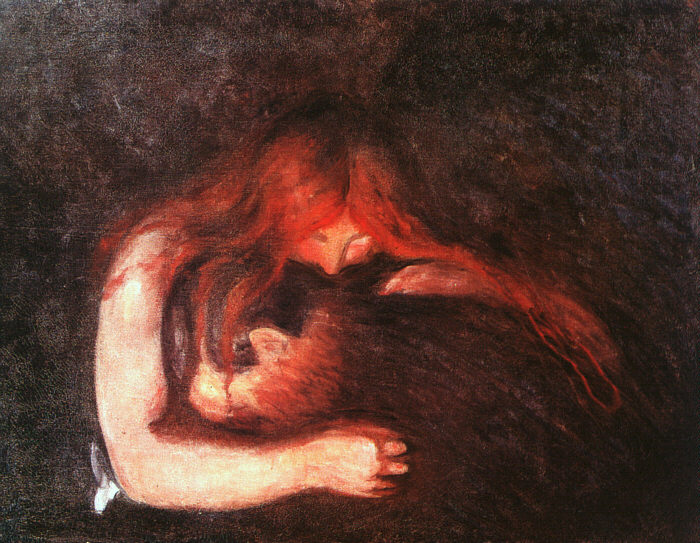
When you read enough horror fiction, certain themes recur consistently in the wonderful chaos of ideas.  Among these, I was recently struck by how often the visual arts appear as the centerpiece of horror stories.  This primarily involves paintings, but also to a lesser extent sculpture and other forms of visual art.*

The Vampire, Edvard Munch, 1893-1894 (source).

I thought it was about time I did a post about art in horror, and described some of the stories that have stood out to me as good examples of the interplay of the two seemingly different forms of expression.

Note: potential mildly NSFW artwork below the fold!

Continue reading

Posted in Horror | 13 Comments

Weird science facts, January 26 — February 1

Here are the (slightly belated) Twitter #weirdscifacts for the previous week!

319. Jan 26: The 1927 Mississippi River flood: at some points, the river was 70 *miles* wide. This is a frightening testament to the destructive power of floods.

319a. Bonus fact, via @jasonrobertshaw: Bull sharks used to swim up and down the Mississippi as far north as Illinois. Can you imagine swimming in the Mississippi outside of St. Louis and getting bit by a shark?

320. Jan 27: Snow rollers: rare, naturally-rolled snowballs! (h/t @patrickneville ) When conditions are right, sheets of snow can be blown by the wind into rolls like a carpet.

321. Jan 28: Surgeon/scientist John Hunter (1728-93) likely infected himself with gonorrhoea to test his theories. Hunter had a hypothesis that syphilis was a late-stage form of gonorrhoea, and he injected an unnamed subject to test the idea.  Scholars believe that he in fact injected himself; it’s hard to believe that someone else would have been willing to undertake the experience.

322. Jan 29: On 1/1/2010, in accordance with Life+70 law of copyright, the works of Sigmund Freud entered Public Domain. (h/t @jgold85)

323. Jan 30: Max Born had rights of German optics book stolen twice: once by Germany when he fled, once by U.S.A. when they conquered it. My Ph.D. advisor Emil Wolf shared this story with me; he worked with Born on a revised English optics book, Principles of Optics, that is still in use today.  Born was Jewish and had to flee the Nazis, who appropriated the rights of his book.  When Germany was conquered, part of the “spoils of war” involved the rights to many German books being given to publishers in the conquering countries.  Born actually received a letter from the U.S. publisher asking what parts of his old book he would be using in the new one, so that they could charge him!  (As I understand it, he more or less told them to stuff it.)

324. Jan 31: The 1903 Amundsen expedition to find NW passage sailed just in time to escape its creditors! It is oddly simultaneously reassuring and depressing to realize that scientists and explorers have always had to worry about losing funding.

325. Feb 01: Via @wiredscience: Vikings may have navigated w/ polarized skylight. This was one of those facts that was all over Twitter, but I really couldn’t beat for the day.

Posted in Weirdscifacts | 3 Comments

Taking flight on light

This post was chosen as an Editor's Selection for ResearchBlogging.orgOn occasion, a scientific idea comes along that is so simple and elegant that one wonders that it hadn’t been done before!  Such is the case with the results of an article published online in Nature Photonics in December, which demonstrates that it is possible to make a microscopic optical wing that can “fly” on beams of light!

How is this possible?  Light carries momentum, and can transfer that momentum to objects that it scatters off of.  For flight, it serves the role of the force of wind, and an appropriately shaped optical wing can direct that force of light to provide lift.

Continue reading

Posted in Optics, Physics | 10 Comments

Weird science facts, January 19 — January 25

I’m currently in the airport in San Francisco, waiting to get my flight back to Charlotte.  I thought this would be a good time to post the past week’s Twitter #weirdscifacts!  Hopefully life will settle down somewhat soon and I’ll be back to more regular science and pulp fiction postings.

312. Jan 19:  At about three tons, a blue whale’s tongue weighs as much as a small elephant. (via @CaptainSkellett)

313. Jan 20: The 1827-28 Burke & Hare murders; motive was cash for anatomy college specimens. In that era, the need for anatomy specimens was on the rise, but legal sources — namely executed criminals — were on the decline.  Burke and Hare took it upon themselves to create their own source of fresh corpses, via murder.

314. Jan 21: The Great Thunderstorm of Widecombe-in-the-Moor, 1638: apparent ball lightning kills 4, injures 60. The ball lightning hit during a church service; it was “explained” at the time as the devil arriving to claim the soul of a man sleeping during church.

315. Jan 22: Scientists have used tombstones to track environmental changes. Tombstones are long-lasting and can serve as a record of pollution and other environmental factors.

316. Jan 23: Scientist & philosopher Francis Bacon died in 1626 from pneumonia, possibly due to studying the use of snow to preserve meat. The connection is not quite certain, but Bacon is often cited as a man who literally died in the pursuit of scientific knowledge.

317. Jan 24: The doctor who kept Einstein’s brain in a jar for 43 years.

318. Jan 25: Flesh-eating plant doubles as bat-cave. Couldn’t beat this post by @edyong209 for sheer weirdness on this day!

Posted in Weirdscifacts | 2 Comments

“Blogging on the career path” at ScienceOnline 2011

At the recent ScienceOnline 2011 meeting (#scio11), one of the panels I participated in was a “Blogging on the career path” with Sheril Kirshenbaum of The Intersection, Janet Stemwedel of Adventures in Ethics and Science, and John Hawks of his eponymous weblog.  Though the session was more broadly concerned with the opportunities and challenges that blogging can introduce into one’s career, it ended up focusing primarily on the question of blogging on the tenure track: how should a tenure-track academic present their blogging in their tenure package, if at all?

I feel somewhat well-positioned to comment on this subject, as I just received tenure this past April — and I included a page in my academic statement on my blogging activities.  Though I did not get any direct feedback regarding the pros or cons of different parts of my statement, it was overall received very well, and used as an illustrative example for the next year of up-for-tenure faculty.

In this post I thought I’d review some of the ideas that came out of the ScienceOnline session (and the one following, by @drisis and @tomlevenson), as well as describe my own strategy for including blogging in the tenure package.  My conclusions should be taken with caution, because my case represents a single data point, but hopefully this will give folks coming up for tenure themselves some inspiration and ideas of their own.

Continue reading

Posted in General science, Personal | 10 Comments

Weird science facts, January 12 — January 18

Just got back from ScienceOnline 2011 this week, and I’m hoping to put up a few posts about it over the next couple of days — as well as a few science posts!  In the meantime, here are the Twitter #weirdscifacts for the past week.  While I was at the meeting, I sent out a distress call asking for help in finding some facts, as I was too, um, “distracted”, to think clearly enough to find my own.  A number of these are courtesy of other Twitterers!

305. Jan 12: c. 1870, physicist William Crookes was one of many to investigate and give credence to spiritualism. It’s easy to forget that, even until the middle of the 20th century, scientists still seriously allowed for the possibility of psychic/spirit forces that have been completely discounted today.

306. Jan 13: John Tyndall died in 1893 at the hands of his own wife. To quote Wikipedia, “In late years he was taking magnesia for dyspepsia and chloral hydrate for insomnia. His wife, who administered the drugs, accidentally gave him none of the former and a lethal overdose of the latter.” (h/t @darwinsbulldog)

307. Jan 14: Johannes Kepler found mathematical inspiration in a wine barrel. A lot of scientists have found inspiration from alcohol!  Via Wolfram Mathworld, “When buying supplies for his second wedding, the great astronomer Johannes Kepler became unhappy about the inexact methods used by the merchants to estimate the liquid contents of a wine barrel. Kepler therefore investigated the properties of nearly 100 solids of revolution generated by rotation of conic sections about non-principal axes.” (h/t @blakestacey)

308. Jan 15: Joseph Black (1728-1799) discovered latent heat and founded thermodynamics while trying to improve whisky distillation. Like I said in the last fact, lots of scientists have been inspired by booze!  (h/t @blakestacey)

309. Jan 16: 9 banded armadillos always give birth to identical quadruplets. (h/t @DianeAKelly)

310. Jan 17: The strangely long-lived belief in polymerized water.

311. Jan 18: Charles Dalziel (1940-1986) performed electric shock expts on 200 volunteers; developed safety devices. From shocking lots of people, Dalziel developed the ground fault circuit interrupter, which protects people in homes today from electrical shock.

Posted in Weirdscifacts | 3 Comments

Use The Giant’s Shoulders #31 to start your day!

This edition of the history of science blog carnival carries a bit of a kick!  The newly-revamped blog Morning Coffee Physics has posted the most excellent 31st edition of The Giant’s Shoulders.

Many thanks to Jasper for putting together an excellent carnival, and best wishes for the continuing success of the blog!

The next edition will be hosted by myself right here at Skulls in the Stars on February 16th.  Submissions can be sent to me or submitted through blogcarnival.com by the 15th.

We still desperately need new hosts!  We’re happy to have folks who have hosted before do so again, so please let us know.

Posted in General science, Science news | 2 Comments

Weird science facts, January 5 – January 11

Here are the Twitter weird science facts for the week!

298. Jan 05: China’s treacherous Yellow River: est. 1.5k floods (millions killed) & 26 course changes in 2.6k years.  The Yellow River is especially dangerous because of the high proportion of silt in it, which continuously raises the level of the river bed.  Historically, levees were built to accommodate the raising river, and the breaking of these levees has lead to the catastrophic flooding and course changes.  In 1938, in the second Sino-Japanese war, Chinese soldiers broke the levees to hinder the progress of the advancing Japanese; the flooding is estimated to have killed over a half million people.

299. Jan 06: The vampire finch? O_o A finch is an unlikely blood sucker, but a certain species has developed the habit of opportunistically feeding on the blood of other birds.

300. Jan 07: 34,000-year-old bacteria found alive!  (h/t @AndreaMustain, @BoraZ)

301. Jan 08: The Theremin, hands-free electronic instrument invented in 1928 (h/t Big Bang Theory!)

302. Jan 09: The infamy of the Tacoma Narrows bridge followed one engineer even as a Japanese POW.  (h/t @blakestacey)

303. Jan 10: In 1669 Hennig Brand discovered phosphorous while boiling urine to search for Philosopher’s Stone.

304. Jan 11: Thunderstorms hurl antimatter into space!

Posted in Weirdscifacts | 1 Comment

Post at Scientific American guest blog on invisibility!

For those wondering where my science-related posts have been these days, I have at least a partial answer: I have a guest post on the Scientific American guest blog on, “Invisibility: After several years of research, it’s just gotten weirder”!  From the introduction:

Is it possible to hide something within an invisible cloak? It has already been over four years since the first groundbreaking theoretical papers on invisible cloaking devices were published, stirring up a near frenzy in the physics and optics communities. Since then, new results have come at a rapid and genuinely surprising pace, and news articles on the recent developments have been a bit overwhelming, even for a worker in the field. In this post, I thought I’d take a look at some of the fascinating results that have been published on invisibility, giving some perspective on how far we’ve come and how far we have to go!

I try and summarize some of the more unusual theoretical results about “cloaking”, showing how far researchers’ imaginations have taken the field.   Give it a look; for those who may have arrived at this blog from the SciAm guest blog post, you can find more of my writings on invisibility in my archives.

Posted in Invisibility, Optics | Leave a comment

4 days until the deadline for The Giant’s Shoulders #31!

There are just 4 days left until the deadline for the 31st edition of The Giant’s Shoulders, to be posted on the 16th of January at Morning Coffee Physics!

Entries can be submitted through blogcarnival.com or directly to the host blog, as usual.  Let’s see some great history of science blogging!

In other news, we still need more hosts for upcoming editions of the carnival; if you’re interested, please leave a comment or contact one of the organizers directly.

Posted in General science, Science news | Leave a comment