Bertram Mitford’s Renshaw Fanning’s Quest

Bertram Mitford (1855-1914) could be said to have been the darker cousin to H. Rider Haggard (1856-1925).  Both authors wrote adventure novels set in the perilous wilds of Africa, but Mitford seems to have used that setting, and his own experiences, to explore the darker side of human nature much more than Haggard.

To me, Mitford’s magnificent work The Sign of the Spider is a study of human desperation: the main character is an anti-hero whose attempts to earn his fortune lead him — both figuratively and literally — down an increasingly dark path.  Mitford’s compact ghost story The Weird of Deadly Hollow looks at the motivations and consequences of revenge.

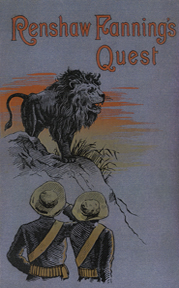
Mitford’s novel Renshaw Fanning’s Quest (1894), his eighth, is an African treasure hunt story reminiscent of King Solomon’s Mines, but more significantly is a story of human greed and betrayal.  Valancourt Books still leads the charge on this fascinating author, and has reprinted ‘Quest with a facsimile of its original cover:

renshawfanningcover

Continue reading

Posted in Adventure fiction | 9 Comments

10 days left until The Giant’s Shoulders #10!

Tick tock, tick tock… There are 10 days left until the deadline for The Giant’s Shoulders #10, to be held on April 16th at Stochastic Scribbles. Entries can be submitted through blogcarnival.com or directly to the host blog, as usual!

Posted in General science, Science news | Leave a comment

The pitter-patter of little feet ON the house…

Well, we’ve got a bird family!  A couple of weeks ago, the fiancée noticed that birds had started building a nest in the wreath on the front door of the house.  We started to take it down before they settled in, but quickly put it back up when I spotted the eggs that had already been laid inside!

Fortunately, we haven’t scared off the parents, who are still buzzing in and out to take care of their nestlings, now hatched.  This afternoon, we put a stepladder off to the side of the nest and took a quick peek inside.  The fiancée saw the little hatchlings breathing:

nest

It was a really bad angle, and we didn’t want to get too close to the nest, but you can see what looks to be a little head and a beak!

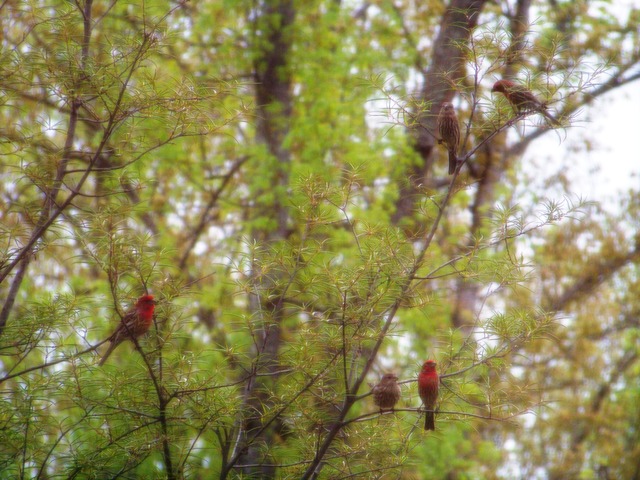
What we don’t know is what kind of bird family we’ve got.  I managed to get a couple of long distance pictures of one of the culprits:

bird1

bird2

Any birders out there got an idea of what we’ve got?  The birds are relatively small, and I swear I saw a flash of red on the male.  Also, we live in the western Carolinas…

Ornithology update:  The fiancée caught a glimpse of the momma bird leaving the nest and now thinks that the bird pictured above isn’t the nest-owner.  She now thinks that we’ve got house finches, which is consistent with the red color I spotted on the male…

Posted in Animals | 4 Comments

Karl Marx to get his own show on MSNBC

Just announced earlier today on Olbermann’s show:

Philosopher, political economist, historian, sociologist, humanist, political theorist, and revolutionary  Karl Marx joins MSNBC as host of “Karl’s Komments,” premiering on Monday, April 6. “Karl’s Komments” will air weekdays, 6-7 p.m. ET. The announcement was made today by Phil Griffin, President, MSNBC.

“I am thrilled to have Karl kicking-off our primetime lineup,” said Griffin. “He’s proven that he can connect with Americans and will be a perfect compliment to Chris, Keith, and Rachel. He’s already made his mark on political thought and I’m excited to see what he’ll do with the 6 p.m. hour.  It hardly matters that he’s dead.”

“Capital is dead labor, which, vampire-like, lives only by sucking living labor, and lives the more, the more labor it sucks.” said Karl, who was contacted via séance through Jenny McCarthy, who turns out to be able to channel all sorts of crazy shit. “The worker of the world has nothing to lose, but their chains, workers of the world unite.

He added, “I’m excited to have this opportunity with MSNBC.”

MSNBC has addressed concerns that the appointment of Marx demonstrates a liberal bias by planning regular guest appearances by Vladimir Lenin for counterbalance.

In related news, Glenn Beck had a really rough time on his FOX News show today:

scanners

(And, in completely unrelated news, congratulations and sincere well-wishes to Ed Schultz!)

Posted in ... the Hell?, Silliness | 2 Comments

Why no press on Y(4140)?

Earlier this month, I came across  a healthy number of articles on the observation at Fermilab of a single top quark, produced by interactions involving the weak nuclear force.  As a scientist who dabbled in particle physics in graduate school, I still like to see what’s going in that field (if enough people ask, I may share the story of why I left particle physics).   The top quark, the heaviest of the set of six quarks, is typically produced in quark/anti-quark pairs via the strong nuclear force.  The production of a single top is a much rarer event and, although predicted theoretically, was very difficult to see and a great achievement.

I was surprised this week, though, to see (via StumbleUpon)  that Fermilab has made another, potentially more significant discovery: an unpredicted resonance with a mass of 4140 MeV (mega-electron volts).   I use the term “resonance” to describe an extremely short-lived “particle” which rapidly decays into other, less massive, components. This particle has been named “Y(4140)”, for lack of better description.  Dorigo at A Quantum Diaries Survivor has a good description of the physics.

The interesting thing about this discovery is that it is previously unpredicted “particle”.  Presumably it is still made of some combination of fundamental quarks and anti-quarks, but it is a combination which hasn’t been seen before, and the exact composition is still unknown.  The thing is, I haven’t seen much talk about Y(4140), in the press or the blogs.  Though the single top quark discovery was a monumental and significant achievement, I would have thought that Y(4140) would have garnered more attention.

Is there some reason I haven’t heard more about this?  Are unknown hadron resonances more common than I realize?  Am I just not reading the right physics blogs?  Any particle physicists want to weigh in?

Posted in Physics | 10 Comments

Surprising fact about… Louisa May Alcott!

One of the fun things about studying pulp horror stories is learning unexpected trivia about the authors.  Just as often, though, the trivia learned is that a famous author ever indulged in such “sensationalist” writings!

As a case in point, I point the reader to the story, Lost in a Pyramid; or, The Mummy’s Curse, written by none other than Louisa May Alcott (1832-1888), probably best known for her novel Little Women:

“And what are these, Paul?” asked Evelyn, opening a tarnished gold box and examining its contents curiously.

“Seeds of some unknown Egyptian plant,” replied Forsyth, with a sudden shadow on his dark face, as he looked down at the three scarlet grains lying in the white hand lifted to him.

“Where did you get them?” asked the girl.

“That is a weird story, which will only haunt you if I tell it,” said Forsyth, with an absent expression that strongly excited the girl’s curiosity.

“Please tell it, I like weird tales, and they never trouble me. Ah, do tell it; your stories are always so interesting,” she cried, looking up with such a pretty blending of entreaty and command in her charming face, that refusal was impossible.

“You’ll be sorry for it, and so shall I, perhaps; I warn you beforehand, that harm is foretold to the possessor of those mysterious seeds,” said Forsyth, smiling, even while he knit his black brows, and regarded the blooming creature before him with a fond yet foreboding glance.

Forsyth describes how, on an expedition to Egypt, he and his colleague were lost within a maze of corridors within the great pyramid.  To escape, they are forced to defile the funerary trappings of one of its mummified inhabitants.  Their actions set in motion an ancient curse, which is fulfulled after Forsyth narrates his dark tale.

The story is charming, albeit possessing an ending which I found a little disappointing.  According to the Louisa May Alcott Encyclopedia, the story was written in late 1868 or the first week of 1869, around the same time that Little Women was written, and published in the Jan 16th issue of Frank Leslie’s The New World, for which Alcott received $25.  The Encyclopedia further notes that a hint of the inspiration for the story can be found in chapter 27 of Little Women itself:

She was just recovering from one of these attacks when she was prevailed upon to escort Miss Crocker to a lecture, and in return for her virtue was rewarded with a new idea. It was a People’s Course, the lecture on the Pyramids, and Jo rather wondered at the choice of such a subject for such an audience, but took it for granted that some great social evil would be remedied or some great want supplied by unfolding the glories of the Pharaohs to an audience whose thoughts were busy with the price of coal and flour, and whose lives were spent in trying to solve harder riddles than that of the Sphinx.

The character of Josephine “Jo” March is based on Alcott herself, and this passage hints at the inspiration Alcott herself used for the story.

Alcott is not the only author to have written “sensational” tales of horror.  I’ll come back to others in upcoming posts.

Posted in Horror | 5 Comments

Optics basics: Young’s double slit experiment

As I’ve so far been restricting my ‘optics basics’ posts to discussions of fundamental concepts related to optics, it might seem strange at first glance to dedicate a post to a single optical experiment.  What will hopefully become clear, however, is that Young’s double slit experiment is connected to so many basic concepts in optical physics  (and still provides surprising new results to this day) that one post is hardly enough to describe all the interesting insights that can be gained by studying the experiment and its implications.

Continue reading

Posted in Optics, Optics basics | 48 Comments

OpenLab 2009 submissions open…

I keep forgetting to note this, but submissions for The Open Laboratory 2009 are now being accepted and can be nominated at this link:

openlab-logo1

The Open Laboratory is a printed collection of the ‘best’ science blog writing of the year, and contains a lot of great entries.  Think about nominating your favorite scienceblog posts for 2009; nominations are accepted through December, I believe.  This year should be particularly excellent because it is being guest edited by the excellent blogger (and cool person) Scicurious!

Of course, if I have written/write  anything you’ve thought particularly compelling in 2009, feel free to nominate it!  I would consider nominating some of my own posts, but I’m still feeling the shame of not making the cut for the 2008 edition… 😦

P.S.  It is also interesting to note that OpenLab has inspired an anthology of a different sort: the best blog writing about roleplaying games, Open Game Table! Considering I have a history in both science and RPGs, I find the connection oddly appropriate…

Posted in Entertainment, General science | 9 Comments

A miscellany of science-related stories

I’ve been stocking up on a collection of fascinating science stories which I couldn’t think of enough to comment on in a blog post.  I’ve finally hit critical mass, though, and thought I’d dump them all at once:

  • Four Spanish high school students, supervised by their science teacher, strapped a digital camera to a weather balloon and sent it up 20 miles to take pictures and atmospheric readings.  The pictures are simply wonderful.
  • The recession has hit science and scientists just as hard as everyone else, but there’s no excuse for this: a well-known paleontologist will plead guilty to stealing a fossil find from federal lands with intention to sell it.  Earlier in the month, he had already plead guilty to stealing fossils from private lands.
  • A reminder of why science is important and superstition is dangerous and counterproductive: the skeletal remains of a 16th century victim of the plague, and suspected vampire,  were uncovered in Venice.  The body was buried with a brick wedged in its mouth, which was done to corpses which were suspected to be vampires.  This reminds me that I’ve been doing some historical reading on witchcraft and witch trials that I have to blog about soon.
  • Yes, we need better volcano monitoring: Mount Redoubt, which has been showing signs of imminent eruption lately, had seemed to quiet down.  It is now back on “watch” status for eruption, after activity increased again.

UPDATE:  Is my timing great, or what?  Mount Redoubt started erupting Sunday night.

Posted in Science news | 5 Comments

A. Merritt’s The Face in the Abyss

I’ve been continuing my reading of the works of A. Merritt (1884-1943), which began with his first serial novel The Moon Pool (1919), continued to his masterful The Metal Monster (1920) and most recently visited The Dwellers in the Mirage (1932).  I was originally planning to step away from Merritt for a little while, but one other volume caught my eye: Merritt’s 1923 serial novel, The Face in the Abyss:

faceintheabyss

I have to say that I really enjoyed The Face in the Abyss (to be referred to henceforth as FIA)!  Though not as brilliantly otherworldly as The Metal Monster, it tells a great adventure story filled with wonderful and haunting imagery, all set in a science fiction world of appreciable complexity.  Though the hero of the tale is still more or less a pulp-fiction stereotype, several of the other main characters have a surprising amount of complexity to them.

Continue reading

Posted in Adventure fiction | 3 Comments